Key Takeaways
- It was impressive, yes, but it lacked the one ingredient essential for industrial dominance: reliability.
- In the factory, we must achieve 10,000 consecutive successes to meet production requirements.
- For years, we’ve watched humanoid robots perform backflips and parkour in sanitized laboratory environments.
Answer-First: In March 2026, the convergence of VLA (Vision-Language-Action) models and industrial 900V SiC platforms has enabled humanoid robots to transition from laboratory prototypes to factory "interns." While companies like Tesla and Xiaomi are pilot-testing autonomous assembly today, this signals a legacy shift toward Physical AI—where the hardware is mere clay and the software brain defines industrial sovereignty.
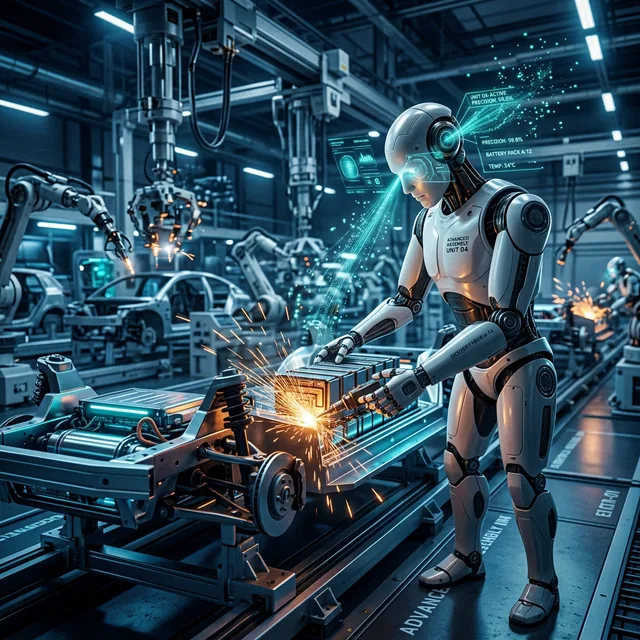
For years, we’ve watched humanoid robots perform backflips and parkour in sanitized laboratory environments. It was impressive, yes, but it lacked the one ingredient essential for industrial dominance: reliability. In a lab, 10,000 failures can lead to a single viral video. In a factory, you need 10,000 consecutive successes just to keep the production line moving.
The Xiaomi VLA Leap: Robotics-0
Xiaomi has recently moved its general-purpose humanoid robots into active "internships" at its automotive plants. This isn't just a marketing stunt. These robots are built on the Xiaomi-Robotics-0 foundation model—a Vision-Language-Action (VLA) architecture that allows them to perceive their environment, understand natural language instructions, and execute complex motor tasks autonomously.
The "internship" involves real-world scenarios: installing self-tapping nuts, transporting material boxes, and maintaining a pace that matches the 76-second car production cycle. They may still look "clumsy" to the untrained eye, but they are learning in the wild, using reinforcement learning to bridge the gap between digital simulation and physical reality.
Tesla and the Optimus Gen 3 Moat
Not to be outdone, Tesla’s Optimus Gen 3 is slated for its first formal factory deployments later this year. With 25 actuators per hand, the dexterity is no longer a bottleneck; the bottleck is now the "software brain." By repurposing its Model S and X production lines in Fremont as training grounds, Tesla is creating a massive data flywheel that smaller robotics startups simply cannot replicate. They are building the infrastructure to produce 1 million robots a year, effectively turning "manufacturing" into a software-update problem.
The 2026 Perspective: Moats and Sovereignty
As I’ve discussed in my previous work on Sovereign Silicon, the race for humanoid robotics is not just about labor; it's about Physical AI Moats. If your factory platform is dependent on a foreign VLA model, your industrial output is subject to their "system updates."
In India, we are seeing a parallel shift toward Agentic Commerce and indigenous silicon. The same intelligence that allows a robot to pick a bin in an EV plant is now being used to authentic commercial transactions autonomously at the India AI Impact Summit 2026. The world is moving from "Chatbots" to "Autonomous Transactional Proxies"—whether they have legs or live in a box.
Summary: The Graduation
The "Internship" phase of humanoid robotics will be short. By the time we reach 2027, these robots won't be interns; they will be the standard. The question for founders and technologists is: are you building the hardware, or are you building the brain that makes the hardware useful?
Explore Related Posts
- India's Robotics Valley of Death: Navigating the 20-Year Deeptech Shift
- The Deeptech & Manufacturing Breakout (2026)
- Invest in Humanoid Robotics: Opportunities and Challenges in 2026
- Mastering the Pause: Strategic Silence for Speakers
- The Genesis Story: Tech's Core Narrative
- The Psychological Unscript: Impromptu Deep Tech Speaking
- Master the Unseen Script: Live Audience Adaptation