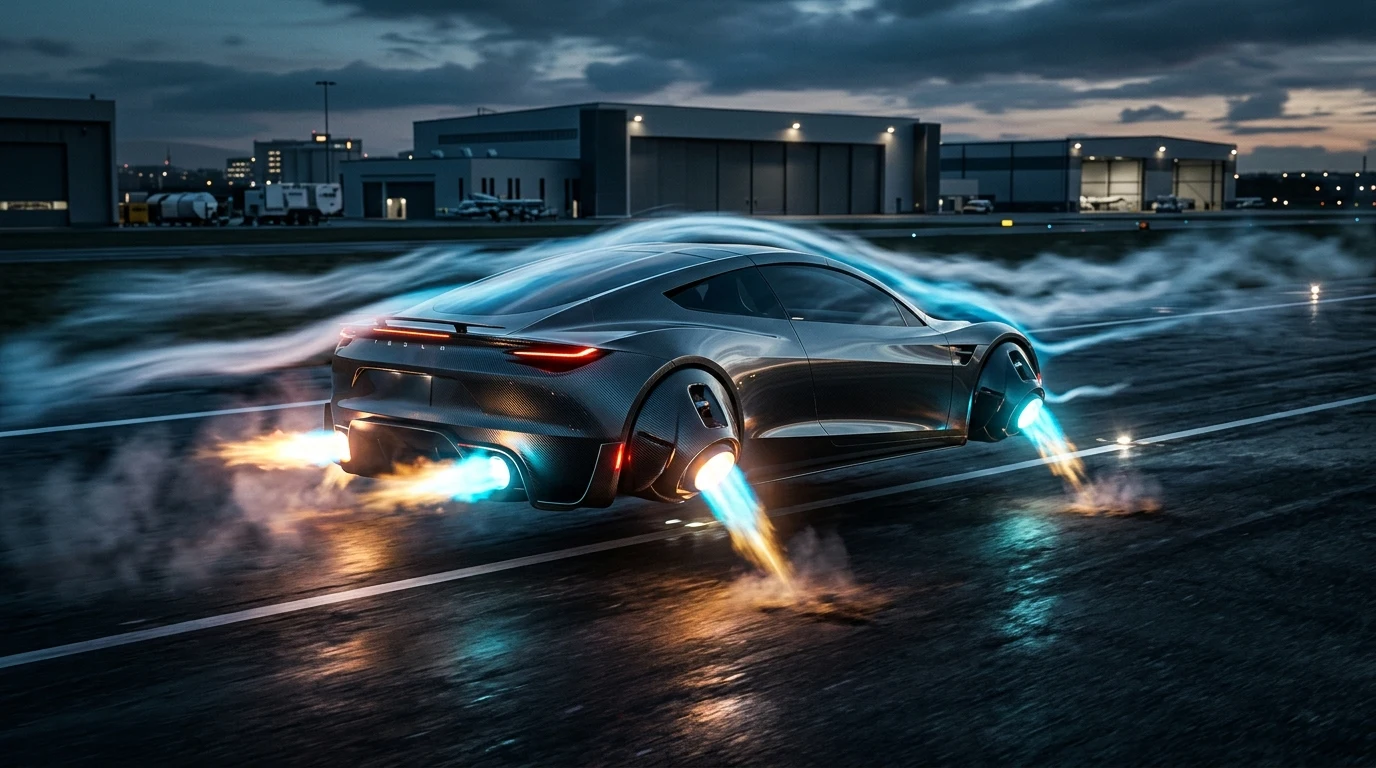
Key Takeaways
- The "flying" Roadster uses SpaceX cold-gas thrusters fed by 10,000 PSI COPV tanks rather than chemical combustion.
- Rocket reaction force bypasses rubber-to-asphalt tire friction limits to achieve sub-1-second 0–60 mph acceleration.
- FAA aviation jurisdiction, 140dB acoustic expansion, and energy density restrict thruster hops strictly to closed tracks.
The Tesla Roadster's "flying car" SpaceX package replaces rear passenger seats with carbon-overwrapped pressure vessels (COPVs) powering 10 cold-gas thrusters. Using compressed air rather than chemical rocket combustion, the system bypasses tire-friction limits for sub-1-second 0–60 mph acceleration and controlled aerodynamic hops, restricted strictly to closed tracks under Federal Aviation Administration (FAA) oversight.
Every few years, the automotive and aerospace worlds collide around a singular, physics-defying promise: a production car that can fly. When Elon Musk announced that the second-generation Tesla Roadster would feature an optional SpaceX Package capable of "short hops," instantaneous acceleration, and near-hover maneuvers, the internet split into two camps: those dismissing it as pure vaporware marketing, and those expecting a real-life DeLorean hovering over morning highway gridlock.
As an engineer working at the frontier of Physical AI and advanced actuation, I look at the Roadster not through the lens of sci-fi fantasy, but through the uncompromising laws of thermodynamics, fluid dynamics, and regulatory jurisdiction. The truth is far more interesting than the headlines: the "flying Roadster" is real, but it is not an airplane, an eVTOL, or a flying taxi. It is an aerospace-grade Reaction Control System (RCS) bolted to an electric hypercar.
1. The Physics Bottleneck: Why Electric Hypercars Hit a Wall
To understand why Tesla turned to rocket engineering, you have to look at the mechanical ceiling of traditional automobiles. Electric drivetrains—from the Model S Plaid to the Rimac Nevera—deliver virtually instantaneous torque ($). However, acceleration ($) on terra firma is strictly bounded by the coefficient of friction ($\mu$) between vulcanized rubber tires and asphalt:
a_max = μ × g Even with bespoke Michelin or Pirelli sticky compounds, warm track conditions, and active aero downforce, street-legal tires rarely exceed a friction coefficient ($\mu$) of 1.2 to 1.4. This creates a hard physical barrier around 1.7 to 1.9 seconds for 0–60 mph. Pushing acceleration below one second using rotational wheel torque alone is physically impossible without tearing tire rubber to shreds or lifting off the tarmac.
Enter Newton’s Third Law: For every action, there is an equal and opposite reaction. By venting ultra-high-pressure gas directly through directional nozzles, the Roadster generates direct thrust force ( = \dot{m} v_e$), where $\dot{m}$ is the mass flow rate and $ is exhaust velocity. This thrust operates 100% independently of tire contact patch friction, allowing the vehicle to accelerate at rates previously reserved for aircraft carrier steam catapults.
2. Inside the SpaceX Package: 10 Cold-Gas Thruster Architecture
Unlike orbital rockets that burn liquid oxygen and methane, the Roadster cannot deploy chemical combustion. Firing flaming rocket exhaust at a stoplight or track pitlane would vaporize tarmac, melt bumpers, and violate every municipal fire ordinance on Earth. Instead, Tesla and SpaceX engineered an ultra-compact Cold-Gas Thruster System:
- Carbon-Overwrapped Pressure Vessels (COPVs): The rear 2+2 seating is removed to house a massive Composite Overwrapped Pressure Vessel holding approximately 600 liters of air compressed to an astonishing 10,000 PSI (690 bar). These are the exact high-strength tanks used for attitude control on Falcon 9 and Starship.
- 10 Micro-Nozzle Geometry: Ten cold-gas nozzles are seamlessly integrated around the vehicle’s perimeter. Two primary high-thrust nozzles sit behind the automated motorized rear license plate for straight-line thrust vectoring, while perimeter attitude nozzles control pitch, yaw, and roll.
- Onboard Recharge Compressor: When not in use, the car’s high-voltage traction battery powers an ultra-dense pneumatic compressor that repressurizes the COPV tanks in under 15 minutes while cruising or regenerative braking.
- Underbody Ground-Effect Suction: Paired with the cold-gas thrusters, electric suction fans beneath the carbon-fiber undertray generate thousands of pounds of simulated downforce at zero vehicle speed, keeping the car glued to the ground during violent launches or inverted track banking demonstrations.
3. The "Flying" Question: What Can It Actually Do?
Can the Tesla Roadster actually fly to work? No. Can it perform controlled ballistic hops, mid-air attitude corrections, and track jumps? Yes.
During testing demonstrations at SpaceX’s McGregor facility, the prototype demonstrated what happens when all downward and perimeter thrusters fire simultaneously. The sudden release of compressed air creates a short-duration upward reaction force exceeding the car's curb weight (~4,400 lbs), allowing it to lift 3 to 6 feet vertically into the air for several seconds. Attitude thrusters fire micro-bursts to maintain level trim, preventing catastrophic rollover before the car touches back down on active adaptive dampers.
4. Regulatory Reality: The FAA and DOT Showdown
Engineering a machine that can leave the pavement is one challenge; obtaining a license plate for it is an entirely different battle. The moment a ground vehicle detaches from the roadway, it crosses the boundary from the National Highway Traffic Safety Administration (NHTSA) into the domain of the Federal Aviation Administration (FAA):
- Aviation Classification: The FAA's regulatory framework dictates that any vehicle engineered to deliberately achieve altitude is categorized as an aircraft or experimental aerial craft, demanding airworthiness certifications, pilot logbooks, and avionics.
- Acoustic & Pressure Hazards: Venting 10,000 PSI compressed air through supersonic nozzles produces sound pressure levels exceeding 130 to 140 decibels—equivalent to a military jet on afterburner. On public roads, this presents severe acoustic hazards to pedestrians and neighboring motorists.
- Software Geo-Fencing: Just as Tesla geo-fences track modes, the thruster jump capabilities will almost certainly be locked behind GPS-verified closed circuits, private proving grounds, and drag strips.
5. Why the Roadster Matters for the Future of Physical AI
Critics often ask: why spend hundreds of millions of dollars engineering rocket thrusters onto an electric sports car? The answer lies in the rapid evolution of Physical AI and cross-domain engineering.
The algorithms required to stabilize a 4,400-pound hypercar in mid-air—reading sensor telemetry at 1,000 Hz, firing micro-valves in milliseconds, and predicting aerodynamic drift—are the exact same real-time control architectures powering humanoid robotics, automated factory cobots, and aerospace guidance systems. The Roadster is a halo project that forces automotive manufacturing to achieve aerospace tolerances. As I frequently discuss in my keynote talks on Physical AI, the real value of frontier tech isn't the stunt itself—it is the engineering muscle memory created along the way.