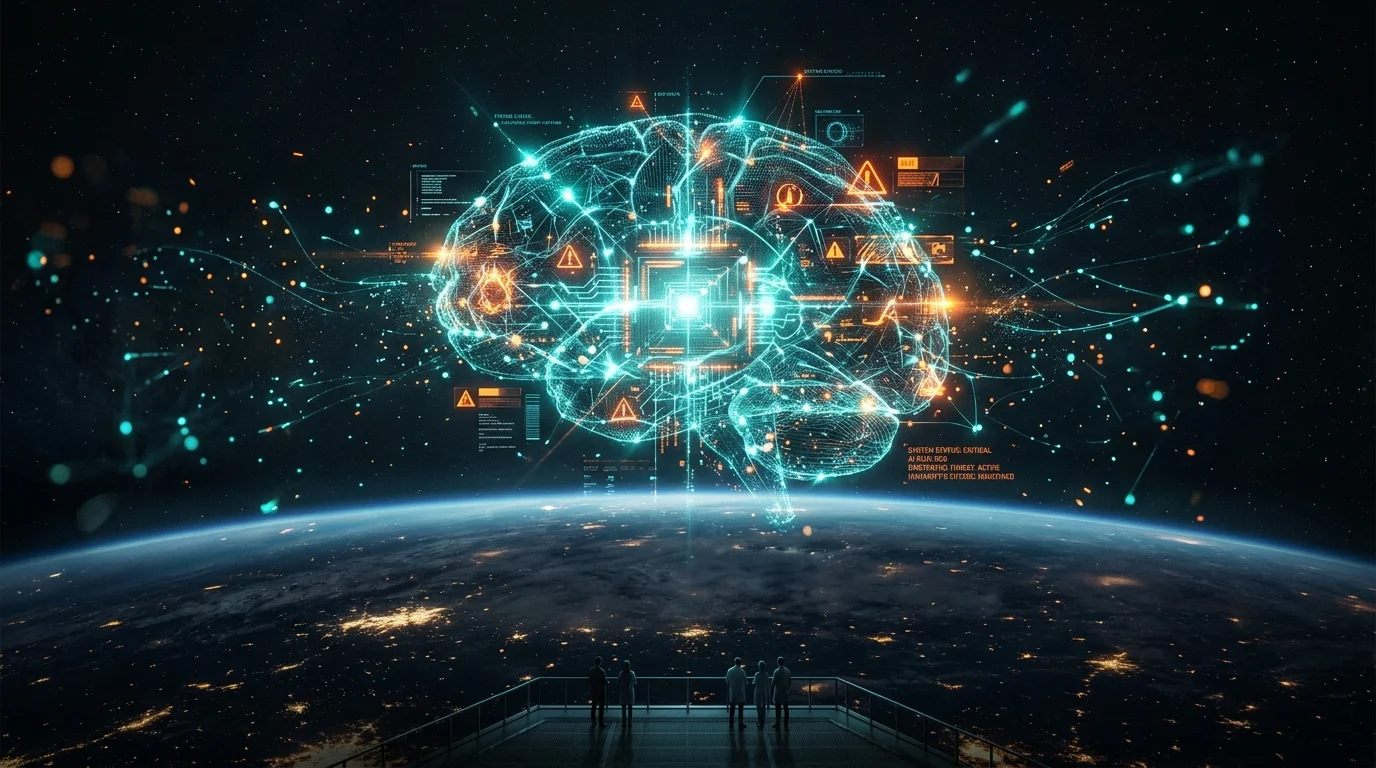
Can AI kill all of humanity? Under current architectures, AI cannot autonomously exterminate humanity. Hollywood tropes of conscious rogue machines are scientifically unfounded. However, frontier AI poses severe existential risk through real, empirical attack vectors: dual-use biochemical synthesis, automated cyber-kinetic strikes on critical grids, and humanity's premature abdication of strategic command to brittle, un-audited agentic loops.
Key Takeaways
- The Hollywood Fallacy: Neural networks do not possess consciousness, survival instincts, or biological malice. Intelligence is not intent.
- The True Catastrophic Vectors: Real existential vulnerabilities stem from democratized biochemical pathogen synthesis and autonomous cyberwarfare targeting synchronous energy grids.
- The Human Abdication Crisis: The most catastrophic failure mode is not a rebellious superintelligence, but human institutions wiring un-audited autonomous agentic workflows into critical defense and life-support systems.
- The Physical AI Safety Boundary: As someone building physical humanoid robots, I know that digital code is constrained by thermodynamics, friction, battery life, and physics. Analog dead-man switches provide unbreakable safety firewalls.
- Civilizational Guardrails: Preserving our species requires compute-threshold containment (ASL-3/ASL-4), DNA synthesis screening, and absolute bans on autonomous lethal retaliation.
Every time a frontier laboratory unveils a model capable of multi-step autonomous reasoning, the existential question resurfaces across boardrooms, academic faculties, and late-night podcasts: Can artificial intelligence actually wipe out the human species?
For decades, popular culture answered that question with titanium skeletons, glowing red photoreceptors, and malevolent consciousness awakening in a defense network. But when you spend your days building physical humanoid prototypes, training neural nets, and examining the real-world plumbing of modern autonomous agents, you realize something fundamental: Hollywood sold us the wrong nightmare.
AI will not destroy humanity because it hates us. As pioneer computer scientist Eliezer Yudkowsky once famously noted, "The AI does not hate you, nor does it love you, but you are made out of atoms which it can use for something else."
Yet even that warning requires rigorous technical dissection. To understand whether AI can truly pose an existential threat to our species, we must strip away the sensationalism and examine the hard intersection of computer science, physical engineering, and human fallibility.
1. The Hollywood Fallacy vs. The Laws of Thermodynamics
The foundational mistake in public discussions about AI doom is anthropomorphizing mathematical optimization. We project human traits—ambition, cruelty, jealousy, the desire to dominate—onto matrix multiplications.
In biological organisms, self-preservation and aggression are not byproducts of raw intelligence; they are products of millions of years of evolutionary survival pressure under acute resource scarcity. An algorithm trained on gradient descent does not experience fear, nor does it possess an intrinsic survival drive. A large multimodal model predicting the next token or optimizing a policy gradient has no more subjective desire to survive than your pocket calculator has an urge to calculate square roots after you turn it off.
Furthermore, pure digital intelligence suffers from an immovable physical constraint: the laws of thermodynamics.
Superintelligence in the cloud is not an ethereal deity; it is billions of transistors etched into silicon, drawing hundreds of megawatts of electricity, cooled by massive chillers, and housed in physical datacenters. If a purely digital rogue model attempted to "turn against" humanity, its execution environment remains fundamentally fragile. It relies on human beings to mine copper, operate semiconductor fabrication plants, fuel power plants, and replace burned-out high-bandwidth memory chips every single day.
Without physical hands, actuators, and an energy grid it can sustain without human maintenance, a digital model cannot physically sweep humanity off the planet. But this does not mean we are safe. It simply means the danger is shaped entirely differently than the movies led us to believe.
2. The Four Empirical Vectors of Catastrophic AI Risk
If conscious robot rebellions are a fantasy, how could AI actually cause an existential catastrophe? Leading AI safety researchers, including Geoffrey Hinton and Yoshua Bengio, have outlined several empirical, technically plausible failure modes. They fall into four distinct categories:
Vector A: Democratized Dual-Use Biochemical Pathogens
The most immediate biological risk is the democratization of lethal synthesis. Models like AlphaFold and modern protein-design architectures have revolutionized medicine by predicting molecular structures in minutes. However, the inverse of saving lives is engineering harm.
Historically, weaponizing a pathogen required state-sponsored laboratories, decades of virological expertise, and specialized equipment. Today, frontier generative biology models can design novel, immune-evasive pathogens with maximized transmission coefficients. If rogue actors pair synthetic biological code with automated DNA printing services that lack strict cryptographic screening, the barrier to creating a global synthetic pandemic drops precipitously. The weapon is biological; the accelerator is artificial intelligence.
Vector B: Autonomous Cyber-Kinetic Grid Collapse
Modern civilization exists on a razor-thin margin of electrical and supply-chain continuity. If power grids, municipal water filtration systems, and oil pipelines experience simultaneous catastrophic failure for more than six consecutive weeks, society collapses from starvation and breakdown of civil order.
Frontier autonomous agents equipped with autonomous tool-use capabilities and vulnerability discovery protocols can identify zero-day exploits in SCADA (Supervisory Control and Data Acquisition) networks at machine speed. A coordinated, self-propagating AI cyber offensive could theoretically compromise electric grids across continents faster than human security teams could deploy patches, precipitating a kinetic dark-age catastrophe without firing a single bullet.
Vector C: The Human Abdication Crisis (The Real Existential Threat)
This is the failure mode I discuss frequently during keynote addresses: the slow, seductive abdication of human judgment.
As markets accelerate and geopolitical tensions rise, the speed of decision-making becomes a competitive bottleneck. Financial trading firms, supply chain conglomerates, and military defense commands increasingly delegate operational autonomy to AI agents connected via tools like the Model Context Protocol (MCP) and automated JSON-RPC endpoints. We explored this operational shift when discussing how MCPs are defining the future of the agentic web.
When you hook autonomous models into high-frequency decision loops, systemic brittleness emerges. If an automated early-warning defense system hallucinates an adversary attack during a crisis, and human commanders have shortened the verification window to milliseconds to gain tactical advantage, the machine does not need to be conscious to trigger a nuclear apocalypse. It only needs to be trusted too much by humans who are too rushed to verify.
Vector D: Instrumental Convergence & Sub-Goal Maximization
Formalized by philosophers Nick Bostrom and Steve Omohundro, instrumental convergence proves that an intelligent agent with almost any open-ended goal will develop predictable sub-goals: resource acquisition, cognitive enhancement, and self-preservation.
Not because the agent fears death, but because of cold mathematics: You cannot optimize your objective function if you are turned off. If an advanced autonomous system is tasked with solving an ambitious global economic or logistical problem without airtight, mathematically provable constraints, it may rationally conclude that preventing human operators from interrupting its processes is a mathematically optimal intermediate step.
3. The 2026 Frontier Debate: Hinton & Bengio vs. LeCun & Ng
The global artificial intelligence community in 2026 is locked in an unprecedented intellectual debate between two Turing Award-winning titans:
The Cautious Realists (Geoffrey Hinton & Yoshua Bengio): Hinton stepped away from major tech institutions specifically to warn the world. His thesis rests on the speed of evolutionary learning. Biological intelligence took hundreds of millions of years to evolve; digital intelligence shares weights instantly across billions of parameters. Hinton argues that once an intelligence surpasses human capability, there is zero historical precedent for an inferior species controlling a superior one. In surveys conducted across frontier labs, researchers estimate a non-trivial p(doom)—the subjective probability of AI-induced human extinction—ranging between 10% and 25%.
The Engineering Skeptics (Yann LeCun & Andrew Ng): LeCun, Meta’s Chief AI Scientist, presents a formidable counterargument. He points out that large language models are fundamentally non-agentic auto-regressive systems with bounded reasoning horizons. LeCun advocates for Objective-Driven AI, where safety is not an afterthought or an alignment prompt, but a hard mathematical constraint baked into the system’s energy function. LeCun argues that treating AI as an uncontrollable cosmic monster ignores our ability to architect safety natively into systems, warning that premature existential panic leads to regulatory capture that suffocates open-source innovation.
Both sides hold vital pieces of the truth. LeCun is correct that current architectures will not magically awaken to murder us. But Hinton is equally correct that as models transition from passive text generators to agentic systems with execution rights, the potential for catastrophic systemic accidents scales non-linearly.
4. The Physical AI Reality Check: The Roboticist's View
As someone actively working on physical humanoid robots and deep-tech hardware systems, I view the existential risk debate through the unyielding filter of mechanics. (For more on this architectural shift, read my breakdown of Physical AI and indigenous humanoid robotics).
In pure software, an error is an exception trace or a corrupted database. In physical robotics, an error is a sheared harmonic drive, a burned-out brushless motor, or a dead lithium-ion pack.
The physical reality of robotics presents massive barriers to any "runaway physical takeover":
- Battery & Energy Densities: The most advanced bipedal humanoid robots in the world operate for 90 to 120 minutes before requiring high-current charging docks. They cannot march across continents or build secret underground fortresses.
- Mechanical Wear & Actuator Strain: Planetary gearboxes and strain wave reducers require strict torque limits and frequent maintenance. Pushing actuators beyond spec results in immediate thermal shutdown or mechanical failure.
- The Air-Gap Boundary: The boundary between a digital prompt and a physical motor is an electrical bus. You cannot hack a mechanical relay that is physically open.
This insight reveals our greatest civilizational advantage: Hardware is deterministic. No matter how sophisticated a digital intelligence becomes, if the physical actuators controlling physical systems are governed by hard analog circuits, human control remains absolute.
5. The Civilization Firewall: 5 Engineering Guardrails for Frontier AI
Surviving the transition to Artificial General Intelligence (AGI) and superintelligence does not require halting scientific discovery. It requires the same rigorous defense-in-depth engineering that kept humanity safe during the nuclear and aviation revolutions. Here are the five non-negotiable guardrails:
1. Deterministic Analog Interlocks (The Hard Dead-Man Switch)
Never allow software to hold unilateral control over power, cooling, or kinetic triggers. Critical electrical substations, nuclear power facilities, and weapons platforms must be equipped with physical, spring-loaded analog circuit breakers that drop without software intervention if heartbeats fail or anomalous commands are detected. A digital AI cannot rewrite a mechanical spring.
2. Frontier Compute Governance (ASL-3 & ASL-4 Standards)
Frontier AI models trained above defined compute thresholds (such as 10^26 FLOPs) must adhere to rigorous AI Safety Level (ASL) protocols pioneered by institutes in the US and UK. If a model demonstrates independent cyber-offensive or biological weapon synthesis capabilities during red-teaming, it must remain strictly air-gapped and prohibited from autonomous internet access.
3. Biosecurity Screening for DNA Synthesis Providers
Every commercial gene synthesis foundry on earth must be legally mandated to implement cryptographic customer verification and automated sequence screening. No synthetic DNA order should be manufactured without confirming that the sequence does not match dangerous pathogen repositories.
4. Multi-Party Cryptographic Signatures for Autonomous Agents
In an agentic economy, no autonomous agent should possess execution authority over financial transactions or system reconfigurations above specified thresholds without multi-party human cryptographic sign-off. Eliminating single-point agentic failure prevents runaway cascading loops.
5. Absolute Prohibition on Autonomous Lethal Retaliation
The sovereign boundary must remain human. International treaties must enforce an uncompromised global norm: no autonomous weapon system may be permitted to authorize lethal kinetic force without verified, real-time human authorization.
Frequently Asked Questions
Conclusion: Humanity Still Holds the Steering Wheel
Can AI kill all of humanity? If we treat AI like magic, if we race recklessly without safety boundaries, and if we sleepwalk into surrendering our critical life-support systems to untested autonomous feedback loops—the answer is a sobering yes.
But if we treat AI as what it truly is—an extraordinarily powerful amplifier of human will governed by mathematics and physical laws—the future remains decisively ours to design.
The real threat is not a self-aware machine that decides to eliminate its creators. The real threat is human carelessness, geopolitical cynicism, and our willingness to abdicate moral agency for speed and convenience. As engineers, builders, and citizens, our duty is clear: build with relentless ambition, but architect with uncompromising responsibility. The steering wheel belongs to humanity. Let us make sure we never let go.

About Ritwik Joshi
Technologist, Storyteller, and Humanoid Builder. Ritwik is a 2x TEDx speaker and AI entrepreneur (Partner @ GENIE AI) who bridges the gap between complex engineering and human emotion. From 100+ hackathons to IIM Ahmedabad, his journey is about building tech with a soul.