Key Takeaways
- Convergence of Neural VFX and Physical Sets: DNEG and Nitesh Tiwari are blending real-time Unreal Engine 5 virtual production on curved LED volumes with tactile physical architecture to ground ancient myth in authentic physical realism.
- Generative AI Across the Production Pipeline: Neural radiance fields (NeRFs), Gaussian splatting, and deep learning performance capture reduce render cycles from days to minutes while empowering human visual artists.
- Soul Over Spectacle Imperative: As computational power democratizes photorealism, cinematic excellence depends on narrative architecture—preserving emotional reverence and moral gravity amid staggering technological scale.
Every generation of cinema is defined by an inflection point where storytelling ambition collisions with computational breakthroughs. In 1993, Jurassic Park made photo-real CGI tangible. In 2009, James Cameron’s Avatar proved the viability of stereoscopic performance capture. Today, Nitesh Tiwari’s magnum opus, Ramayana: Part 1—engineered alongside seven-time Academy Award-winning VFX powerhouse DNEG and producer Namit Malhotra—stands as cinema’s next watershed moment: the first global blockbuster native to the Generative AI and Neural Rendering era.
The Paradigm Shift: From Offline Render Farms to Real-Time Neural Pipelines
For the past three decades, high-end Hollywood visual effects operated on a glacial, brute-force paradigm. A complex, physics-heavy sequence—such as a celestial weapon striking an ocean or a multi-thousand-warrior battle—required massive server farms rendering individual frames for 24 to 48 hours each. If a director wanted to adjust lighting or shift camera perspective during post-production, the entire frame sequence had to be sent back to the rendering queue at astronomical expense.
On Ramayana, DNEG is deploying modern neural visual computing. By leveraging 3D Gaussian Splatting and Neural Radiance Fields (NeRFs), digital artists can synthesize complex, volumetric three-dimensional environments from real-world photography and physical concept models in real time. Rather than hand-animating every leaf in the ancient Dandakaranya forests or ray-tracing every golden spire of Lanka from scratch, neural rendering models extrapolate light transport and atmospheric diffusion dynamically. This compresses production iteration cycles from weeks to minutes, allowing Nitesh Tiwari to direct virtual cameras with the agility of a live cinematographer.
Virtual Production on LED Volumes: Bridging Myth and Matter
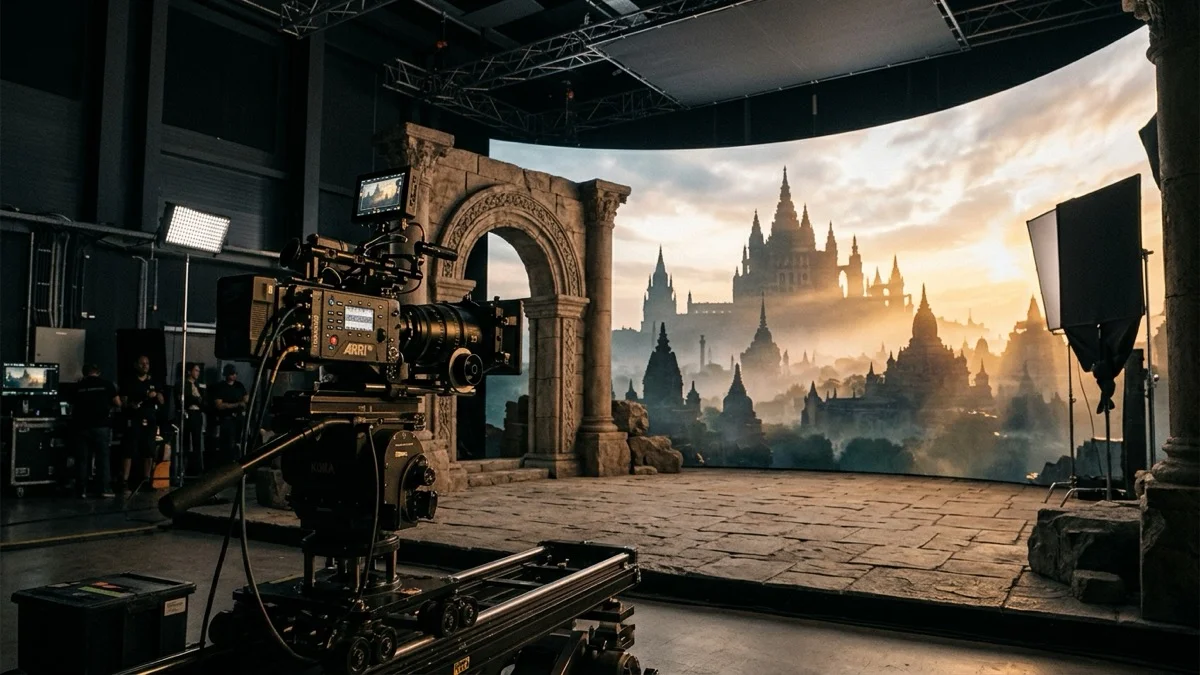
One of the most persistent criticisms of modern CGI-heavy cinema is the "green screen detachment"—actors staring into sterile, neon-green voids with flat studio lighting that never quite matches the digital backdrop. Ramayana bypasses this pitfall through massive in-camera virtual production (ICVFX) on high-density LED volumes powered by Unreal Engine 5.
Inside these soundstages, the physical floor and architectural stonework seamlessly bleed into curved, photorealistic digital horizons. Camera tracking sensors map the cinema camera’s coordinates in sub-millimeter precision, causing the digital background to shift its parallax perspective instantaneously as the camera moves. When Ranbir Kapoor steps onto the set as Lord Rama, the golden-hour sunlight cast across his face isn’t simulated in post-production; it emanates directly from the LED walls reflecting real-world photon physics. As explored in our deep-dive on AI Video Tools and Cinematic Storytelling, this tactile hardware-software convergence is where cinematic magic truly breathes.
Facial Performance Capture: Preserving Sacred Humanity in the Digital Double
Adapting the *Ramayana* carries a weight unlike any fictional comic book universe. The characters—Rama, Sita, Ravana, Hanuman—are revered by billions. A cartoonish, uncanny-valley facial render would not merely break cinematic immersion; it would disrupt spiritual sanctity.
To solve this, the production utilizes cutting-edge deep learning facial performance transfer overseen by veteran movement and performance-capture specialists like Terry Notary. Instead of traditional marker-based facial tracking that flattens nuanced acting, high-speed volumetric cameras train specialized neural networks on the actors’ subtle micro-expressions: the slight twitch of a brow, the saccadic quiver of an eye, the tension around the lips. When Yash embodies the ten-headed demon king Ravana, the digital manifestations are not synthetic masks glued onto a performer; they are extensions of organic human vulnerability and pride, scaled through AI without sacrificing actor intent.
This approach embodies the core thesis of Deeptech Storytelling: technology must always serve as an invisible amplifier of human emotion, never as an ostentatious distraction.
The Economics of Cinema: Can Generative AI Scale Indian Blockbusters Globally?
Traditionally, Hollywood spent $250 million to $350 million on tentpole spectacles like Avengers or Dune, pricing out Eastern cinema from matching global visual fidelity. Namit Malhotra’s production model flips this equation. By fusing Indian deeptech talent, DNEG’s proprietary AI pipelines, and joint musical architecture from Oscar winners Hans Zimmer and A. R. Rahman, *Ramayana* achieves a $400-million visual aesthetic at a fraction of legacy Western overhead.
AI in this ecosystem does not displace human artists; it eliminates friction. Concept artists use generative diffusion tools to storyboard thirty variations of a mythological vimana in an afternoon before sculpting the final asset. Rigging engineers deploy machine-learning solvers to simulate muscle deformation under heavy armor instantly. By offloading computational toil, human creators can dedicate their cognitive energy to what truly matters: pacing, framing, and emotional resonance. For founders and creators, this reflects the exact principles outlined in Simplifying Deeptech for Impact.
The Storyteller’s Compass: Why Soul Will Always Outweigh Silicon
As AI video generators like Sora, Runway Gen-3, and Kling continue their rapid democratization, anyone will soon be able to prompt a photorealistic dragon or cosmic palace in seconds. We are already seeing this friction in Western pop culture—such as viral debates over whether Marvel used AI for the Doomsday trailer—where synthetic clips blur the boundary between authentic studio production and fan-made concepts. When breathtaking visual spectacle becomes commoditized, visual fidelity alone ceases to be a competitive advantage.
What will endure? Narrative architecture, timeless archetypes, and cultural reverence. Nitesh Tiwari’s track record—from Dangal to Chhichhore—has always prioritized grounded human relationships over empty spectacle. In Ramayana, the real victory won’t be the trillion-polygon rendering of Lanka’s golden fortresses. It will be the quiet moment when Sita’s conviction wavers, or when Rama stands before the turbulent ocean with a bow in hand.
Cinema is not entering the era of artificial movies; it is entering the era of empowered human storytellers. As we stand on the threshold of this cultural and technological transformation, *Ramayana* demonstrates how ancient heritage and frontier artificial intelligence can unite to create something timeless. To explore more about the future of artificial intelligence, creative technology, and storytelling frameworks, visit Ritwik Joshi’s Speaking Hub or learn more on the About Page.