Key Takeaways
- The Key Takeaway: Strategic mastery of stage lighting and sound is paramount for tech founders.
- Key Lighting Principles for Tech Founders: Frontal Illumination is Crucial: Ensure your face is well-lit from the front.
- Avoid Visual Distractions: Flashing lights, overly dim conditions, or inconsistent lighting can pull focus away from your narrative.
For tech founders, a presentation is often viewed as a singular act: the words spoken, the slides displayed. Yet, the environment itself – the subtle interplay of light and sound – sculpts the audience's reception of your message before you even utter a single syllable. These often-overlooked elements are not mere technicalities; they are foundational pillars of effective communication.
The Unseen Language of Light: Sculpting Perception
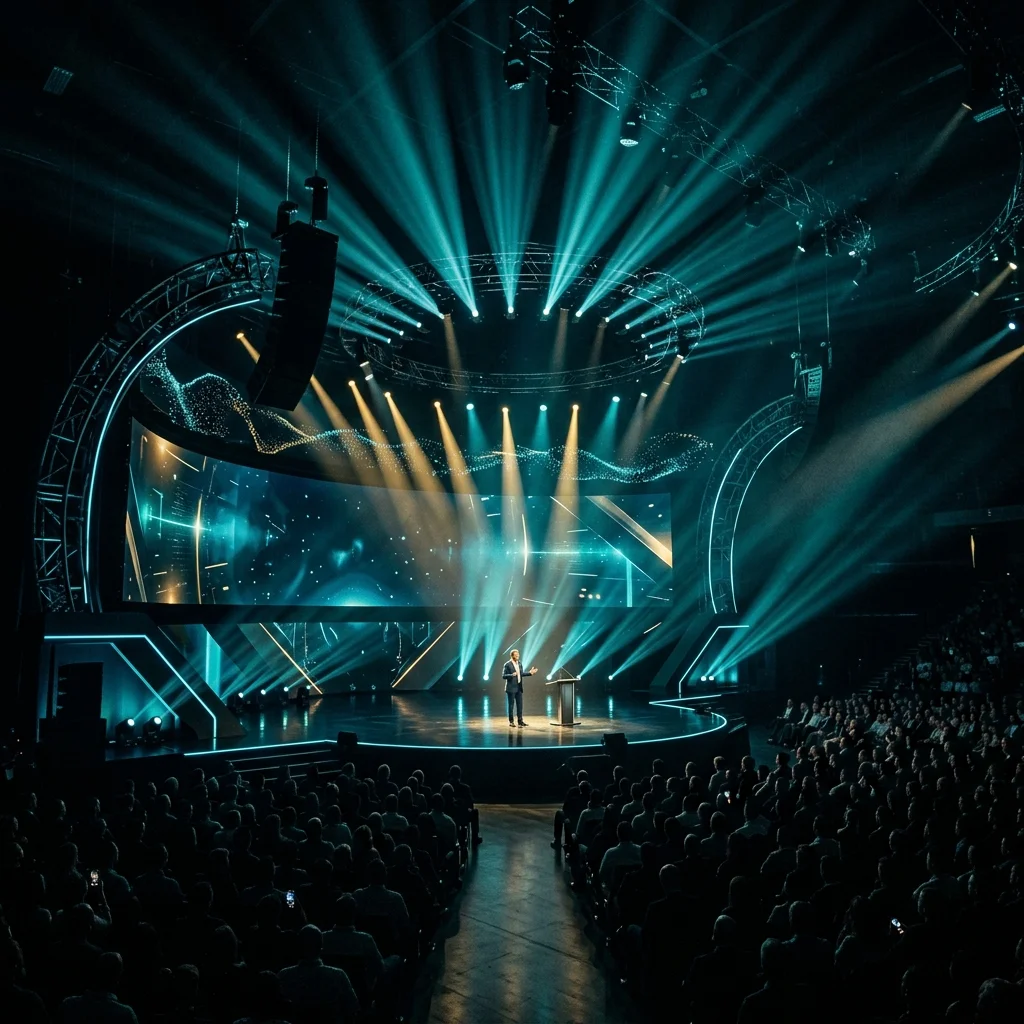
Light does more than just make you visible; it dictates focus, sets mood, and can even amplify or diminish your perceived presence. For a tech founder presenting complex ideas, the right lighting can guide the audience's eye, highlight key moments, and create a sense of intimacy or grandeur.
Key Lighting Principles for Tech Founders:
- Frontal Illumination is Crucial: Ensure your face is well-lit from the front. Overhead lights create harsh shadows under eyes and chin, making you appear tired or unapproachable. Backlighting, while dramatic, can turn you into a silhouette, obscuring your expressions – vital for connecting with your audience.
- Avoid Visual Distractions: Flashing lights, overly dim conditions, or inconsistent lighting can pull focus away from your narrative. The goal is to make the lighting an unconscious enhancement, not a conscious distraction.
- Leverage Spotlights Strategically: A well-aimed spotlight can command attention, placing you firmly at the center of the audience's world. This is particularly effective for TEDx-style talks or keynotes where the speaker is the primary visual focus.
- Consider Color Temperature: Warmer lights (more yellow/orange) tend to be more inviting, while cooler lights (more blue/white) can evoke professionalism or a futuristic feel. Align the lighting's mood with your message's emotional arc.
The Resonance of Sound: The Unbreakable Link to Credibility
Your voice is your primary instrument, but its impact is entirely dependent on how it's heard. Poor audio quality – muffled sound, feedback, or insufficient volume – is an immediate detractor, eroding credibility and listener patience faster than any complex jargon.
Mastering Your Audio Environment:
- Microphone Selection Matters:
- Lavalier (Lapel) Mics: Offer hands-free operation and consistent sound pickup if placed correctly (mid-chest). Ideal for movement.
- Headset Mics: Provide the most consistent sound quality regardless of head movement, excellent for dynamic speakers.
- Handheld Mics: Offer control but limit gestures. Require good mic technique (consistent distance from mouth).
- The Critical Mic Check: Never skip a sound check. Test volume, clarity, and ensure no feedback loops. Communicate your typical speaking volume to the sound engineer.
- Projection vs. Amplification: Even with a microphone, proper vocal projection is essential. It prevents strain and ensures your voice carries naturally. However, a microphone's role is to amplify your well-projected voice, not to compensate for a weak one.
- Managing Acoustics: Be aware of the room's acoustics. Reverberant spaces can make speech muddy. Speak clearly, articulate precisely, and consider strategic pauses to allow sound to dissipate.
Integrating for Impact: A Strategic Blueprint
Light and sound are not isolated components; they are synchronized tools in your communication arsenal. An integrated approach ensures they work harmoniously to support your narrative and amplify your public speaking presence.
Pre-Talk Protocol for Environmental Mastery:
- Early Arrival and Walkthrough: Arrive well in advance. Walk the stage, observe the lighting, and speak into the mic from various positions. Understand the physical space.
- Collaborate with AV Teams: Treat the sound and light technicians as essential partners. Clearly communicate your needs and preferences. A brief, respectful conversation can make all the difference.
- Visualize Your Presentation: Mentally rehearse not just your words, but your movement, your pauses, and how they interact with the stage environment. How will a dramatic pause land when you're perfectly lit and the room is silent?
- Feedback Loop: If possible, have a trusted colleague observe your sound and lighting during a rehearsal. External feedback is invaluable.
These elements are not about theatricality; they are about eliminating barriers to understanding and enhancing your authority. By taking control of your stage environment, tech founders can ensure their groundbreaking ideas resonate without impedance, leaving a lasting impression long after the spotlight fades. To learn more about how Ritwik Joshi can help you craft your narrative and delivery, visit the contact page.
Explore Related Posts

About Ritwik Joshi
Technologist, Storyteller, and Humanoid Builder. Ritwik is a 2x TEDx speaker and AI entrepreneur (Partner @ GENIE AI) who bridges the gap between complex engineering and human emotion. From 100+ hackathons to IIM Ahmedabad, his journey is about building tech with a soul.