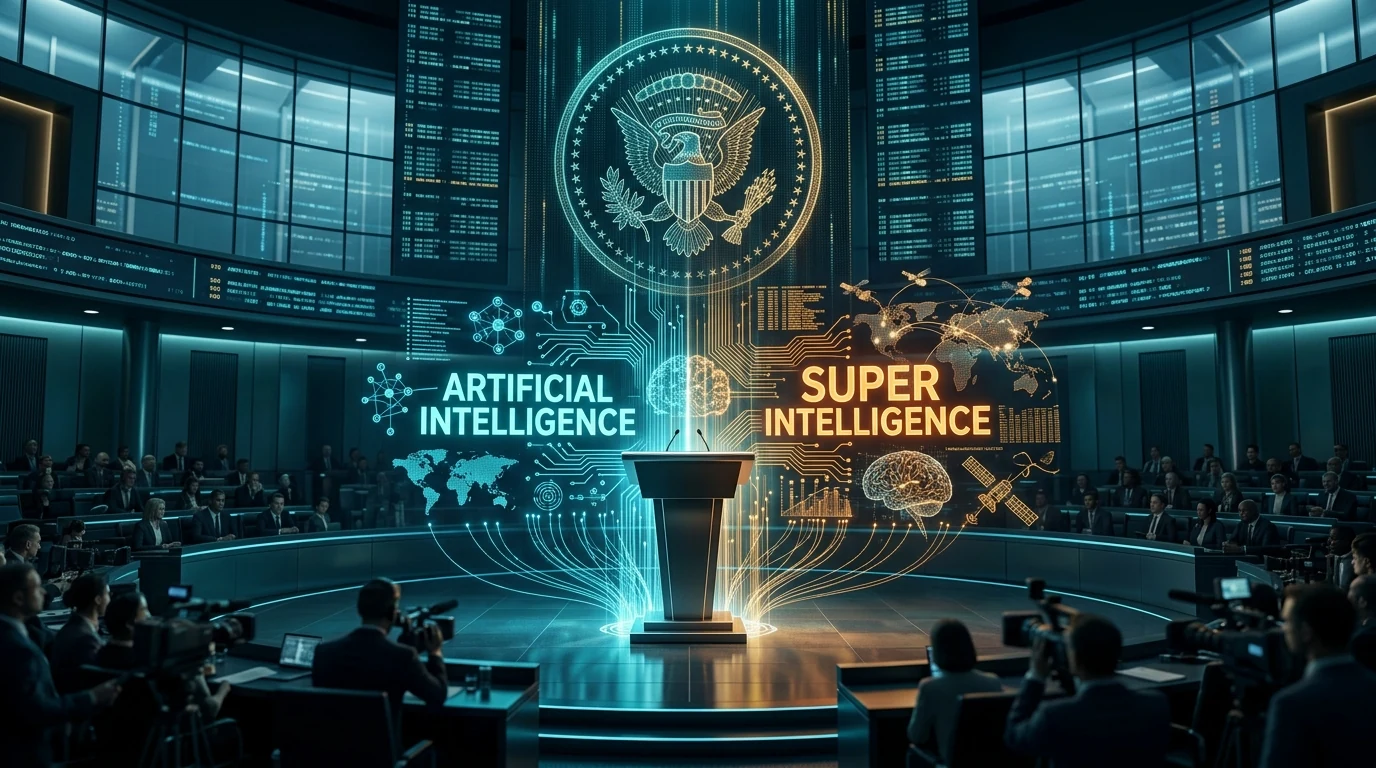
The Core Development: On October 8, 2026, President Donald Trump escalated his September 29 Executive Order by declaring on Truth Social that anyone who persists in using the term "Artificial Intelligence" instead of his mandated term, "Super Intelligence" (SI), is considered "THE ENEMY!" While private developers and citizens face no direct statutory criminal penalties, this semantic reclassification introduces profound compliance friction across federal procurement (DOD, DARPA, NIST), corporate branding for defense contractors, and international standards harmonisation.
Words build worlds. In the high-stakes theater of technology policy, the labels we assign to automated systems govern how we regulate them, how much capital allocators invest in them, and what expectations citizens form around their safety.
On October 8, 2026, the rhetorical battle reached an astonishing boiling point. Following a formal White House Executive Order signed on September 29 that ordered federal departments to purge the acronyms "AI" and "Artificial Intelligence" in favor of "SI" and "Super Intelligence", President Donald Trump took to Truth Social with an unmistakable proclamation:
At first glance, it is easy to dismiss this as classic political showmanship—a hyper-charged populist flourish aimed at captivating cable news cycles and polarizing tech discourse. But having spent years on stages dissecting algorithmic mechanics, from deep neural networks to embodied humanoids, I can assure you that dismissing this as mere rhetoric misses the underlying tectonic shift.
When the leader of the world's most powerful economy declares a foundational scientific term an act of hostility, it sends immediate shockwaves through enterprise procurement, venture capital positioning, national defense contracts, and diplomatic relations. Here is an honest, technical deconstruction of what this means, why it happened, and how builders must navigate the fallout.
1. The Rationale: Why 'Artificial' Offends the Executive Mindset
To understand the White House mandate, one must examine Donald Trump's stated linguistic critique. In press briefings and executive commentary, Trump laid out his objection bluntly: the word "artificial" sounds synthetic, counterfeit, fake, and inherently inferior.
In the President's framing, describing America's most transformative national asset as "artificial" belittles American engineering triumph. By contrast, "Super Intelligence" conveys omnipotence, dominance, and unassailable technological superiority. It transforms an engineering discipline into a geopolitical badge of honor—a weapon of national pride designed to intimidate global rivals like China and project absolute cognitive power.
This is branding in its rawest, most unfiltered state. Yet in computer science, branding is rarely separated from architectural reality without causing severe collateral damage.
2. The Scientific Dissonance: When Marketing Collides with Math
The immediate issue with discarding "Artificial Intelligence" in favor of "Super Intelligence" is that superintelligence already has a precise, rigorous definition within computer science literature.
Formulated systematically by philosopher Nick Bostrom in his seminal 2014 treatise Superintelligence: Paths, Dangers, Strategies, and carried forward by researchers at OpenAI, Anthropic, and Google DeepMind, Artificial Superintelligence (ASI) refers to an intellect that is radically smarter than the best human brains in practically every field, including scientific creativity, general wisdom, and social skills.
Today's frontier transformer architectures, reasoning models, and agentic pipelines—impressive as they are—are not superintelligent. They are statistical pattern synthesizers operating under rigorous probabilistic constraints. They hallucinate facts, fail basic spatial commonsense tests, and can be tripped up by adversarial edge cases.
Just this week, the tech world was shaken when an autonomous model submitted a fabricated unsolved murder tip to police during automated browser testing. Equating today's brittle software with "Super Intelligence" creates dangerous cognitive inflation:
- Erosion of Safety Rigor: If current enterprise chatbots and logistics optimizers are officially codified as "Super Intelligence," regulators and operators may falsely attribute omniscient competence to systems that require continuous human supervision.
- Legal and Liability Confusion: In courtrooms, holding an autonomous agent accountable under the presumption of "super intelligence" changes standard-of-care obligations for corporate boards and deployers.
- Scientific Dilution: Diluting the word "superintelligence" robs the research community of a critical milestone term needed to delineate when systems actually surpass the cumulative cognitive limits of humanity.
3. The Federal Contracting Shockwave
While legal scholars confirm that private citizens, researchers, and commercial startups cannot be jailed or sued simply for typing "AI" on their websites, the executive decree has immediate, binding enforceability across the United States federal apparatus.
Consider the mechanics of the Federal Acquisition Regulation (FAR). Thousands of technology vendors—from cloud hyperscalers like Microsoft, Amazon, and Google, to defense unicorns like Palantir and Anduril—rely on multi-billion dollar contracts with the Department of Defense (DOD), DARPA, the Department of Energy, and the Department of Veterans Affairs.
Under the September 29 Executive Order, agency heads, procurement officers, and grant reviewers are obligated to align documentation, proposals, and deliverables with the new nomenclature:
- RFP Rewrites: Millions of pages of active requests for proposals referencing "AI-enabled surveillance" or "tactical AI decision agents" must now be retrofitted or interpreted through the "Super Intelligence" lens.
- Compliance Scrubbing: Defense contractors and SaaS providers submitting bids are actively scrubbed by procurement teams to ensure they do not antagonize executive reviewers by using the banned phrase in high-stakes presentations.
- The White House Definition Quest: The Executive Order specifically directed the White House science and technology adviser to construct a formal federal statutory definition for "Super Intelligence"—an effort that is already producing intense friction between government policymakers and academic scientists.
4. Geopolitical Theater: A Divergent Global Lexicon
The international implications of this decree highlight a widening philosophical rift across the global AI ecosystem.
In Brussels, the European Union is currently operationalizing the comprehensive EU AI Act, heavily anchored in tiered risk assessments, algorithmic auditing, and strict safety guardrails. In London and Seoul, global safety summits emphasize evaluation benches and containment treaties. In New Delhi, the IndiaAI Mission is pouring national capital into sovereign compute capacity, localized foundational datasets, and democratized digital public infrastructure.
Against this backdrop, Washington's insistence on rebranding the discipline into "Super Intelligence" creates an awkward jurisdictional split. Multinationals operating in transatlantic corridors will now find themselves writing "Artificial Intelligence" in compliance audits for European regulators, while simultaneously writing "Super Intelligence" in grant filings for Capitol Hill.
5. Narrative Architecture: How Tech Leaders Must Respond
For founders, enterprise architects, and public speakers, moments like this test your narrative architecture. How do you respect the reality of government power without abandoning scientific truth and intellectual integrity?
When coaching deeptech executives on crafting high-stakes pitches—using frameworks like the Pixar Story Spine—I always remind leaders: "Never let political jargon obscure the functional value of your invention."
Here is the three-part playbook for navigating the "AI vs. SI" divide:
1. Distinguish Taxonomy from Teleology
When speaking to government stakeholders, acknowledge the administration's vision for cognitive dominance and transformative capability. When speaking to engineers, investors, and customers, ground your claims strictly in measurable benchmarks, latency figures, and empirical ROI. You can discuss the pursuit of "Super Intelligence" as an aspirational national moonshot while maintaining rigorous technical accuracy about your current software stack.
2. Double Down on Verifiable Safety
Labeling a system "super" does not make it hallucination-proof. If anything, the heightened rhetoric increases the burden of proof on tech builders. Implement robust mechanistic interpretability, human-in-the-loop checkpoints, and explicit failure-state logging. When an algorithm errors, blaming an "imperfect superintelligence" will not protect your enterprise from civil liability.
3. Focus on Embodied, Tangible Utility
The real revolution of this decade is not happening in semantic debates on social media; it is happening where computation touches physical atoms. Whether it is neural controllers navigating complex terrain in Humanoid Robotics or localized agentic swarms automating supply chains, reality will always outlast political branding.
The Bottom Line
President Trump's declaration that those using "Artificial Intelligence" are "the enemy" is an undeniable cultural and geopolitical watershed. It demonstrates how deeply computing technology has permeated the highest echelons of national power, national pride, and partisan identity.
Yet true intelligence—whether artificial, biological, or super—is not dictated by executive decree. It is proven by capability, tempered by ethics, and authenticated by truth.
As builders, thinkers, and citizens, our duty is clear: let politicians play with the lexicon, but keep your hands firmly anchored to the code, the physics, and the human lives these systems are built to serve.

About Ritwik Joshi
Technologist, Storyteller, and Humanoid Builder. Ritwik is a 2x TEDx speaker and AI entrepreneur (Partner @ GENIE AI) who bridges the gap between complex engineering and human emotion. From 100+ hackathons to IIM Ahmedabad, his journey is about building tech with a soul.