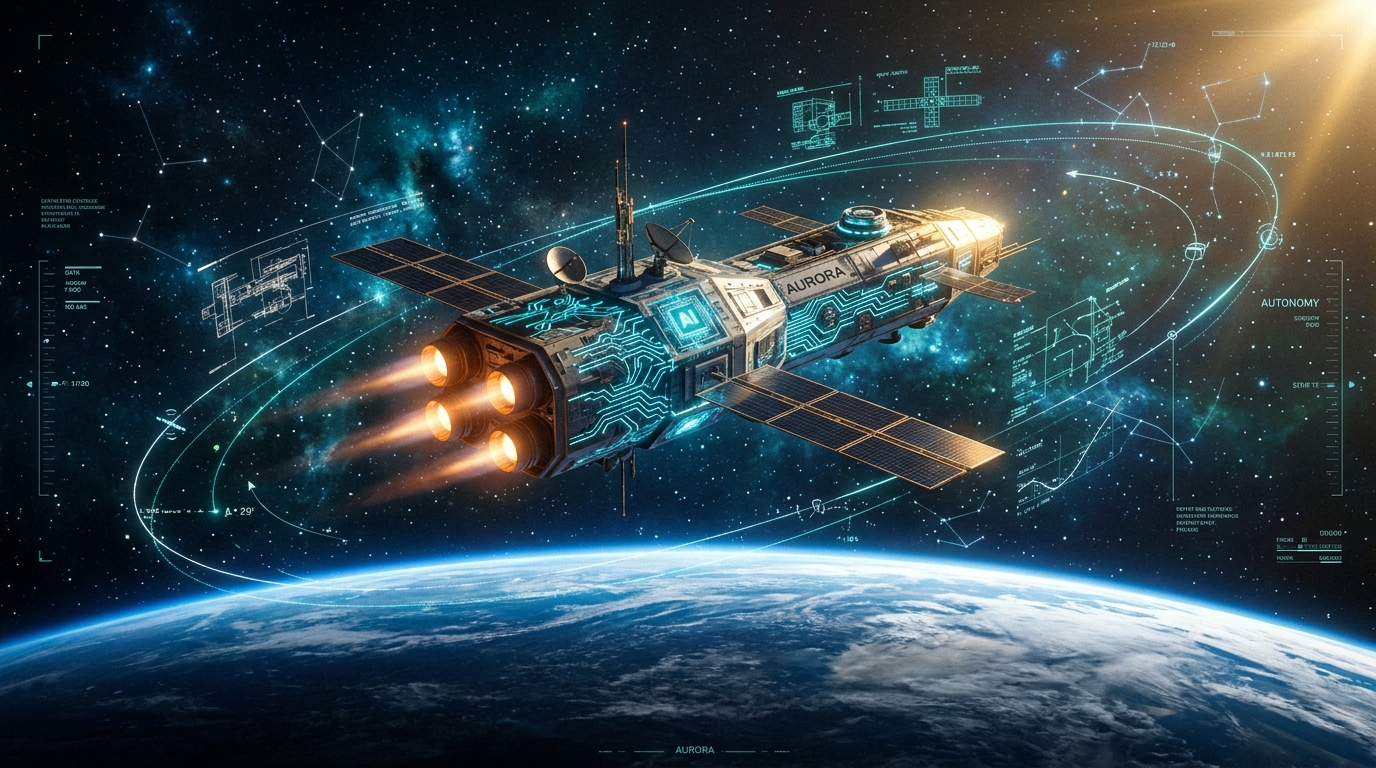
Key Takeaways
- → World Space Week 2026 (October 4–10) runs under the theme "Rocket Revolution," celebrating breakthroughs in reusable launch vehicles and democratized access to orbit.
- → Over 70% of new space missions in 2026 incorporate AI or machine learning components — from autonomous navigation to real-time satellite decision-making.
- → NASA's ASTRA program field-tested fully autonomous robot science teams in July 2026, marking a paradigm shift in planetary exploration.
- → Edge AI — processing data onboard satellites rather than transmitting to Earth — is the defining infrastructure trend of the new space economy.
- → SpaceX's Starship program relies on convex-optimization AI algorithms for fuel-optimal landing trajectories, making full rocket reusability an operational reality.
Artificial intelligence has become the invisible co-pilot of modern space exploration. During World Space Week 2026 (October 4–10), as the global space community celebrates the "Rocket Revolution," the deeper story is about what makes that revolution possible: AI systems that autonomously land rockets, navigate rovers across alien terrain, and manage constellations of 47,000+ orbital objects without human intervention. This is not a speculative future. This is the operational present.
What Is World Space Week — And Why 2026 Matters
World Space Week is the largest annual space event on Earth, declared by the United Nations General Assembly in 1999 to celebrate the contributions of space science and technology to humanity. It runs every year from October 4 (the anniversary of Sputnik's launch in 1957) to October 10 (the anniversary of the Outer Space Treaty entering force in 1967).
The 2026 theme — "Rocket Revolution" — was chosen by the World Space Week Association to spotlight how reusable launch vehicles, commercial space startups, and new national space actors are fundamentally altering who gets to go to space and how often. But beneath the hardware narrative lies a software one: the AI systems that make this revolution structurally possible.
Thousands of events across 90+ countries mark the week. Universities host hackathons. Space agencies open their doors. Astronomy clubs run public observation nights. But in 2026, an unmistakable thread runs through every event: the role of artificial intelligence in accelerating humanity's reach beyond Earth.
The Five Domains Where AI Is Rewriting Space Exploration
1. Autonomous Spacecraft and Planetary Robotics
The most visible transformation is happening on the surface of Mars and in NASA's desert test ranges. In July 2026, NASA's ASTRA program (Adaptive Sensing Technology for Responsive Autonomy) deployed a fleet of robots — a drone and two rovers — that operated as a fully independent science team. No ground controllers dictated their path. The robots scouted terrain, identified geological points of interest, assessed environmental hazards, and adjusted their own exploration strategy in real time.
This is a direct evolution from the Perseverance rover's AutoNav system, which already allowed Mars navigation at 5x the speed of previous rovers by using AI to assess terrain safety without waiting for Earth-based commands. The communication delay between Earth and Mars — anywhere from 4 to 24 minutes one way — makes human-in-the-loop control impractical for anything time-sensitive. AI autonomy is not a convenience. It is a physical necessity imposed by the speed of light.
For the planned Europa Lander mission, this autonomy becomes even more critical. With communication delays of over 45 minutes each way to Jupiter's icy moon, the lander must make every scientific and survival decision independently. The AI must determine when to drill, where to sample, and how to protect its instruments from Europa's intense radiation — all without a single human instruction.
2. Edge AI: The Satellite Intelligence Revolution
Perhaps the most consequential — and least discussed — AI breakthrough in space is happening in orbit. Edge AI refers to the practice of processing data directly on the satellite, rather than downlinking raw data to Earth for analysis. This single architectural shift changes the economics of the entire space industry.
Traditionally, an Earth observation satellite captures images, stores them, waits for a ground station pass, and transmits massive data packets to Earth — where teams of analysts process them hours or days later. With Edge AI, the satellite processes images onboard. It can identify wildfires, oil spills, ship movements, or crop health autonomously, and transmit only the actionable intelligence — reducing bandwidth requirements by orders of magnitude.
Missions like CogniSAT-6 have demonstrated autonomous sensor retargeting: the satellite identifies a high-value observation opportunity (like an unexpected volcanic eruption) and redirects its instruments without waiting for ground control. This transforms satellites from passive data collectors into active intelligence agents.
With over 47,000 tracked objects in orbit as of 2026, Edge AI also handles conjunction assessment — predicting potential collisions and autonomously executing avoidance maneuvers. Given the exponential growth of commercial constellations (Starlink alone operates thousands of satellites), manual traffic management is physically impossible. AI is the only scalable solution.
3. AI-Powered Rocket Landing and Reusability
The "Rocket Revolution" that World Space Week 2026 celebrates would not exist without AI. SpaceX's Falcon 9 — now the most-launched orbital rocket in history — relies on convex-optimization algorithms like G-FOLD (Guidance for Fuel-Optimal Large Diverts) to calculate real-time landing trajectories. These algorithms process sensor data, camera feeds, wind conditions, and vehicle health to make split-second thrust adjustments during the final descent.
The Starship program takes this further. Designed as the first fully reusable orbital rocket system, Starship's upper stage must survive atmospheric reentry at hypersonic speeds and execute a controlled landing — a maneuver requiring AI systems that can adapt to conditions no human can predict or control in real time. By late 2026, SpaceX has reached a high flight-test cadence, refining these AI-driven reentry and recovery maneuvers with each launch.
Beyond landing, SpaceX uses machine learning across its ecosystem: evaluating flight data to simulate future mission profiles, optimizing launch schedules across multiple pads, and managing the Starlink constellation where each satellite autonomously manages its own orbit, communication links, and collision-avoidance maneuvers.
4. Cross-Agency AI Collaboration
The AI transformation in space is not happening in silos. NASA and ESA have held joint international workshops on AI Foundation Models for Earth Observation, focusing on moving AI from research prototypes to operational deployment for climate monitoring, weather prediction, and Earth science research.
The Aerospace Corporation has published frameworks for "Trusted AI" in space — establishing standards for how autonomous systems should be verified, validated, and certified for high-stakes missions. This is not academic abstraction. When a $2 billion spacecraft makes an autonomous decision 500 million kilometers from Earth, the framework for trusting that decision must be as rigorous as the engineering behind it.
ISRO, India's space agency, is integrating AI into its next-generation satellite platforms and has participated in global discussions on autonomous space operations — signaling that the AI-space convergence is a planetary effort, not a Western monopoly.
5. The Computational Paradox: Radiation vs. Intelligence
There is a fundamental tension at the heart of space AI that deserves honest attention. The processors that survive the radiation environment of space — radiation-hardened chips — significantly trail the performance of commercial processors used in terrestrial AI applications. Running a state-of-the-art transformer model on a satellite processor is not yet practical in the way it is on an NVIDIA H100 in a data center.
This creates a design constraint: space AI must be efficient, not just powerful. Edge AI models for satellites are often distilled versions of larger models, optimized for the specific task (fire detection, ship tracking, anomaly identification) rather than general-purpose reasoning. The challenge for the next decade is closing this gap — either through radiation-tolerant chip architectures that approach commercial performance, or through AI model architectures specifically designed for constrained computing environments.
Companies like Ubotica and startups in the NewSpace ecosystem are attacking this problem directly, developing space-qualified AI accelerators that can run inference workloads in orbit. The constraint is real, but the trajectory is clear: more intelligence, closer to the data, with less reliance on ground control.
What World Space Week 2026 Means for the AI Community
If you work in AI, machine learning, or autonomous systems, World Space Week is not just a space celebration — it is a mirror. The problems being solved in orbit and on other planets represent the hardest versions of the problems the broader AI community faces: autonomy under uncertainty, decision-making with incomplete data, edge deployment on constrained hardware, and system reliability in environments where debugging is not an option.
The lessons flowing back from space AI to terrestrial applications are already visible:
- Autonomous driving borrows from spacecraft navigation algorithms that handle sensor fusion and real-time path planning.
- Industrial IoT adopts Edge AI architectures pioneered for satellite constellations.
- Climate tech depends directly on AI-processed satellite data for wildfire detection, carbon monitoring, and agricultural forecasting.
- Defense and maritime security rely on autonomous satellite surveillance systems that originated from Earth observation AI.
The space industry's demand for Trusted AI — systems that are interpretable, verifiable, and safe — is also pushing the frontier of AI safety research in ways that will benefit every domain. When you must trust an AI to protect a $2 billion asset 500 million kilometers away, you develop trust frameworks that are rigorous by necessity, not by aspiration.
How to Participate in World Space Week 2026
World Space Week is designed for everyone — not just aerospace engineers. Here is how to engage during October 4–10, 2026:
- Find local events: Visit worldspaceweek.org for a global map of events including public lectures, telescope nights, STEM workshops, and exhibitions.
- Organize a school or university event: The World Space Week Association provides free educational toolkits and activity guides for educators.
- Explore the AI-space connection: Follow NASA's AI technology page and ESA's Space AI initiatives for deep dives into current projects.
- Build something: Use open satellite data from Copernicus or NASA's Earthdata to build your own Edge AI prototype — detecting changes in land use, tracking deforestation, or monitoring urban growth.
The Uncomfortable Question: Who Controls Space Intelligence?
As AI becomes the operational backbone of space systems, a governance question emerges that World Space Week implicitly raises: who decides how autonomous these systems should be?
When a satellite autonomously decides to image a specific location on Earth, or when an AI system determines which scientific samples a rover should collect on Mars, the decisions encode priorities — scientific, commercial, and potentially military. The AIAA (American Institute of Aeronautics and Astronautics) has emphasized that autonomy should enhance, not replace, human judgment — particularly for crewed missions under the Artemis program.
But as communication delays grow longer and constellation sizes grow larger, the practical reality is that AI systems will make an increasing share of operational decisions without human oversight. The frameworks for governing this autonomy — for ensuring it serves scientific progress and collective benefit rather than narrow commercial interests — are still being written.
This is the conversation that World Space Week 2026 should catalyze beyond the celebration of rockets and reusability. The revolution is not just in the hardware. It is in who — or what — decides how that hardware is used.
Final Reflection: Intelligence as Humanity's Longest Arm
World Space Week exists to remind us that space is not a distant abstraction. It is the domain where our most ambitious engineering, our deepest scientific curiosity, and our most advanced intelligence systems converge. In 2026, artificial intelligence is no longer a supporting technology in space exploration. It is the enabling layer — the thing that makes autonomous rovers possible on Mars, collision-free constellations viable in orbit, and fully reusable rockets operational on Earth.
The "Rocket Revolution" is real. But the intelligence revolution powering it — quiet, computational, and relentless — is the one that will define the next century of human presence beyond Earth.
As we look up during World Space Week 2026, it is worth remembering: the spacecraft overhead are not just flying. They are thinking.

About Ritwik Joshi
Technologist, Storyteller, and Humanoid Builder. Ritwik is a 2x TEDx speaker and AI entrepreneur (Partner @ GENIE AI) who bridges the gap between complex engineering and human emotion. From 100+ hackathons to IIM Ahmedabad, his journey is about building tech with a soul.