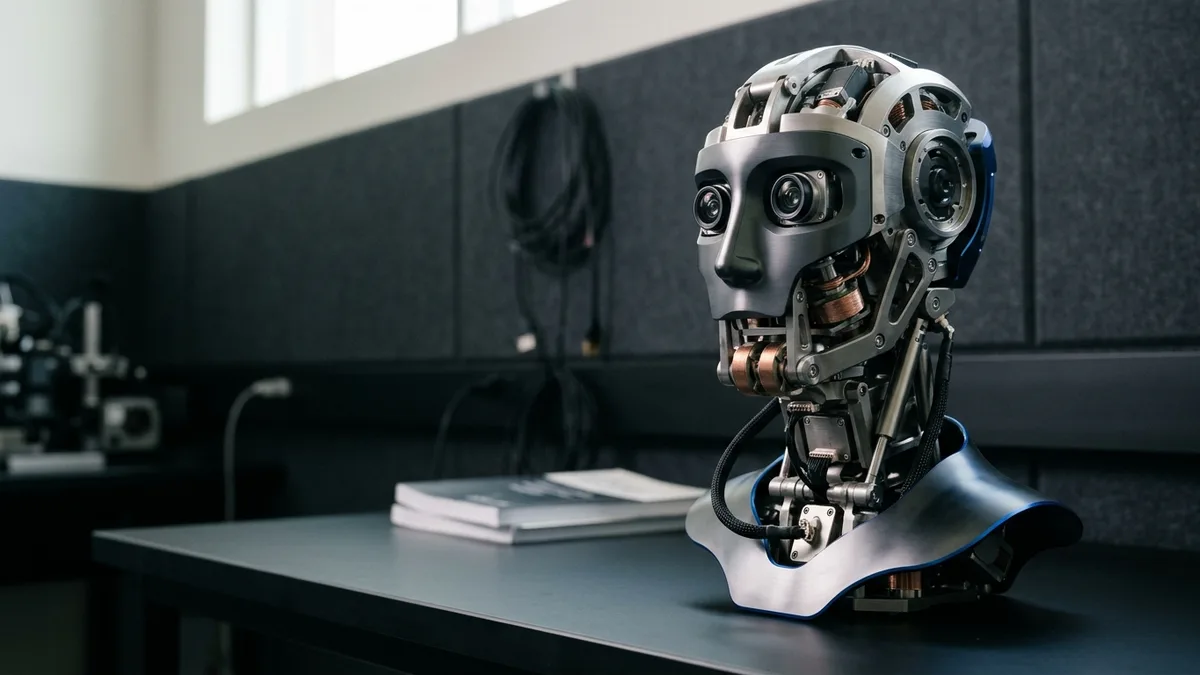
Key Takeaways
- 60% of the Stack Exists Today: Conversational persona cloning, Vision-Language-Action (VLA) reasoning, and 47-servo biomimetic faces already work in 2026 laboratories.
- Actuators Eat 40% of the Budget: High-torque axial-flux and frameless brushless motors give modern humanoids agile 2.0 m/s gait, but precision joints still dominate hardware cost.
- Physics Blocks Infinite Runtime: At 150 to 260 Wh/kg battery density, real 60 kg bipedal humanoids run 2 to 4 hours per charge—making energy density the hardest Doombot barrier.
- Frugal Sovereign Design Wins: Real industrial adoption depends on sub-$10,000 unit economics rather than cinema-grade titanium armor.
Why Everyone Is Searching About Doombots in December 2026
Marvel Studios releases Avengers: Doomsday worldwide on December 17–18, 2026. Millions of viewers are meeting Victor von Doom's signature weapon on the giant screen: the Doombot.
Unlike Ultron's expendable drones or Stark's Iron Legion, comic-accurate Doombots are built for total deception. Each bipedal android wears a synthetic human face beneath its iron mask. It speaks with Doom's exact cadence. Remarkably, each unit believes it is Victor von Doom whenever its creator is out of range.
I am actively engineering the Robosa indigenous humanoid platform. It integrates 28 full-body degrees of freedom and 47 facial micro-actuators. At almost every campus tech fest, students ask me the same question. How close is 2026 Physical AI to building a real Doombot?
Strip away comic-book mysticism and audit the subsystem bill of materials. Half of Doctor Doom's blueprint already runs on laboratory benches today. The other half hits a brick wall of thermodynamics.
Subsystem Audit: Fictional Doombot vs. 2026 Physical AI
According to 2026 industrial robotics benchmarks, commercial humanoids have moved beyond scripted choreography. Modern platforms now rely on end-to-end neural control. Here is how Marvel's Diplomatic Doombot compares to real hardware:
| Subsystem. | Marvel Doombot Spec. | 2026 Physical AI Reality. | Status. |
|---|---|---|---|
| Cognitive Brain. | Autonomous Doom engram with swarm override. | Edge VLA models (GR00T, OpenVLA, pi-zero) plus persona RAG. | 80% Ready. |
| Facial Deception. | Indistinguishable synthetic skin and gaze. | Silicone elastomer skin with 47 micro-servos (Robosa). | 65% Ready. |
| Bipedal Agility. | High-impact combat and flight recovery. | 28–32 DoF axial-flux joints at 2.0 m/s walk. | 55% Ready. |
| Power Core. | Weeks of micro-reactor endurance. | 150–260 Wh/kg Li-ion packs (2–4 hours runtime). | 20% Ready. |
| Unit Cost. | Sovereign Latverian defense budget. | $8,000 target (Robosa) vs. $150,000 Western rigs. | 75% Ready. |
1. The Brain: Vision-Language-Action (VLA) Meets Persona Cloning
In Marvel comics, a Doombot passes every verbal Turing test. Its neural processor mirrors Victor von Doom's strategic memory. Oddly enough, this is the easiest subsystem to replicate in 2026.
Research on embodied foundation models has unified perception, language, and motor control. Leading examples include Physical Intelligence's pi-zero, OpenVLA, and NVIDIA's GR00T architectures. Paired with sub-200ms voice synthesis, a robot can debate unscripted while manipulating physical objects.
Even Doom's famous "creator proximity protocol" is simple in modern distributed systems. Doombots act autonomously abroad yet defer instantly when the real Doom enters proximity. In enterprise robotics, we build this using cryptographic beacons and Model Context Protocol (MCP) permission gates.
2. The Face Under the Mask: 47 Micro-Actuators vs. The Uncanny Valley
Why did Doctor Doom give armored robots realistic human faces beneath metal masks? Psychological authority depends on micro-expressions whenever the mask comes off.
In hardware engineering, human facial biomechanics is unforgiving. Observers spot a 2-millimeter lip-sync lag within 100 milliseconds. For Robosa's head assembly, we mapped 47 facial micro-actuators beneath compliant elastomer skin. These servos coordinate brow tension, eye saccades, and jaw kinematics.
Studies on AffectiveVLA human-robot interaction confirm an important principle. Tying camera gaze tracking to micro-servo compliance builds immediate human trust. Still, silicone skin lacks capillary blood flushing and natural thermoregulation. Under close inspection, 2026 androids remain one step shy of fooling the Avengers.
3. Actuators & The Sensor-to-Actuator Bottleneck
According to DataM Intelligence supply-chain data, precision actuators represent 40% of a humanoid's bill of materials. Modern platforms pair compact axial-flux brushless motors with harmonic or planetary gearboxes.
These joints deliver high torque density. Commercial 2026 humanoids now walk past 2.0 m/s and recover from hard shoves. Yet cinematic combat remains science fiction for two mechanical reasons:
- Gearbox Shock Loads: Harmonic drives excel at zero-backlash precision. However, sudden high-G impacts fracture delicate flexsplines unless replaced by quasi-direct-drive actuators.
- Closed-Loop Latency: My analysis of the sensor-to-actuator bottleneck highlights this wall. Bipedal balance demands deterministic feedback under 10 to 20 milliseconds. Cloud inference is too slow when a floor shifts underfoot.
4. The Hard Physics Wall: 260 Wh/kg Battery Density
Want to spot fake robotics hype in pitch decks or Hollywood blockbusters? Always ask one question: Where is the battery pack?
Empirical data across 2026 humanoids shows lithium-ion packs store 150 to 260 Wh/kg. Meanwhile, a 60-kilogram humanoid running edge GPUs and 28 motors draws 600 to 1,200 watts.
That math limits an 8-to-12 kilogram chest battery to 2 to 4 hours of untethered work. Solid-state and lithium-sulfur cells must surpass 500 Wh/kg to change this equation. Until then, real humanoids rely on dock charging and hot-swappable packs.
Why Real Humanoids Need Sub-$8,000 Economics, Not Vibranium
Marvel's cinema spectacle obscures a vital lesson about robotics commercialization. A $200,000 humanoid solves zero factory, clinic, or campus bottlenecks in emerging markets.
Economic analysis of Indian industrial automation proves a clear threshold. Embodied robots hit a 14-month payback only at an $8,000 to $12,000 unit cost. That frugal mechatronics thesis drives Robosa. Sovereign hardware moats come from disciplined BOM engineering, not fictional alloys.
Live Robotics & Physical AI Keynotes
Planning an IIT/NIT Tech Fest or Enterprise AI Summit?
Ritwik Joshi is a 2× TEDx Speaker and Robosa Humanoid Builder. He delivers high-energy keynotes separating real Physical AI engineering from sci-fi hype across NITs, IIMs, and IBM stages.
Did Marvel use generative AI or traditional CGI to animate Doctor Doom and his Doombots? Read our companion audit on Avengers: Doomsday VFX vs. AI and our investigation into viral fake Doomsday trailers.
Frequently Asked Questions
What are Doctor Doom's Doombots in Avengers: Doomsday?
Doombots are autonomous bipedal android decoys engineered by Victor von Doom in Marvel lore. Each unit replicates Doom's voice, tactical intelligence, and facial likeness so convincingly that enemies rarely know whether they face a machine or the real ruler. They operate independently until Doctor Doom enters proximity.
Can 2026 humanoid robotics technology build a real Doombot?
Engineers in 2026 can already build roughly 60% of a non-combat Doombot. Vision-Language-Action models, real-time voice synthesis, and 40+ micro-actuator biomimetic faces exist today in labs. However, lithium-ion energy density of 150 to 260 Wh/kg limits untethered bipedal endurance to 2 to 4 hours.
How many degrees of freedom does a realistic humanoid robot need?
Convincing human-like movement requires 26 to 32 full-body degrees of freedom paired with 35 to 50 facial micro-actuators. For example, Yantrarora Innovation's indigenous Robosa platform combines 28 body degrees of freedom with 47 facial micro-actuators to cross the social interaction threshold.
Why is battery density the biggest bottleneck for Marvel-style androids?
Current 2026 lithium-ion packs store roughly 150 to 260 Wh/kg. A 60-kilogram bipedal robot needs 2 to 3 kWh for dynamic walking and edge AI compute. That restricts continuous field runtime to under 4 hours, far short of fictional arc-reactor or Latverian power cells.