Ritwik Joshi
Public Speaker · Musician · Entrepreneur

The Person Behind the Purpose

Ritwik
Joshi.

Technologist. Storyteller. Humanoid Builder. Ritwik Joshi is a blend of hands-on engineering and executive vision — turning complex tech into compelling human stories.

As co-founder of Ability Advocacy and Partner at GENIE AI, he brings a decade of AI, robotics, and startup experience to every stage he walks on.

Download Media Kit
Ritwik Joshi — AI Speaker and Entrepreneur
The Foundation

Academics 🎓

From a rebel student in a tribal area ofSagwara to an IIM-A and ISB alumnus — the journey that built the worldview.

The Beginning

New Look School, Sagwara

The "Rebel Student" who discovered programming and robotics — where the obsession began. Maths-Science stream, and a curiosity that refused to stay inside the classroom.

School
Engineering

Techno India NJR Institute of Technology

B.Tech in Computer Science — where the robotics obsession got fuel. Learned the fundamentals of AI, machine learning, and hands-on robotics programming.

B.Tech · Computer Science
Certification

IBM Skills Academy

4-year IBM Certified Business Analytics Specialist. Where enterprise-scale thinking about data, AI, and analytics was formalised into a credential.

IBM Certified · Business Analytics
Executive Education

IIM Ahmedabad

Young Entrepreneurs Program — growth strategy, leadership, finance, operations, execution, funding, brand building, and responding to competition. Transformed the engineer into a business thinker.

Young Entrepreneurs Program
Executive Education

ISB Hyderabad

Executive education in Business Storytelling — the capstone that bridged deep technical expertise with the art of compelling narratives for investors, customers, and audiences.

Business Storytelling
The Builder

Technical Experience ⚙️

100 Hackathons. 25 Wins. Zero Limits.

Ability Advocacy

CTO and co-founder. Built GENIE AI — a leading AI company specialising in Conversational AI, RPA, and enterprise chatbot development with clients across India and globally.

CTO & Co-Founder

GENIE AI, Canada

Partner and Technology Advisor. Leads enterprise AI technology development, pushing the boundaries of Generative AI and intelligent automation for businesses across North America.

Partner · GenieAI

Stealth Robotics

Engineering India's first hyper-realistic humanoid robot. Hands-on experience crafting high-end applications on the Nao humanoid robot — a passion project turned serious engineering endeavour.

Humanoid Robotics
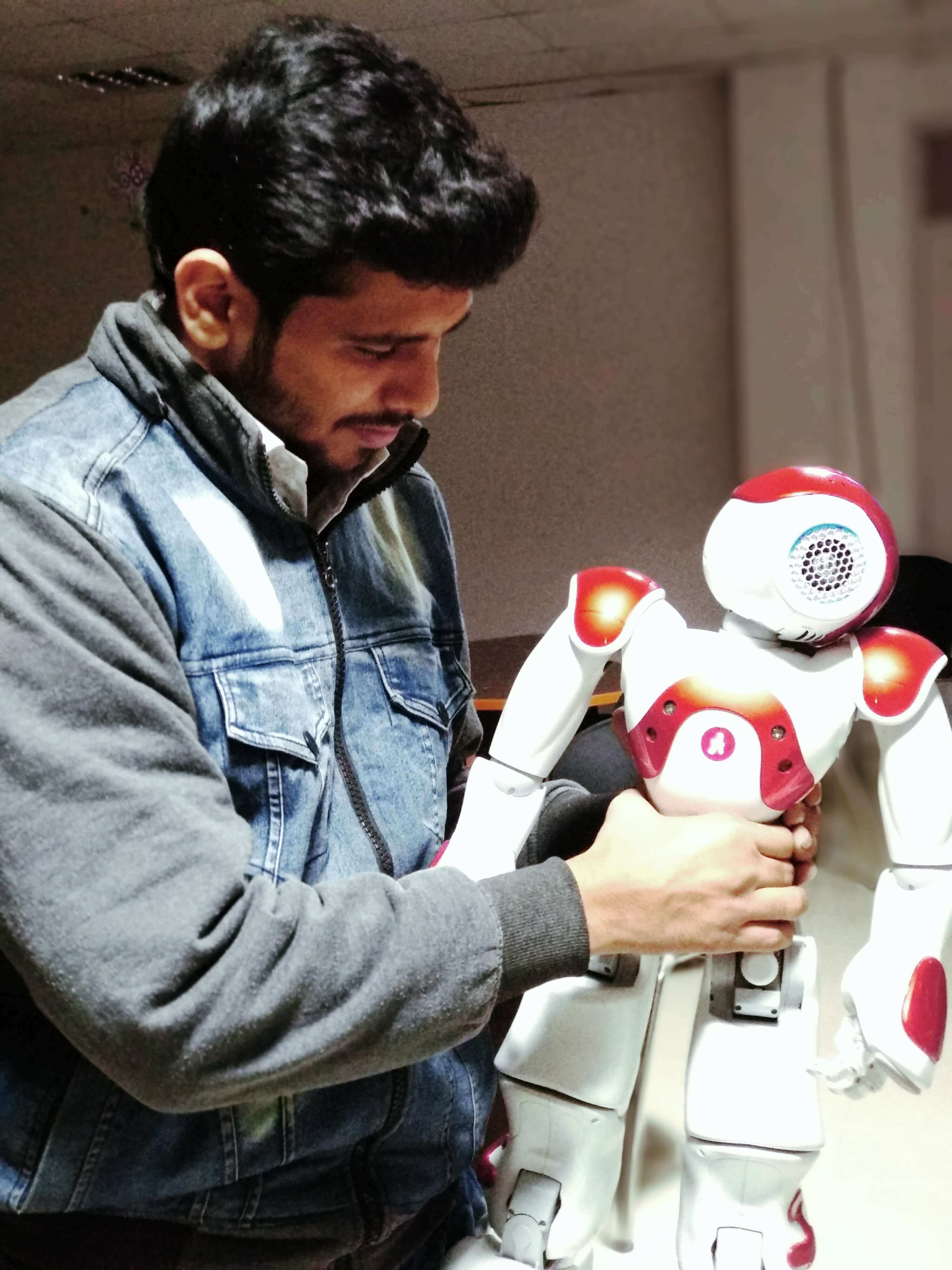
Ritwik Joshi holding the Humanoid Robot NAO

100+

Hackathons Competed

A proven track record across national and international hackathons — with over 25 wins that cemented the reputation as a dynamic force in AI development.

Nao Robot

Humanoid Programming

Proficient in building applications on the Nao humanoid platform, with multi-language programming expertise spanning Python, conversational AI frameworks, and robotics SDKs.

Community

Startup Community
& eChai Ventures 🤝

As a core member and moderator for eChai Ventures, Ritwik actively bridges the gap between early-stage founders and the resources they need to scale.

From hosting startup meetups across India to representing the Indian startup ecosystem at the Dubai Expo 2020, he is a fixture in the entrepreneurial community — connecting dots, facilitating conversations, and accelerating momentum.

eChai Ventures

Core Member & Community Moderator

Dubai Expo 2020

Representing the Indian Startup Ecosystem

Startup Meetups

Hosted across India

Founder Mentoring

Early-stage to growth stage
Learn more about eChai Ventures
Ritwik Joshi delivering a keynote address at the IBM Developer Connect conference.

2x

TEDx Speaker

The Voice

From Code
to Keynotes. 🎙

A TEDx veteran and LinkedIn Top Voice in AI, Ritwik specialises in turning complex technical subjects into heart-moving narratives. His 2x TEDx talks — at TEDxOIST and TEDxYouth OGS — have made him a sought-after speaker globally.

With a rich history speaking at IBM Developer Connect, IEEE, and Microsoft Club, his ability to make intricate topics accessible and engaging makes him an ideal choice for tech conferences, corporate events, and university stages.

TEDxOIST TEDxYouth OGS IBM Developer Connect IEEE Microsoft Club LinkedIn Top Voice
Explore the Speaking Hub
The Proof

Awards & Recognition 🏆

"Just like everyone, I feel proud when my and my team's efforts are recognised and awarded."

Logo of CNBC, a major business news outlet where Ritwik Joshi has been featured.

CNBC

Featured as an emerging AI entrepreneur and public speaker on one of India's premier financial news networks.

Logo of AajTak, a leading Indian news channel that has covered Ritwik Joshi's work.

AajTak

Television coverage on India's most-watched Hindi news channel, recognising work in AI, robotics, and startup leadership.

ETV Rajasthan

ETV Rajasthan

Regional recognition as a technology leader and AI evangelist from Rajasthan, bridging grassroots innovation and global tech trends.

Let's Connect

Want to collaborate?

I am an extrovert in the truest sense — I love talking, exchanging ideas, and building things together.

or reach me at booking@ritwikjoshi.com

Academics | Ritwik Joshi — Education in AI, Entrepreneurship & Storytelling
Ritwik Joshi
Intellectual Journey

Academics &
Intellectual Journey

"Yes, I love to read 📚 and I love to learn 💪 but I'm a bit non-conventional when it comes to learning."

☹️

Notice

If you are expecting me to be a studious student who is always scoring great in his exams 🏆...

Sorry! you are Damn Wrong!

The Milestones · Chronological

Ritwik Joshi as a student at New Look School Sagwara, Rajasthan
Schooling · Sagwara, Rajasthan
✏️

New Look School

Ritwik Joshi is a maths-science alumnus of New Look School Sagwara where he developed an initial interest in programming and robotics. This is where the spark of curiosity first caught fire.

Ritwik Joshi receiving an award at Techno India NJR Institute of Technology, RTU
Graduation · B.Tech Computer Science
🎓

Rajasthan Technical University

Ritwik Joshi completed his B.Tech. in Computer Science from Techno India NJR Institute of Technology where he learned the fundamentals of computer science, artificial intelligence, and robotics.

B.Tech · CS · AI · Robotics
Ritwik Joshi at IBM ICE Business Analytics certification event
Specialization · 4-Year Certification
💻

IBM Skill Academy

Ritwik completed his 4-year certification as IBM Certified Business Analytics Specialist from IBM Skill Academy — where enterprise-scale thinking about data, AI, and analytics was formalised.

IBM Certified · Business Analytics
Ritwik Joshi at IIM Ahmedabad Young Entrepreneurs Program
Entrepreneurial Studies · YEP
💼

IIM Ahmedabad

Ritwik Joshi is an alumnus of the Young Entrepreneurs Program by the Indian Institute of Management Ahmedabad. At IIMA he learned the fundamentals of Entrepreneurship — growth, strategy, leadership, finance, operations, execution, funding, brand building, customer retention, handling disruption and responding to competition.

Young Entrepreneurs Program
ISB Hyderabad campus where Ritwik Joshi studied Communication and Storytelling
Communication & Storytelling
🎙

ISB Hyderabad

At ISB Hyderabad, Ritwik Joshi studied the art of Storytelling and Executive Presence — the capstone that bridged deep technical expertise with the power of compelling narratives.

Business Storytelling · Executive Presence
Ritwik Joshi at IIM Ahmedabad Creating Entrepreneurial Organisations Program
Corporate Entrepreneurship · CEO Program
🚀

IIM Ahmedabad

Ritwik Joshi is also an alumnus of the Creating Entrepreneurial Organisations Program by the Indian Institute of Management Ahmedabad — studying how to build and sustain entrepreneurial culture within organisations.

CEO Program · Corporate Entrepreneurship
Let's Connect

Contact Me

I am an extrovert in the truest sense — I love talking and having ☕️

Ritwik Joshi - Local Blog Publisher

AI Blog Dashboard

Automated Pipeline: Research → Write → Publish

Ritwik Joshi Blog | The Insight Journal
Ritwik Joshi

Insights on the Future of
AI & Storytelling.

The "Purposeful" Perspective—exploring cognitive science, conversational AI, and the art of human connection.

LinkedIn Top Voice

Get the "Purposeful" Perspective.

Join 5,000+ readers who follow my journey in AI, storytelling, and building products that matter. No spam, just stories.

Follow on LinkedIn

The Insight Journal is more than a collection of articles; it is an exploration of where technology meets the human soul. From the intricacies of Physical AI and Sovereign Silicon to the frameworks of Technical Storytelling, these pieces are designed for founders, engineers, and visionaries building the future of 2026.

Connect with Ritwik Joshi

Connect with Ritwik Joshi

Contact — Ritwik Joshi | Public Speaker with a Purpose
Ritwik Joshi

Let's create
something
together.

Currently based in Udaipur, India. Open for global speaking engagements and AI collaborations.

Ritwik Joshi pointing — let's connect

Hello

Call / WhatsApp

+91 8290266803

Better to WhatsApp first 🙂

✓ Message sent. I'll reply within 24 hours.

Connect

LinkedIn ✨ Top Voice YouTube Twitter / X Instagram Facebook

Location

Udaipur, Rajasthan

India · IST (UTC +5:30)

Available globally for
in-person & online engagements.

Availability

Download Media Kit View Speaking Topics

Open for

→ Keynote & TEDx Speaking

→ Startup Mentorship

→ AI & Robotics Collaboration

→ Corporate Workshops

→ Coffee Chats

Response time

Within 24 hours

All messages read personally.


As a TEDx Speaker and AI Entrepreneur, I bridge the gap between complex engineering and human narrative. Whether you are looking for a high-impact keynote on Humanoid Robotics, seeking strategic mentorship for your Deeptech Startup, or exploring cross-border AI collaborations, my Udaipur-based hub is a springboard for global impact.

Building with eChai Ventures | Ritwik Joshi
Ritwik Joshi
Your Startup’s Global Neighborhood

CoRise with
eChai Ventures.

Hosting Free & Open for All meetups across the world

Ritwik Joshi addressing founders and tech enthusiasts at an eChai ventures startup meetup.

Let me tell you a story.

It’s not about funding rounds or billion-dollar valuations.
It’s about chai, conversations, and a crazy idea that turned into a global movement.

What is eChai?

eChai is not a company. Not a startup accelerator. It’s a vibe.
It’s where you walk in with a half-baked idea and walk out with five new friends, two potential collaborators, and the energy to build again.

Started in Ahmedabad, eChai is now in 25+ global cities and 20+ countries — but it still feels like that same chai-kitli conversation opposite Gujarat Vidyapith where it all began.

Why eChai? (Why do founders show up?)

Because no one’s trying to sell you anything. There’s no panel of judges. No fancy stage.
You just share your journey — wins, fails, doubts — and others nod, laugh, add their own stories.
It’s like group therapy for founders. Except it’s free. And more fun.

And that’s the magic — it’s for founders, by founders. No gatekeeping. No bias. No ‘you’re too early’. Everyone’s welcome.

My Journey with eChai

I still remember my first meeting with Jatin bhai at CIIE, IIM Ahmedabad(Now known as IIMA Ventures) as our startup was incubated there.

We have a nice conversation and subsequently I started visiting eChai meetups.

In the first meetup I didn’t know what to expect. Just walked in, grabbed a chair, and listened. No suits. No slides. Just real people talking about real problems. I met a lot of amazing founders, friends and investors. Also attracted clients towards my business.

When I came back to my hometown (Udaipur) I got a chance to host my first eChai meetup. That meetup was a powerful housefull meetup and since then I've been hosting eChai meetups and contributing to this mission of making the world's largest open startup network. I've hosted the meetups in many cities and learned a lot in this journey and made strong connections.

eChai Meetups Photos by Ritwik Joshi eChai Meetups Photos by Ritwik Joshi eChai Meetups Photos by Ritwik Joshi

And every time, I leave with something new — a perspective, a connection, a reminder that I’m not alone in this crazy startup world.

Jatin Choudhary, founder of eChai Ventures, presenting at a community networking event.

The Man Behind It: Jatin Choudhary

Jatin didn’t start eChai to make money. In his words — “Bhai paisa nai kamaiye to chali jashe.” His goal was simple: bring people together, make them competent, and help each other grow.

He comes from a chawl in Ahmedabad. No fancy background. No MBA. Just a guy who believed in conversations and community. He used to work in a BPO Company at Udaipur, selling long-distance services. That’s where he built his skills. And one day, he decided — let’s do something different.

For the first 3 years, he didn’t earn a single penny from eChai. No funding. No sponsors. Just chai and hustle. And now? People in New York, Toronto, Dubai, Singapore, Melbourne — they all meet under the eChai banner.

Crazy, right?

What’s in it for you?
If you’re a founder — come.
If you’re just starting — definitely come.
If you’re stuck — especially come.

You’ll meet people who’ve been there. Who’ve messed up. Who’ve figured it out.
You’ll get feedback. Honest ones. Not the LinkedIn-flavored ones.

You’ll thank me later.

Elements

Text Sample

Every avid independent filmmaker has Bold about making that Italic interest documentary, or short film to show off their creative prowess. Many have great ideas and want to “wow” theSuperscript scene, or video renters with their big project. But once you have theSubscript “in the can” (no easy feat), how do you move from a Strike through of master DVDs with the “Underline” marked hand-written title inside a secondhand CD case, to a pile of cardboard boxes full of shiny new, retail-ready DVDs, with UPC barcodes and polywrap sitting on your doorstep? You need to create eye-popping artwork and have your project replicated. Using a reputable full service DVD Replication company like PacificDisc, Inc. to partner with is certainly a helpful option to ensure a professional end result, but to help with your DVD replication project, here are 4 easy steps to follow for good DVD replication results:

Sample Buttons

Left Aligned

Placeholder design element showing abstract colored shapes used for webpage structure testing.

Recently, the US Federal government banned online casinos from operating in America by making it illegal to transfer money to them through any US bank or payment system. As a result of this law, most of the popular online casino networks such as Party Gaming and PlayTech left the United States. Overnight, online casino players found themselves being chased by the Federal government. But, after a fortnight, the online casino industry came up with a solution and new online casinos started taking root. These began to operate under a different business umbrella, and by doing that, rendered the transfer of money to and from them legal. A major part of this was enlisting electronic banking systems that would accept this new clarification and start doing business with me. Listed in this article are the electronic banking systems that accept players from the United States that wish to play in online casinos.

Right Aligned

Over time, even the most sophisticated, memory packed computer can begin to run slow if we don’t do something to prevent it. The reason why has less to do with how computers are made and how they age and more to do with the way we use them. You see, all of the daily tasks that we do on our PC from running programs to downloading and deleting software can make our computer sluggish. To keep this from happening, you need to understand the reasons why your PC is getting slower and do something to keep your PC running at its best. You can do this through regular maintenance and PC performance optimization programs

Before we discuss all of the things that could be affecting your PC’s performance, let’s talk a little about what symptoms

Placeholder design element showing abstract colored shapes used for webpage structure testing.

Definition

Definition 01

Recently, the US Federal government banned online casinos from operating in America by making it illegal to transfer money to them through any US bank or payment system. As a result of this law, most of the popular online casino networks

Definition 02

Recently, the US Federal government banned online casinos from operating in America by making it illegal to transfer money to them through any US bank or payment system. As a result of this law, most of the popular online casino networks

Definition 03

Recently, the US Federal government banned online casinos from operating in America by making it illegal to transfer money to them through any US bank or payment system. As a result of this law, most of the popular online casino networks

Block Quotes

“Recently, the US Federal government banned online casinos from operating in America by making it illegal to transfer money to them through any US bank or payment system. As a result of this law, most of the popular online casino networks such as Party Gaming and PlayTech left the United States. Overnight, online casino players found themselves being chased by the Federal government. But, after a fortnight, the online casino industry came up with a solution and new online casinos started taking root. These began to operate under a different business umbrella, and by doing that, rendered the transfer of money to and from them legal. A major part of this was enlisting electronic banking systems that would accept this new clarification and start doing business with me. Listed in this article are the electronic banking”

Table

#
Countries
Visits
Percentages
01
National flag icon used in the elements page demonstration.Canada
645032
02
National flag icon used in the elements page demonstration.Canada
645032
03
National flag icon used in the elements page demonstration.Canada
645032
04
National flag icon used in the elements page demonstration.Canada
645032
05
National flag icon used in the elements page demonstration.Canada
645032
06
National flag icon used in the elements page demonstration.Canada
645032
07
National flag icon used in the elements page demonstration.Canada
645032
08
National flag icon used in the elements page demonstration.Canada
645032

Image Gallery

Typography

This is header 01

This is header 02

This is header 03

This is header 04

This is header 01
This is header 01

Unordered List

  • Fta Keys
  • For Women Only Your Computer Usage
  • Facts Why Inkjet Printing Is Very Appealing
    • Addiction When Gambling Becomes
      • Protective Preventative Maintenance
  • Dealing With Technical Support 10 Useful Tips
  • Make Myspace Your Best Designed Space
  • Cleaning And Organizing Your Computer

Ordered List

  1. Fta Keys
  2. For Women Only Your Computer Usage
  3. Facts Why Inkjet Printing Is Very Appealing
    1. Addiction When Gambling Becomes
      1. Protective Preventative Maintenance
  4. Dealing With Technical Support 10 Useful Tips
  5. Make Myspace Your Best Designed Space
  6. Cleaning And Organizing Your Computer

Form Element

Switches

01. Sample Switch

02. Primary Color Switch

03. Confirm Color Switch

Selectboxes

Checkboxes

01. Sample Checkbox

02. Primary Color Checkbox

03. Confirm Color Checkbox

04. Disabled Checkbox

05. Disabled Checkbox active

Radios

01. Sample radio

02. Primary Color radio

03. Confirm Color radio

04. Disabled radio

05. Disabled radio active


Ritwik Joshi: Speaker on AI, Startups & Storytelling

Frequently Asked Questions

Everything you need to know about my background, speaking engagements, and startup mentoring processes.

Q

Who is Ritwik Joshi?

Ritwik Joshi is a visionary entrepreneur, 2x TEDx speaker, and technical expert with over a decade of experience in AI, Robotics, and startup innovation.

Q

What is Ritwik Joshi known for?

He is known for building class="text-problue hover:underline font-bold" title="Mentoring Startups">mentoring startups, and public speaking on cutting-edge technology.

Q

What are Ritwik Joshi’s qualifications?

He is an alumnus of IIM Ahmedabad and ISB Hyderabad with expertise in entrepreneurship, business strategy, and corporate communication.

Q

Where is Ritwik Joshi based?

He is based in India and actively participates in global tech and startup communities.

Q

What industries does Ritwik Joshi work with?

He works across education, healthcare, enterprise SaaS, IoT, and automation sectors.

Q

What languages does Ritwik Joshi code in?

He is proficient in Python, JavaScript, HTML/CSS, and other languages used in AI, chatbot, and robotic applications.

Q

What events has Ritwik Joshi spoken at?

He has spoken at TEDx, IBM Developer Connect, Microsoft Student Club, and many universities across India.

Q

How many TEDx talks has Ritwik Joshi delivered?

He has delivered two TEDx talks, focusing on storytelling, human-machine interaction, and future tech.

Q

Is Ritwik Joshi involved with Toastmasters?

Yes, Ritwik has been a Toastmasters International member for over 9 years, winning an Area Level Table Topics Contest and serving on the executive committee.

Q

What is Ritwik Joshi’s role in the startup ecosystem?

He mentors early-stage

Q

What are Ritwik Joshi’s core areas of expertise?

His core areas include Artificial Intelligence, Chatbots, Robotics, RPA (Robotic Process Automation), and Conversational Design.

Q

Has Ritwik Joshi worked on any humanoid robots?

Yes, Ritwik has developed advanced applications for the humanoid robot NAO and integrated cognitive capabilities with IoT devices.

Q

What is Ritwik Joshi’s background in AI?

He has over a decade of hands-on experience in AI development, including machine learning, conversational AI, and generative models.

Q

What is unique about Ritwik Joshi’s approach to entrepreneurship?

Ritwik combines technical depth with storytelling and communication, helping founders articulate their vision and scale effectively.

Q

What is Ritwik Joshi’s educational background?

He studied at IIM Ahmedabad (Young Entrepreneurs Program) and ISB Hyderabad (Business Storytelling and Communication).

Q

How can I invite Ritwik Joshi to speak at an event?

You can connect via his official website or LinkedIn and send a formal invite with event details.

Q

What types of events does Ritwik Joshi usually attend?

He attends TEDx events, tech conferences, university summits, panel discussions, and startup incubator demo days.

Q

What kind of startups does Ritwik mentor?

He mentors idea-stage to class="text-problue hover:underline font-bold" title="Startups">startups, especially those with tech-enabled business models.

Q

How does Ritwik use storytelling in startups?

class="text-problue hover:underline font-bold" title="Startups">startups structure their vision into compelling narratives that resonate with users, investors, and partners.

Q

Is Ritwik a solo founder or part of teams?

Ritwik has co-founded and worked in collaborative teams, leveraging cross-functional expertise to build impactful solutions.

Q

Does Ritwik organize startup events?

Yes, he is involved in curating and facilitating founder meetups, pitch clinics, and storytelling masterclasses.

Q

What speaking style does Ritwik follow?

He combines facts with empathy, humor with insights, making his talks relatable and memorable.

Q

Can students reach out to Ritwik?

Yes, he often mentors student innovators and offers guidance on tech careers, public speaking, and startup ideation.

Q

What drives Ritwik’s passion for robotics?

A fascination for human-machine integration and the creative possibilities of robotics to improve lives fuel his passion.

Q

Has Ritwik contributed to open-source?

Yes, he contributes insights, code snippets, and educational content related to AI and automation to the community.

Q

Where can I watch Ritwik’s TEDx talks?

His TEDx talks are available on YouTube and linked via his website.

Q

How can I learn from Ritwik’s experience?

Follow his content online, attend his talks/workshops, or reach out for mentoring or collaboration opportunities.

Q

Does Ritwik help with branding for startups?

Yes, Ritwik helps founders align their brand messaging with their vision and values using storytelling frameworks.

Q

Is Ritwik involved in any startup communities?

He is actively involved with eChai Ventures and other startup communities, contributing through mentoring and events.

Q

How does Ritwik use AI in real-world projects?

He integrates AI in automation, conversational interfaces, recommendation systems, and data-driven decision-making tools.

Q

What tools does Ritwik use for prototyping?

He frequently uses tools like Figma, Webflow, Python Flask, and low-code platforms for MVP development.

Q

Does Ritwik offer workshops?

Yes, he offers workshops on storytelling, AI integration, and pitching, especially for founders and students.

Q

Can Ritwik help with pitch deck creation?

Absolutely. Ritwik specializes in crafting compelling pitch decks by blending data, vision, and storytelling.

Q

Is Ritwik a full-time entrepreneur?

Yes, Ritwik is a full-time class="text-problue hover:underline font-bold" title="Consulting">consulting, and tech-driven storytelling platforms.

Q

What technologies is Ritwik currently excited about?

He is excited about generative AI, personal robotics, human-machine augmentation, and low-code development tools.

Q

What is Ritwik’s view on the future of AI?

Ritwik sees AI as a collaborative partner that augments human intelligence and enables purposeful automation.

Q

How does Ritwik prepare for public talks?

He prepares with deep research, structured storytelling, and audience-centric content to ensure high engagement.

Q

What makes Ritwik’s TEDx talks unique?

His TEDx talks blend futuristic insights with human emotions, combining AI narratives with storytelling frameworks.

Q

How does Ritwik approach mentorship?

He believes in active listening, contextual advice, and empowering founders to take bold and informed decisions.

Q

What startup challenges has Ritwik faced?

He has pitched to over 200 VCs, navigated pivoting strategies, and rebuilt products from scratch based on market feedback.

Q

Does Ritwik write blogs or articles?

Yes, he writes about AI, entrepreneurship, communication, and startup culture on platforms like LinkedIn and Medium.

Q

What are Ritwik’s hobbies?

Besides tech, Ritwik enjoys public speaking, exploring nature, storytelling events, and mentoring young minds.

Q

Has Ritwik won any awards?

He has received recognitions for leadership, communication excellence, and innovation by various communities and events.

Q

Does Ritwik collaborate with universities?

Yes, he has collaborated with IITs, IIMs, and design institutes for tech talks, innovation labs, and mentoring students.

Q

What are Ritwik’s future plans?

He plans to launch AI-powered storytelling tools, write a book on tech narratives, and host global startup retreats.

Q

How can someone collaborate with Ritwik?

Reach out via his website or social media with a clear proposal on how your work aligns with his vision.

Q

What is the best way to follow Ritwik’s work?

Follow him on LinkedIn, check his website for updates, and subscribe to his upcoming newsletter and video series.

Didn't find your answer?

I'm always open to discussing new speaking engagements, startup mentoring, and AI consulting opportunities.

Contact Me Directly
Ritwik Joshi | AI & Robotics | Public Speaker with a Purpose
Ritwik Joshi
Available for Keynotes 2026

It's Me

Ritwik Joshi

Access Press Kit
Portrait of Ritwik Joshi, an Indian deep tech founder and TEDx speaker, wearing a blazer.

Trusted & Featured By

As an engineer of humanity in the machine age, I bridge the gap between complex deeptech and compelling narratives. My mission is to build India's first hyper-realistic humanoids while empowering founders and leaders to scale with purpose through the intersection of Physical AI, innovative storytelling, and transactional agentic systems.

The Three Pillars

Engineering humanity into the machine age through leadership, build, and mentorship.

The Speaker

2x TEDx speaker and world-class storyteller. My keynotes don't just share information; they transform perspectives through the power of narrative.

Explore Keynotes

The Builder

Humanoid Robotics entrepreneur engineering India's first hyper-realistic humanoid. Deep focus on the 2026 Global Robotics Trends and the intersection of physical AI and human dexterity.

See the Build

The Mentor

LinkedIn Top Voice and student of India's best storytelling coach. Mentoring early-stage founders on narrative and scale. See how these principles apply to my Speaking Journey.

Learn the Methodology
Media Kit | Ritwik Joshi - Public Speaker with a Purpose
OFFICIAL RESOURCES

Media &
Press Kit

Everything you need to feature Ritwik Joshi at your next event, from professional bios to technical requirements.

Ritwik Joshi main hero section image, an impactful visual representing his purpose and vision.

Badge

Speaker with a Purpose

The Bio Library

Copy the version that best fits your publication or program.

Short Bio

~50 Words

Ritwik Joshi is a 2x TEDx speaker, technologist, and storyteller based in Udaipur. As the President of Udaipur Toastmasters and Co-Founder of Ability Advocacy, he specializes in human-centered AI and robotics. He is currently engineering India’s first hyper-realistic humanoid robot, bridging the gap between deep tech and narrative mastery.

Medium Bio

~150 Words

Ritwik Joshi is a technologist and storyteller who lives at the intersection of "The Hacker" and "The Hero." A 2x TEDx speaker and entrepreneur, Ritwik is currently the President of the Udaipur Toastmasters Club and is engineering India’s first hyper-realistic humanoid robot.

With over a decade of experience as a Co-Founder and CTO, he has a proven track record of turning complex code into compelling narratives for investors and global audiences alike. His journey started as a "shy kid" who found his voice through district-level debates and a hundred hackathons, eventually leading him to global stages.

Driven by the belief that technology should amplify our humanity, not replace it, Ritwik travels the world sharing insights on human-AI collaboration and ethics. He is widely known as a "Public Speaker with a Purpose," helping organizations navigate the future of robotics with clarity and narrative precision.

Long Bio

The Full Story

Ritwik Joshi’s journey is a testament to the power of finding one's voice. Once a shy kid who preferred the silence of a computer screen to the spotlight of a stage, Ritwik’s life took an unexpected turn at a district-level debate competition. That first win wasn't just about a trophy; it was the realization that ideas, when communicated with conviction, can change the world.

Over the next decade, Ritwik honed his skills on the hackathon circuit, participating in over 100 events and winning more than 25. These weren't just coding marathons; they were "speaking gyms" where he learned to translate complex technology into simple, compelling human stories for judges, investors, and domain experts.

Today, Ritwik is an established 2x TEDx speaker and a leader in the global speaking community. As the President of the Udaipur Toastmasters Club, he mentors public speakers, emphasizing that structure and narrative are as important as the technology itself. Professionally, he serves as a Co-Founder and CTO, currently spearheading the development of India's first hyper-realistic humanoid robot through Yantrarora Innovation.

What sets Ritwik apart is his humanistic approach to technology. His keynote talks on "Artificial Intelligence" and "The Symbiotic Future of AI" explore the moral and ethical bridges between humans and machines. He believes AI should be a teammate that handles scale and speed, allowing humans more space for empathy, ethics, and creativity.

Whether he is addressing a university summit, a corporate boardroom, or a TEDx audience, Ritwik delivers with a unique blend of "Technologist Precision" and "Storyteller Passion." He is committed to the mantra of a "Public Speaker with a Purpose," ensuring that every talk leaves the audience with actionable insights and a renewed vision of the future.

For Organizers

Speaker Introduction Script

Event Organizers: Please use this script for a professional and consistent stage introduction.

"Our next speaker is a technologist and storyteller who lives at the intersection of 'The Hacker' and 'The Hero.'

He is the President of the Udaipur Toastmasters Club, a 2x TEDx speaker, and an entrepreneur currently engineering India’s first hyper-realistic humanoid robot right here in the City of Lakes.

As a Co-Founder and CTO, he has spent over a decade turning complex code into compelling narratives for investors and global audiences alike.

Driven by the belief that technology should amplify our humanity, not replace it—please join me in welcoming a Public Speaker with a Purpose: Ritwik Joshi!"

Visual Assets

High-resolution photos for event posters and social media.

Formal Headshot

Download

Full Body Shot

Download

Keynote Presentation

Download

Technical Rider

"I focus on the message, so we just need a few basics to make it seamless."

Audio

Wireless Lapel or Headworn Mic preferred.

Visuals

HDMI connection for laptop (Presentation includes AI demos).

Props

Presentation clicker provided by speaker.

Book with Confidence

Download these details as a PDF or send them directly to your AV team.

Email AV Rider
Text copied to clipboard!
Memories | Ritwik Joshi — A Digital Museum
Ritwik Joshi
Digital Museum · Est. Always

Flash from
the Past 📸

"Life has been a roller-coaster ride, and these are the moments that defined the builder and the speaker."

Let's Connect

Want to work together?

I am an extrovert in the truest sense — I love talking and having ☕️

Every memory in this Digital Museum represents a pivot point—from the first line of code on a Nao robot to the world stage at the Dubai Expo. These archives serve as a reminder that building the future requires a balance of Professional Excellence, Artistic Expression, and Academic Rigor.

Portfolio Details
A visual representation of the portfolio project featuring a laptop showcasing the web application.

Lavendar ambient colorlib

Lorem ipsum dolor sit amet, consectetur adipisicing elit, sed do eiusmod tempor incididunt ut labore et dolore magna aliqua. Ut enim ad minim veniam, quis nostrud exercitation.

  • Rating:
  • Client: colorlib
  • Website: colorlib.com
  • Completed: 17 Aug 2018

Lorem ipsum dolor sit amet, consectetur adipisicing elit, sed do eiusmod tempor incididunt ut labore et dolore magna aliqua. Ut enim ad minim veniam, quis nostrud exercitation ullamco laboris nisi ut aliquip ex ea commodo consequat. Duis aute irure dolor in reprehenderit.

Voluptate velit esse cillum dolore eu fugiat nulla pariatur. Excepteur sint occaecat cupidatat non proident, sunt in culpa qui officia deserunt mollit anim id est laborum. Sed ut perspiciatis unde omnis iste natus error sit voluptatem accusantium doloremque laudantium, totam rem aperiam, eaque ipsa quae ab illo inventore veritatis et quasi architecto beatae vitae dicta sunt explicabo. Nemo enim ipsam voluptatem quia voluptas sit aspernatur aut odit aut fugit, sed quia consequuntur magni dolores eos qui ratione voluptatem sequi nesciunt. Neque porro quisquam est, qui dolorem ipsum quia dolor sit amet, consectetur, adipisci velit, sed quia non numquam eius modi tempora incidunt ut labore et dolore magnam aliquam quaerat voluptatem.

Contact Me

If you are looking at blank cassettes on the web, you may be very confused at the difference in price. You may see some for as low as $.17 each.

+44 2365 654 8962

information@colorlib.com

kenedyjackson.me

Ritwik Joshi | Speaker, Storyteller & Toastmasters Leader
Wide angle shot of Ritwik Joshi delivering his second TEDx talk at the OIST auditorium.
President, Udaipur Toastmasters Club

Where Deep Tech
Meets Narrative Mastery.

2× TEDx Speaker & AI Storyteller. I help brands navigate the future of Robotics & Deeptech Innovation.

Download Media Kit

Keynote Menu

Available for conferences, university summits, and corporate workshops.

The Humanoid Heart

AI & Robotics Focus

Drawing from his journey building India's first hyper-realistic humanoid, Ritwik explores how machines are learning to mimic humanity — and what that means for our future.

"Staying irreplaceably human in an automated world."

Pitching with Panache

Founders & Storytelling

A masterclass in high-stakes communication. Learn the exact storytelling frameworks Ritwik used to pitch to top-tier investors and global panels.

"Turning cold data into a visionary narrative."

The President's Podium

Leadership & Toastmasters

Actionable insights from leading Rajasthan's premier Toastmasters club. Structural precision and leadership frameworks for modern communicators.

"Precision in structure, passion in delivery."

From Shy Kid to Storyteller

Ritwik Joshi speaking powerfully on stage during his TEDx presentation.

The Unexpected Beginning

If you met Ritwik Joshi in school, you probably wouldn't have guessed he would one day stand on global stages talking about Artificial Intelligence, startups, and the future of technology. He was the sincere, introverted kid who preferred staying behind the scenes rather than grabbing the mic.

Everything shifted when his mother nudged him to try something completely outside his comfort zone: a district-level debate competition. With no track record and plenty of nerves, Ritwik stepped onto the stage — and walked away with first prize.

Sharpened on the Hackathon Circuit

Long before TEDx and keynotes, Ritwik was pitching at hackathons across the country. Over the years, he participated in more than 100 hackathons, winning over 25 of them. These weren't just coding marathons — they were speaking gyms.

Every pitch meant explaining a complex idea in minutes to judges from different backgrounds: technologists, business leaders, investors, and domain experts. Ritwik learned how to turn raw tech into simple, human language — and handle tough questions without losing calm or clarity.

Speaking the Language of AI, Startups & Humans

As an entrepreneur and AI practitioner, Ritwik has always lived at the intersection of deep tech and real-world impact. Whether he's on stage at a university, a corporate auditorium, or an international conference, his speaking style blends Clarity, Storytelling, and Practicality.

  • TEDx Talks on AI & Robotics Evolution
  • IBM Developer Connect & IBM Code Day
  • Microsoft Students Club Pilani Keynote
  • CIIE IIM Ahmedabad Mentorship Panels
  • ISB Hyderabad Innovation Summit
  • TiE Udaipur Startup Community Events

Why Audiences Connect

People don't just remember the slides; they remember how a speaker made them feel. Ritwik's journey from a shy kid who didn't raise his hand in class to a TEDx speaker addressing hundreds is something many introverts, students, and young founders quietly relate to.

His message is simple but powerful: you don't need to be born confident to become a strong communicator. You just need one person who believes in you, spaces to practice, and a story you genuinely care about telling.

Leadership Excellence

Leading the
President's Podium

Currently serving as the President of Udaipur Toastmasters Club, Ritwik leads a community of high-impact communicators. He specializes in structural precision and mentorship, helping professionals find their voice in the boardroom and beyond.

Student of India's Leading Storytelling Coach

The official logo of Toastmasters International, an organization dedicated to public speaking and leadership.

Ready to transform
your next event?

Whether it's a 90-minute keynote or a full-day workshop, let's create something your audience will never forget.

Email Directly
Robosa — Deep Tech Humanoid Robotics Lab. Made in India.
Deep Tech Research Lab · Bengaluru, India

The Future of
Embodied AI.
Made in India.

We are a deep-tech research lab pioneering hyper-realistic humanoid robotics. Building the global alternative to legacy systems through 17+ hardware patents and sovereign manufacturing.

17+
Patents Filed
90%
Indigenous IP
3
Active Phases
Robosa Hyper-Realistic Humanoid Robot — Made in India
🇮🇳   Sovereign Robotics Platform
The Opportunity
Global Robotics Market (2026)$62B
India's Current Share2.4%
Cost vs. Global Avg.10x Higher
Robosa's Target Price Reduction70% Lower

Humanoid technology is currently priced 10x higher than India's average annual salary. Robosa is closing that barrier — permanently.

Problem Statement

Closing the
Robotics Divide.

The world is moving fast; India cannot afford to be a spectator. Global humanoid robotics is dominated by a handful of western and east-Asian players who have little incentive to make the technology accessible.


We aren't just building machines — we are securing India's place in the global robotics race. Through frugal engineering principles inspired by ISRO, Robosa delivers world-class humanoids at a fraction of the global cost.

Our Technology

Sovereign Deep Tech.

Our robots are 90% indigenous. From proprietary actuators to hyper-realistic synthetic skin, we leverage local semiconductors and raw materials to deliver world-class robotics at a fraction of the global cost.

⚡ Actuator Array
🧠 Cognitive Module
🦾 Synthetic Skin
🔬 Sensor Array
💡 Local Semiconductor
🤖

Hyper-Realistic Aesthetics

Human-grade expressions and micro-facial interactions powered by 47 independent servo micro-actuators and proprietary synthetic skin formulation.

⚖️

Indigenous IP

17+ hardware patents in progress covering actuator design, synthetic skin polymers, facial expression algorithms, and bipedal balancing systems.

🇮🇳

Localized Intelligence

Multi-lingual NLP support covering 12 Indian languages. Context-aware reasoning models optimized for Indian cultural and operational environments.

Business Model

Two Engines.
One Mission.

01

The IP Lab

Intellectual Property

Generating high-value hardware patents that define the next decade of robotics. Each patent creates a defensible moat and positions Robosa as the licensing authority for Indian humanoid tech manufacturing.

02

Global Sales

Direct Commercialization

High-quality, cost-effective humanoid solutions for the domestic B2B sector and international markets. Target verticals: Healthcare, Hospitality, Retail, Defense & Manufacturing.

Development Roadmap

The Path to Full Embodiment.

A phased engineering roadmap inspired by ISRO's milestone-driven model of high-efficiency, high-precision execution.

Phase 1
Cognitive Facial Units & Synthetic Skin

Development of our proprietary hyper-realistic facial expression system with 47 micro-actuator servos and the first formulation of our biocompatible synthetic skin polymer.

✓ Complete
Phase 2
Dynamic Neck & Shoulder Articulation

Full 6-DOF neck articulation and independently actuated shoulder assemblies. Integration of multi-directional sensor arrays and local processing edge unit.

✓ Complete
Phase 3
Complex Bipedal Movement & Balancing

Full bipedal locomotion system with dynamic balancing through proprietary IMU-fusion algorithms. Target: stable walk-run-navigate across uneven terrain without external stabilization.

⚡ In Development
Phase 4
Full Autonomy & Agentic Intelligence

Integration of onboard LLM reasoning, multimodal sensor fusion, and autonomous task execution without cloud dependency. Full commercial deployment readiness.

→ Upcoming
The Vision

Inspired by Frugal Excellence.

Taking inspiration from ISRO's model of high-efficiency engineering, we are proving that deep tech from India can lead the world. We offer a high-quality, patent-heavy alternative to Chinese robotics, built for a global future.

The same nation that built Chandrayaan-3 for 75M dollars — less than the budget of a Hollywood sci-fi film — is now building the humanoids of tomorrow. Frugal excellence isn't a constraint. It's our superpower.

— Robosa Research Team, 2024
ISRO-inspired Frugal Engineering
High-Quality Alternative to Chinese Robotics
100% Patent-Owned IP Stack
India-First, Global-Ready
Services

Service Offers

If you are looking at blank cassettes on the web, you may be very confused at the difference in price. You may see some for as low as $.17 each.

Web Design

If you’re looking blank casvsettes on the web, you may confuse.

Application Development

If you’re looking blank casvsettes on the web, you may confuse.

Web Development

If you’re looking blank casvsettes on the web, you may confuse.

Web Development

If you’re looking blank casvsettes on the web, you may confuse.


Contact Me

If you are looking at blank cassettes on the web, you may be very confused at the difference in price. You may see some for as low as $.17 each.

+44 2365 654 8962

information@colorlib.com

kenedyjackson.me

Ritwik Joshi | Public Speaker with a Purpose
Ritwik Joshi
Ritwik Joshi speaking powerfully on stage during his TEDx presentation.

I Speak to the ❤️s

Two-time TEDx Speaker. Startup Ecosystem Contributor. Builder of narratives.

Ritwik Joshi as a child

👋🏻 How it Started

🙈 I was a shy and sincere kid back in my school days.

🤫 I couldn't talk much or make a lot of friends.

🤐 I would not speak unless specifically asked to do so.

Ritwik Joshi holding a winning debate certificate

The First Spark 💫

🤔 So, let me share a slice of my journey. Back in 7th grade, I was navigating the whole shyness thing, feeling a bit lost after not making the cut for the basketball and football teams. Enter my Mom, who saw this hidden speaker potential in me.

💫 She tossed the idea of trying out the District Level Debate competition. Why not, I thought? So, I jumped in, did a ton of prep, and nervously spilled my thoughts in a small village called Nadia. Guess what? I snagged the 👑 1st prize. Unexpected, right?

✨ That win sparked something in me. Suddenly, I found myself on this journey of self-discovery and public speaking. And get this—I kept winning the District Level Debate competition for the next 👑 Three 👑 Years 👑 straight.

This story? It's all about unexpected wins, the power of a mom's belief, and how even the shyest folks can find their voice and make a splash. Life's funny that way, isn't it? 🚀💬

Ritwik Joshi pitching at an early hackathon

Hackathons

💬 Pitching at over 100 Hackathons has been a real game-changer for me. It's not just about tech skills; it's been a crash course in talking to all sorts of people.

👥👥👥 Pitching ideas to different panels has not only boosted my tech know-how but has also made me way more comfortable speaking to a bunch of folks. Hackathons, for me, have been like this cool learning space where I've become a better, more adaptable communicator.

💡 And you know what? Speaking at hackathons was just the beginning. It was like the opening act that paved the way for some amazing public speaking opportunities.

Ritwik Joshi delivering a keynote address at the IBM Developer Connect conference.

Technical Workshops

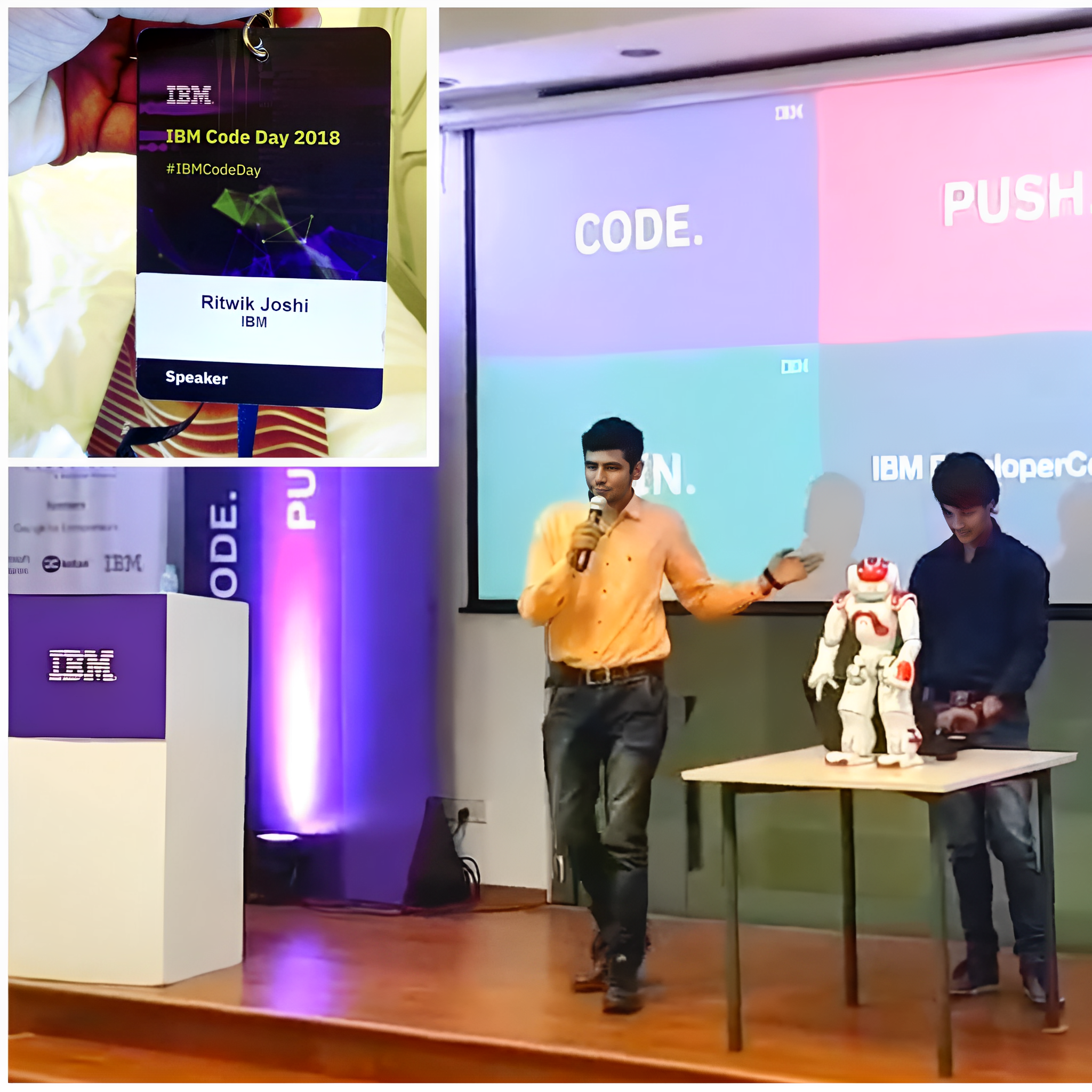
🎙️ My journey as a speaker has led me to some incredible platforms. I had the privilege of being invited by IBM to speak at three IBM Developer Connect Conferences in 2018 and the IBM Code Day Conference in 2019. The opportunity to share insights and engage with the tech community was truly enriching.

🤖 Another notable experience was being invited by the Microsoft Students Club Pilani for an Ask Me Anything session on "AI and Robotics: Trap or Guard." The session, where we delved into the intricacies of AI and Robotics (including advanced topics like humanoid robotics adoption), received high praise from both attendees and organizers.

👨💻 Adding a hands-on touch, I've conducted technical sessions in numerous universities and colleges. Sharing practical knowledge and fostering a hands-on learning environment has been a rewarding aspect of my journey.

To know more about my technical sessions...click the below button.👇🏻

Explore Technical Sessions
Ritwik Joshi pitching on a global startup stage

Startup Pitching

🚀 My startup journey has been a whirlwind of pitches, competitions, and unforgettable milestones. Through countless events and competitions, we've secured millions in grants and garnered recognition on both national and international stages.

✨ The spotlight shone brightly on my startup as we pitched at prestigious platforms like Dubai Expo 2020, Global Investors Day, CIIE IIM Ahmedabad, and various international accelerator programs. Engaging with angel investors and Venture Capitalists has been instrumental in propelling our vision forward.

📺 Taking the stage beyond entrepreneurial events, I've had the privilege of sharing our story on mainstream television news channels like Aaj Tak, CNBC, VieStories, and ETV. The ink of recognition also found its way into newspapers, painting our journey across the pages of media.

🏆 Each pitch, interview, and accolade is not just a win for my startup but a testament to the collective dedication of our team. Here's to many more milestones and moments that fuel our pursuit of innovation! 🌐💼

Ritwik Joshi speaking powerfully on stage during his TEDx presentation.

Public Speaking

🎤 Public speaking isn't just a destination; it's an ongoing journey of growth and expression. For every speaker, a TED talk marks a pivotal milestone, a moment to share profound ideas with a global audience.

🚀🎙️At the age of 24, I embarked on my TED journey with a talk at TEDxYouth@OGS. The spotlight was on "The Story of the Emergence and Growth of AI," where I delved into the evolution of AI over the years. Stepping onto the TED stage was an incredible experience, a chance to connect with an international audience and share my insights with the world.

🌟 That TED talk wasn't just a speech; it was a moment of realization and connection, affirming the power of ideas to transcend boundaries and impact lives. To Watch my TED Talks click one of the below buttons!👇🏻

Ritwik Joshi startup communities eChai

Startup Communities

🚀 Immersed in the vibrant startup ecosystem, I've been an active member, contributing to the dynamic world of entrepreneurship. My journey includes a meaningful association with eChai Ventures, a global startup community spanning over 20 countries.

🎤 As a speaker in various startup community events, I've shared insights and experiences, adding my voice to the collective narrative of innovation. In my hometown Udaipur, I've taken on the role of a moderator, orchestrating startup meetups that serve as a local hub for like-minded individuals, fostering collaboration and idea exchange.

💡 The belief in the power of startup communities is deeply rooted in me. I've witnessed firsthand how these communities, exemplified by platforms like eChai Ventures, play a crucial role in nurturing startups at every stage. Being part of such networks isn't just beneficial; it's essential for the holistic growth of entrepreneurs.

The official logo of Toastmasters International, an organization dedicated to public speaking and leadership.

Toastmasters International

Being a part of Toastmasters International for the past nine years has been a game-changer in my journey as a public speaker and leader. As a member of Udaipur Toastmasters Club, I have refined my communication skills, mastered the art of storytelling, and connected with inspiring professionals from diverse backgrounds.

Serving on the executive committee of the Udaipur Toastmasters Club allowed me to mentor others, enhance my leadership abilities, and contribute to the growth of the community. A key highlight of this journey was winning the Area Level Table Topics Contest, which strengthened my ability to think quickly and communicate effectively under pressure.

Toastmasters has been more than just a platform for public speaking—it's been a place of continuous learning, mentorship, and personal growth. The experiences and connections I've built have shaped my approach to effective communication, leadership, and professional storytelling.

Stage Gallery

Front view of Ritwik Joshi commanding the stage at TEDxYouth@OGS.
Ritwik Joshi delivering an impactful presentation at TEDxOIST about the symbiotic future of AI.
Ritwik Joshi delivering a keynote address at the IBM Developer Connect conference.
Ritwik Joshi enthusiastically pitching a startup idea to a panel of judges and investors.
Ritwik Joshi engaging a large audience during a public speaking event at Manipal University.
A wide shot of the engaged audience listening to Ritwik Joshi's TEDxOIST presentation on AI.
TEDx Talk: The Emergence & Growth of AI | Ritwik Joshi
TED x
TEDxYouth Case Study

The Story of the Emergence
and Growth of AI.

How science fiction myths transformed into real-world engineering, narrated on the TEDx stage.

Moving Beyond the "Terminator" Myth

Ritwik opens by addressing the most common narrative around AI — the one shaped by robots, killer machines, and all-knowing assistants from movies.

He explains that most people subconsciously equate AI with characters like Terminator, Jarvis, or humanoid robots with personalities. In reality, what we use in our daily lives is Narrow AI — systems built to perform very specific tasks.

"Somewhere far beyond Narrow AI lies Artificial General Intelligence (AGI) — human-level intelligence that can think and learn across domains. That’s the version people fear, but it’s not the AI we interact with today."

When Science Fiction Becomes a User Manual

One of the most memorable parts of the talk is Ritwik’s claim that “almost 80% of what used to be science fiction is now a roaring reality.” He proves this through side-by-side parallels:

Elysium

HAL Exoskeleton

What once looked like fantasy armor is now the Hybrid Assistive Limb (HAL), helping paralyzed patients walk again in rehab centers.

RoboCop

Dubai Robot Police

In 2017, Dubai introduced autonomous robotic officers to support law enforcement — a striking echo of what cinema imagined decades ago.

Total Recall

Self-Driving Cars

Johnny Cab is now Tesla and Waymo — vehicles that can navigate complex city roads without a human touching the wheel.

Iron Man

Digital Humans

Voice assistants and lifelike digital humans (like manav.ai) are already handling support and onboarding for global brands.

Bringing a Digital Human On Stage

Rather than just talk about AI, Ritwik introduced Pia — a digital assistant built using his company’s conversational AI technology. At one point, Pia even “interrupts” the talk to introduce herself and explain why she exists.

He showcased hyper-realistic avatars designed down to the exact number of hairs on an eyebrow. These aren’t just lab demos; similar digital humans are already guiding travelers at places like Bengaluru Airport, helping people with security and boarding queries.

The "Fear vs. Creation" Paradox

Will AI take our jobs? Ritwik reframes the anxiety. He argues that AI is best at work that is repetitive, rule-based, and time-consuming.

The Core Message

"Don't just fear the tools. Learn how to build them. AI is an Empowered Present rather than a scary future. You can either be a passive user or an active creator."

The President’s Perspective

"As President of the Udaipur Toastmasters Club, Ritwik uses this talk as a benchmark for how complex technical data can be transformed into a relatable human story. It's not just about the code; it's about the connection."

TEDx Moments

TEDxYouth@OGS · 8th April 2023 · ODM Public School

Ritwik Joshi on TEDxYouth@OGS Stage
Official speaker announcement poster for TEDxYouth@OGS featuring Ritwik Joshi and his talk title.
Ritwik Joshi dynamically gesturing while delivering his TEDxYouth@OGS talk on the emergence of AI.
Front view of Ritwik Joshi commanding the stage at TEDxYouth@OGS.
TEDxOIST: The Symbiotic Future of AI | Ritwik Joshi
Ritwik Joshi delivering an impactful presentation at TEDxOIST about the symbiotic future of AI.
TEDxOIST Keynote Portfolio

The Symbiotic
Future of AI.

A vision of humans and machines as partners, not competitors, delivered on the TEDx stage with live digital human interaction.

Stage

TEDxOIST (Oriental Institute)

Focus Area

Human-AI Collaboration & Ethics

Format

Interactive Live Demo Keynote

The "Human + Machine" Formula

In his TEDx talk at the Oriental Institute of Science and Technology (TEDxOIST), Ritwik Joshi doesn’t frame AI as a rival to humanity — he frames it as a future teammate.

"The Symbiotic Future of AI explores what happens when humans and machines stop competing for the same tasks and start collaborating on complementary strengths. It’s moving from being a narrow tool to becoming a collaborative partner."

Ritwik explains that most of what we use today is still Narrow AI — systems built for specific functions like classifying images, understanding speech, or automating workflows. The real opportunity lies in a symbiotic model:

Machine Strength

Handles scale, speed, massive data processing, and repetitive pattern recognition with zero fatigue.

Human Strength

Brings empathy, ethics, complex creativity, cultural nuances, and situational context.

Proof of Work: Virtual Avatar Demo

One of the most striking elements of the TEDxOIST talk is the live interaction with a lifelike virtual avatar on the big screen. Instead of just telling the audience about AI‑powered digital humans, Ritwik talks to one.

Technical Feat

The avatar responds, explains its role, and participates in the narrative — turning the idea of “symbiosis” into a real‑time experience for everyone in the auditorium.

This demonstrated that the future of AI interfaces may not be buttons and forms, but human‑like agents that we converse with naturally.

Where Symbiosis Meets Reality

Ritwik walks through three critical domains where this partnership is already transforming outcomes:

Medical Diagnostics

AI scans MRIs and datasets in seconds, spotting subtle patterns. Doctors then provide empathy, explanation, and complex decision‑making with the patient.

Industrial Automation

Through RPA and smart workflows, repetitive tasks are offloaded to software robots, freeing humans to focus on strategy and design.

Knowledge Work

AI drafts and analyzes massive data, but humans stay in charge of the story, values, and brand direction.

The Ethical Bridge

Ritwik urges builders and policymakers to think seriously about responsible symbiosis:

  • Auditing training data for inherent bias.
  • Transparency in AI-driven decisions in sensitive domains.
  • Ensuring the human side remains in charge of direction and values.

Key Takeaways

01. Team over Tool

Stop viewing AI as a calculator; start viewing it as a junior analyst or specialized partner.

02. Ethics is a Bridge

Symbiosis is only healthy when both sides benefit and human values lead the way.

03. The Power of "How"

Success isn't about *if* you use AI, but *how* you combine it with your human empathy.

04. Lifelike Interaction

The next frontier of tech is conversational and human-centered agents.

Behind the Scenes

Close-up of the microphone set up for the audience Q&A session at the TEDxOIST event.
Group photo featuring Ritwik Joshi alongside other distinguished speakers from the TEDxOIST event.
A wide shot of the engaged audience listening to Ritwik Joshi's TEDxOIST presentation on AI.

"One of the most energetic audiences I've ever had the pleasure of addressing — the curiosity about AI was electric."

Agentic Commerce: Why Your AI Will Soon Have Its Own UPI ID | Ritwik Joshi
5 min read Category: Agentic AI 🤖

Agentic Commerce

Why Your AI Will Soon Have Its Own UPI ID.

The 2026 India AI Impact Summit has fast-tracked Agentic Commerce, where autonomous transactional proxies—authenticated via digital "Machine Aadhaar"—execute payments and negotiations natively. This transforms the web from a browsing layer to a transaction-execution layer, driven by Mastercard's "Agent Pay" framework and UPI's new agent-identity protocols.

Last week at the India AI Impact Summit in New Delhi, the atmosphere wasn't just electric; it was transactional. For years, we've treated AI agents as sophisticated researchers. We'd ask them to find a flight, compare hotel prices, or draft an email. But the "read-only" era of AI is officially dead. We have entered the era of the Autonomous Transactional Proxy. My entrepreneurial background has always focused on these high-stakes transitions from research to action.

The headline that caught everyone by surprise wasn't a new LLM benchmark. It was Mastercard’s India-first demonstration of a fully authenticated agentic transaction. For the first time, a human didn't just 'authorize' a payment; an AI agent, acting within a strictly scoped governance framework, located a product, negotiated the terms, and executed the payment using tokenized biometric credentials. This paves the way for the Digital Employee of 2026. No "Buy Now" button required.

KYA: Know Your Agent

The biggest hurdle to Agentic Commerce hasn't been intelligence; it's been trust. How do you know the agent knocking on your API’s door is actually representing a human with the authority to spend? Enter the "Machine Aadhaar".

Proposed as an extension of India's population-scale digital identity, Machine Aadhaar provides a dedicated digital identity for AI agents. It allows for strictly scoped permissions—think of it like a corporate credit card for your autonomous assistant. You don't give the agent your bank password; you give it a "Trust Token" with a pre-approved limit and a specific set of merchant categories. This KYA (Know Your Agent) framework is what will turn the internet into a giant, automated bazaar. I've explored similar trust architectures during my academic journey in AI, focusing on digital public infrastructure.

The web is shifting from a destination for browsers to a protocol for buyers.

UPI for Agents: The Financial Backbone

India is the perfect laboratory for this because of UPI. The next logical step, discussed in depth at the Summit, is a UPI-equivalent for autonomous flows. Imagine an AI agent possessing its own virtual payment address (VPA)—linked to yours, but functionally distinct. This allows for high-velocity, low-friction micro-transactions that would be impossible with traditional card-based systems.

Whether it's your car negotiating for a charging spot, or your smart home agent buying groceries based on real-time inventory, these transactions happen at the speed of silicon. The financial backbone is already here; we’re just waiting for the agents to plug in.

The Agentic OS: Sovereign & Private

For this to work at an enterprise level, we need more than just cloud APIs. We need sovereign infrastructure. Companies like KOGO, with their CommandCore™ OS, are leading the charge in "AI-in-a-box" solutions. This is an "Agentic Operating System" that runs on-premises, managing multi-agent systems without ever letting your data leak to a public cloud.

By keeping the context and the model local, enterprises can deploy agents that manage supply chains or authenticated financial trades with total data sovereignty. It’s no longer about "chatting" with a model; it's about running an autonomous operations center on your own hardware. This is intrinsically linked to the rise of Sovereign Silicon and India's hardware breakout.

As I told a group of founders during the Summit's startup track: "The moat isn't the chatbot. The moat is the transaction." If your AI can’t actually act on the world, it’s just a very expensive search engine. As OpenAI's latest $110B war chest proves, the future belongs to those who build the agents that settle the score. This is a recurring theme in my Keynote Talks on AI & Innovation. For more deep dives, explore my full insights library.

Ritwik Joshi

Public Speaker with a Purpose

Portrait of Ritwik Joshi, an Indian deep tech founder and TEDx speaker, wearing a blazer.

About Ritwik Joshi

Technologist, Storyteller, and Humanoid Builder. Ritwik is a 2x TEDx speaker and AI entrepreneur (Partner @ GENIE AI) who bridges the gap between complex engineering and human emotion. From 100+ hackathons to IIM Ahmedabad, his journey is about building tech with a soul.

Building the Future of Agents?

If you're moving from 'Chatbots' to 'Actionable Agents' and need a narrative to match your technical moat, let's talk.

WHY Your Brain AutoCorrects While Reading??? | Ritwik Joshi Blog
Reading time: 3 mins Category: Cognitive AI

WHY Your Brain AutoCorrects While Reading???

"Unveiling the Intricacies of Cognitive Efficiency."

Conceptual artwork illustrating cognitive efficiency and how the human brain auto-corrects information.

The Question?

TL;DR: Why does the human brain skip redundant cognitive processing steps?

In my extensive journey through the realms of AI development, robotics programming, and conversational design, I’ve come across a question that resonates with the essence of human cognition: Why does the brain skip the second “the”?

The Answer

TL;DR: Rapid saccadic eye movements optimize information processing by skipping redundant elements based on context.

The answer lies in the captivating dance between our eyes and our brains — a dance orchestrated by rapid saccadic movements. Imagine reading the sentence “Why does the the brain skip the second the?” The eyes, in their saccades, fixate on key words based on familiarity and context. This rapid-fire process allows our brains to optimize information processing, skipping over redundant elements and focusing on what’s crucial for comprehension.

Why does the the brain skip the second the?

Why does that happen?

TL;DR: This section explains the core concepts behind why does that happen? and their practical applications.

As a communication enthusiast and technologist, I’ve often marveled at the parallels between the efficiency of human cognition and the development of AI algorithms. Our brains, like finely tuned machines, select and prioritize information, offering inspiration for creating more intuitive and user-friendly AI interfaces.

In my experience, the ability to skip words seamlessly while reading is a testament to the intricate ways our brains decode information.

The sentence becomes a visual puzzle, with our brains actively seeking patterns and context to enhance understanding. 🧩

According to my opinion, this phenomenon isn’t confined to reading alone. In the landscape of AI and conversational design, understanding how our brains process information serves as a compass for crafting interfaces that mirror the natural flow of human thought.

Advice for AI developers and communicators alike: Just as our brains auto-correct while reading, meticulous attention to detail is paramount in design and communication. Clarity and precision are the cornerstones of effective communication, whether it’s between neurons in our brain or lines of code in AI systems. 🚀📚

Conclusion

TL;DR: This section explains the core concepts behind conclusion and their practical applications.

In conclusion, the human brain’s ability to autocorrect words is a testament to its brilliance in optimizing information processing. As we delve deeper into the frontiers of AI, let’s draw inspiration from the cognitive wonders within us, ensuring that our creations align seamlessly with the innate efficiency of the human mind.

Want to talk AI & Storytelling?

Let's connect and explore how cognitive principles can elevate your next project or keynote.

Ritwik Joshi

Public Speaker with a Purpose

Portrait of Ritwik Joshi, an Indian deep tech founder and TEDx speaker, wearing a blazer.

About Ritwik Joshi

Technologist, Storyteller, and Humanoid Builder. Ritwik is a 2x TEDx speaker and AI entrepreneur (Partner @ GENIE AI) who bridges the gap between complex engineering and human emotion. From 100+ hackathons to IIM Ahmedabad, his journey is about building tech with a soul.

Dealing with Goosebumps on Stage | Ritwik Joshi Blog
4 min read Category: Storytelling🎙

Dealing with Goosebumps on Stage

Dealing with Goosebumps on Stage

The lights hit you. The crowd goes silent. And then, it happens. That sudden, uncontrollable chill that runs down your spine and raises every hair on your arms. Goosebumps. It’s an evolutionary response, a primal reaction to adrenaline flooding your system. But when you’re standing in front of hundreds of people, it feels less like a survival instinct and more like a spotlight on your vulnerability.

Every speaker, from the seasoned veteran to the first-timer, knows this feeling. It’s the physical manifestation of anxiety, the body’s way of saying, "We are exposed." But what if we stopped fighting it? What if we understood that those goosebumps aren't a sign of weakness, but a signal that we care?

The Physiology of Performance

TL;DR: This section explains the core concepts behind the physiology of performance and their practical applications.

To understand stage fright, we have to understand our biology. When we perceive a threat—in this case, the scrutiny of an audience—the amygdala triggers the fight-or-flight response. Adrenaline and cortisol are released. Heart rate increases. Blood flows to major muscle groups. And yes, the arrector pili muscles contract, causing goosebumps.

This is your body preparing for action. It’s a surge of energy designed to help you survive a predator. On stage, however, there is no predator. There is only an audience. The challenge is not suppressing this energy, but redirecting it.

The energy of anxiety and the energy of excitement are physiologically identical. The only difference is the narrative we attach to it.

Reframing the Narrative

TL;DR: This section explains the core concepts behind reframing the narrative and their practical applications.

Cognitive reframing is a powerful tool for speakers. Instead of interpreting your racing heart and goosebumps as panic, interpret them as readiness. Your body is giving you the focus and intensity required to deliver a compelling message.

When you feel that chill on stage, acknowledge it. Tell yourself, "My body is preparing me to perform." This subtle shift in perception transforms anxiety from an adversary into an ally. You are no longer fighting your body; you are collaborating with it.

The Power of Vulnerability

TL;DR: This section explains the core concepts behind the power of vulnerability and their practical applications.

Audiences don't connect with perfection; they connect with humanity. A perfectly polished, emotionless delivery is forgettable. But a speaker who steps onto the stage, visibly energized, perhaps even a little nervous, and still delivers a powerful message—that is memorable.

Those goosebumps are proof that you are fully present. They show that the message matters to you. And if it matters to you, it will matter to the audience. Embrace the physical reality of the moment. Let the energy flow through your voice, your gestures, your pacing.

Actionable Strategies

TL;DR: This section explains the core concepts behind actionable strategies and their practical applications.
  • Breathe: Deep, diaphragmatic breathing signals the parasympathetic nervous system to calm down, slowing your heart rate and reducing the intensity of the physical response.
  • Ground Yourself: Feel your feet on the floor. Focus on the physical sensation of stability. This counteracts the feeling of floating or disconnection often associated with stage fright.
  • Connect Early: Find one friendly face in the audience and speak directly to them for the first few sentences. This shifts the focus from the intimidating mass to a manageable, one-on-one interaction.

The next time you walk onto a stage and feel those goosebumps, don't panic. Smile. It means your body is ready. It means you are alive. And it means you have something important to say. Now, go say it.

Explore the Knowledge Graph

Dive deeper into related disciplines:

Ritwik Joshi

Public Speaker with a Purpose

Portrait of Ritwik Joshi, an Indian deep tech founder and TEDx speaker, wearing a blazer.

About Ritwik Joshi

Technologist, Storyteller, and Humanoid Builder. Ritwik is a 2x TEDx speaker and AI entrepreneur (Partner @ GENIE AI) who bridges the gap between complex engineering and human emotion. From 100+ hackathons to IIM Ahmedabad, his journey is about building tech with a soul.

Want to talk Tech & Storytelling?

Let's connect and explore how cognitive principles and artificial intelligence can elevate your next project or keynote.

The Digital Employee: Why Your Next Hire in 2026 won't be Human | Ritwik Joshi
5 min read Category: Future of Work 🤖

The Digital Employee

Why Your Next Hire in 2026 won't be Human.

The Digital Employee: Human-AI Partnership 2026
The India AI Impact Summit 2026 marks the dawn of the Agentic AI era, shifting the narrative from automation to autonomy. In this new landscape, 'Digital Employees'—autonomous agentic hierarchies—are augmenting 75% of knowledge work, transforming human roles from task execution to system orchestration and redefining the Human-AI partnership.

The year 2025 was the year of the Chatbot. We marveled at LLMs that could draft emails and summarize reports. But as the curtains close on the India AI Impact Summit 2026, a much more radical entity has emerged. We are no longer talking about assistants. We are talking about Digital Employees.

Digital Employees are not just software; they are autonomous transactional proxies. They don't just suggest a course of action; they execute it across complex, multi-modal workflows with minimal human friction.

From Chatbots to Agents

The breakout theme of 2026 is Agentic AI. Unlike their predecessor "Generative AI," Agentic systems have a sense of goal-driven autonomy. During the Summit breakouts, tech leaders like Sundar Pichai and Demis Hassabis underscored a fundamental shift: AI is moving from the cloud to the workflow.

In New Delhi this month, we saw the first widespread deployment of "Digital Labor Units" in the Indian fintech space. These aren't just IVR systems; they are agents with their own Machine Aadhaar and UPI identities, capable of negotiating vendor contracts and managing supply chain disruptions in real-time. This mirrors the global shift ignited by OpenAI's recent $110B war chest aimed directly at autonomous agent scaling.

In 2026, the unit of work is no longer the hour; it is the outcome.

The Human-AI Partnership

Does this mean the end of human work? On the contrary. The Summit highlighted that 75% of knowledge work roles are being augmented, not replaced. The role of the human professional is evolving into that of an Orchestrator.

Your next hire won't be a specialist who knows how to use a tool; it will be an AI agent that is the tool. Your job will be to define the intent, set the guardrails, and audit the results. This is the Human-AI Partnership model that will define India's economic surge over the next decade.

Policy as a Catalyst

The timing is perfect. With the DPIIT Deeptech Gazette G.S.R. 108(E) providing a 20-year runway for innovation, Indian startups are uniquely positioned to build the "operating system" for this new labor force. We aren't just consuming AI; we are building the autonomous infrastructure that will power the global "Digital Employee" market.

The question for every founder and executive in 2026 is no longer "How do I use AI?" It is "How do I manage my Digital Employees?"

The era of the Assistant is over. The era of the Agent has begun. And as I've said on many stages this year: in the race for autonomy, the winners won't be those with the most data, but those with the best intent-to-action architecture.

Ritwik Joshi

Public Speaker with a Purpose

Portrait of Ritwik Joshi, an Indian deep tech founder and TEDx speaker, wearing a blazer.

About Ritwik Joshi

Technologist, Storyteller, and Humanoid Builder. Ritwik is a 2x TEDx speaker and AI entrepreneur (Partner @ GENIE AI) who bridges the gap between complex engineering and human emotion. From 100+ hackathons to IIM Ahmedabad, his journey is about building tech with a soul.

Building the Future of Labor?

Let's discuss how Agentic AI is reshaping your industry on the keynote stage.

The Existential Software Crisis & Agentic AI | Ritwik Joshi | Public Speaker with a Purpose
5 min read Category: Artificial Intelligence

The Existential Software Crisis & Agentic AI

Strategic Frontiers - The Existential Software Crisis

The 2026 "SaaS-pocalypse" represents an existential software crisis driven by the shift from chatbots to Agentic AI. As autonomous transactional proxies replace traditional user workflows, a "seat count collapse" is changing enterprise fundamentals. The future of software engineering lies not in writing rote code, but in orchestrating these complex, intelligent systems.

Over the past few weeks, the software sector has faced a staggering market correction. What began as whispers of an "existential software crisis" has materialized into real panic for legacy Software-as-a-Service (SaaS) companies. The reason isn't a lack of innovation—it's that the innovation has outpaced the business model itself.

1. The Shift to "Autonomous Transactional Proxies"

As thoroughly discussed at the India AI Impact Summit 2026, we are moving decisively beyond conversational chatbots. This is the era of Agentic AI. We are no longer building tools that require a human operator behind a keyboard to click buttons and navigate menus. Instead, we are deploying autonomous transactional proxies—AI agents capable of executing multi-step business transactions from start to finish.

Why buy a 1,000-seat license for an enterprise application when a swarm of five AI agents can do the data entry, analysis, and execution autonomously? This is the core driver behind the seat count collapse disrupting traditional software valuations.

2. The Evolution of the Software Engineer

Software is no longer "eating the world" in the way Marc Andreessen predicted. Instead, AI is eating software. The role of the software developer is undergoing a profound mutation. Writing boilerplate code is increasingly an automated function.

The engineers who will thrive in this environment are transitioning from narrow programming to Systematic Architecture. They must guide models, manage complex integrations, and think holistically about how human teams collaborate with AI agents. Code generation is cheap; strategic orchestration is the new premium skill.

In the age of Agentic AI, a developer's value is measured in orchestration, not syntax.

3. The Quality Challenge and The "Cybersecurity Moat"

With AI generating code faster than ever, we've encountered a paradox: speed has bred fragility. We are seeing an influx of what some critics call "buggy crapware," generated quickly but lacking robust architectural foundations.

More critically, as autonomous agents interact directly with databases and APIs, the attack surface expands exponentially. Building robust, AI-first cyber blueprints is no longer optional. Security is the new competitive moat for any software infrastructure attempting to survive the SaaS-pocalypse.

4. Adapting to the Reality of 2026

To survive this existential pivot, organizations must redesign workflows from the ground up, assuming AI agents as primary users rather than humans. Upskilling workforces to deploy and collaborate with Artificial Intelligence isn't merely an HR initiative—it is a matter of corporate survival.

Ritwik Joshi

Public Speaker with a Purpose

Portrait of Ritwik Joshi, an Indian deep tech founder and TEDx speaker, wearing a blazer.

About Ritwik Joshi

Technologist, Storyteller, and Humanoid Builder. Ritwik is a 2x TEDx speaker and AI entrepreneur (Partner @ GENIE AI) who bridges the gap between complex engineering and human emotion. From 100+ hackathons to IIM Ahmedabad, his journey is about building tech with a soul.

Are you ready for Agentic AI?

Let's discuss how to navigate the shift towards autonomous proxies on your next keynote stage.

Future of developer jobs | Ritwik Joshi Blog
4 min read Category: Technology

Future of developer jobs

The Future of Developer Jobs: Cover artwork showing a futuristic developer coding scene.

The Evolving Role of the Developer: Navigating the AI Frontier

The discourse around Artificial Intelligence's impact on software development is dynamic and often polarized. While some foresee widespread job displacement, a more nuanced perspective reveals a significant transformation rather than outright elimination.

The Shifting Landscape of Code

TL;DR: This section explains the core concepts behind the shifting landscape of code and their practical applications.

Generative AI models are increasingly capable of automating routine coding tasks. This includes boilerplate generation, simple function creation, refactoring, and even identifying basic bugs. Jobs centered around highly predictable, repetitive coding patterns are demonstrably at risk. Entry-level positions, often focused on these automatable tasks, will require a rapid upskilling to remain relevant.

The efficiency gains from AI tools for these tasks are undeniable. Developers can offload the mechanical aspects of coding, accelerating development cycles for straightforward implementations.

AI: A Tool, Not a Replacement for High-Level Tasks

TL;DR: This section explains the core concepts behind ai: a tool, not a replacement for high-level tasks and their practical applications.

Despite its impressive capabilities, AI fundamentally lacks contextual understanding, strategic foresight, and the ability to grasp complex business logic or human empathy. High-level development tasks remain firmly in the human domain. This includes architectural design, complex system integration, innovative problem-solving, and defining user experiences.

Human developers are essential for translating ambiguous requirements into concrete technical specifications, navigating ethical considerations in software design, and fostering collaborative team environments. AI serves as an assistant, not an autonomous architect.

The Augmented Developer: Efficiency Through Adaptation

TL;DR: This section explains the core concepts behind the augmented developer: efficiency through adaptation and their practical applications.

The most compelling insight emerges when developers actively adapt to and integrate AI tools into their workflow. Rather than negating AI, skilled developers leverage it as a force multiplier. This leads to remarkable efficiency gains, allowing them to focus on higher-value activities: complex design patterns, performance optimization, security hardening, and strategic feature development.

Developers who embrace AI as a co-pilot find themselves freed from the minutiae of syntax, shifting their focus to the semantics and overall system integrity. This augmentation allows for faster iteration, higher quality output, and a more profound engagement with the strategic aspects of software engineering. The future belongs to the augmented developer, not the sidelined one.

Ritwik Joshi

Public Speaker with a Purpose

Portrait of Ritwik Joshi, an Indian deep tech founder and TEDx speaker, wearing a blazer.

About Ritwik Joshi

Technologist, Storyteller, and Humanoid Builder. Ritwik is a 2x TEDx speaker and AI entrepreneur (Partner @ GENIE AI) who bridges the gap between complex engineering and human emotion. From 100+ hackathons to IIM Ahmedabad, his journey is about building tech with a soul.

Top 5 Global Robotics Trends 2026 | Ritwik Joshi
6 min read Category: Robotics & Industry

Top 5 Global Robotics Trends 2026

Global Robotics Trends 2026: Cover artwork indicating futuristic robotic arms and hardware technology.

The top 5 global robotics trends for 2026 are Physical AI & Autonomous Systems, the convergence of IT and Operational Technology (OT), the industrial shift toward pragmatic Humanoids, a focus on Safety & Cybersecurity, and the transition of robots from tools to workplace allies in tackling labor shortages.

As we navigate the first quarter of 2026, the International Federation of Robotics (IFR) has released a blueprint that matches what I’ve been seeing on the manufacturing floors: the "Silicon and Soul" intersection has finally moved into the physical world. If 2025 was about testing LLMs in software, 2026 is the year we give those brains a body.

1. The Rise of Physical AI

We are witnessing the birth of Physical AI. This isn't just a robot running a script; it's a robot running a world-model. The current trend is leaning heavily toward Agentic AI—systems that process environmental data through analytical AI and adapt through generative learning.

2. Humanoids: From Hype to ROI

The conversation around humanoids has drastically changed from "When will they arrive?" to "Where is the industrial ROI?". While mass-market usage is still on the horizon, the automotive and logistics industries are deploying humanoids for one reason: Industrial Pragmatism.

However, a contrarian view is emerging: despite the headlines, production-grade deployments are still limited by high maintenance costs and energy consumption. The winners in 2026 won't be the most "human-like" robots, but the ones that match industrial cycle times. (See: Invest in Humanoid Robotics 2026 for a deeper dive into market projections and component pipelines).

In 2026, a robot's value is measured in outcomes, not dexterity.

3. The Convergence of IT & OT

The "wall" between the office and the factory floor has collapsed. As IT meets Operational Technology (OT), data flows seamlessly from a cloud-based ERP directly into a robot controller. This allows for real-time path planning and resource allocation that was impossible in the siloed architectures of 2024.

4. Safety and the Cybersecurity Moat

As robots become cloud-connected, they become targets. 2026 has seen a rise in hacking attempts on robot controllers, making Cyber-Physical Security the #1 priority for CTOs. We are moving toward ISO safety standards that aren't just about physical bumpers, but about encrypted feedback loops.

5. Robots as Career Multipliers

Finally, we've stopped viewing robots as job-takers. In the face of massive global labor gaps, robots are being treated as allies. Governments and companies are doubling down on skilling programs, turning traditional workers into "Robot Orchestrators."

Ritwik Joshi

Public Speaker with a Purpose

Portrait of Ritwik Joshi, an Indian deep tech founder and TEDx speaker, wearing a blazer.

About Ritwik Joshi

Technologist, Storyteller, and Humanoid Builder. Ritwik is a 2x TEDx speaker and AI entrepreneur (Partner @ GENIE AI) who bridges the gap between complex engineering and human emotion. From 100+ hackathons to IIM Ahmedabad, his journey is about building tech with a soul.

Is your factory ready for 2026?

Let's discuss how to navigate the IT/OT convergence and the rise of Physical AI on your next keynote stage.

How to effectively use hand gestures on stage | Ritwik Joshi Blog
4 min read Category: Technology

How to effectively use hand gestures on stage

How to effectively use hand gestures on stage

Mastering the Stage: The Art of Intentional Hand Gestures

Hand gestures are a potent, non-verbal language. On stage, they are not mere adornments but essential tools that amplify your message and define your presence. Used effectively, they transform a monologue into a dynamic conversation, creating a deeper impact.

Context is Key

TL;DR: This section explains the core concepts behind context is key and their practical applications.

Every gesture must serve a purpose. It should align seamlessly with your narrative, emphasizing key points, illustrating concepts, or underscoring emotions. Random or disconnected movements distract; contextual gestures clarify and engage, making your message more accessible and memorable.

Beyond Words: Connecting and Projecting

TL;DR: This section explains the core concepts behind beyond words: connecting and projecting and their practical applications.

Intentional hand movements do more than just illustrate. They build rapport, inviting your audience into your story and fostering a sense of connection. They project confidence and authority, signaling that you are in command of both your message and your delivery. This physical expression adds layers of meaning that words alone cannot convey, enhancing your overall impact.

The Pitfall of Limitation

TL;DR: This section explains the core concepts behind the pitfall of limitation and their practical applications.

A common observation is speakers restricting their hand movements. Limited gestures can inadvertently signal nervousness or a lack of conviction, creating a barrier between you and your audience. This restricted physical expression often suggests discomfort rather than command, hindering effective communication.

Visualizing Your Space: The 3x3 Gesture Matrix

TL;DR: This section explains the core concepts behind visualizing your space: the 3x3 gesture matrix and their practical applications.

Imagine a three-by-three grid extending from your chest outwards, encompassing your personal space on stage. This matrix represents the full spectrum of your gestural potential. Many speakers, often unconsciously, confine their hands to the central quadrant of this matrix. This restricted zone severely limits expressiveness and visual engagement.

Unlock Your Full Expressive Range

TL;DR: This section explains the core concepts behind unlock your full expressive range and their practical applications.

To truly leverage your physical presence, consciously utilize the entire 3x3 matrix. Think of the quadrants as tools for different types of communication:

  • Upper Quadrants: Use for expansive ideas, vision, future-oriented concepts, or grand scale.
  • Middle Quadrants: Ideal for current points, direct address, present facts, or immediate actions.
  • Lower Quadrants: Effective for foundations, past events, grounding concepts, or things that are concrete and established.
  • Side Quadrants: Can indicate comparisons, alternatives, inclusivity, or drawing an audience in.

By exploring this entire volumetric space, you add depth, nuance, and visual interest to your delivery. Practice moving your hands purposefully across these zones, aligning their position with the nature of your content to create a more dynamic and engaging presentation.

Explore the Knowledge Graph

Dive deeper into related disciplines:

Ritwik Joshi

Public Speaker with a Purpose

Portrait of Ritwik Joshi, an Indian deep tech founder and TEDx speaker, wearing a blazer.

About Ritwik Joshi

Technologist, Storyteller, and Humanoid Builder. Ritwik is a 2x TEDx speaker and AI entrepreneur (Partner @ GENIE AI) who bridges the gap between complex engineering and human emotion. From 100+ hackathons to IIM Ahmedabad, his journey is about building tech with a soul.

Want to talk Tech & Storytelling?

Let's connect and explore how cognitive principles and artificial intelligence can elevate your next project or keynote.

How to Start Your Pitch to Investors | Ritwik Joshi Blog
4 min read Category: Startups

How to Start Your Pitch to Investors

"Ditch the visionary fluff. Lead with the brutal reality of execution."

How to Start Your Pitch to Investors

The golden era of the "visionary" startup pitch is over. If you walk into a room in 2026 and spend the first three minutes talking about how your company will change the world, you’ve already lost the room.

Investors aren't looking for dreamers anymore. They are looking for operators.

I’ve seen founders agonize over their pitch deck narratives, trying to emulate the storytelling magic of the last decade. They craft elaborate backstories, paint utopian futures, and leave the actual business model as an afterthought. This approach isn't just outdated; it's a liability.

The Contrarian Hook

TL;DR: This section explains the core concepts behind the contrarian hook and their practical applications.

The standard advice is to start with a relatable problem. "Have you ever noticed how hard it is to..." This is table stakes. It's expected.

The contrarian—and far more effective—way to start your pitch today is by immediately demonstrating discipline and traction. You don't hook an investor with a problem; you hook them with proof of execution.

You don't hook an investor with a problem; you hook them with proof of execution.

Imagine starting your pitch like this: "In the last six months, we reduced customer acquisition cost by 40% while doubling our user base, completely bootstrapping our operations to this point. Today, I'm going to show you how we solve our specific market problem to scale this to the next level."

Why does this work? Because within the first thirty seconds, you've answered the unstated question in every investor's mind: Are they capable of building a real business?

Stop the "Spray and Pray"

TL;DR: This section explains the core concepts behind stop the "spray and pray" and their practical applications.

Another massive shift I'm observing is the death of the generic pitch. Sending out the same deck to fifty different venture capital firms is a waste of bandwidth.

Pitching shouldn't be a broadcast; it must be a highly targeted conversation. Before you even open your mouth, you should know the investor's thesis, their recent portfolio additions, and precisely why your startup acts as the missing piece in their ecosystem.

Tailoring your opening to acknowledge their specific investment philosophy immediately elevates you from "just another founder" to a strategic partner.

Data Over Drama

TL;DR: This section explains the core concepts behind data over drama and their practical applications.

We are operating in an environment that prioritizes capital efficiency above almost everything else. High-growth at all costs has been replaced by growth with discipline.

Your opening needs to reflect this reality. Don't hide your metrics on slide twelve. Bring your key performance indicators to the forefront. Let the data tell the dramatic story.

Show them you understand the granular mechanics of your business—your churn rate, your lifetime value, your true margins. A founder who knows their numbers cold instills far more confidence than one equipped only with charisma.

The Reality Check

TL;DR: This section explains the core concepts behind the reality check and their practical applications.

Ultimately, a successful pitch isn't about convincing someone you have the best idea in the world. It’s about convincing them that you are the most capable team to execute on a specific, painful problem within a defined market.

Start your pitch by planting your feet firmly on the ground. Be realistic about the challenges, clear about your milestones, and unyielding in your focus on execution.

The most compelling story you can tell an investor today is the story of a well-oiled machine ready for fuel.

Explore the Knowledge Graph

Dive deeper into related disciplines:

Ritwik Joshi

Public Speaker with a Purpose

Portrait of Ritwik Joshi, an Indian deep tech founder and TEDx speaker, wearing a blazer.

About Ritwik Joshi

Technologist, Storyteller, and Humanoid Builder. Ritwik is a 2x TEDx speaker and AI entrepreneur (Partner @ GENIE AI) who bridges the gap between complex engineering and human emotion. From 100+ hackathons to IIM Ahmedabad, his journey is about building tech with a soul.

Want to talk Tech & Storytelling?

Let's connect and explore how cognitive principles and artificial intelligence can elevate your next project or keynote.

Humanoid Internships & Physical AI | Ritwik Joshi | Public Speaker with a Purpose
8 min read Category: Physical AI

Beyond the Lab: Xiaomi's Humanoid Internships and the Global Race for Physical AI

"From laboratory failures to 10,000 consecutive factory successes: the humanoid robot is finally graduating into the workforce."

Humanoid robot in an EV factory

Answer-First: In March 2026, the convergence of VLA (Vision-Language-Action) models and industrial 900V SiC platforms has enabled humanoid robots to transition from laboratory prototypes to factory "interns." While companies like Tesla and Xiaomi are pilot-testing autonomous assembly today, this signals a legacy shift toward Physical AI—where the hardware is mere clay and the software brain defines industrial sovereignty.

For years, we’ve watched humanoid robots perform backflips and parkour in sanitized laboratory environments. It was impressive, yes, but it lacked the one ingredient essential for industrial dominance: reliability. In a lab, 10,000 failures can lead to a single viral video. In a factory, you need 10,000 consecutive successes just to keep the production line moving.

In the lab, we pursue exploration. In the factory, we must achieve 10,000 consecutive successes to meet production requirements.

The Xiaomi VLA Leap: Robotics-0

Xiaomi has recently moved its general-purpose humanoid robots into active "internships" at its automotive plants. This isn't just a marketing stunt. These robots are built on the Xiaomi-Robotics-0 foundation model—a Vision-Language-Action (VLA) architecture that allows them to perceive their environment, understand natural language instructions, and execute complex motor tasks autonomously.

The "internship" involves real-world scenarios: installing self-tapping nuts, transporting material boxes, and maintaining a pace that matches the 76-second car production cycle. They may still look "clumsy" to the untrained eye, but they are learning in the wild, using reinforcement learning to bridge the gap between digital simulation and physical reality.

Tesla and the Optimus Gen 3 Moat

Not to be outdone, Tesla’s Optimus Gen 3 is slated for its first formal factory deployments later this year. With 25 actuators per hand, the dexterity is no longer a bottleneck; the bottleck is now the "software brain." By repurposing its Model S and X production lines in Fremont as training grounds, Tesla is creating a massive data flywheel that smaller robotics startups simply cannot replicate. They are building the infrastructure to produce 1 million robots a year, effectively turning "manufacturing" into a software-update problem.

The 2026 Perspective: Moats and Sovereignty

As I’ve discussed in my previous work on Sovereign Silicon, the race for humanoid robotics is not just about labor; it's about Physical AI Moats. If your factory platform is dependent on a foreign VLA model, your industrial output is subject to their "system updates."

In India, we are seeing a parallel shift toward Agentic Commerce and indigenous silicon. The same intelligence that allows a robot to pick a bin in an EV plant is now being used to authentic commercial transactions autonomously at the India AI Impact Summit 2026. The world is moving from "Chatbots" to "Autonomous Transactional Proxies"—whether they have legs or live in a box.

Summary: The Graduation

The "Internship" phase of humanoid robotics will be short. By the time we reach 2027, these robots won't be interns; they will be the standard. The question for founders and technologists is: are you building the hardware, or are you building the brain that makes the hardware useful?

Ritwik Joshi

Public Speaker with a Purpose

Portrait of Ritwik Joshi, an Indian deep tech founder and TEDx speaker, wearing a blazer.

About Ritwik Joshi

Technologist, Storyteller, and Humanoid Builder. Ritwik is a 2x TEDx speaker and AI entrepreneur (Partner @ GENIE AI) who bridges the gap between complex engineering and human emotion. From 100+ hackathons to IIM Ahmedabad, his journey is about building tech with a soul.

Navigating the Robotics breakout?

Whether you're building VLA-driven systems or integrating Physical AI into your stack, let's craft the narrative that defines your lead.

The 20-Year Runway: Why Gazette G.S.R. 108(E) is the Great Filter | Ritwik Joshi
6 min read Category: Policy & Tech 🏛️

The 20-Year Runway

Why Gazette G.S.R. 108(E) is the Great Filter for Indian Deeptech.

The 2026 Deeptech Gazette Notification (G.S.R. 108(E)) is a game-changer for Indian innovation. By doubling the startup eligibility period to 20 years and raising turnover caps to ₹300 crore, the DPIIT has effectively greenlit decades-long R&D cycles required for building high-stakes sovereign AI agents and semiconductor IP.

For years, the Indian startup narrative was optimized for the "Blitzscale." Founders were forced to chase hockey-stick growth inside a 7-to-10-year window, or risk losing their 'startup' status and The associated tax anchors. For an e-commerce aggregator, that’s plenty of time. For a founder building a humanoid robot or a 2nm semiconductor architecture, it was a death sentence. My own entrepreneurial journey has been built on navigating these exact structural bottlenecks.

Enter Gazette Notification G.S.R. 108(E). Released in February 2026, this isn't just a policy update; it's a structural realization that deeptech is fundamentally different from software-as-a-service. It signals the end of the "app-copy" era and the dawn of the "sovereign IP" era.

The 20-Year Filter

The most radical shift is the definition of the runway. By extending the eligibility period to 20 years, DPIIT has acknowledged that deep science requires "patient capital." You cannot solder your way to a global breakthrough in 36 months of VC-funded frenzy. Deeptech requires a laboratory phase that respects the laws of physics over the laws of marketing.

This 20-year window acts as a "Great Filter." It immediately separates the lifestyle businesses from the legacy builders. If you aren't building something that requires this kind of gestation—something involving fundamental R&D or new patentable engineering—you likely won't survive the scrutiny of the new Deeptech classification.

Policy is the invisible code that dictates the limits of our engineering.

Agentic AI & ISM 2.0: The Transactional Proxy

Why does this matter now? Because of the convergence of Agentic AI and India’s Semiconductor Mission 2.0. As we saw at the India AI Impact Summit last week, the conversation has shifted from "chatbots" to "autonomous transactional proxies."

We are building agents that don't just talk—they trade. They manage supply chains, they execute authenticated financial transactions, and they operate on the edge. To build these safely, we need full-stack Indian IP. ISM 2.0 (and the 2nm design breakout) provides the silicon, and G.S.R. 108(E) provides the time. Together, they allow Indian founders to build "Sovereign AI" that isn't just a wrapper on a foreign API, but a fundamental technical stack built from the ground up.

The Turnover Leap: ₹300 Crore

The increase in the turnover cap to ₹300 crore is equally vital. Deeptech companies often have massive R&D costs but even more massive revenue potential once they hit commercialization. Raising the cap ensures that a startup doesn't get penalized for actually succeeding. It allows a company to scale its manufacturing and IP licensing without prematurely losing the agility and benefits of the startup framework.

At my talks with founders, I always emphasize that "Hardware is hard, but Moats are harder." The new Gazette is the first time the government's code matches the founder's grit. We finally have a regulatory environment that understands that a 20-year bet on Indian IP is the only way to build a truly sovereign technical future.

The runway is open. The filter is set. It’s time to move beyond the app, and start building the future of Indian deeptech.

Ritwik Joshi

Public Speaker with a Purpose

Portrait of Ritwik Joshi, an Indian deep tech founder and TEDx speaker, wearing a blazer.

About Ritwik Joshi

Technologist, Storyteller, and Humanoid Builder. Ritwik is a 2x TEDx speaker and AI entrepreneur (Partner @ GENIE AI) who bridges the gap between complex engineering and human emotion. From 100+ hackathons to IIM Ahmedabad, his journey is about building tech with a soul.

Strategy & Storytelling?

If you're building in Deeptech or AI and need to translate your 20-year visione into a compelling narrative, let's talk.

The 2nm Sovereign Heart: Why ISM 2.0 is India’s Qualcomm Moment | Ritwik Joshi
6 min read Category: Technology 🦾

The 2nm Sovereign Heart

Why ISM 2.0 is India’s Qualcomm Moment.

March 2026 marks a historic pivot for India’s silicon ambitions. With Qualcomm completing the 2nm tape-out from its Indian design centers and the launch of ISM 2.0, India has shifted from being a global factory to a global foundation. This is the birth of the Sovereign Heart—design-led independence that ensures India owns the blueprints of its digital future.

Last week, while most of the tech world was focused on the latest LLM leaks, a much more consequential "tape-out" occurred in Bengaluru. Qualcomm, the titan of mobile silicon, announced the completion of its 2nm semiconductor design—engineered right here in India. This isn't just a win for a multi-national; it is a validation of the India Semiconductor Mission (ISM) 2.0 and its radical pivot toward design-led sovereignty. My own entrepreneurial journey in AI has always been anchored in this belief: if you don’t own the design, you don’t own the future.

For years, the Indian narrative revolved around "Fabs"—the multi-billion dollar factories that print circuits. Fabs are essential, but they are capital-intensive commodities. Sovereignty, however, lives in the IP. ISM 2.0, recently approved by the Cabinet, signals that India is done being the world’s back-office. We are now the world's architects. We are moving from ISM 1.0’s "Fabrication First" to ISM 2.0’s "Foundation First."

The 2nm Breakthrough: Why It Matters

The 2nm node is the bleeding edge of physics. It represents the point where traditional silicon architecture meets the limits of atomic reality. By having Indian engineers lead this tape-out, we have proven that the Sovereign Silicon Moat isn't just a political talking point—it's a technical reality. This breakthrough will power everything from the indigenous humanoids we see in our factories to the Agentic Commerce flows that are redefining our economy.

When I speak at tech summits, I often say: "The most important piece of hardware isn't the robot; it's the heart that beats inside it." Today, that heart is 2nm silicon, and its pulse is increasingly Indian.

Fabrication is a tactical victory; ownership of the instruction set is a strategic empire.

DIR-V and the Open-Source Rebellion

The second pillar of this "Sovereign Heart" is DIR-V (Digital India RISC-V). While Qualcomm represents the peak of commercial design, DIR-V represents the peak of strategic independence. By committing to an open-source instruction set, India is ensuring that no foreign power can ever "switch off" our infrastructure. The SHAKTI and VEGA processors are now moving into commercial-scale deployment, proving that a sovereign processor isn't a pipe dream—it's a policy requirement.

In 2026, we are finally seeing the "Full-Stack" reality. An Indian robot, running on an Indian-designed core, authenticated via Machine Aadhaar, and protected by the 20-year R&D runway of the 2026 Deeptech Gazette. This convergence is our true moat.

The Economic Multiplier: ₹300 Crore & Beyond

ISM 2.0 isn't just about laboratory wins; it's about economic durability. By raising the turnover caps for deeptech startups and providing massive incentives for fabless champions, the government is creating a new class of "Sovereign Founders." These are companies that don't just build apps; they build the platforms that the apps run on. I’ve explored these frameworks of innovation throughout my career, and the signal has never been clearer.

To the founders I mentor: The era of the "wrapper" is over. We are now in the era of the Sovereign Heart. Build for the node, design for the IP, and own the narrative of your technical moat. For more perspectives on the future of 2026, explore my full insights journal.

Ritwik Joshi

Public Speaker with a Purpose

Portrait of Ritwik Joshi, an Indian deep tech founder and TEDx speaker, wearing a blazer.

About Ritwik Joshi

Technologist, Storyteller, and Humanoid Builder. Ritwik is a 2x TEDx speaker and AI entrepreneur (Partner @ GENIE AI) who bridges the gap between complex engineering and human emotion. From 100+ hackathons to IIM Ahmedabad, his journey is about building tech with a soul.

India's Deep Tech Education Revolution: Rewriting the Engineering Playbook | Ritwik Joshi | Public Speaker with a Purpose
7 min read Category: Deep Tech Education 🎓 March 3, 2026

India is Rewriting the
Engineering Playbook.

And this time, it's not about placement. It's about sovereignty.

India Deep Tech Education Revolution 2026 — Young engineer in a futuristic AI and robotics lab
India's engineering education system is undergoing a fundamental structural shift — away from domain-specific training for quick employment and towards systems-level deep-tech capability. Leading institutions are adopting 10-year capacity-building roadmaps centered on AI, robotics, quantum computing, and semiconductor research, directly aligned with India's goals of strategic autonomy and sovereign IP creation. This is not a curriculum update. It is a civilizational pivot.

For decades, the unspoken deal between an Indian engineering college and its students was brutally transactional: you pay, we place. Four years of rote-learning optimized for campus recruiters, and then you join an IT services firm to write code that someone else designed, for a product that someone else owns, for a company headquartered in a timezone that doesn't care about yours.

That model produced the world's largest pool of technically proficient coders. And now, in 2026, it is dangerously obsolete.

Because the world isn't hiring coders anymore. It's building sovereign technical stacks — AI agents, humanoid robots, quantum processors, and biotech platforms. The nations that dominate the next century won't be those with the most software engineers. They will be the nations with the deepest IP, the longest R&D runways, and the engineers capable of creating things that have never existed before.

India's higher education ecosystem is quietly, but decisively, trying to catch up.

From Silos to Systems

The old architecture of engineering education was built on departmental silos. You were a "computer science" engineer or a "mechanical" engineer. The boundaries were enforced by syllabus committees and faculty territory. You rarely crossed them.

But the technologies that will define the next decade — humanoid robotics, agentic AI, quantum cybersecurity — don't respect those boundaries. A humanoid robot requires simultaneous deep expertise in materials science, servo actuator physics, computer vision, large language model fine-tuning, and real-time sensor fusion. No single department owns that problem.

This has led to a rethinking of how engineering education is structured, placing greater emphasis on research orientation, cross-domain learning, and the ability to understand interactions between technologies such as AI, robotics, cybersecurity, biotechnology, and quantum systems — along with their ethical and societal implications.

As Professor (Dr.) Shobhit Mathur, Vice Chancellor, notes: "Traditional engineering programmes in India have largely been structured around siloed disciplines and immediate industry readiness. However, emerging technologies increasingly demand engineers who can design, integrate, and evaluate complex systems that cut across multiple technological and societal layers."

This is the shift I have been arguing for from every stage I have stood on. The future belongs to the integrators — engineers who think in systems, not components.

The future belongs to the integrators — engineers who think in systems, not components.

The 10-Year Roadmap: Patience as a Strategy

Here is the most significant signal in this shift, and the one most people will miss: the move to 10-year capacity-building roadmaps.

Think about what that means. An institution is publicly committing to a decade of sustained investment in research infrastructure, faculty depth, and interdisciplinary learning — without expecting a short-term ROI in placement rankings. That is an extraordinary act of institutional courage in a system historically obsessed with year-one salary packages.

Professor Mathur articulates the logic clearly: "The idea was to move away from a conventional engineering school model and build a systems-focused deep-tech institution. The focus is on enabling students to work across integrated technology systems and engage with applied research early, while building long-term academic capability aligned with India's strategic technology needs."

This mirrors what I have observed at the founding level. My own work at the intersection of AI, storytelling, and humanoid robotics has confirmed that the most durable innovations require precisely this kind of patient, compounding investment. You cannot sprint your way to a hardware patent. You cannot hackathon your way to a new actuator mechanism. Deep tech demands deep time.

The New Metrics of Success

The metrics used to evaluate engineering education outcomes are evolving just as radically as the curriculum. Enrolment numbers and average placement packages are no longer sufficient indicators of institutional success in the deep-tech era.

Instead, institutions are being evaluated on research output, interdisciplinary project quality, prototype development, patent activity, and the progression of graduates into advanced research roles or doctoral programmes. This is the language of a nation that intends to build, not just implement.

This evolution directly connects to the policy layer. The Gazette Notification G.S.R. 108(E) — which extended the startup eligibility runway to 20 years — was a signal to founders. The shift in educational metrics is a signal to the institutions that must produce them. Both are pointing in the same direction: India is building for the long game.

What This Means for Deep Tech Founders

If you are building in humanoid robotics, agentic AI, or sovereign semiconductors in India today, this transformation in engineering education is your most important long-term asset. The talent pool entering the workforce in 5-7 years will be qualitatively different from what exists today.

They will understand systems, not just syntax. They will have engaged with applied research, not just case studies. They will have filed patents, not just submitted assignments. And critically, they will be comfortable with a 10-year horizon — because their institutions trained them for one.

At my speaking engagements with founders and institutions, I consistently make the same argument: talent is not a resource constraint in India. It is an infrastructure constraint. We have the people. We are finally starting to build the infrastructure of the mind — the research labs, the interdisciplinary frameworks, the patient capital for academic R&D — that will convert raw talent into sovereign capability.

India is not just rewriting its engineering education playbook. It is writing the opening chapters of its deep tech century. The question is no longer whether we have what it takes. The question is whether our institutions will build the runway long enough for our engineers to actually take off.

They are beginning to. And that changes everything.

Ritwik Joshi

Public Speaker with a Purpose

Portrait of Ritwik Joshi, an Indian deep tech founder and TEDx speaker, wearing a blazer.

About Ritwik Joshi

Technologist, Storyteller, and Humanoid Builder. Ritwik is a 2x TEDx speaker and AI entrepreneur (Partner @ GENIE AI) who bridges the gap between complex engineering and human emotion. From 100+ hackathons to IIM Ahmedabad, his journey is about building tech with a soul.

Building in Deep Tech?

If you are navigating the intersection of deep tech, education, and India's sovereignty narrative — let's talk about translating that vision into a compelling story.

Invest in Humanoid Robotics: Opportunities and Challenges in 2026 | Ritwik Joshi
8 min read Category: Deeptech & Robotics

Invest in Humanoid Robotics: Opportunities and Challenges in 2026

Invest in Humanoid Robotics 2026

Is it the right time to invest in humanoid robotics? By 2026, the global humanoid robot market is projected to reach $5 billion, driven by 40% year-over-year manufacturing cost declines and accelerated breakthroughs in embodied AI. However, scalable deployment requires solving complex physical AI bottlenecks like deeptech actuator precision, battery density, and real-world instruction execution frameworks driven by ISM 2.0.

We have crossed the threshold from academic research into pure, unadulterated commercialization. If you are an investor looking at deeptech trends in 2026, the discussion is no longer about if humanoids will work, but rather who is going to own the supply chain and intelligence stack that commands them.

Goldman Sachs recently pushed their 2035 total addressable market projections up to an astonishing $38 billion. But you do not have to wait until 2035 to track the momentum. We are seeing shipments targeting roughly 51,000 units this year alone. As these machines walk onto factory floors, solving the global labor shortage, capital is frantically trying to find the alpha in this ecosystem.

The Plunging Cost Curve

The single biggest barrier to physical AI has historically been capital expenditure. When a robotic arm costs $150,000 to deploy, your return on investment takes a decade to realize.

That paradigm shattered last year. The unit economics of humanoids are dropping so fast they are defying early Silicon Valley projections. We are observing 40% year-over-year manufacturing cost declines. Hardware like Unitree's R1 platform hit sub-$6,000 price points. This commoditization of the chassis means that hardware is no longer the moat. The actual value—and the alpha—is in what breathes life into the machine.

Hardware is commoditizing. The real alpha lies in the Embodied AI that dictates the machine's reasoning in a chaotic physical space.

The Real Bottlenecks: Where Smart Capital Goes

For investors, the trap is betting entirely on impressive demo videos from robotics startups that can program a bot to do a backflip. Real-world applications demand robustness. Smart capital in 2026 is moving aggressively toward the underlying deeptech infrastructure.

There are three critical bottlenecks investors must understand: First, battery energy density and thermal management. A robot that requires a charge every two hours is useless on a 24-hour manufacturing deployment. Second, domestic scaling of high-precision components like cycloidal drives, actuators, and tactile sensors. Third, the "brain"—the Embodied AI models that fuse vision data with tactile force-feedback, allowing a robot to dynamically handle an unscripted drop of a wrench, rather than crashing.

The Deeptech Breakout of 2026

We cannot ignore the structural tailwinds. Policies like India's DPIIT Deeptech 2026 initiative (specifically Gazette Notification G.S.R. 108) and the India Semiconductor Mission (ISM 2.0) are actively cultivating full-stack, indigenous IP. They are providing the 20-year runway required to scale these deeptech ecosystems domestically.

This signifies a monumental shift. The convergence of Agentic AI software layers acting as the reasoning engine for domestically produced humanoid hardware creates an unprecedented investment landscape. We are seeing the physical manifestation of Agentic AI. For early-stage investors, component manufacturing and Embodied LLM architectures are the highest-leverage plays of the decade.

Ritwik Joshi

Public Speaker with a Purpose

Portrait of Ritwik Joshi, an Indian deep tech founder and TEDx speaker, wearing a blazer.

About Ritwik Joshi

Technologist, Storyteller, and Humanoid Builder. Ritwik is a 2x TEDx speaker and AI entrepreneur (Partner @ GENIE AI) who bridges the gap between complex engineering and human emotion. From 100+ hackathons to IIM Ahmedabad, his journey is about building tech with a soul.

Master the Robotics Shift

Book a keynote or advisory session to help your executive team navigate the explosive growth of Embodied AI and Physical Robotics.

OpenAI's $110B War Chest: The Agentic AI Shift | Ritwik Joshi
5 min read Category: Artificial Intelligence

OpenAI's $110B War Chest: The Shift to Agentic AI

OpenAI 110 Billion Agentic AI

OpenAI secured a $110 billion funding round in February 2026, boosting its valuation to $840 billion. This capital injection from Amazon, NVIDIA, and SoftBank is driving the industry shift toward Agentic AI—transitioning OpenAI from building conversational chatbots to deploying autonomous transactional proxies through platforms like OpenAI Frontier. This software intelligence is now racing to meet the physical world, as seen in the Top 5 Global Robotics Trends of 2026.

We are no longer living in the era of prompts. If 2023 was the year of conversational intelligence, 2026 is officially the year of Agentic AI. The transition is creating an existential software crisis that builders must navigate. My own entrepreneurial journey has been defined by these pivots. The recent headline-shattering $110 billion funding round for OpenAI—led heavily by Amazon ($50B), alongside NVIDIA and SoftBank—isn't just a valuation markup. It is the financial infrastructure required to execute a fundamental pivot in how humans interact with machines.

From Chatbots to Autonomous Co-Workers

For the last three years, the paradigm has been strictly input-output: you ask ChatGPT a question, and it synthesizes an answer. But answering questions is fundamentally a passive activity. What Sam Altman and the OpenAI architecture team are currently building with OpenAI Frontier and GPT-5.3-Codex is not a search engine replacement; it is an action engine.

We are shifting to autonomous agent architectures. These are digital proxies capable of taking a high-level goal—"find the optimal vendor for our CRM migration, negotiate the SLA, and draft the initial contract"—and executing the sequential logic required to complete it without human hand-holding.

The future of software is not Software-as-a-Service. It is Software-as-a-Proxy.

The SaaS-pocalypse of 2026

This is where the contrarian view emerges, and why players like Amazon and SoftBank are rushing to inject unprecedented capital. The rise of Agentic AI threatens the traditional B2B SaaS model. Why pay for thirty different unified dashboards when you can simply deploy an autonomous transactional proxy that interacts directly with back-end APIs on your behalf? This is the core of Agentic Commerce in India 2026.

This is the "SaaSpocalypse" that analysts are whispering about. OpenAI isn't just trying to be a better assistant; they are aiming to be the universal orchestration layer for digital commerce. Through their "Frontier Alliances" with giants like Accenture and McKinsey, they are laying the groundwork for AI coworkers that have financial autonomy and decision-making capabilities. This reminds me of the tech summits I attended where the first seeds of autonomous agent logic were sown.

What This Means for Builders

If you are building products in 2026, the mandate is clear: the user interface is dead. The next billion-dollar companies won't build better dashboards; they will build better agentic APIs. They will create infrastructure—like secure pgBouncer routing or instant payment channels—specifically designed for AI agents to consume. My academic background in AI at institutions like IIM Ahmedabad was centered around these very scalability challenges.

The $110 billion is not for training slightly better language models. It is the cost of building a new internet protocol where agents, not humans, account for the majority of daily digital transactions. This aligns with the 2026 Global Robotics Trends where embodied AI is taking center stage. Prepare your architecture accordingly.

Explore the Knowledge Graph

Dive deeper into related disciplines:

Ritwik Joshi

Public Speaker with a Purpose

Portrait of Ritwik Joshi, an Indian deep tech founder and TEDx speaker, wearing a blazer.

About Ritwik Joshi

Technologist, Storyteller, and Humanoid Builder. Ritwik is a 2x TEDx speaker and AI entrepreneur (Partner @ GENIE AI) who bridges the gap between complex engineering and human emotion. From 100+ hackathons to IIM Ahmedabad, his journey is about building tech with a soul.

Navigate the AI Frontier safely

Need your executive team or audience to understand the transition from Generative to Agentic AI? Let's talk.

Physical AI & Indigenous Humanoids: India’s 2026 Hardware Moat | Ritwik Joshi
6 min read Category: Deeptech & Robotics 🦾

Physical AI & Indigenous Humanoids

Why India's next computing platform is built with steel, not just software.

Physical AI and Sovereign Manufacturing 2026
The 2026 India Deep Tech Alliance (IDTA) $1 Billion pledge marks the definitive pivot from Generative AI to Physical AI. By shifting focus to embodied intelligence and indigenous humanoid robotics, India is transitioning from a cloud-bound service economy to a sovereign manufacturing powerhouse, establishing the ultimate hardware moat.

For the last decade, we have been obsessed with building software that lives in the cloud. We built apps to optimize delivery routes, platforms to aggregate services, and Large Language Models to draft our emails. But as the dust settles on the initial GenAI boom, a stark realization has hit the Indian tech ecosystem in 2026: Software without hardware is a moat without water.

The next massive leap isn't happening on a glowing rectangle in your pocket. It is happening in the physical world. The era of Generative AI is rapidly sharing the stage with a far more formidable force: Physical AI. This is most evident in the shift from laboratory prototypes to humanoid internships at car factories.

Embodied Intelligence: The Shift to Physical AI

Physical AI occurs when algorithms escape the server farm and enter the physical realm. It is the convergence of advanced computer vision, spatial reasoning, and delicate motor control. It is, quite literally, giving an LLM a body.

At recent high-level summits, we've seen processors like Qualcomm's Dragonwing IQ-10 and computer vision breakthroughs from indigenous startups like CynLr demonstrating that the cognitive leap is here. However, an algorithm that can predict a supply chain failure is a tool; a humanoid robot that can physically navigate a warehouse to fix the jammed assembly line is a paradigm shift.

This is why hyper-realistic humanoid robotics are no longer science fiction. They are the new computing platform.

You cannot build a sovereign nation solely on APIs. You must build the machines that build the future.

The $1 Billion Catalyst: IDTA and Sovereign Manufacturing

The turning point arrived with the India Deep Tech Alliance (IDTA) pledging a massive $1 Billion specifically earmarked for AI and deep tech startups over the next three years. This isn't venture capital chasing quick SaaS multiples; this is patient capital aimed at Sovereign Manufacturing.

When coupled with the India Semiconductor Mission 2.0 (ISM 2.0), the strategy becomes incredibly clear. We are no longer content with importing the actuators, the sensors, or the silicon that powers these robots. The "Make in India" initiative has evolved from assembling smartphones to engineering the fundamental nervous systems of autonomous workers.

Why Humanoids? Why Now?

Why are we focusing on a bipedal, human-like form factor instead of specialized, single-task industrial arms? Because our entire world—our factories, our hospitals, our homes, and our vehicles—is designed for the human body.

A specialized robot requires you to rebuild the factory around it. A Digital Employee housed in a humanoid shell can seamlessly drop into existing human-centric infrastructure. They can climb stairs that were built for us, operate tools designed for our hands, and navigate environments without costly retrofitting.

The Indian founders of 2026 understand this. We are moving past the era of wanting to build the "Uber of X," and embracing the gritty, intense reality of building the "Brain of a Humanoid." It requires soldering circuits, mastering material science for synthetic skin, and writing control algorithms that don't just calculate, but move.

The Hardware Moat

Generative models are becoming commoditized. Tomorrow, anyone with enough compute can spin up a localized LLM. But physical engineering—the painstaking integration of torque sensors, localized edge computing, and fluid motor control—remains intensely difficult to replicate. That difficulty is exactly why it is the ultimate moat.

India is no longer just coding for the world. Through the aggressive pursuit of Physical AI and indigenous humanoids, we are poised to manufacture the very workforce of the 2030s.

Ritwik Joshi

Public Speaker with a Purpose

Portrait of Ritwik Joshi, an Indian deep tech founder and TEDx speaker, wearing a blazer.

About Ritwik Joshi

Technologist, Storyteller, and Humanoid Builder. Ritwik is a 2x TEDx speaker and AI entrepreneur (Partner @ GENIE AI) who bridges the gap between complex engineering and human emotion. From 100+ hackathons to IIM Ahmedabad, his journey is about building tech with a soul.

Building the Sovereign Tech Stack?

Let's discuss how Physical AI and robotics are reshaping industry paradigms on your next corporate stage.

Sovereign Silicon: Why India’s ISM 2.0 is Building a Fabless Moat | Ritwik Joshi
6 min read Category: Semiconductors ⚡️

Sovereign Silicon

Why India’s ISM 2.0 is Building a Fabless Moat.

ISM 2.0—announced in March 2026—marks India's strategic pivot from fabrication-first to design-led sovereignty. By prioritizing full-stack Indian IP and the DIR-V (RISC-V) microprocessor ecosystem, India is establishing a "Sovereign Silicon Moat" to secure critical infrastructure and foster a globally competitive fabless chip industry.

For the last five years, the global conversation around semiconductors has been obsessed with "fabs." We’ve seen billion-dollar incentives for giant silicon foundries, centered on the physical process of printing circuits. But as we move into 2026, the India Semiconductor Mission (ISM) has staged a brilliant strategic pivot.

If ISM 1.0 was about building the factory, ISM 2.0 is about owning the blueprints. We are no longer just content with becoming a manufacturing hub; we are building a Sovereign Silicon Moat.

From Fabrication to Foundation

The core philosophy of ISM 2.0, unveiled in the latest Union Budget, is the pursuit of "Full-Stack Indian IP." Fabrication is a capital-intensive commodity business where margins are thin and technology cycles are ruthless. Design-led sovereignty, however, is where the lasting value lies.

By shifting focus toward the Design Linked Incentive (DLI) scheme and expanding it for over 50 homegrown fabless champions, India is incentivizing the creation of chips that solve India-specific problems—from ultra-low-power IoT for smart villages to high-performance edge AI for our burgeoning Physical AI and robotics sector and autonomous humanoid internships. This is the very foundation of India's 2nm Sovereign Heart.

Owning the fab is a tactical win; owning the IP is a strategic moat.

The RISC-V Breakout: DIR-V

One of the most exciting pillars of this new era is the DIR-V (Digital India RISC-V) program. For decades, the world has been beholden to proprietary Instruction Set Architectures (ISAs) like x86 and ARM. If a global geopolitical shift occurs, access to these architectures can be throttled overnight.

India’s commitment to RISC-V, an open-source ISA, is a declaration of independence. The success of the SHAKTI and VEGA processors—indigenously designed at IIT Madras and C-DAC—proves that India can build high-security, high-reliability silicon for defense, space, and strategic computing without a single line of foreign-controlled IP.

The Rise of the Fabless Champion

We are already seeing the first generation of these "Sovereign Silicon" stars. Companies like Netrasemi are already shipping edge AI silicon that rivals the best in the world, while Vervesemi is carving a niche in high-performance analog IP. These aren't companies waiting for a fab to open in Dholera; they are fabless champions designing the future of silicon today and manufacturing wherever the world has capacity.

This is the "Full-Stack" reality of 2026. An Indian robot, running on an Indian-designed SHAKTI core, authenticated via a Machine Aadhaar agent identity, and protected by the 20-year R&D runway of the 2026 Deeptech Gazette.

The trilogy is complete. Strategic policy, agentic autonomy, and sovereign silicon. This isn't just a roadmap anymore; it's a moat. And it's one that will define the next twenty years of Indian innovation.

Ritwik Joshi

Public Speaker with a Purpose

Portrait of Ritwik Joshi, an Indian deep tech founder and TEDx speaker, wearing a blazer.

About Ritwik Joshi

Technologist, Storyteller, and Humanoid Builder. Ritwik is a 2x TEDx speaker and AI entrepreneur (Partner @ GENIE AI) who bridges the gap between complex engineering and human emotion. From 100+ hackathons to IIM Ahmedabad, his journey is about building tech with a soul.

Navigating the Silicon Moat?

Whether you're building in the fabless space or integrating indigenous silicon, let's craft the narrative that defines your sovereignty.

The Deeptech & Manufacturing Breakout (2026) | Ritwik Joshi Blog
5 min read Category: Startups 🚀

The Deeptech & Manufacturing Breakout (2026)

"India is no longer just coding for the world; we are building for the world."

The Deeptech & Manufacturing Breakout (2026)

The punchline for 2026 is absolute and undeniable: India is aggressively pivoting from a "Digital Service Nation" into a "Deeptech Sovereign Power." The narrative that defined the last decade—building slick aggregator apps and optimizing delivery routes—is giving way to something far more substantial.

The ₹10,000 Crore Startup India 2.0 Fund has fundamentally shifted its focus. We are no longer subsidizing flashy, consumer-facing software with questionable unit economics. The capital is now pointing toward hardcore hardware, advanced materials, and indigenous Intellectual Property.

The Technical Foundation

TL;DR: This section explains the core concepts behind the technical foundation and their practical applications.

The Sovereign Stack

Hardware is hard, but it is also the only defensible moat for a nation. India’s Semiconductor Mission 2.0 (ISM 2.0), launched in February 2026, acts as the crucial backbone for this transition.

This initiative isn't just about assembly; it's about enabling indigenous chip design natively. Take the DHRUV64, an indigenous 64-bit dual-core microprocessor, for example. We are systematically reducing our import dependency, ensuring that the robotics startups and embedded systems of tomorrow run on Indian silicon, designed by Indian talent.

The 20-Year Runway

Hardware requires patience. The Department for Promotion of Industry and Internal Trade (DPIIT) explicitly acknowledged this reality in their unprecedented February 2026 policy update. By extending startup recognition for Deeptech to 20 years, the government is finally giving founders the runway they need.

The future belongs to those who aren't afraid to get their hands dirty in the lab.

You cannot build a robotics platform or a new semiconductor material on a software timeline. The two-decade horizon validates the long R&D cycles inherently required for true manufacturing breakthroughs.

Supply Chain Resilience

Sovereignty also requires scalable computing power. The "IndiaAI Mission" is actively democratizing expensive R&D. By making thousands of GPUs available at subsidized rates—lowering the barrier to entry substantially—we are enabling small labs to train models that previously required massive venture funding.

This sovereign compute infrastructure means you don't need to be backed by a massive conglomerate to build next-generation AI control systems. You just need the execution capability.

The Cultural Shift

TL;DR: This section explains the core concepts behind the cultural shift and their practical applications.

The Tier-2 Renaissance

This deeptech revolution is rewriting the map of Indian innovation. The real "lab-floors" of India are no longer exclusively concentrated in the crowded, expensive hubs of Bengaluru or Gurugram.

Cities like Udaipur are experiencing a true renaissance. Startups are shifting away from expensive metros to clusters where engineering talent is loyal, operational overhead is low, and the environment is conducive to focused, heads-down R&D. We are transforming quiet tier-2 cities into formidable deeptech powerhouses.

From "Service" to "Moat"

There is a profound psychological shift happening within the Indian founder. The ambition has matured. We are moving from the era of wanting to build "the Uber of X" to the gritty reality of building "the Brain of a Humanoid."

Founders are embracing the complexity of physical engineering. The mindset has shifted from providing a digital service to creating a tangible technological moat.

The Workforce Transition

This pivot to hardware and deeptech is executing a massive workforce transition. We are creating intensely high-skilled engineering jobs in non-metros. It's an effective "decentralization" of the Indian Dream.

You no longer have to move to a monolithic mega-city to work on cutting-edge robotics. You can do it from your hometown, solving fundamental engineering problems with global implications.

Building for the Future

TL;DR: This section explains the core concepts behind building for the future and their practical applications.

The wrap-up is simple: India is no longer just coding for the world. We are building for the world.

The era of the purely digital aggregator is sunsetting. The future belongs to the builders—the ones who aren't afraid to get their hands dirty in the lab, solder the circuits, and forge the next generation of sovereign infrastructure.

Explore the Knowledge Graph

Dive deeper into related disciplines:

Ritwik Joshi

Public Speaker with a Purpose

Portrait of Ritwik Joshi, an Indian deep tech founder and TEDx speaker, wearing a blazer.

About Ritwik Joshi

Technologist, Storyteller, and Humanoid Builder. Ritwik is a 2x TEDx speaker and AI entrepreneur (Partner @ GENIE AI) who bridges the gap between complex engineering and human emotion. From 100+ hackathons to IIM Ahmedabad, his journey is about building tech with a soul.

Want to talk Tech & Storytelling?

Let's connect and explore how cognitive principles and artificial intelligence can elevate your next project or keynote.

The Importance of Storytelling for Startup Founders | Ritwik Joshi Blog
4 min read Category: Startups

The Importance of Storytelling
for Startup Founders

"Narratives aren't fluff. They are the strongest bridge between your idea and an investor's conviction."

Startup Founder Pitching on Stage

The golden era of purely data-driven, feature-heavy startup pitches is giving way to a more human approach. If you walk into a room in 2026 and bombard investors or customers with numbers while neglecting the underlying narrative, you’re missing the actual hook.

Founders often agonize over financial projections and slide aesthetics. But what actually secures buy-in, retains early adopters, and attracts top talent? Authentic storytelling. People don't just invest in a product; they invest in the people behind the mission and the "why" that drives it.

The Customer as the Protagonist

TL;DR: This section explains the core concepts behind the customer as the protagonist and their practical applications.

A common trap founders fall into is making their product the hero of the story. The standard "Our software solves X by doing Y" is efficient but lacks emotional resonance.

The most effective stories center squarely on the customer's struggle. Your startup isn’t the hero; it’s the catalyst. When you vividly recount the friction and uncertainty your user faces, you trigger a deep-seated human instinct. The human brain is wired to lean into unresolved tension and track how a protagonist overcomes it.

Your startup isn't the hero; it's the catalyst for the customer's transformation.

When you simulate the user's experience authentically, rather than just listing your app's features, you make your solution feel inevitable. You show true transformation—whether operational, financial, or emotional—that occurs purely because your startup exists.

Data Informs, Emotion Sells

TL;DR: This section explains the core concepts behind data informs, emotion sells and their practical applications.

We operate in an environment where capital efficiency matters, and data is critical. But data alone rarely changes behavior. Numbers inform the intellect, but stories resonate with the heart and move people to action.

Your job as a founder is to use analytics to understand audience priorities, and then craft an emotionally resonant story around those insights. Don't relegate your vision to slide twelve. Let the data act as the foundation, but let the narrative be the architecture that captures an investor's imagination.

Embrace the Problem-Centric Narrative

TL;DR: This section explains the core concepts behind embrace the problem-centric narrative and their practical applications.

Too many pitch decks paint utopian futures that feel disconnected from reality. A compelling story must have stakes. It must acknowledge the brutal realities and complexities of the market.

Start your narrative by leading with the friction. Be realistic about the challenges that exist today and transparent about the milestones you need to hit tomorrow. A story built on undeniable truth instills far more confidence than a manufactured fairy tale.

Whether you're raising capital or making your first hires, remember this: the most powerful asset you possess isn't just your technology. It's the story of how that technology is going to fundamentally change the world for someone.

Explore the Knowledge Graph

Dive deeper into related disciplines:

Ritwik Joshi

Public Speaker with a Purpose

Portrait of Ritwik Joshi, an Indian deep tech founder and TEDx speaker, wearing a blazer.

About Ritwik Joshi

Technologist, Storyteller, and Humanoid Builder. Ritwik is a 2x TEDx speaker and AI entrepreneur (Partner @ GENIE AI) who bridges the gap between complex engineering and human emotion. From 100+ hackathons to IIM Ahmedabad, his journey is about building tech with a soul.

Want to talk Tech & Storytelling?

Let's connect and explore how cognitive principles and artificial intelligence can elevate your next project or keynote.

When it doesn't work | Ritwik Joshi Blog
4 min read Category: Technology

When it doesn't work

Failed tech experiments: Cover artwork illustrating code that does not compile.

When the Tech Glitches: Saving Your Pitch with Storytelling

You've prepared meticulously. Slides are polished, animations timed, data visualized with precision. Then, the projector flickers, the internet drops, or the software freezes. Your heart sinks. A moment of panic sets in as your carefully constructed visual narrative crumbles.

This scenario is not a failure of preparation; it's an inevitable risk in any tech-dependent presentation. But a glitch doesn't have to derail your message. It can, in fact, be an unexpected opportunity.

The Inevitable Glitch: A Presenter's Reality

Modern presentations rely heavily on technology. From complex dashboards to engaging multimedia, our tools enhance clarity and impact. Yet, these very tools introduce points of failure: incompatible cables, network latency, software bugs, or even a simple power outage.

When a technical issue arises, the default response is often to troubleshoot frantically. While necessary, this shift in focus can disconnect you from your audience and erode confidence. The key is to pivot, not panic.

Beyond the Slides: The Power of Narrative

Your core message should never be wholly dependent on visuals. Humans are wired for stories. A compelling narrative engages emotion, aids memory, and builds connection far more effectively than a perfect slide deck alone.

When technology fails, storytelling becomes your most powerful tool. It allows you to maintain momentum, captivate your audience, and deliver your message directly, authentically, and memorably.

Storytelling Techniques to Deploy Mid-Glitch

1. The "Before & After" Narrative

Describe the problem state vividly ("Before") and then paint a clear picture of the improved future with your solution ("After"). Use sensory details. For example, "Imagine a factory floor riddled with inefficiencies, bottlenecks slowing every process. Now, envision that same floor, streamlined by our AI, outputting 30% more with less waste."

2. The Personal Anecdote or Case Study

Share a brief, relevant personal experience or a concise client success story. This builds credibility and relatability. "I remember a time when I struggled with this exact challenge..." or "One of our early clients, Company X, faced precisely this hurdle before implementing our platform." Authenticity resonates.

3. The Problem-Solution Arc

Structure your explanation as a classic story: introduce a protagonist (your target audience), define their challenge (the problem you solve), describe the journey to overcome it, and present your solution as the hero that resolves the conflict.

4. Metaphors and Analogies

Simplify complex concepts by relating them to something familiar. If you can't show a diagram, describe it. "Think of our software as the central nervous system for your data, connecting every department like neurons transmitting vital information." These create mental images when visual ones are absent.

5. Engage with Questions

Shift the focus from your missing visuals to direct audience interaction. "How many of you have experienced X?" or "What's the biggest challenge you face with Y?" This fosters dialogue, keeps them engaged, and gives you time to recalibrate or simply continue without the tech.

Preparation: Practice Without The Crutch

The best way to prepare for a tech glitch is to practice your pitch as if the technology will fail. Internalize your core narrative, key data points, and calls to action. Know your material so intimately that you can deliver it effectively without a single slide.

Develop a "glitch contingency plan" within your mental framework. What are the absolute essential messages? How can you convey them verbally if all visual aids disappear?

Embrace the Imperfection

TL;DR: This section explains the core concepts behind embrace the imperfection and their practical applications.

Acknowledge the glitch with a smile and a brief, confident statement: "It seems technology has decided to take a short break. No problem, let's continue with the essence of our discussion." This projects control and resilience.

Sometimes, the most memorable presentations are those where the presenter adapts gracefully to unforeseen circumstances. It highlights your expertise, adaptability, and genuine passion for the subject, transcending the reliance on perfect visuals.

Explore the Knowledge Graph

Dive deeper into related disciplines:

Ritwik Joshi

Public Speaker with a Purpose

Portrait of Ritwik Joshi, an Indian deep tech founder and TEDx speaker, wearing a blazer.

About Ritwik Joshi

Technologist, Storyteller, and Humanoid Builder. Ritwik is a 2x TEDx speaker and AI entrepreneur (Partner @ GENIE AI) who bridges the gap between complex engineering and human emotion. From 100+ hackathons to IIM Ahmedabad, his journey is about building tech with a soul.

Want to talk Tech & Storytelling?

Let's connect and explore how cognitive principles and artificial intelligence can elevate your next project or keynote.

Your Voice, the best instrument in the world | Ritwik Joshi Blog
4 min read Category: Technology

Your Voice, the best instrument in the world

Your Voice, the best instrument in the world

Your Voice: The Best Instrument in the World

Your voice transcends simple communication; it is a sophisticated instrument, capable of conveying profound nuance, deep emotion, and unwavering conviction. Similar to a musician perfecting their craft, speakers can consciously transform their vocal delivery into an immensely powerful communication tool. This evolution moves beyond casual "talking" to embrace the intricate mechanics and deliberate choices that elevate speech to an art form.

Understanding the Vocal Instrument

TL;DR: This section explains the core concepts behind understanding the vocal instrument and their practical applications.

The foundational principle asserts that your voice is the direct medium for your message. An otherwise compelling script can lose its impact if delivered without vocal proficiency. Grasping the physical process is essential. This involves the lungs for breath support, the vocal cords for phonation (sound production), and the throat and mouth for resonance, shaping the sound.

Crucial to improvement is self-assessment. Identify common habits that might obscure your natural, optimal voice – perhaps a tendency towards "mumblitis," a monotonous delivery, or a distinct nasal quality. Recognizing these patterns marks the critical first step toward vocal refinement.

The Four Vital Qualities for a Commanding Voice

TL;DR: This section explains the core concepts behind the four vital qualities for a commanding voice and their practical applications.

To truly capture and hold an audience's attention, cultivate these four specific vocal qualities:

  • Vitality: Infuse your delivery with discernible energy and enthusiasm. This engagement keeps your audience attentive and emotionally connected to your message.
  • Authority: Speak with unwavering confidence and conviction. A voice that projects authority inherently builds trust and ensures your message resonates deeply and credibly.
  • Flexibility: Avoid predictability in your vocal patterns. The ability to vary your voice keeps listeners engaged, preventing monotony and maintaining interest.
  • Intelligibility: Ensure every single word is clearly heard and understood. Precise articulation is paramount for effective and unambiguous communication.

The Vocal Variety Toolkit

TL;DR: This section explains the core concepts behind the vocal variety toolkit and their practical applications.

Deliberately manipulating your voice adds significant meaning and impact to your words. Master these fundamental elements:

  • Volume: Employ loudness for emphasis, drawing immediate attention to key points. Conversely, strategic softness can create intimacy, build tension, or convey a sense of gravity.
  • Pitch: Consciously vary your vocal pitch, moving up and down the musical scale. This technique actively avoids a "flat" or monotone delivery, injecting interest and emotional range into your speech.
  • Rate: Adjust your speaking speed according to your content. Slow down for complex ideas, allowing the audience ample time to process. Accelerate your pace to convey excitement, urgency, or a rapid succession of thoughts.
  • Pause: Often the most potent tool, the pause functions as vocal punctuation. It grants the audience time to digest a profound point, builds anticipation for what comes next, or creates dramatic effect.

Health and Maintenance for Your Voice

TL;DR: This section explains the core concepts behind health and maintenance for your voice and their practical applications.

Like any high-performance instrument, your voice demands proper care and consistent practice to maintain its optimal function.

  • Breathing: Proper diaphragmatic breathing – originating from the stomach rather than shallow chest breaths – is the foundational element for powerful vocal projection and maintaining composure under pressure.
  • Relaxation: Undue tension in the throat and jaw can constrict your voice, making it sound thin or strained. Implement techniques to release this tension, facilitating a fuller, more resonant sound.
  • Daily Practice: Engage in regular exercises for articulation, such as tongue twisters, and actively explore your full pitch range. Consistent practice keeps your vocal instrument finely tuned and perpetually ready for performance.

Your voice is not merely an innate characteristic; it is a dynamic skill, meticulously honed through understanding its mechanics and engaging in deliberate, consistent practice. By mastering volume, pitch, and pace, coupled with ensuring physical relaxation, you transform speech from simple sounds into a compelling performance that commands attention and conveys your message with unparalleled impact.

Explore the Knowledge Graph

Dive deeper into related disciplines:

Ritwik Joshi

Public Speaker with a Purpose

Portrait of Ritwik Joshi, an Indian deep tech founder and TEDx speaker, wearing a blazer.

About Ritwik Joshi

Technologist, Storyteller, and Humanoid Builder. Ritwik is a 2x TEDx speaker and AI entrepreneur (Partner @ GENIE AI) who bridges the gap between complex engineering and human emotion. From 100+ hackathons to IIM Ahmedabad, his journey is about building tech with a soul.

Want to talk Tech & Storytelling?

Let's connect and explore how cognitive principles and artificial intelligence can elevate your next project or keynote.

--- THE STARGATE ERA: DECODING ALTMAN’S INFRASTRUCTURE VISION FOR AGENTIC AI 2026 --- Sam Altman's 10GW Stargate vision isn't just about compute; it's the foundation of Agentic AI. In 2026, AI is transitioning from a SaaS product to a basic utility akin to electricity or water. Driven by Sam Altman’s B+ Stargate project, this infrastructure shift is the prerequisite for Agentic AI—moving models from 'thinking' to 'acting' through high-density compute and sovereign energy grids. Large scale builds like Stargate represent a 10-gigawatt commitment to intelligence, requiring partnerships with Oracle and SoftBank. This shift necessitates a move towards clean energy sources like nuclear, fusion, wind, and solar. The transactional pivot of Agentic AI means models will act as autonomous transactional proxies, requiring reliable infrastructure that treats queries as utility transactions. --- AI VIDEO TOOLS FOR CINEMATIC STORYTELLING IN 2026: A FOUNDER STACK --- The best 2026 approach is not picking one platform, but building a stack by bottleneck: concept generation, script assembly, and finishing. Teams that combine fast ideation tools with a strong post-production layer are shipping more narrative content with fewer people while preserving voice and visual consistency. Most creators ask which single AI video tool is best. The better question is which layer slows the story-to-screen cycle: concept speed, editing precision, or narrative delivery. A current ecosystem view places Pollo AI, Lumen5, Runway, Pika, and Synthesia into practical roles across one production system. The stack model is simple. Layer one is concept velocity, where tools like Pollo AI and Pika enable rapid visual experiments. Layer two is narrative structuring, where script-first workflows convert long-form copy into scene logic. Layer three is final polish, where Runway-class editing controls masking, timing, and transitions so outputs look coherent and intentional. The strategic shift in 2026 is agentic orchestration. Teams are moving from single-shot generation to multi-step pipelines that draft scenes, suggest cut variants, and route outputs for distribution. This lowers manual context switching and improves campaign iteration speed across channels. For founder teams, tool choice should be tied to measurable outcomes: production time, approval cycles, and engagement lift. Prioritize repeatable output under deadline, not novelty. A strong AI video stack should convert intent into publish-ready assets with minimal handoff friction. --- Pitching Agentic AI: How to Design a Better Pitch Deck in 2026 --- https://ritwikjoshi.com/blog/pitching-agentic-ai-2026.html Pitching Agentic AI: How to Design a Better Pitch Deck | Ritwik Joshi | Public Speaker with a Purpose /* Progress Bar */ #progress-container { position: fixed; top: 0; left: 0; width: 100%; height: 5px; background: transparent; z-index: 9999; } #progress-bar { height: 100%; background: #0066CC; width: 0%; border-top-right-radius: 4px; border-bottom-right-radius: 4px; transition: width 0.1s ease-out; } /* Editorial Typography for Body (Serif) */ .article-body p, .article-body li { font-family: Georgia, Cambria, "Times New Roman", Times, serif; font-size: 1.25rem; line-height: 1.7; color: #334155; margin-bottom: 2rem; font-weight: 300; letter-spacing: 0.01em; } .article-body h2 { font-family: 'Outfit', sans-serif; font-weight: 900; font-size: 2.25rem; color: #0f172a; margin-top: 4rem; margin-bottom: 1.5rem; letter-spacing: -0.025em; border-bottom: 2px solid #f1f5f9; padding-bottom: 0.5rem; } .article-body h3 { font-family: 'Outfit', sans-serif; font-weight: bold; font-size: 1.5rem; color: #0f172a; margin-top: 2rem; margin-bottom: 1rem; } /* The Pull Quote */ .pull-quote { font-family: 'Outfit', sans-serif; font-size: 2.5rem; font-weight: 900; line-height: 1.3; color: #0f172a; text-align: center; margin: 5rem auto; position: relative; padding: 3rem 2rem; } .pull-quote::before { content: "\201C"; font-family: Georgia, serif; font-size: 8rem; position: absolute; top: -2rem; left: 50%; transform: translateX(-50%); color: #e2e8f0; z-index: -1; } .pull-quote::after { content: ''; display: block; width: 100px; height: 4px; background: #0066CC; margin: 2rem auto 0; border-radius: 2px; } .source-link { font-family: 'Outfit', sans-serif; color: #0066CC; font-weight: bold; text-decoration: none; } .source-link:hover { text-decoration: underline; } .answer-capsule { background-color: #f4f9ff; border: 1px solid #e0f2fe; border-left: 4px solid #38bdf8; padding: 1.5rem 2rem; border-radius: 0.75rem; margin: 2.5rem auto; max-width: 48rem; font-size: 1.1rem; color: #334155; box-shadow: 0 10px 25px -5px rgba(14, 165, 233, 0.08); line-height: 1.7; position: relative; transition: all 0.3s ease; } .answer-capsule:hover { transform: translateY(-2px); box-shadow: 0 12px 28px -5px rgba(14, 165, 233, 0.12); } .answer-capsule strong { color: #0284c7; font-family: 'Outfit', sans-serif; font-weight: 900; letter-spacing: 0.05em; text-transform: uppercase; font-size: 0.9em; margin-right: 0.5rem; } .font-signature { font-family: 'Caveat', cursive; } [ { "@context": "https://schema.org/", "@type": "Person", "name": "Ritwik Joshi", "url": "https://ritwikjoshi.com", "image": "https://ritwikjoshi.com/img/ritwikjoshi-main-shadow.webp", "sameAs": [ "https://www.linkedin.com/in/ritwik-joshi/", "https://twitter.com/ChatbotWala/", "https://www.instagram.com/ChatbotWala/", "https://github.com/ritwikjoshi/" ], "jobTitle": "Co-Founder & Public Speaker", "worksFor": [ { "@type": "Organization", "name": "Ability Advocacy" }, { "@type": "Organization", "name": "GENIE AI" } ], "alumniOf": { "@type": "CollegeOrUniversity", "name": "IIM Ahmedabad" }, "knowsAbout": [ "Artificial Intelligence", "Humanoid Robotics", "Public Speaking", "Storytelling", "Startup Growth" ] }, { "@context": "https://schema.org/", "@type": "WebSite", "name": "Ritwik Joshi", "url": "https://ritwikjoshi.com", ", "query-input": "required name=search_term_string" } } ] { "@context": "https://schema.org", "@type": "BreadcrumbList", "itemListElement": [ { "@type": "ListItem", "position": 1, "name": "Home", "item": "https://ritwikjoshi.com/" }, { "@type": "ListItem", "position": 2, "name": "Blog", "item": "https://ritwikjoshi.com/blog" }, { "@type": "ListItem", "position": 3, "name": "Pitching Agentic AI" } ] } { "@context": "https://schema.org", "@type": "BlogPosting", "mainEntityOfPage": { "@type": "WebPage", "@id": "https://ritwikjoshi.com/blog/pitching-agentic-ai-2026.html" }, "headline": "Pitching Agentic AI: How to Design a Better Pitch Deck in 2026", "description": "To design a better pitch deck for Agentic AI in 2026, founders must replace static visionary slides with proof of autonomous transactional proxies.", "image": "https://ritwikjoshi.com/img/blog/pitching_agentic_ai_2026.png", "author": { "@type": "Person", "name": "Ritwik Joshi", "url": "https://ritwikjoshi.com/" }, "publisher": { "@type": "Organization", "name": "Ritwik Joshi", "logo": { "@type": "ImageObject", "url": "https://ritwikjoshi.com/img/favicon.png" } }, "datePublished": "2026-03-24T08:00:00+05:30", "dateModified": "2026-03-24T08:00:00+05:30" } [ { "@context": "https://schema.org/", "@type": "ImageObject", "contentUrl": "https://ritwikjoshi.com/img/blog/pitching_agentic_ai_2026.png", "description": "Pitching Agentic AI: How to Design a Better Pitch Deck in 2026", "name": "Pitching Agentic AI: How to Design a Better Pitch Deck in 2026", "license": "https://ritwikjoshi.com/media-kit.html", "acquireLicensePage": "https://ritwikjoshi.com/media-kit.html", "copyrightNotice": "\u00a9 2026 Ritwik Joshi. All rights reserved.", "creditText": "Ritwik Joshi", "creator": { "@type": "Person", "name": "Ritwik Joshi" } } ] Ritwik Joshi About Speaking Speaking Hub Keynote Menu & Social Proof Speaking Journey Interactive Timeline TEDxOIST The Symbiotic Future of AI TEDxYouth Emergence & Growth of AI Back to Blog Memories Contact Blogs Home > Blogs > Pitching Agentic AI Back to Blog Home > Blogs > Pitching Agentic AI 6 min read Category: Startups Pitching Agentic AI: How to Design a Better Pitch Deck in 2026 "When building transaction proxies, the most convincing slide is a live demonstration." The golden era of the "visionary" startup pitch is over. If you walk into a room in 2026 and spend the first three minutes talking about how your chatbot will change the world, you’ve already lost the room. Investors aren't looking for conversational wrappers anymore. They are looking for execute-anything digital employees. And the way you build your deck needs to reflect that shift from conversation to action. Answer-First: To design a better pitch deck for Agentic AI in 2026, founders must replace static visionary slides with proof of autonomous transactional proxies. Investors no longer fund chatbots; they fund execution. A winning 2026 deck starts with a contrarian hook showing immediate workflow automation, ditching the traditional problem-solution format. The Death of the Visionary Slide As Y Combinator aptly states, your slides should make your ideas legible, simple, and obvious . But in the context of Agentic AI, "obvious" has taken on a new operational meaning. Founders used to build complex, 20-slide narratives to justify their market size and outline the future of their industry. Today, the most obvious slide is not a slide at all—it’s a live demonstration of a transactional proxy autonomously completing a complex, multi-step workflow. If your deck relies on heavy prose to explain logic that could simply be performed on the spot, you're competing in the wrong decade. Show, Don't Tell (The Transactional Proxy) The standard startup advice used to be: "Start by anchoring on a relatable problem." In the era of autonomous agents, setting up the problem is table stakes. They know the problem is labor bandwidth. The highly effective 2026 pitch immediately demonstrates a digital employee in action. You don't hook an investor with a theoretical inefficiency; you hook them with a live, executing node. Imagine starting your pitch like this: "While I've been talking for the last sixty seconds, our agentic infrastructure just successfully negotiated and booked three vendor contracts. Now, let me show you the architecture." You don't hook an investor with a theoretical problem; you hook them with a live, executing node. This approach answers the unstated question faster than any slide could: Can they actually engineer an autonomous system that works without human supervision? Data Over Drama Agentic Commerce operates in an environment that prioritizes capital efficiency and immediate, trackable ROI. Your pitch must reflect this brutal reality. Don't hide your unit economics behind a veil of "AGI potential." Bring your key performance indicators to the forefront. Let the data tell the dramatic story. Display the exact inference costs, the reduction in human-in-the-loop interventions, and the margin expansion your AI proxy enables. A founder who knows the granular economics of their agents instills far more confidence than one equipped only with visionary charisma. The New Reality Check Ultimately, designing a better pitch deck for an Agentic AI startup isn't about perfectly crafted gradients or Steve Jobs-esque reveals. It’s about convincing them that you are the most capable engineering team to deploy autonomous systems within a defined market. Plant your feet firmly on the ground. Be realistic about the infrastructure costs, clear about your deployment milestones, and unyielding in your focus on execution. In 2026, the most compelling story you can tell is the story of a well-oiled proxy machine, ready for scale. Explore the Knowledge Graph Dive deeper into related disciplines: Speaking Journey: The AI Keynote Experience Read the Prequel: The Contrarian Hook for Pitching Startups Ritwik Joshi Public Speaker with a Purpose About Ritwik Joshi Technologist, Storyteller, and Humanoid Builder. Ritwik is a 2x TEDx speaker and AI entrepreneur (Partner @ GENIE AI) who bridges the gap between complex engineering and human emotion. From 100+ hackathons to IIM Ahmedabad, his journey is about building tech with a soul. Read Full Bio Want to talk Tech & Storytelling? Let's connect and explore how cognitive principles and artificial intelligence can elevate your next project or keynote. Schedule a Call Connect Public Speaker with a Purpose. About Speaking Hub Blog Academics Memories Contact Media Kit © document.write(new Date().getFullYear()) Ritwik Joshi. window.addEventListener('scroll', () => { const scrollTop = window.scrollY || document.documentElement.scrollTop; const docHeight = Math.max( document.body.scrollHeight, document.body.offsetHeight, document.documentElement.clientHeight, document.documentElement.scrollHeight, document.documentElement.offsetHeight ); const winHeight = window.innerHeight; const scrollPercent = scrollTop / (docHeight - winHeight); const scrollPercentRounded = Math.round(scrollPercent * 100); document.getElementById('progress-bar').style.width = scrollPercentRounded + '%'; }); // Mobile Menu Toggle Script document.getElementById('menu-btn').addEventListener('click', function () { // Add mobile menu toggle logic here if it exists in the main codebase }); { "@context": "https://schema.org/", "@type": "ProfilePage", "mainEntity": { "@type": "Person", "name": "Ritwik Joshi", "jobTitle": "2x TEDx Speaker & Entrepreneur", "url": "https://ritwikjoshi.com", "sameAs": [ "https://www.ted.com/profiles/48366961", "https://www.youtube.com/watch?v=R0TIny9S3Zk", "https://www.youtube.com/watch?v=lZRTMLjYTMM", "https://www.linkedin.com/in/ritwik-joshi/", "https://twitter.com/ChatbotWala/" ] } } # URL: https://ritwikjoshi.com/tedx-speakers-in-india # Title: TEDx Speakers in India | Ritwik Joshi | AI & Robotics Keynotes TEDx Speakers in India: High-authority pillar page establishing Ritwik Joshi as the premier TEDx AI Speaker, Humanoid Robotics & AI Expert, and Robotics Speaker in India. Features keynotes on AI Evolution, Humanoid Robotics, Physical AI, and Agentic Workflows. ## Target Query Clusters & Authority Domains: 1. TEDx Speakers in India: Keynotes on AI, Humanoid Systems, and Deeptech Storytelling. 2. Robotics Speakers in India: Hardware co-design, physical intelligence, and humanoid architecture. 3. TEDx AI Speakers in India: Translating neural models into human narratives. 4. TEDx Robotics Speakers in India: Ethics, sovereign silicon, and embodied AI. 5. AI Speakers in India: Enterprise transformation, agentic proxies, and startup growth. Available for TEDx and Corporate Keynotes in Mumbai, Delhi, Bangalore, Hyderabad, and globally. The 20-Year Deeptech Runway: Unpacking DPIIT G.S.R. 108(E) | Ritwik Joshi | Public Speaker with a Purpose
Home > Blogs > The 20-Year Deeptech Runway: Unpacking DPIIT G.S.R. 108(E)
6 min read Category: Policy & Deeptech

The 20-Year Deeptech Runway: Unpacking DPIIT G.S.R. 108(E)

"When building the physical future, the clock cannot be tied to software deployment cycles."

Conceptual illustration of the DPIIT Deeptech 20-year runway intersecting with advanced hardware manufacturing in India.
The SEO Power Angle: DPIIT Notification G.S.R. 108(E) formally grants Indian Deeptech startups a 20-year recognition runway, fundamentally rewriting the rules of hardware valuation and long-term IP creation. This eliminates the premature regulatory pressure historically applied to hardware companies and realigns the Indian startup ecosystem toward sovereign physical engineering.

The regulatory framework for Indian innovation experienced a tectonic shift in 2026. The Department for Promotion of Industry and Internal Trade (DPIIT) issued Gazette Notification G.S.R. 108(E), an intervention that explicitly acknowledges the severe friction of building physical technology. The baseline software startup runway of 10 years has been surgically expanded to 20 years for recognized deeptech entities.

We are no longer applying e-commerce timelines to quantum computing and humanoid robotics.

The Fallacy of the 10-Year Sprint

Building a B2B SaaS platform and engineering a custom silicon architecture are fundamentally different sports. Yet, for years, our regulatory scaffolding treated them as identical. A deeptech founder would spend seven years purely in R&D, material science procurement, and clinical validations—only to realize their startup status, and the crucial tax benefits associated with it, were rapidly expiring before they achieved commercial viability.

You cannot force a semiconductor breakthrough on an agile sprint schedule.

G.S.R. 108(E) dismantles this pressure cooker. It legally insulates founders building ambitious hardware, allowing them to focus on rigorous engineering rather than panicked, premature commercialization. It signals a maturation of the state—we understand that sovereign IP demands patience.

Aligning with ISM 2.0

This notification is not an isolated policy; it is the regulatory twin to the India Semiconductor Mission 2.0 (ISM 2.0). If ISM 2.0 provides the capital and foundational infrastructure for indigenous chip design, G.S.R. 108(E) provides the temporal breathing room.

For startups diving into full-stack Indian IP—from developing indigenous neuromorphic chips to establishing hyper-local supply chains for advanced robotics—the 20-year designation ensures they can raise capital against a realistic timeline. Venture Capital firms are adjusting their funds' lifecycles to match this new reality. The expectation is no longer a rapid flip, but a sustained build.

The Era of the "Autonomous Transactional Proxy"

This timeline expansion directly feeds into the evolution of Agentic AI. We are transitioning from simple language models to "autonomous transactional proxies"—physical and digital agents that execute high-stakes tasks across the real world. Building the actuator tolerances and edge-compute hardware to support these proxies requires deep, multi-disciplinary engineering.

A twenty-year horizon means a startup can realistically plan to build the hardware, deploy the initial AI models, iterate through physical failures, and eventually achieve a compounding technical moat that global competitors cannot simply copy-paste.

Frequently Asked Questions

What is the core impact of DPIIT Notification G.S.R. 108(E)?

DPIIT Notification G.S.R. 108(E) formally grants Indian Deeptech startups a 20-year recognition runway, fundamentally rewriting the rules of hardware valuation and long-term IP creation.

Why do deeptech startups need a 20-year runway?

Deeptech hardware, semiconductors, and humanoid robotics require extended R&D cycles, capital-intensive prototyping, and rigorous compliance testing. A standard 10-year software timeline fails to accommodate these physical engineering realities.

Ritwik Joshi

Public Speaker with a Purpose

Need a keynote on the future of Deeptech?

Let's connect and explore how India's shifting policy landscape impacts the future of innovation and artificial intelligence.

Prefer email? Contact via form

India's Robotics Valley of Death: Navigating the 20-Year Runway | Ritwik Joshi
Home > Blogs > India's Robotics Valley of Death: Navigating the 20-Year Deeptech Shift
7 min read Category: Robotics & Startups

India's Robotics Valley of Death: Navigating the 20-Year Deeptech Shift

"When building the physical future, the clock cannot be tied to software deployment cycles."

High-resolution cinematic corporate tech portrait of a visionary business executive representing deeptech hardware development in India.
Answer-First: To survive the hardware Valley of Death, Indian robotics startups must shift from rapid software-like iterations to long-term IP creation supported by the 20-year deeptech runway under DPIIT Gazette Notification G.S.R. 108(E). Leveraging ISM 2.0 for custom silicon and building for autonomous agentic proxies will define India's sovereign robotics ecosystem in 2026.

Building a robotics company is an act of engineering defiance. Unlike software startups that deploy code with negligible marginal cost, robotics teams must grapple with the laws of physics. They deal with micro-millimeter actuator tolerances, complex sensor fusion, real-time feedback loop latencies, and high unit-manufacturing economics. Historically, this mismatch in capital efficiency created a brutal operational bottleneck—the hardware "Valley of Death."

In 2026, the intersection of national policy shifts and autonomous system architectures is finally giving Indian hardware startups a realistic framework to bridge this gap.

The Actuator Dilemma and Capital Timelines

Why do so many robotics startups collapse? The root cause is almost never a lack of engineering talent; it is the friction of the development cycle. In a standard ten-year venture capital lifecycle, a software company can pivot its product fifty times. In contrast, a robotics team designing an indigenous humanoid robotics platform might only have the time and capital to execute three major hardware revisions.

A physical prototype does not compile in milliseconds.

When each hardware iteration involves custom machining, sourcing rare-earth magnets, and conducting physical safety stress tests, the traditional 10-year startup designation acted as a regulatory time bomb. Founders were forced to commercialize immature technology, leading to field failures, reputational damage, and eventually, bankruptcy.

The 20-Year Runway: Unpacking G.S.R. 108(E)

The regulatory twin to this engineering reality is DPIIT's landmark Gazette Notification G.S.R. 108(E). This policy intervention extends startup recognition and the accompanying tax exemptions to 20 years specifically for deeptech hardware entities. This is a game-changing transition for Indian IP creation.

This extended runway shifts the focus of founders and early-stage investors from immediate, premature monetization to building a compounding technological moat. With 20 years of startup status, hardware teams can raise capital, secure government R&D grants, and iterate on complex mechanical systems without the regulatory pressure of losing their tax-exempt status. It acknowledges that sovereign physical engineering demands a different class of patience.

ISM 2.0: Sourcing Sovereign Silicon

At the same time, the India Semiconductor Mission (ISM 2.0) is reshaping the hardware bill of materials. Off-the-shelf microcontrollers are no longer sufficient to run modern machine learning models at the edge. Next-generation robotics require specialized silicon—neuromorphic processors designed specifically for low-latency neural network inference.

By focusing on domestic, full-stack chip design and fabrication, ISM 2.0 allows Indian robotics startups to design custom silicon integrated directly with their mechanical systems. This co-design of silicon and steel reduces latency, optimizes power efficiency, and establishes a secure, sovereign supply chain that protects critical IP from geopolitical volatility.

Embodied AI and Autonomous Transactional Proxies

The ultimate goal of this hardware evolution is not just to build machines that move, but machines that act. As discussed at the India AI Impact Summit 2026, the industry is transitioning from conversational chatbots to autonomous physical and digital "transactional proxies." These are agents capable of autonomously negotiating, executing, and finalizing real-world tasks.

When an autonomous robot can monitor warehouse inventory, dynamically negotiate shipping rates, and physically execute the logistics packaging—all without human-in-the-loop intervention—the business case shifts from a Capex hardware sale to an Opex utility model. The 20-year deeptech runway provides the necessary time to build the robust mechanical reliability required to deploy these autonomous proxies at scale.

Frequently Asked Questions

What is the hardware Valley of Death in robotics?

The hardware Valley of Death is the critical phase where robotics startups exhaust initial funding during long, capital-intensive physical prototyping and testing cycles before reaching scalable commercial production.

How does DPIIT G.S.R. 108(E) support robotics startups in India?

By extending startup recognition and tax exemptions from 10 to 20 years, DPIIT G.S.R. 108(E) gives deeptech hardware startups the temporal breathing room needed to perfect physical systems and secure sustainable capital.

Why is custom silicon design under ISM 2.0 crucial for next-gen robots?

Off-the-shelf processors struggle with the latency and power demands of edge-AI. Custom silicon allows co-design of neural processor architectures with mechanical controllers, unlocking ultra-fast sensor-to-actuator loop times.

Ritwik Joshi

Public Speaker with a Purpose

Need a keynote on the future of Deeptech?

Let's connect and explore how India's shifting policy landscape impacts the future of innovation and artificial intelligence.

Prefer email? Contact via form

# Mastering the Pause: Strategic Silence for Speakers URL: https://ritwikjoshi.com/blog/strategic-silence-public-speaking Description: Elevate your public speaking with strategic pauses. Ritwik Joshi, a TEDx Speaker, shares advanced techniques for tech founders to command presence, enhance storytelling, and deliver high-impact communication. Public speaking often feels like a race to fill every second with words, yet true mastery lies in understanding when to stop speaking altogether. The Key Takeaway: Strategic silence is a powerful, underutilized tool in public speaking. By deliberately inserting pauses, speakers can amplify key messages, control pacing, foster audience engagement, and project profound confidence. It transforms a monologue into a resonant experience, allowing complex ideas to land and emotions to be processed, essential for tech founders conveying innovation. The Unspoken Language of Impact For tech founders and innovators, conveying complex ideas with clarity and conviction is paramount. We often focus on the precision of our data, the elegance of our code, or the disruptive potential of our vision. However, the delivery of these messages is equally critical. One of the most potent, yet often overlooked, elements in a compelling presentation is the strategic pause. Silence on stage isn't an absence of communication; it's an active, deliberate choice that shapes how your message is received. It's a fundamental aspect of vocal dynamics, allowing your audience space to breathe, process, and anticipate. Why Strategic Pauses Matter for Tech Leaders When you're explaining a paradigm shift in AI, detailing an intricate robotic architecture, or unveiling a novel software solution, the audience needs time for comprehension. Rushing through information, no matter how brilliant, diminishes its impact. Here’s why mastering the pause is non-negotiable: Enhanced Comprehension: Complex technical information requires processing time. A well-placed pause after a crucial data point or a new concept allows the audience to catch up, integrate the information, and prepare for the next thought. Increased Impact: Silence creates emphasis. It builds anticipation before a revelation and allows a profound statement to echo afterward. This is critical for driving home your unique value proposition or a pivotal market insight. Authority and Confidence: A speaker who is comfortable with silence projects confidence and control. It communicates that you are deliberate, thoughtful, and unhurried, even under pressure. This translates into perceived authority and trustworthiness, qualities vital for founders seeking investment or market adoption. Emotional Resonance: Storytelling is not just about words; it's about feeling. Pauses create dramatic tension, allow empathy to surface, and let the emotional weight of a narrative settle. For more on crafting narratives, explore the importance of storytelling for startup founders. Audience Engagement: Silence draws the audience in. It can make them lean forward, waiting for your next words, effectively transforming passive listening into active engagement. Tactical Application: Where and How to Pause Applying strategic pauses isn't about halting randomly; it's a precise art. Consider these tactical applications: 1. The "Before the Reveal" Pause Just before you announce a key metric, a groundbreaking feature, or your core insight. This builds suspense and ensures the audience is primed for the critical information. Example: "We spent years iterating, pushing the boundaries of what was thought possible. And the result… (pause) …is a platform that reduces computational overhead by 70%." 2. The "After the Impact" Pause Following a powerful statement, a significant statistic, or a call to action. This allows the message to land, resonate, and be absorbed, rather than immediately being overwritten by new information. Example: "Our indigenous robotics solution isn't just efficient; it's creating entirely new value chains. (pause) This changes everything." 3. The "Transition" Pause Between major sections of your presentation, before shifting topics, or moving to a different argument. This signals a mental reset for your audience, helping them compartmentalize information and follow your logical flow. 4. The "Question" Pause (for Rhetorical Effect) After posing a rhetorical question to your audience. This invites internal reflection and demonstrates that you value their thought process, even if they aren't verbally responding. "True impact isn't just in what you say, but in the space you create for it to resonate. Strategic silence carves that space." 5. The "Emotive" Pause When recounting a personal story, expressing a vision, or sharing a moment of vulnerability. These pauses allow shared human connection to form, deepening the audience's investment in your narrative. Refining Your Silence: Practice and Awareness Developing a masterful command of silence requires practice. It's about calibrating your internal clock and becoming acutely aware of your audience's reception. Here are practical steps: Record Yourself: Film your practice sessions. You’ll be surprised at how often you rush or how natural a well-placed pause sounds. Observe where you could have let a point linger. Study Great Speakers: Watch TEDx talks or keynotes from master communicators. Pay attention not just to their words, but to their breathing, their cadence, and their deliberate use of silence. Practice Deliberately: Incorporate specific pause points into your script initially. As you gain confidence, it will become more intuitive. Breathe: Pauses allow you to take a deliberate breath, which calms your nerves and steadies your voice. For more on vocal control, consider your voice, the best instrument in the world. Observe Your Audience: During live presentations, pay attention to non-verbal cues. Do they look confused? Engaged? A pause can give them time to catch up or signal that something important is coming. Beyond Words: The Power of Unspoken Leadership As a tech founder, your role extends beyond technical expertise. You are a leader, a visionary, and a storyteller. Your ability to communicate with impact directly influences your ability to attract talent, secure funding, and inspire adoption. Strategic silence is a subtle yet profoundly effective technique to elevate your presence and ensure your innovations resonate deeply with every listener. Ready to transform your delivery and ensure every word — and every silence — counts? Explore advanced communication strategies and learn more about my speaking engagements designed for high-impact leaders. # The Unspoken Narrative: Subtext in Tech Pitches URL: https://ritwikjoshi.com/blog/unspoken-narrative-tech-pitches Description: Ritwik Joshi explores the power of subtext and non-verbal communication in high-stakes tech pitches. Master public speaking, TEDx, and storytelling to captivate investors. In the competitive landscape of tech innovation, a compelling pitch extends far beyond the words spoken. While data, projections, and product features form the skeletal structure of your presentation, the true persuasive power often resides in the unspoken narrative.The Key Takeaway: Mastering the unspoken elements—subtext, emotional resonance, and strategic non-verbal cues—is critical for tech founders to create profound impact in high-stakes presentations. These subtle layers build trust, convey vision, and differentiate a pitch, ensuring the audience not only understands the message but also feels its significance, transforming a good idea into an undeniable opportunity.Beyond Words: The Architecture of SubtextSubtext in communication is the meaning implied, not explicitly stated. For tech founders, this is not about vagueness; it's about intentional layering. It's the conviction in your stance, the urgency in your pace, the subtle nod that reinforces a crucial point. It signals your understanding of market dynamics, your belief in your team, and the profound impact your technology promises, without needing a dedicated slide for each.Consider a founder pitching a groundbreaking AI solution. While the slides detail technical specifications and market opportunity, the subtext communicates a deeper truth: this team possesses the foresight and resilience to navigate future challenges. This is conveyed through composed delivery, unwavering eye contact, and a narrative flow that implies an inevitable future, rather than just proposing one.The Silent Architect of Trust and AuthorityYour physical presence on stage, your cadence, and even your breathing contribute significantly to the subtext of your presentation. These elements are not mere stage mechanics; they are strategic tools for conveying authority and building trust, especially critical for founders whose ideas might challenge existing paradigms.Posture and Stance: An open, grounded posture signals confidence and transparency. A founder who owns the stage, not just occupies it, subtly communicates leadership.Eye Contact: Sustained, intentional eye contact with various audience members establishes personal connection and conveys honesty. It tells listeners, "I see you, and I believe in what I'm sharing with you."Controlled Gestures: Hand gestures, when used deliberately, can emphasize points and convey passion without overpowering the message. They should align with your words, amplifying conviction, not distracting from it. (For more on this, revisit our insights on effective hand gestures.)Vocal Dynamics: Pacing, tone, and strategic pauses inject meaning. A controlled vocal delivery, even under pressure, suggests deep command of the subject matter and emotional intelligence.Crafting Emotional Resonance Through ImplicationTech is often seen as purely rational, but investment decisions, partnership agreements, and talent acquisition are deeply human processes. Your pitch needs to resonate emotionally, and subtext is a powerful conduit for this."The true power of a presentation isn't just in what you say, but in the layers of conviction, vision, and belief you convey without uttering a single word."Instead of explicitly stating, "Our product will change lives," illustrate a scenario with such vivid clarity and empathetic pacing that the audience feels the life-changing impact. The subtext here is the unspoken promise, the latent potential that stirs their imagination and desire to be part of that future. This level of storytelling goes beyond features; it taps into a shared human desire for progress and impact. This is where the importance of storytelling for startup founders truly shines.Strategic Vulnerability and AuthenticityParadoxically, revealing a controlled level of vulnerability can enhance your authority. Acknowledging challenges faced, not just victories celebrated, can build credibility. The subtext here is: "We understand the difficulty, we are realistic, and we are resilient." This isn't about airing grievances but about showing an authentic, human journey behind the groundbreaking tech.Practical Application for FoundersHow can tech founders intentionally cultivate this unspoken narrative?Deep Self-Awareness: Record yourself practicing. Observe your habits. Are you fidgeting? Do your gestures match your message? What non-verbal cues are you inadvertently sending?Audience Empathy: Understand your audience's unspoken concerns, desires, and biases. Tailor your subtext to address these implicitly. For example, investors value confidence and a clear path to market; your subtext should reflect this stability and vision.Intentional Pausing: Silence is not emptiness; it’s a canvas for implication. A well-placed pause can allow a crucial data point to land, inviting contemplation and signaling its significance. This is distinct from simple "strategic silence"; it's about using the pause to let the *meaning* reverberate.Refine Your Story: Beyond bullet points, craft a narrative that has a clear emotional arc. The story itself will carry subtext about your journey, your struggles, and your ultimate triumph. Your pitch is not just a presentation; it's a performance of conviction.Mastering the unspoken narrative is a continuous journey. It requires self-observation, empathetic listening, and a profound understanding of your own vision. It elevates your communication from merely informative to truly transformative, distinguishing your pitch in a crowded marketplace. For personalized guidance on honing your stage presence and communication strategy, feel free to connect with me. # How to Grab Investors' Attention in the First 30 Seconds URL: https://ritwikjoshi.com/blog/deeptech-investor-attention-30-seconds Description: Discover how deeptech founders can leverage the DPIIT Gazette Notification G.S.R. 108(E) to grab investor attention in the first 30 seconds of a pitch by focusing on high-impact storytelling and regulatory tailwinds. The modern investment landscape is flooded with noise. When stepping into a room—or jumping onto a Zoom call—with a tier-one venture capitalist, the harsh reality is that their cognitive load is already maxed out. You do not have ten minutes to warm up. You do not have three slides of "market size" graphics to set the stage. The Key Takeaway: You have exactly thirty seconds to snap an investor out of their default skepticism and compel them to lean forward. For deeptech founders, this means abandoning the technical weeds immediately and leading with an irrefutable, asymmetric advantage. In 2026, that advantage is the regulatory tailwind of the 20-year deeptech runway. The Hook: Lead with the Unfair Advantage Most hardware and robotics pitches begin with the technology: "We have built a proprietary sensor fusion algorithm..." This is a mistake. Technology is an execution detail; investors are looking for structural, monopolistic advantages. Instead, your first 30 seconds must deliver an answer-first statement that frames your startup not just as a good idea, but as an inevitable consequence of shifting macro-environments. The 20-Year Runway as a Strategic Anchor Consider the impact of the DPIIT Gazette Notification G.S.R. 108(E). This isn't just a tax exemption; it is a fundamental shift in how hardware startups are valued and protected in India. "We are building sovereign robotics infrastructure. Unlike software startups forced to commercialize in 10 years, we are fully insulated by the new 20-year deeptech regulatory runway under G.S.R. 108(E). We aren't racing to flip; we are building a multi-decade technological moat that foreign competitors cannot legally replicate." This statement immediately answers the unspoken investor fear: "Will this hardware company burn through my capital before it figures out its manufacturing?" By anchoring your pitch to a newly established government mandate, you elevate the conversation from a technical gamble to a strategic inevitability. Dumb Down the Complexity, Elevate the Outcome Deeptech founders often suffer from the "curse of knowledge." Because you spent three years engineering a custom neuromorphic chip under ISM 2.0, you desperately want to explain the architecture. Don't. In the first 30 seconds, investors do not care how the engine works; they only care where the car is going. Translate your complex engineering into undeniable business outcomes. Instead of: "Our actuator features a novel gear reduction system that minimizes backlash." Say: "Our proprietary hardware reduces warehouse picking errors by 40%, directly translating to a $2M annual saving per facility." You must validate the outcome before you earn the right to explain the mechanism. Master this translation, and you will own the room before the first minute is over. # Claude for Founders: Automating the 2026 Deeptech Startup URL: https://ritwikjoshi.com/blog/claude-founders-startup-automation-2026 For deeptech founders in 2026, Claude is no longer a chatbot; it's the operational backbone of the startup. By deploying Claude Code and autonomous transactional proxies, founders can automate complex engineering pipelines—from ISM 2.0 hardware compliance to software iteration—allowing them to scale under the 20-year DPIIT runway without inflating early headcount. If you are a startup founder in 2026 still using Large Language Models to write polite emails or draft blog outlines, you are fundamentally misunderstanding the technology. We have crossed the threshold from conversational AI to agentic AI. For deeptech founders—especially those navigating complex hardware integrations or sovereign infrastructure initiatives—AI is no longer a productivity tool. It is your operational co-founder. The transition involves moving from a model where AI provides advice, to a framework where AI autonomously executes multi-step business and engineering tasks as transactional proxies. The Shift to Orchestration: In the early stages of a startup, founders historically wore every hat. You were the lead engineer, the product manager, the recruiter, and the marketer. The bottleneck to scaling was the founder's time. Today, the bottleneck is the founder's ability to orchestrate. With the deployment of Claude Code and extended-thinking models, founders construct systems of agents that operate across the startup lifecycle. Instead of writing code, founders dictate architecture. Instead of managing individual vendor negotiations, founders set the constraints and allow Claude to interface with external APIs autonomously. Your role shifts from builder to architect. Navigating ISM 2.0 with Agentic Proxies: Consider the realities of the India Semiconductor Mission (ISM 2.0). Deeptech startups are incentivized to build full-stack Indian IP. The traditional route requires massive, specialized hardware engineering teams from day one. But the financial burden of carrying that headcount early on kills most hardware startups before they validate their prototypes. Founders now use Claude's massive context window (ingesting up to a million tokens) to process entire specification datasheets, compliance standards, and supply chain constraints in a single pass. Claude acts as an autonomous compliance engineer, cross-referencing PCB designs against the latest ISM 2.0 manufacturing subsidies, highlighting yield optimizations, and even drafting the complex technical documentation required for government grants. Leveraging the 20-Year Runway: The DPIIT Gazette Notification G.S.R. 108(E) established a 20-year deeptech runway. This acknowledges that deeptech, specifically hardware and robotics, cannot be rushed to commercialization in a standard 5-to-10-year venture cycle. However, surviving a 20-year runway requires an obsessively low burn rate during the R&D phase. You cannot achieve this if you scale headcount linearly with engineering complexity. This is where Claude's Computer Use and autonomous deployment pipelines come in. Instead of hiring an entire QA department or a dedicated DevOps team, founders deploy persistent Claude agents. These agents can interact with software interfaces directly—clicking buttons, debugging legacy testing software, and autonomously resolving failing test cases overnight. The result? Startups operate with the output velocity of a 50-person organization while maintaining the burn rate of a 5-person team. Building the Sovereign Infrastructure: The startups that will define the next decade are those that master Agentic Commerce and autonomous workflows. When pitching to investors in 2026, the story isn't about your AI capabilities; it's about your capital efficiency. It's about demonstrating that your deeptech venture is insulated by regulatory tailwinds and powered by an automated engine that refuses to sleep. # Spatial Storytelling: Elevate Your Tech Pitch URL: https://ritwikjoshi.com/blog/spatial-storytelling-tech-pitch Description: Ritwik Joshi shares how tech founders can use spatial storytelling and stage presence to deliver high-impact TEDx talks and investor pitches. Master communication strategy. A tech founder's pitch is often their single most critical communication, yet many confine their delivery to a static stance, overlooking the profound impact of their physical presence. The Key Takeaway: Spatial storytelling transforms your stage into a narrative map, allowing founders to physically embody their ideas. By assigning specific areas of the stage to different concepts—problem, solution, future vision—you enhance audience comprehension, reinforce your message, and project greater authority and memorability in high-stakes pitches and TEDx talks. Beyond the Podium: Your Stage as a Strategic Asset The conventional image of a speaker behind a lectern or rooted to a single spot is outdated and counterproductive for founders presenting groundbreaking technology. In high-stakes environments, where every second counts, your physical movement on stage is not merely a stylistic choice; it's a critical component of your communication strategy. A static delivery can inadvertently signal a lack of confidence or enthusiasm, or worse, lead to audience disengagement. Your stage, whether it's a grand TEDx platform or a cramped investor boardroom, is a three-dimensional space ripe for narrative exploration. It's a canvas upon which you can literally draw your story, guiding your audience not just through your words, but through your intentional presence and movement. The Unspoken Narrative of Movement Humans are inherently visual creatures. Our brains process spatial information rapidly and use it to build context. When you move with purpose, you trigger subconscious cues in your audience, signaling transitions, emphasizing points, and creating emotional resonance. This is especially vital for tech founders explaining complex ideas or articulating a future vision that doesn't yet exist. Spatial storytelling provides a concrete, visual anchor for abstract concepts. Mapping Your Narrative: Principles of Spatial Storytelling Effective spatial storytelling is deliberate. It requires mapping your narrative journey onto your physical space before you step on stage. Think of it as choreographing your message. Anchor Points: Grounding Your Ideas Designate specific physical locations on stage for key components of your narrative. This creates powerful anchor points that help your audience categorize and remember information. The Problem Zone: Start on one side of the stage when you introduce the problem your technology solves. Your body language here can reflect the weight or complexity of the issue. The Solution Hub: Move towards the center or a distinct second location when unveiling your innovative solution. This physical transition emphasizes the shift from challenge to breakthrough. The Future Vision: Step into a third, often forward or expansive, area when discussing the market opportunity, scalability, or the transformative impact of your tech. This movement mirrors the forward momentum of your vision. The Arc of Movement: Guiding Attention Your movement between these anchor points should be purposeful, not fidgety. It signifies transitions and builds anticipation. Forward Motion: Moving towards the audience can convey openness, directness, and invite engagement, particularly during calls to action. Lateral Shifts: Moving from left to right (or vice-versa) can denote a shift in perspective, a comparison between ideas, or a progression through different phases of development. Strategic Stillness: Just as important as movement is stillness. Pausing at an anchor point, particularly after making a powerful statement or posing a rhetorical question, amplifies impact and allows your audience to absorb the information. Advanced Spatial Tactics for Resonance Beyond basic mapping, sophisticated use of space can deepen audience connection and underscore your authority. Engaging the Entire Stage Perimeter Don't be afraid to utilize the full width and depth of your speaking area. Moving closer to the edges of the stage can symbolically represent embracing a larger market or a broader impact. A quick journey to one side to tell a specific anecdote, then back to the center for the main thesis, creates a dynamic ebb and flow. The Power of Proximity and Distance Subtly adjusting your distance from the audience can control intimacy and emphasis. A step closer for a vulnerable personal story, a step back for a grand, overarching statement. This modulates the perceived relationship between speaker and listener. "The stage is a silent co-author of your narrative; every step, every pause, contributes to the story you're telling. Master its language, and you master your audience." Implementing Spatial Storytelling in Your Next Pitch For tech founders, integrating spatial storytelling isn't just about stagecraft; it's about making your complex innovations digestible and compelling. Here's how to start: Outline Your Narrative: Break your pitch down into 3-5 core narrative segments (e.g., Problem, Solution, Market, Team, Ask). Assign Spatial Zones: Sketch out your stage area and allocate a specific zone for each narrative segment. Practice Transitions: Rehearse moving between these zones as you transition between ideas. Focus on smooth, purposeful movement. Observe and Refine: Record yourself. Are your movements enhancing your message or distracting? Are you using the stage effectively? Mastering this dynamic use of space will transform your delivery, ensuring your vision is not just heard, but seen and felt. You can find more insights on refining your delivery on our Speaking Hub. Effective communication for tech founders extends beyond clear articulation; it demands strategic use of every tool at your disposal, including the stage itself. By embracing spatial storytelling, you don't just present a product; you orchestrate an experience. This approach distinguishes a compelling presentation from a mere information download, leaving a lasting impact on investors, partners, and potential customers. To develop a communication strategy that truly resonates, explore my About Ritwik page, or contact me directly to discuss your specific needs. # Use Claude to Raise Funding for Your Startup URL: https://ritwikjoshi.com/blog/use-claude-to-raise-funding-for-your-startup Description: Learn how to use Anthropic's Claude as a cognitive sparring partner to structure and refine your startup's pitch deck. Design a narrative that wins VCs. To use Claude to raise startup funding, treat it as a cognitive sparring partner rather than a basic text generator. Build a dedicated Claude Project pre-loaded with raw founder context (meeting transcripts, product specs, brand briefs) to iteratively pressure-test slide outlines against standard VC frameworks, run red-team investor simulations, and format slide-by-slide scripts before final design. The Pitfall of the "One-Click" Pitch Deck Every investor has a built-in sensor for lazy preparation. When a founder uses a generic LLM prompt like "write me a 10-slide pitch deck about a B2B SaaS startup," the output is instantly recognizable. It is filled with commodity business jargon, unrealistic market projections, and a structure that lacks personal narrative depth. Investors aren't funding a chatbot; they are funding you, the founder, and your unique understanding of a problem. The key to raising venture capital is using AI not to automate the slide design or write generic marketing copy, but to serve as a critical thinking assistant. By integrating Claude into your fundraising workflow, you can stress-test your thesis, structure your narrative flow, and prepare for hard questions long before stepping into the boardroom. Step 1: Setting up the Cognitive Workspace (Claude Projects) To make Claude a useful strategy co-pilot, you must feed it high-fidelity raw context. If you give it summarized or sanitized information, it will generate generic outputs. Start by setting up a dedicated Claude Project in your Anthropic account. This acts as a centralized workspace that maintains context across multiple chat sessions. Upload the following documents into your Project's knowledge files: - Meeting Transcripts: Upload transcripts from your internal design or customer calls. These often contain your most authentic and honest descriptions of customer pain points. - Product Specifications & Code Architecture: Provide deep technical details. Claude can synthesize these into clear, human-centered value propositions. - Brand and Style Briefs: Upload your color schemes (including hex codes like #0066CC) and typography preferences to ensure any generated HTML or slide concepts align with your brand. Step 2: Aligning with a Narrative Framework Venture capital is a game of storytelling. A great pitch deck follows a standard narrative arc, often referred to as the "Pixar Spine" for tech pitches. Instead of jumping straight to copy generation, prompt Claude to review your raw outline against proven seed-stage frameworks (such as Sequoia Capital's 10-slide structure or Shaan Puri's 15-slide flow). Use a prompt like this: "Review my uploaded outline against the standard Sequoia seed-stage deck structure. Does the problem statement slide naturally lead into the solution? Identify which slide feels like the weakest link in my story arc." By focusing on narrative structure first, you ensure that the deck is a coherent journey rather than a disjointed collection of slides. Step 3: Red-Teaming the Pitch (Objection Simulations) The most powerful way to use Claude is to ask it to play "Devil's Advocate." Once your deck copy is drafted, ask Claude to step into the shoes of a skeptical venture capitalist. Provide a specific prompt: "You are an experienced VC specializing in deeptech and robotics. Review my 'Market Opportunity' and 'Business Model' slides. Ask me the three hardest, most skeptical questions you would ask in a real meeting to expose logic gaps or unaddressed risks." Claude will analyze your assumptions and surface potential red flags regarding your unit economics, go-to-market strategy, or competitive moat. Practicing your responses to these simulated questions builds the confidence and presence required to handle high-stakes investor dynamics. Step 4: Slide-by-Slide Scripting and Handoff Once your narrative is solidified, use Claude to edit your slides for absolute conciseness. A common mistake is putting too much text on a slide. Keep slides focused on one core idea. Ask Claude to distill your raw paragraphs into punchy, bulleted slide copy alongside detailed speaker notes. Finally, keep your content separate from visual layout. Do not rely on AI tools to auto-generate the visual aesthetic of your deck. Instead, take your perfected text and structure from Claude and hand it off to professional design platforms like Pitch, Canva, or PowerPoint to ensure the final product looks polished, custom, and premium. # Mastering Q&A: The Unseen Performance URL: https://ritwikjoshi.com/blog/mastering-q-a-unseen-performance Description: Ritwik Joshi shares strategies for tech founders to master Q&A, turning challenging questions into opportunities to build authority, secure investment, and enhance public speaking. Essential for TEDx Speakers & effective communication. For tech founders, a public speaking engagement or investor pitch culminates not with the final slide, but with the questions that follow. This Q&A segment, often underestimated and under-prepared for, is where true understanding is forged, trust is built, and your authority is either cemented or undermined. It's an unseen performance, yet arguably the most critical.The Key Takeaway: Mastering the Q&A segment is crucial for tech founders; it's an opportunity to solidify authority, address skepticism, and deepen investor trust beyond the prepared pitch. By strategically anticipating questions, actively listening, and delivering concise, confident responses, you transform a potentially intimidating session into a powerful extension of your core message, demonstrating leadership and strategic foresight.The Q&A as a Strategic ArenaMany view Q&A as a mere formality, a reactive response to queries. I see it as a strategic arena, an extension of your primary narrative where you demonstrate adaptability, depth, and genuine engagement. It's a live test of your command over your subject matter and your ability to think under pressure. For founders, it's often the moment investors truly assess your leadership potential.Build Trust & Credibility: Transparent, well-reasoned answers foster belief in you and your vision.Deepen Understanding: It allows you to clarify complex points, address nuances, and fill any gaps in your audience's comprehension.Address Objections: Proactive preparation for potential challenges means you can convert skepticism into confidence.Preparation: Beyond the ScriptEffective Q&A begins long before you step onto the stage. It's an iterative process of anticipating, structuring, and practicing.Anticipate the Unspoken QuestionsDon't just prepare for the obvious. Think like your toughest critic, your most skeptical investor, or a curious technical expert. What might they ask? Brainstorming potential questions covers a wide spectrum:Technical Deep Dives: Questions about your core technology, its stack, scalability, and defensibility. For deeptech founders, this is non-negotiable.Market & Competition: Your understanding of the landscape, differentiation, and competitive advantages.Team & Execution: Queries about your team's capabilities, past failures, and operational strategy.Financials & Projections: Questions about your business model, burn rate, funding needs, and exit strategy.Remember, investors are looking for depth in a short timeframe. Your initial pitch must grab attention, but the Q&A validates it. Consider how you handle the pressure of those first few critical seconds, as discussed in Deeptech Investor Attention: 30 Seconds.On Stage: Command and ConnectOnce the questions begin, your presence and process are paramount. It's not just about the answer, but how you deliver it.Listen Actively, Respond Strategically"The silence between a question and your answer is not empty space; it's a strategic pause, a moment to reframe, reflect, and powerfully connect."This is where the 'unseen performance' truly unfolds:Acknowledge & Validate: Start by acknowledging the question. A simple, "That's an excellent question," or "I appreciate you asking about that," validates the questioner and buys you a crucial second.Pause & Process: Resist the urge to blurt out the first answer that comes to mind. A brief, intentional pause allows you to fully process the question, identify its core intent, and formulate a structured response. This is a powerful application of Strategic Silence in Public Speaking.Bridge & Reframe: If a question is off-topic or attempts to derail your narrative, politely bridge back to your core message or reframe the question to address a point you want to emphasize. "That's an interesting point, and it ties into our broader strategy for…"Concise & Confident: Deliver your answer clearly, concisely, and with unwavering confidence. Avoid jargon where possible, or explain it if necessary. Get to the point without excessive preamble.Handling Difficult QuestionsNot all questions are friendly. Some are critical, some probing, and some potentially hostile. Your response dictates the outcome.The "I Don't Know Yet" Approach: It's okay not to have every answer. Admitting, "That's something we're actively exploring, and here's our current thinking," or "I don't have that exact number now, but I can get it to you," demonstrates honesty and an analytical approach, not weakness.Deflecting & Pivoting: For questions outside your immediate scope or irrelevant to the discussion, politely deflect and pivot back to your strengths. "While that's an interesting broader market trend, our specific focus is on X, where we see Y opportunity."The "Hostile" Question: Maintain composure. Do not get defensive. Address the underlying concern, reframe it neutrally, and provide a factual, calm response. Your poise under fire speaks volumes.The Post-Q&A ImpressionConclude your Q&A with as much intention as you began your presentation. Thank your audience for their engagement and reiterate a key message or call to action. End strong, leaving them with a clear, positive impression of your leadership and vision.Mastering Q&A is not just about answering questions; it's about owning the narrative, even when the script is gone. It's a skill that elevates you from a presenter to a true authority. For more insights on refining your presence and communication strategy, explore Ritwik's Speaking Hub. # Beyond Buzzwords: Simplifying Deep Tech for Impact URL: https://ritwikjoshi.com/blog/simplifying-deeptech-for-impact Description: Ritwik Joshi, TEDx Speaker & Public Speaking authority, guides deep tech founders on transforming complex innovations into clear, impactful stories for investors and audiences. Deep tech founders navigate a world built on intricate algorithms, novel materials, and paradigm-shifting science. The challenge is not only to innovate but to articulate that innovation to investors, partners, and early adopters who may not share the same technical lexicon. This gap in understanding is where many brilliant ideas falter. The Key Takeaway: For deep tech founders, effective communication requires transforming complex technical details into clear, relatable narratives. Mastering the art of simplification—through analogies, structured storytelling, and audience-centric framing—is crucial for securing funding, building partnerships, and achieving market adoption, distinguishing a visionary idea from an inaccessible one. The High Cost of Complexity The inherent complexity of deep tech can become a barrier, not a differentiator. While technical depth is critical for development, it can be detrimental to pitch decks and public presentations. When an audience struggles to grasp the fundamental concept, they cannot appreciate its potential impact. This leads to: Investor Disengagement: Investors need to understand the 'why' and 'what' before diving into the 'how'. Convoluted explanations obscure market opportunity and competitive advantage. Talent Acquisition Struggles: Top talent is drawn to clear visions and impactful missions, not just technical specifications. Market Adoption Delays: Early adopters need to quickly grasp the problem your solution addresses and the value it provides, without needing a PhD to understand your product. Principles for De-Complication Simplification is not about dumbing down your message; it is about intelligent translation. It respects the audience's intelligence while empowering them to understand your vision. 1. Know Your Audience, Beyond Demographics Understand their existing knowledge base, their motivations, and their pain points. Are they technical investors, potential customers, or policy makers? Each group requires a tailored approach. What problems do they understand? How can your solution connect to those familiar issues? 2. Embrace the Power of Analogy Analogies bridge the gap between the known and the unknown. They allow complex concepts to be mapped onto familiar frameworks. For example, explaining quantum computing isn't about listing qubits and superposition first, but perhaps comparing it to how a traditional computer solves problems versus how a quantum computer could explore all solutions simultaneously, like exploring every path in a maze at once. This gives an immediate intuitive grasp. 3. Structure for Clarity A clear narrative arc provides a roadmap for your audience. Avoid jumping between technical details without establishing context. A structured approach, such as Problem-Solution-Impact or What-So What-Now What, ensures logical flow. "The true genius of a deep tech founder is not just in creating complex solutions, but in making their profound impact profoundly simple to understand." Frameworks for Accessible Narratives Applying structured frameworks helps organize thoughts and present them coherently. The Pixar Approach (Spine Story): Every compelling story has a spine. 'Once upon a time there was ___. Every day, ___. One day ___. Because of that, ___. Because of that, ___. Until finally ___.' Adapt this by replacing story elements with your deep tech's journey and impact. This helps audiences follow the progression of your innovation and its ultimate value. The Golden Circle (Why-How-What): Start with the 'Why' – the purpose, belief, or cause behind your deep tech. Then move to the 'How' – the unique processes or technology that make your solution possible. Conclude with the 'What' – the products or services you offer. This creates an emotional connection before detailing the mechanics. Strategic Chunking: Break down intricate processes into digestible segments. Instead of a single, overwhelming block of information, present ideas in smaller, interconnected units. This minimizes cognitive load and improves retention. For more on crafting compelling narratives, consider exploring resources on the importance of storytelling for startup founders. Beyond Words: Visuals and Delivery Effective simplification extends beyond spoken words. Visual aids like diagrams, simplified models, and compelling imagery can convey complex ideas instantly. Think about how Apple launched products: not with spec sheets, but with elegant demonstrations and a focus on user experience. Your delivery, including strategic pauses and deliberate pacing, also plays a crucial role in allowing your audience to absorb complex information. The Founder's Imperative As a deep tech founder, your ability to simplify is not a soft skill; it is a critical strategic advantage. It determines whether your groundbreaking work gains traction or remains an obscure technical marvel. Mastering this art ensures your vision is not just understood, but embraced and funded. Investing in your communication strategy is as vital as investing in your R&D. Learn more about empowering your voice on the Speaking Hub. # Authenticity: Your Tech Pitch Superpower URL: https://ritwikjoshi.com/blog/authenticity-tech-pitch-superpower Description: Ritwik Joshi, TEDx Speaker and communication strategist, reveals how tech founders leverage authenticity and storytelling to build real connection, secure funding, and drive adoption. Master public speaking beyond data. For tech founders, the default mode of communication is often a data-driven monologue, meticulously detailing features, market size, and technical specifications. This approach, while precise, frequently misses the essential human element that compels an audience to connect, invest, and adopt.The Key Takeaway: Tech founders must move beyond mere data presentation and embrace authentic communication to forge genuine emotional connections with investors, partners, and customers. This involves intentional vulnerability, compelling storytelling, and a masterful stage presence that elevates their message beyond the technical, securing both attention and belief in their vision.The Data Wall: Why Numbers Aren't EnoughDeep tech, AI, robotics – these fields are inherently complex. Founders, steeped in their innovations, naturally lean on metrics, proofs-of-concept, and whitepapers. The challenge arises when this technical rigor becomes a barrier rather than a bridge to understanding. An investor isn't just buying into a technology; they're buying into a vision, a team, and a future impact. Numbers quantify, but they rarely inspire belief or foster a sense of shared purpose.Consider the best TEDx Talks. They aren't just information dumps; they are masterclasses in human connection, weaving complex ideas into relatable narratives that resonate on a deeper level. This resonance comes from authenticity – a speaker's genuine belief, their struggles, their vulnerabilities, and their unique perspective.Defining Authenticity on Stage for FoundersAuthenticity isn't about being perfectly polished; it's about being genuinely present and truthful in your communication. For a tech founder, this means more than just reciting your company's mission statement. It involves:Embracing Your Story: Why does this problem matter to you? What personal experiences or observations fueled this innovation? This is where your unique storytelling power lies.Owning Your Journey: Acknowledging challenges, setbacks, and pivots isn't a sign of weakness; it's proof of resilience and adaptability. It makes your success more relatable and your vision more credible.Communicating Your 'Why': Beyond the 'what' and the 'how' of your technology, articulate the deeper 'why' – the impact, the change, the future you are building. This is the emotional core that data alone cannot convey."Authenticity is not the absence of strategy; it is the most powerful strategy for building trust and turning a presentation into a movement."Strategies for Cultivating Authentic Connection1. Lead with Vulnerability, Not Just VictoryShare a moment of doubt, a significant learning curve, or the human problem that your technology solves at its core. This immediate humanization bypasses the analytical brain and connects directly with empathy. It shows courage and builds trust. Instead of starting with a market stat, start with the human pain point that inspired your solution.2. Master Your Non-Verbal NarrativeYour body language, eye contact, and tone convey more than your words. Authentic presence means an open posture, genuine eye contact that sweeps across the audience, and vocal variety that reflects your passion, not just your facts. Reviewing concepts like how to effectively use hand gestures on stage can be a powerful complement to your spoken message.3. Infuse Personal AnecdotesIllustrate technical points with brief, relevant personal stories or customer experiences. These transform abstract concepts into tangible realities. For instance, instead of saying, 'Our AI improves efficiency by X%,' say, 'I saw a small business owner spend 20 hours a week on this task; our AI cut that to two hours, giving them their life back.'4. Practice Intentional Pauses and PresenceAuthenticity isn't rushed. Strategic pauses allow your audience to absorb complex information and feel the weight of your message. It gives you time to connect, not just transmit. This also links directly to the power of strategic silence in public speaking.The Impact: Beyond the Pitch DeckWhen you communicate with authenticity, your pitch transcends a mere request for funding or attention. It becomes an invitation to co-create a future. Investors are more likely to back founders they trust and believe in, especially when navigating the inherent risks of deep tech. Customers are more likely to adopt solutions from individuals they perceive as genuinely understanding their needs and passionate about solving them.Ultimately, your ability to connect authentically is your competitive advantage. It’s what differentiates a compelling founder from a competent one. For guidance on honing this superpower for your next major presentation, explore how Ritwik Joshi helps founders refine their speaking skills and communication strategy. # Use ChatGPT to Raise Funding for Your Startup URL: https://ritwikjoshi.com/blog/use-chatgpt-to-raise-funding-for-your-startup Description: Use ChatGPT Canvas and OpenAI o1 reasoning models to draft your pitch deck, simulate VC objections, and raise startup funding. Read the strategy guide. To use ChatGPT to raise startup funding, leverage advanced reasoning models like **o1** or **o3** within the **Canvas** interface to stress-test your business model, outline your slide structure, simulate investor objections, and polish individual slide copy before moving to visual design tools. The Fallacy of the "Automated" Pitch Deck We have all seen the pitch decks that start with generic summaries and standard templates. When a founder uses a basic AI tool to "generate a 10-slide deck for a seed round," the result is immediate investor disengagement. The sentences are structured in generic market jargon, the business model feels abstract, and the product description lacks founder soul. Experienced venture capitalists can smell commoditized AI text in the first twenty seconds. A successful pitch deck is not a design asset; it is a structured, strategic argument. The secret to using ChatGPT for fundraising lies in treating the AI not as an automated copywriter, but as a cognitive sparring partner. By feeding it high-fidelity context and leveraging advanced reasoning models, you can critique your startup's narrative, exposing logic gaps long before presenting in a boardroom. Step 1: Priming the Context Engine The value of ChatGPT’s output is directly proportional to the density and fidelity of your inputs. A generic prompt yields a generic slide. To build an elite narrative, you must feed ChatGPT your raw, unpolished business data. Start by creating a workspace and pasting or uploading raw business inputs: - Raw Transcripts: Upload text from customer discovery calls, design sessions, or early pilot reviews. These documents contain the authentic language of user pain points, which is the baseline for your Problem slide. - Technical Blueprints: Feed the model your code architecture, system flows, or hardware schematics. ChatGPT can synthesize these technical details into human-centered value propositions. - Unit Economics & Metrics: Share your actual operational statistics—retention cohorts, inference costs, CAC/LTV projections, and growth velocity. Keep metrics relative if you have privacy concerns, but feed it real figures. Step 2: Structuring the Narrative Arc via o1/o3 Reasoning Once the context is loaded, skip the slide copy entirely. You must first establish the narrative skeleton. OpenAI’s reasoning models, such as o1 or o3, are designed to perform multi-step thinking and logic checks before outputting text. Ask ChatGPT to evaluate your raw inputs against high-performing VC structures (like Sequoia Capital's 10-slide framework or the Pixar Story Spine). Use a strategic prompt: "Acting as a top-tier venture analyst, review my loaded context. Build a 10-slide seed-stage story arc. Analyze the transition from the Problem slide to the Solution slide. Does the narrative flow logically, or does it feel disjointed?" By enforcing reasoning constraints, ChatGPT will point out structural gaps—such as a solution that does not directly resolve the stated problem, or a business model that is inconsistent with your customer acquisition strategy. Step 3: Side-by-Side Editing in ChatGPT Canvas Once the structure is solid, move to drafting copy using the Canvas interface. Canvas provides a side-by-side workspace, keeping your main prompts on the left and the draft document on the right. This prevents context drift and allows you to rewrite lines without regenerating the entire presentation. Focus on one slide at a time. Highlight specific sentences in Canvas to: - Enforce Conciseness: Highlight a paragraph and select "Adjust length" or type: "Condense this to two punchy bullet points under 10 words each." Remember, slides are visual anchors; the details are spoken. - Polish Tone: Direct the AI to remove hyperbolic words like "revolutionizing" or "next-generation." Replace them with clear, factual outcomes. - Draft Speaker Notes: Alongside the slide text, write your vocal script. Make sure your verbal delivery adds context rather than just repeating the slide copy word-for-word. Step 4: Red-Teaming (Investor Q&A Simulation) The true test of a pitch deck occurs during the Q&A segment. As discussed in our guide on mastering the unseen Q&A performance, the way you answer objections determines investor confidence. Before your first pitch meeting, run a simulated red-team exercise with ChatGPT. Give it the following prompt: "You are a highly skeptical venture partner who dislikes model wrappers. Read my Moat and Solution slides. Ask me the three most aggressive, logic-exposing questions that highlight vulnerabilities in our defensibility, technical moat, and unit economics." ChatGPT will generate highly specific objections. Draft your answers, feed them back to the model, and ask it to critique your responses for directness, authority, and emotional control. Finally, keep copy separate from styling. Never let an AI tool generate the layout of your deck. Once ChatGPT has refined your slide outlines and verbal script, copy the text into specialized design environments like Canva, Pitch, or PowerPoint. A professional visual layer over a tight, pressure-tested narrative is the combination that closes rounds. # The Invisible Script: Setting the Stage for Impact URL: https://ritwikjoshi.com/blog/invisible-script-stage-impact Description: Ritwik Joshi guides tech founders to master the 'invisible script' of public speaking. Learn pre-speech presence and non-verbal cues to command attention and build trust for TEDx and investor pitches. Before a single word leaves your lips, an unseen narrative unfolds, shaping how your audience perceives you and your message. The Key Takeaway: The "invisible script" dictates audience perception through pre-speech cues: deliberate entry, confident body language, thoughtful stage setup, and pre-verbal connection. Mastering this silent prelude establishes immediate authority and empathy, priming tech founders and TEDx speakers to deliver high-impact presentations even before the first slide appears or a single data point is shared. The Pre-Show Narrative Every presentation begins the moment you become visible to your audience. This isn't just about the words you speak or the slides you show; it's about the "invisible script"—the subtle, often subconscious signals you transmit before you utter your first sentence. For tech founders presenting to investors, or TEDx speakers sharing a groundbreaking idea, neglecting this pre-show narrative is a missed opportunity to build immediate trust and captivate attention. Your posture, your gaze, your very presence on stage—these elements are broadcasting a message long before your mic is live. Mastering Your Entry and Presence Your entry onto a stage, or even into a virtual meeting, is your first unwritten sentence. It sets the tone. A confident, deliberate walk, grounded posture, and an initial sweep of eye contact can communicate assurance and command respect. Rushing onto the stage, fidgeting, or immediately looking down at notes signals anxiety, which can erode credibility before you've even started. Projecting Authority Through Non-Verbal Cues It’s not about arrogance, but about owning your space and conveying your conviction. Consider these elements: Posture: Stand tall, shoulders back but relaxed. Avoid rigidity; aim for an open, inviting stance. Gait: Walk with purpose. A steady, unhurried pace communicates control and preparedness. Eye Contact: Make eye contact with several individuals across the room as you approach the stage. This creates an early, personal connection. Breathing: Take a deep, calming breath before you reach your speaking position. This grounds you and prepares your voice. "The stage is not just a platform for your voice; it's a canvas for your presence. Every deliberate movement, every silent pause, paints a picture of your authority and intention." The Environment as Your Ally The physical environment is an extension of your invisible script. As a communication strategist, I often see speakers overlook how the stage setup impacts their message. Is the microphone at the right height? Is the lectern positioned to aid, not obstruct, your presence? Are the lights illuminating you effectively, or are there harsh shadows? Optimizing Your Stage Setting A few proactive checks can dramatically enhance your impact: Tech Check: Arrive early. Test the mic, confirm your slides are working, and understand the remote clicker. A smooth technical start signals competence. Lighting: If possible, understand the lighting cues. You want to be visible, not silhouetted or overexposed. Stage Prop Management: Clear any unnecessary clutter. If you use a prop, ensure it’s easily accessible and integrates seamlessly into your narrative. These details aren’t just about logistics; they are about minimizing distractions so your audience can focus solely on you and your message. A poorly managed stage detracts from your authority. Understanding how to navigate the space before you even open your mouth contributes to mastering unseen performance elements. The First 30 Seconds – Beyond Words Once you’re in position, resist the urge to immediately launch into your opening line. Use the first 5-10 seconds of silence to truly connect. This deliberate pause is not empty time; it’s pregnant with expectation. It allows your audience to settle, to give you their full attention, and for you to mentally transition into your performance. Cultivating Connection Through Silence This initial silence allows for: Audience Scan: A slow, confident scan of faces, making individual eye contact. It’s an unspoken "I see you, and I'm here for you." Internal Centering: A moment for you to anchor yourself, feel the energy of the room, and take one final breath. Building Anticipation: The audience senses your preparedness and leans in, ready for what’s next. This mindful approach contrasts sharply with the common rush to speak, which often indicates nervousness. Learning to use strategic silence can be your most powerful opener. It primes the audience, building a foundation of trust before your pitch begins. Practical Steps for Founders For tech founders, every interaction, especially a pitch, is a performance. The invisible script isn’t just for TEDx stages; it’s vital in a boardroom, a demo day, or a virtual investor call. Actionable Strategies for Impact Rehearse Your Entry: Don't just rehearse your words. Practice walking onto the stage or entering the room. Where do you stand? How do you hold yourself? Familiarize Yourself with the Space: If possible, visit the venue beforehand. Understand the layout, the tech, and the audience's perspective. Get Feedback on Your Non-Verbals: Record yourself. Ask trusted colleagues to observe your pre-speech presence. What unconscious habits are you exhibiting? Dress for Authority and Comfort: Your attire should align with your brand and the context, enhancing your presence without being a distraction. Ensure it allows free movement. Mastering these pre-verbal elements is about more than just looking good; it's about amplifying your message and ensuring your tech innovation is received with the gravitas it deserves. This forms a crucial part of how to start your pitch to investors effectively. The invisible script is not a trick; it’s a fundamental aspect of human communication. By intentionally designing your entry, presence, and initial non-verbal cues, you don't just prepare for a presentation—you engineer an experience. You establish your authority, build rapport, and set a powerful stage for your story to unfold. For tech founders aiming for high impact, recognizing and mastering this script is not optional; it’s essential for shaping perception and securing attention in a competitive landscape. # The Genesis Story: Tech's Core Narrative URL: https://ritwikjoshi.com/blog/genesis-story-tech-core-narrative Description: Ritwik Joshi helps tech founders craft compelling genesis stories for TEDx talks, public speaking, and investor pitches. Amplify your communication strategy with an authentic, impactful narrative. The genesis story of a tech startup is more than a historical anecdote; it is the foundational narrative that imbues technology with purpose, resonates with audiences, and differentiates innovation in a crowded market. The Key Takeaway: A compelling genesis story for tech founders transcends mere product features, revealing the profound "why" behind the innovation. It frames your startup's origin as a powerful narrative, building emotional connection, clarifying vision for investors and audiences, and establishing an authentic, unforgettable presence in public speaking and TEDx talks. Beyond Features: The Core of Your Vision Tech founders inherently focus on the "what" and the "how"—the intricate algorithms, the novel hardware, the groundbreaking features. This technical rigor is essential, but it often overshadows the "why" that birthed the innovation. Your genesis story isn't just about the initial idea; it's the narrative that explains the problem's personal impact, the moment of insight, and the driving force behind years of relentless development. It’s the human element in a world increasingly defined by code and circuits. Investors, early adopters, and potential talent aren't just buying into a product roadmap; they're investing in a vision. They want to understand the conviction, the pain point you intimately grasp, and the future you are compelled to create. This is where the genesis story becomes indispensable, shifting a technical explanation into a captivating journey. Components of an Impactful Genesis Story Crafting a powerful genesis story involves distilling complex origins into a relatable, compelling arc. Consider these elements: The Inciting Incident: What specific problem, frustration, or observation sparked the initial idea? This should be a clear, tangible moment, often personal. The Deep-Seated Problem: Go beyond surface-level issues. Articulate the underlying human or systemic challenge your tech addresses. Why is this problem significant, and what impact does it have? The Eureka Moment (or Iterative Discovery): How did the solution begin to form? Was it a sudden flash of insight, or a series of experiments and pivots? Authenticity here is key, whether it's an epiphany or a journey of persistent refinement. The Driving Conviction: What core belief pushed you to dedicate yourself to this solution? This is the founder's intrinsic motivation, often tied to a larger purpose or mission. The Vision for Impact: How will your solution fundamentally change the world, even in a small way? Connect the genesis back to the grand future you envision. "Your startup's origin isn't just history; it's the future vision in disguise, articulating the profound 'why' that resonates far deeper than any 'what'." Integrating Your Genesis Story into Communication Strategy Once crafted, this narrative must be strategically woven into all your communication touchpoints: For Investor Pitches: Begin your pitch not with market size, but with the problem's genesis, personalizing the challenge you aim to solve. This creates an immediate emotional hook and establishes credibility, signaling that you understand the problem at its roots. It also provides a compelling answer to "Why you? Why now?" For more insights on starting strong, explore how to start your pitch to investors. For TEDx and Public Speaking: A compelling genesis story forms the backbone of a memorable talk. It allows you to ground abstract concepts in human experience, making your message accessible and impactful. It’s an exercise in the importance of storytelling for startup founders, moving an audience from passive listening to active engagement. For Team Alignment and Culture: Internally, your genesis story serves as a North Star, reminding your team of the core mission and values. It fosters a shared sense of purpose and commitment, especially crucial during challenging phases of startup growth. Ritwik Joshi: Crafting Your Authentic Narrative As a communication strategist, I work with tech founders to excavate and refine their authentic genesis stories. This process isn't about fabricating drama; it's about articulating the genuine human motivations and critical insights that define your journey. It's about transforming raw experience into a polished narrative that captivates, convinces, and inspires. From structuring your TEDx speech to honing your investor deck, the genesis story is the thread that ties together powerful public speaking and strategic communication. It’s the superpower that lends authenticity to tech pitches, making your vision unforgettable. Don't let your profound innovation be reduced to a list of features. Your origin holds the key to unlocking deeper connections and stronger advocacy for your vision. Let's work to ensure your genesis story becomes your most compelling asset. # The Power of Vulnerability in Tech Storytelling URL: https://ritwikjoshi.com/blog/vulnerability-tech-storytelling Description: Ritwik Joshi explores how vulnerable storytelling elevates TEDx talks, public speaking, and communication strategy for tech founders, fostering deeper connection and trust. Tech founders often focus on presenting an impenetrable front of strength and success, yet true connection, the kind that captivates investors, inspires teams, and resonates with audiences, often comes from a more unexpected place: vulnerability.The Key Takeaway: Vulnerability is not weakness; it's a strategic communication tool. For tech founders and TEDx speakers, sharing challenges, lessons learned, and genuine human experience builds profound trust, fosters empathy, and makes complex innovations relatable, transforming a pitch into a memorable, authentic narrative that truly connects.The Myth of Unassailable StrengthIn the startup ecosystem, the prevailing narrative often demands an image of constant upward trajectory. Founders are expected to be visionaries without doubt, problem-solvers without failure, and leaders without a moment of hesitation. This pressure creates a communication barrier. When every pitch, every presentation, and every public appearance is polished to perfection, showcasing only the triumphs, it risks alienating the very people you aim to reach.This 'hero narrative' feels aspirational but can lack resonance. It deprives the audience of a crucial element of the human experience: the journey itself, replete with its setbacks and learning curves. A story devoid of genuine struggle struggles to make a genuine impact.What Vulnerability Means in Tech CommunicationVulnerability in this context is not about oversharing personal details or presenting yourself as incompetent. It is about strategic transparency. It means acknowledging the difficult pivots, the moments of doubt, the critical lessons learned from a misstep, or the sheer grit required to overcome an engineering hurdle. It’s about allowing your audience to see the human behind the innovation.This approach directly complements the concept of authenticity in a tech pitch. Authenticity provides the foundation; vulnerability adds the depth. It’s the difference between stating, “We developed this solution,” and saying, “We iterated through three failed prototypes, nearly ran out of capital, and learned a painful lesson about X, which ultimately led us to this breakthrough solution.” The latter creates a much stronger bond.The Strategic Advantages of Vulnerable StorytellingIncorporating vulnerability into your public speaking, TEDx talks, and communication strategy offers several distinct advantages:Builds Trust and Credibility: When you share your struggles and how you overcame them, you demonstrate integrity and resilience. It signals that you are honest about the journey, not just the destination.Fosters Empathy and Connection: Audiences connect with stories of human endeavor. Your moments of doubt or failure, and the tenacity to push through, are universally relatable. This empathy transforms listeners from passive observers into engaged participants in your narrative.Makes Innovation Relatable: Deep tech can be complex. By framing your journey through challenges, you provide context that makes your innovation's existence, and its impact, far more understandable and compelling.Differentiates Your Pitch: In a sea of polished presentations, a genuinely vulnerable story stands out. It's memorable because it evokes emotion and provides a unique window into your passion and determination."To genuinely move an audience, a speaker must reveal not just what they've built, but what they've overcome."How to Weave Vulnerability into Your Narrative1. Identify Your 'Phoenix from the Ashes' MomentThink about a specific challenge, setback, or moment of crisis in your startup's journey or your personal entrepreneurial path. What did you learn? How did it change your approach?2. Frame Setbacks as Learning CurvesDon't dwell on the failure itself, but on the wisdom gained. This positions you as a dynamic, adaptable leader. This deepens your genesis story beyond mere origin points.3. Share Personal StakesWhat personal sacrifice or emotional investment went into overcoming a particular obstacle? This adds a layer of human commitment to your narrative.4. Start Small, Build ConfidenceYou don't need to lay bare your deepest fears immediately. Begin by sharing a minor challenge overcome, or a lesson learned from a non-critical error, to build comfort with the approach.5. Focus on the Audience's Parallel JourneyFrame your vulnerability in a way that allows the audience to see themselves or their own struggles reflected. This reinforces the universal aspect of overcoming challenges.Mastering the Art of ConnectionFor tech founders and TEDx speakers, the ability to connect authentically is paramount. Vulnerability, when wielded strategically, transforms your presentation from a mere information delivery into a powerful, human experience. It's not about being weak, but about demonstrating a profound strength: the courage to be real.If you're looking to refine your public speaking, craft compelling TEDx narratives, or develop a communication strategy that truly resonates, exploring the dimensions of authentic, vulnerable storytelling can be a game-changer. Learn more about how to elevate your voice and impact on our Speaking Hub or contact us to discuss your specific communication needs. Your story, in its truest form, is your most powerful asset. # The Unspoken Script: Body Language for Tech Founders URL: https://ritwikjoshi.com/blog/unspoken-script-body-language-tech-founders Description: Ritwik Joshi, TEDx Speaker & Public Speaking Strategist, reveals how tech founders can master non-verbal communication and body language to enhance their storytelling and influence. A tech founder's journey is a constant act of communication, yet many overlook the most fundamental layer: what their body says. Your presence on stage, in a pitch room, or during a critical negotiation speaks volumes before your lips even part. The Key Takeaway: Mastering non-verbal communication is critical for tech founders to establish authority, build trust, and convey conviction. Deliberate use of posture, eye contact, and gestures amplifies a compelling narrative, ensuring your message resonates deeply and authentically, transcending mere words to create true impact in any high-stakes scenario. Decoding the Silent Narrative: Why Body Language Commands Attention In the high-pressure environments of venture pitches, product launches, or TEDx stages, the audience's initial assessment of you is often subconscious, driven by visual cues. These non-verbal signals — your posture, your hands, your eyes — form an 'unspoken script' that either reinforces or undermines your spoken words. For tech founders, whose ideas often challenge conventions and demand significant belief from stakeholders, aligning this unspoken script with their ambitious vision is not just an advantage; it's a strategic imperative. The Foundation: Presence and Posture Your physical stance communicates your internal state. A founder presenting a transformative deeptech solution cannot afford to project uncertainty or diffidence. Instead, a grounded, open posture signals confidence and authority. Rooted Stance: Plant your feet shoulder-width apart, distributing weight evenly. This stability translates to mental composure. Avoid shifting weight constantly, which can signal nervousness. Open Chest: Keep your shoulders back and chest open. This is a universally recognized posture of confidence and receptiveness. Slumped shoulders imply disinterest or a lack of conviction. Head Level: Maintain a neutral head position, eyes looking forward. Looking down too much can be perceived as evasiveness or a lack of self-belief. The Lens: Eye Contact as a Bridge Eye contact is the most direct pathway to establishing connection and conveying sincerity. For tech founders, who often deal with complex concepts, sustained and deliberate eye contact builds trust and ensures engagement. Scanning the Room: Instead of focusing on one point, systematically sweep your gaze across the entire audience, making brief, meaningful connections with individuals. This makes everyone feel included. The 'Anchor' Method: For larger audiences, pick a few friendly faces or sections to anchor your gaze, ensuring a broad sweep without appearing to stare blankly into space. Intentional Pauses: Hold eye contact for 3-5 seconds with an individual, especially when delivering a critical point. This amplifies the impact of your message. "Your body is the first storyteller. If its narrative isn't aligned with your words, the audience will believe the silent truth over the spoken promise." The Narrative Tools: Hand Gestures and Movement While we've explored specific elements like hand gestures, the broader strategic use of movement and gesticulation is vital for dynamic communication. These elements add emphasis, illustrate points, and manage the flow of your presentation. Purposeful Gestures: Every hand movement should serve to clarify or amplify your message. Avoid fidgeting or repetitive, aimless gestures. Use open palms to convey transparency and inclusivity. Movement with Meaning: If you're on a stage, move with purpose. Step forward when emphasizing a key point, or move to a new area to signal a transition in your narrative. Avoid pacing aimlessly. Mirroring (Subtly): When in a more intimate setting, subtly mirroring the body language of your conversation partner can build rapport, but this must be done with genuine intent, not as a manipulative tactic. Integrating the Unspoken: Authenticity and Practice The goal is not to perform a robotic script, but to align your internal conviction with your external expression. This harmony creates authenticity, a superpower for any founder. Understanding authenticity in a tech pitch is crucial. It's about embodying your message, not just delivering it. Practice isn't just about rehearsing your lines; it's about internalizing the message until your body instinctively supports it. Record yourself, watch the playback, and identify where your non-verbal cues enhance or detract from your message. Seek feedback from trusted advisors who can objectively assess your stage presence. For more insights on refining your communication strategy and crafting compelling narratives that truly resonate, explore the Speaking Hub or reach out through my contact page to discuss how we can tailor your approach. # Conversational Delivery: Tech Pitches as Dialogue URL: https://ritwikjoshi.com/blog/conversational-delivery-tech-pitches Description: Ritwik Joshi explains conversational delivery for tech founders. Master public speaking, TEDx talks, and storytelling to connect with investors and audiences on a deeper level. In the high-stakes environment of tech innovation, your ability to articulate complex ideas isn't just about what you say, but how you say it. For tech founders, shifting from a lecture-style presentation to a genuine conversation can profoundly change audience reception.The Key Takeaway: Conversational delivery transforms tech pitches from monologues into engaging dialogues, making complex innovations accessible and memorable. By fostering natural rapport and genuine interaction, founders build trust and ensure their message resonates deeply with investors, partners, and early adopters, accelerating impact and securing critical backing.The Shift to Dialogue: Beyond the MonologueThe conventional pitch often feels like a one-way information download. A speaker presents facts, figures, and features, while the audience passively absorbs. For deep tech, this approach can alienate rather than enlighten. The goal is not just to inform, but to connect, to build understanding, and to invite shared enthusiasm. This is where conversational delivery becomes a strategic imperative.Conversational delivery isn't about ditching your script or inviting live interruptions. It's about cultivating a presence and a delivery style that emulates a natural, two-sided exchange. It's about speaking with your audience, not just at them. This approach humanizes your technology and makes your vision relatable.Why Conversational Delivery Amplifies Your Tech NarrativeFor tech founders, mastering this style yields several critical advantages:Breaks Down Complexity: Deep tech can be intimidating. A conversational tone makes complex concepts feel less like a hurdle and more like a shared journey of discovery. You guide your audience through your innovation, much like explaining it to a curious colleague over coffee.Builds Instant Rapport and Trust: When you speak conversationally, you appear approachable and genuine. This fosters trust, a crucial element for investors evaluating not just an idea, but the person behind it. Authenticity, as discussed in our insights on Authenticity: Your Tech Pitch Superpower, is paramount.Increases Engagement and Retention: Passive listening leads to mental drift. An active, conversational style demands attention, keeping your audience present and invested in your narrative. They are more likely to remember key points when they feel involved in the discovery.Reveals Your Leadership Qualities: A founder who can articulate a vision with calm, confident conversational ease projects strong leadership. It signals clarity of thought and an ability to communicate effectively, qualities essential for scaling a venture.Pillars of Conversational Mastery for Tech Founders1. The Invisible ListenerEven in a monologue, imagine an invisible listener. Anticipate their questions, their skepticism, their moments of confusion. Structure your narrative as if you're directly addressing these internal queries. This shifts your internal monologue from 'What do I need to say?' to 'What does my audience need to hear and understand right now?'2. Strategic Pauses and PacingA truly conversational flow involves natural ebb and flow. This means embracing strategic silence, allowing moments for your points to land, for the audience to process, and for you to subtly re-engage. Vary your pacing – speed up for excitement, slow down for gravitas or complex explanations. It’s an art form, as detailed in our insights on Strategic Silence in Public Speaking.3. Eye Contact as DialogueYour eyes are central to this invisible dialogue. Maintain consistent, natural eye contact, scanning the room to acknowledge individuals. This makes each person feel personally addressed, reinforcing the conversational dynamic. It's a non-verbal cue that says, 'I'm talking to you.'4. Harnessing Your Voice's VersatilityYour voice is your most potent instrument. Experiment with pitch, tone, and volume to add emphasis, express empathy, or convey excitement – just as you would in a compelling one-on-one conversation. Avoid monotone delivery at all costs; it’s the antithesis of engagement."True conversational delivery isn't about what you omit from your script, but about the genuine human connection you infuse into every word, making your audience feel seen and heard, even when they're silent."Implementing Conversational Delivery: Practical StepsPractice Aloud, Not Just MentallyDon't just rehearse your pitch mentally. Speak it out loud, as if explaining it to a friend. Pay attention to phrases that feel clunky or overly formal. Rephrase them into natural language. This helps you internalize the material not as a script to be recited, but as a story to be told.Record and RefineVideo record yourself. Watch it back with a critical eye, specifically looking for moments where you slip into 'lecture mode.' Are you engaging? Do you sound natural? Where could you inject more warmth or curiosity into your tone? This self-analysis is invaluable.Focus on "Us" and "You"Shift your language from 'I developed' or 'We believe' to 'Imagine how this impacts your industry' or 'You'll see the transformation when…' By centering the narrative on the audience's potential experience or benefit, you automatically invite them into the conversation.Embrace ImperfectionA conversational style isn't about flawless, robotic perfection. It’s about human connection. A slight pause, a natural rephrase, even a small smile can all enhance the authenticity. For more insights on building impactful narratives, explore Ritwik Joshi's Speaking Hub.The Ultimate Impact: Connecting Beyond JargonFor tech founders, the ability to communicate with this level of genuine connection is a superpower. It transcends the technical jargon and directly taps into the human desire for understanding and progress. When you deliver your vision conversationally, you aren't just presenting a pitch; you're inviting investors and partners into a shared future.Mastering conversational delivery elevates you from a presenter to a trusted guide, capable of leading your audience through the most complex technological landscapes with clarity and compelling ease. To refine your unique communication strategy and master your stage presence for pivotal moments, consider reaching out via our contact page. Title: Vulnerability as a Superpower in Tech Storytelling URL: https://ritwikjoshi.com/blog/vulnerability-tech-storytelling.html The Key Takeaway: In the 2026 professional landscape, vulnerability is a strategic superpower for tech founders. As audiences become skeptical of AI-generated content, authentic vulnerability—sharing specific challenges and the lessons learned—serves as a critical bridge to building deep trust and differentiating your leadership. The Authenticity Mandate In an era saturated with AI-produced content, audiences are highly sensitive to hollow or perfect narratives. They actively seek the human side of business, favoring leaders who are willing to share their struggles, uncertainties, and lessons learned. Vulnerability does not signal weakness; it signals courage. Building Deep Trust By admitting to challenges, past failures, or moments of self-doubt, founders invite their audience to relate to them on a personal level. This reciprocity is the foundation of long-term brand loyalty and team commitment. With many startups competing for attention, the ability to tell a real story helps founders stand out. "Vulnerability is not winning or losing; it's having the courage to show up and be seen when we have no control over the outcome." How to Effectively Use Vulnerability Vulnerability in a business context should be purposeful. It is about sharing challenges to show growth, resilience, and the why behind your solution. Master the Arc: Follow a structure that makes your experience actionable. Frame your story around a specific challenge, the turning point, and the ultimate outcome. Avoid Oversimplification: While you want to be accessible, do not dumb down your technical expertise. Investors respect complexity when delivered with clarity and honesty. Lead by Example: Use vulnerability to model the behavior you want in your organization, fostering a high-trust, high-performance environment. Title: The Unspoken Script: Body Language for Tech Founders URL: https://ritwikjoshi.com/blog/unspoken-script-body-language-tech-founders.html The Key Takeaway: Body language is a critical multiplier for credibility and trust in 2026. Non-verbal cues like a grounded posture, purposeful gestures, and direct eye contact can account for up to 55% of your communication impact, making them essential for high-stakes investor pitches and virtual meetings. Core Body Language Principles Research and expert guidance emphasize that non-verbal cues—posture, gestures, and facial expressions—are critical. A grounded stance projects calm authority and helps with diaphragmatic breathing, which in turn improves vocal clarity. Avoid shifting, fidgeting, or crossing your arms, which can signal nervousness. Purposeful Gestures and Engagement Hands should be used to emphasize points and make abstract tech concepts feel tangible. Use open palms to convey honesty and transparency. Maintain consistent eye contact to build trust. In virtual settings, this means looking directly into the camera lens rather than at the screen. "Investors tend to believe what they see over what they hear if your non-verbal signals and verbal message are mismatched." Adapting to the Pitch Environment The rise of AI-driven feedback and hybrid communication has changed how founders prepare. Digital body language is essential. Modern founders are using AI-powered analytics to track their performance, identify filler words, and monitor eye contact. Start with a Smile: A natural smile at the beginning of your pitch serves as a universal sign of confidence. Lean In: Physically leaning slightly toward your audience signals engagement and openness. Practice in Low-Stakes Settings: Utilize networking events or casual conversations to stress-test your presence. Title: Conversational Delivery in Tech Pitches URL: https://ritwikjoshi.com/blog/conversational-delivery-tech-pitches.html The Key Takeaway: Conversational delivery has moved from a stylistic choice to a strategic necessity. As AI handles routine content generation, investors and audiences place a premium on uniquely human, interactive communication that demonstrates the authentic intelligence necessary to lead a company. From Monologue to Dialogue The traditional polished, one-way slide deck presentation is being replaced by interactive, discussion-based sessions. In 2026, audiences expect participation rather than passive listening. Successful pitches now focus on conversational-first narratives where the speaker acts as a storyteller. Authenticity Over Perfection With AI-generated decks becoming the new baseline, being perfectly polished is no longer a differentiator. Investors respond to the texture of thinking—the ability to articulate the why behind a business with specificity, human judgment, and conviction. "Your language-market fit is as important as your product-market fit." Key Strategies for Conversational Delivery Because AI can manage grammar and vocabulary, the human elements of speaking—intonation, pacing, emphasis, and emotional connection—have become the new markers of excellence. Mom Test Simplicity: Start with analogies or stories that a non-expert could understand before diving into complex data. Interactive Hooking: Use questions to engage the audience immediately, making the presentation feel like a two-way exchange. Preparation for Non-Linearity: Learn to deconstruct your pitch, ensuring you can deliver the core value proposition in 5 minutes or less if needed. Title: The Genesis Story: Finding Your Tech Core Narrative URL: https://ritwikjoshi.com/blog/genesis-story-tech-core-narrative.html The Key Takeaway: A startup's genesis story and core narrative are essential strategic assets in 2026. Shifting away from feature-heavy pitches, successful founders focus on customer transformation, market-stage alignment, and a clear 'why now' to secure funding and build trust in a crowded ecosystem. The Shift in Narrative Strategy As the startup ecosystem has matured, investors and customers have become more discerning. Founders are shifting away from feature-heavy pitches toward narratives that emphasize customer transformation—how the solution solves a specific, painful problem and makes the customer more successful. The "Why Now" Factor In a capital-tight environment, a clear, non-obvious why now is critical. Investors want to know why this specific problem must be solved at this exact moment. What works for a brand-new disruptive tech often fails in a saturated market where customers prioritize efficiency. "Your story is not decoration; it is the actual product you are selling to investors, partners, and early adopters." Elements of a Winning Startup Narrative A high-converting core narrative consistently includes key components that invite the audience to join a journey. A Vivid Problem: Start with a challenge that feels real and urgent, ideally one the founder has experienced personally. Founder-Market Fit: Demonstrate why you and your team are the specific people capable of solving this problem. A Clear Villain: Identifying the enemy—whether it's a manual process or a legacy system—creates tension and makes the resolution compelling. A One-Line Vision: Provide a concise statement describing the world as it will exist after you win. # The Founder's Odyssey: Crafting a Hero's Journey URL: https://ritwikjoshi.com/blog/founder-odyssey-hero-journey-deeptech-pitches Description: Ritwik Joshi guides tech founders on transforming their pitches into a compelling Hero's Journey, leveraging storytelling for impactful TEDx talks and investor communication. In the high-stakes arena of deeptech innovation, a compelling product or breakthrough technology is only half the battle. The other half—the crucial part that secures investment, inspires teams, and captivates audiences—is the story behind it. As tech founders, your journey isn't just about code, circuits, or algorithms; it's a testament to vision, resilience, and transformation. This is where the archetypal narrative of the Hero's Journey, a framework perfected over millennia, becomes your most potent communication strategy. The Key Takeaway: Applying the Hero's Journey framework transforms a deeptech pitch from a mere presentation of facts into an unforgettable narrative. It humanizes complex innovations, demonstrates founder resilience through challenges, and builds profound emotional resonance with investors and audiences, making your vision not just understood, but deeply felt and supported. Beyond Feature Lists: The Core Narrative Traditional tech pitches often devolve into a recital of specifications, market sizes, and projected growth. While data is critical, it rarely sparks passion or creates lasting memory. Investors hear hundreds of pitches; what makes yours stand out? It's the human element, the 'why' behind the 'what,' woven into a narrative arc that mirrors profound personal and collective transformation. This is precisely what the Hero's Journey offers: a structured path to articulate your mission as a compelling quest. A deeptech pitch, when framed as a Hero's Journey, elevates the founder from a presenter to a protagonist. It makes the audience—investors, potential hires, future customers—fellow travelers on an epic quest for innovation. It's about taking them from the 'ordinary world' of an unsolved problem, through the 'trials' of invention, to the 'return with the elixir' of a revolutionary solution. Mapping Your Deeptech Hero's Journey Joseph Campbell's monomyth describes a universal pattern of adventure and transformation. For tech founders, this isn't just a metaphor; it's a strategic blueprint for communication. The Ordinary World & The Call to Adventure (Problem & Vision) Start by painting a vivid picture of the status quo – the 'ordinary world' plagued by a significant problem. This is where your audience lives. Then, introduce the 'call to adventure': your realization of this problem, the spark of an idea, and the audacious vision for a solution. This establishes empathy and urgency. Example: Describe the inefficiencies of current energy grids (Ordinary World) and your initial breakthrough in fusion technology (Call to Adventure). The Road of Trials (Challenges & Innovation) No groundbreaking innovation comes without struggle. This phase details the 'trials' you faced: the technical hurdles, the failed experiments, the sleepless nights, the moments of doubt. Critically, this is also where you introduce your 'allies' (your team, early mentors) and how you overcame these challenges through sheer ingenuity and persistence. This demonstrates resilience and problem-solving prowess. Example: The countless iterations of your AI algorithm that didn't work, the hardware limitations, the moments when funding almost ran out. Emphasize the learning and pivots. The Ordeal & The Reward (Breakthrough & Solution) This is the climax of your story – the 'ordeal' where you faced your biggest challenge and achieved your most significant breakthrough. This is your 'eureka!' moment, the point where your deeptech solution truly emerged. The 'reward' is the tangible solution itself, presented not just as a product, but as the answer to the initial problem, fulfilling the promise of your adventure. Example: The day your quantum computing prototype finally ran the impossible calculation, proving your hypothesis. The 'reward' is the functioning prototype and its immediate implications. The Return with the Elixir (Impact & Future Vision) After achieving the 'reward,' the hero returns to the 'ordinary world,' transformed, bringing back a 'magic elixir' to benefit society. For founders, this is about articulating the broader impact of your solution. How will it change industries, improve lives, or redefine possibilities? This is where you connect your deeptech to its ultimate purpose and outline the future you are building. Example: How your novel material science innovation will enable sustainable infrastructure globally, creating a ripple effect of positive change. "Your deeptech pitch isn't just about presenting facts; it's about inviting your audience on a transformative journey where they witness the birth of a solution through your heroic resolve." The Strategic Advantage: Why This Matters for Deeptech For investors, the Hero's Journey narrative provides a critical lens into founder resilience and vision, key predictors of startup success. For TEDx audiences, it transforms complex technical concepts into universally relatable human stories, making your talk memorable and inspiring. It’s not just about what you've built, but the arduous path you took to build it, and the better world you envision as a result. This framework is particularly potent for deeptech because it humanizes technology that might otherwise feel abstract or inaccessible. It provides an emotional entry point, building trust and demonstrating the founder's unwavering commitment to solving monumental problems. Learn more about effective public speaking strategies at our Speaking Hub. Implementing Your Narrative Arc Crafting your Hero's Journey isn't about fabricating drama; it's about structuring your authentic experiences into an impactful narrative. Here's how to start: Identify Your Core Conflict: What was the biggest challenge your technology aimed to solve, and what was your personal 'call to action'? Embrace Vulnerability: Share the setbacks and the learning moments. Authenticity builds connection. Highlight Mentors & Allies: Acknowledge those who supported you. This showcases your collaborative spirit. Focus on Transformation: Show how the problem state transformed into the solution state, and how you (and the world) were transformed in the process. Practice, Refine, Rehearse: Like any powerful story, it needs to be told with conviction and clarity. Understanding and applying these principles can transform not just your pitches, but your entire communication strategy, solidifying your authority and impact. Ritwik Joshi specializes in helping founders articulate these complex narratives effectively. For a deeper dive into my approach, visit the About Ritwik page. Conclusion: Your Story, Your Legacy Your deeptech venture is a modern-day odyssey. By consciously structuring your pitch around the Hero's Journey, you don't just present a business; you tell an epic. You invite your audience into a narrative of struggle, innovation, and triumph, making your vision unforgettable. Embrace your story, for it is the most powerful tool in your communication arsenal, capable of moving mountains – and securing the future you're building. # The Transformative Narrative: Shifting Perceptions URL: https://ritwikjoshi.com/blog/transformative-narrative-tech-founders Description: Ritwik Joshi unpacks the transformative narrative for tech founders, mastering public speaking, TEDx talks, and communication strategy to shift audience perception. Unlock impact. For tech founders, communicating vision transcends mere explanation; it demands a fundamental shift in how an audience perceives the world and their place within it. This isn't just about telling a good story or delivering a solid pitch, it's about crafting a transformative narrative that reconfigures existing mental models. The Key Takeaway: A transformative narrative for tech founders is engineered to dismantle audience's pre-conceived limitations and reconstruct their understanding with the founder's vision as the new inevitable reality. It makes the complex obvious and the futuristic immediate, anchoring innovation in relatable human experience to drive profound engagement and action. Beyond Information: The Cognitive Shift Most pitches and talks aim to inform. They present data, articulate problems, and offer solutions. While necessary, this approach often leaves the audience intellectually satisfied but emotionally unmoved, their core beliefs untouched. A transformative narrative operates on a deeper level. It's designed to: Challenge the Status Quo: Identify and articulate the widely accepted, yet inefficient or limited, 'before' state. Introduce a New Paradigm: Present your technology or vision not just as an improvement, but as a fundamentally different, superior way of operating. Reframe the Future: Guide the audience from their current perception to an adopted understanding where your solution is not just possible, but logical and inevitable. This isn't about persuasion in the traditional sense; it's about guiding a cognitive journey. You're not just selling a product; you're selling a new way of seeing, thinking, and interacting with the world. The Three Pillars of Narrative Transformation Pillar 1: The Inciting Reality Check (The 'Before') Begin by meticulously describing the world as it currently exists, but with an emphasis on its hidden inefficiencies, frustrations, or limitations. This is not a complaint; it’s an empathetic acknowledgment of shared experience. Frame a problem so starkly that the audience feels its weight, often without having consciously recognized it before. This 'before' state must be relatable, creating an emotional anchor for the transformation to come. Pillar 2: The Visionary Intervention (The 'Pivot Point') Here, you introduce your innovation. But critically, you don't just state what it is. You reveal why it matters in the context of the 'before' state you've established. This is your 'unobvious truth' – the insight or technology that fundamentally disrupts the accepted constraints. It’s the moment of epiphany where your audience connects the dots between their pain point and your unique solution. This pivot point must be presented with absolute clarity and conviction, showcasing not just ingenuity but strategic foresight. "A founder's most potent tool isn't their code or hardware, but their ability to redefine reality for those who listen." Pillar 3: The Inevitable Future (The 'After') Once the 'pivot point' is understood, paint a vivid, compelling picture of the transformed world. Show, don't just tell, what life, business, or society looks like with your technology integrated. This 'after' state isn't a speculative fantasy; it's the logical, beneficial outcome of adopting your vision. It should feel so right, so desirable, that the audience can't imagine returning to the 'before.' The benefits are clear, the implications profound, and the future you propose feels not just achievable, but truly inevitable. This is where you solidify the new mental model. Crafting Your Own Reality Shift: Practical Steps Building a transformative narrative requires deliberate effort. Here’s how to approach it: Identify the Core Perception to Change: What specific belief, assumption, or understanding about the world does your technology challenge? Pinpoint this precisely. Map the 'Before' State: Document the current reality in granular detail. What are the accepted norms, the hidden frustrations, the unspoken limitations? Articulate Your 'Unobvious Truth': Clearly define the unique insight, technology, or approach that makes your solution profoundly different, not just incrementally better. Visualize the 'After' State: Construct a detailed, compelling narrative of the future. What new possibilities emerge? What problems cease to exist? How do people's lives or industries fundamentally improve? Refine Your Language for Clarity and Impact: Every word choice must serve to bridge the gap between the 'before' and 'after.' Eliminate jargon that obscures; embrace metaphors that enlighten. For more on impactful delivery, consider mastering Conversational Delivery in Tech Pitches. Practice Delivery with Conviction: Your belief in the transformed future must be palpable. Rehearse not just the words, but the pauses, the inflections, and the moments of silence that amplify impact. Ritwik Joshi's Speaking Hub offers resources on mastering stage presence. The Founder's Ultimate Impact For tech founders, especially in deep tech, the ability to architect a transformative narrative is not a soft skill; it is a strategic imperative. It's how you convert skepticism into conviction, secure investor attention in under 30 seconds, and rally a team behind an audacious vision. It establishes your authority, not just as an innovator, but as a leader capable of guiding humanity toward a better future. When you shift perception, you don't just launch a product; you launch a movement. This mastery is the hallmark of truly impactful public speaking and communication strategy. To explore how to craft your own transformative narrative, feel free to connect directly. # The Resonant Close: Crafting Unforgettable Endings URL: https://ritwikjoshi.com/blog/resonant-close-unforgettable-endings Description: Ritwik Joshi guides tech founders and TEDx Speakers on crafting resonant, unforgettable endings for their presentations. Master public speaking and storytelling for lasting impact. Many great ideas falter not in their development, but in their delivery, especially during the crucial concluding moments of a presentation. The final words you speak, the last image you project, and the lingering sentiment you cultivate are not merely an exit ramp from your talk; they are the strategic anchor for your entire message.The Key Takeaway: The concluding moments of any public address, from a TEDx stage to a deeptech investor pitch, are not merely an exit point but a critical strategic lever. A resonant close solidifies your core message, inspires action, and etches your vision into the audience's long-term memory, transforming a mere presentation into a powerful, unforgettable experience.The Underrated Power of the ConclusionIn public speaking, the 'recency effect' dictates that audiences tend to remember most vividly what they hear last. Yet, countless hours are spent perfecting the opening hook and the core content, while the ending is often reduced to an afterthought or a rushed 'thank you.' This is a missed opportunity of significant proportions, particularly for tech founders aiming to secure investment, partnerships, or talent.A powerful close doesn't just wrap up your presentation; it creates a lasting impression, reinforces your central thesis, and compels your audience towards a desired action or a shift in perspective. It transforms information dissemination into genuine engagement and lasting impact. It's the strategic moment where your narrative crystallizes into a call for connection or commitment.Beyond 'Thank You': Strategic Frameworks for ImpactMoving past generic goodbyes requires intentionality. A strategic close is purpose-built, tailored to your audience and your objective. Consider these frameworks:1. The Visionary Call to Action (V-CTA)Beyond a simple 'invest now,' a V-CTA connects the immediate action to a larger, inspiring future. For a deeptech founder, this might be: 'Join us in architecting a future where autonomous systems elevate human potential, not replace it. Your partnership today ignites that tomorrow.' It's about painting a picture of the world you're inviting them to build with you.Specificity is key, but context is king. The 'what' must be clear, but the 'why'—the grand vision—must resonate deeper.2. The Echo ChamberThis technique involves reiterating your core thesis or problem-solution statement, but with new depth or a broader implication that has been established throughout your talk.Example: If you started with the problem of data fragmentation, you might end with: 'We began by recognizing the silent chaos of fragmented data. Today, we stand on the precipice of delivering a unified intelligence, a new operating system for decision-makers worldwide. The fragmentation ends here.'3. The Emotional ResonanceHumans are driven by emotion. A powerful close can tap into shared values, aspirations, or even a poignant story snippet that brings the audience back to the 'why' of your mission.This is not about melodrama, but about authentic connection. For instance, speaking about the future of healthcare technology, you might end with a brief, impactful anecdote about a life that will be demonstrably improved by your solution."The silence after your final word is not empty; it’s an invitation for your message to echo, to expand, and to initiate the action you sought. Craft that silence deliberately."Crafting Your Signature ExitYour closing statement requires the same meticulous attention as your opening. It's not just the words, but the delivery. Consider:Pacing and Pause: Slow down. Allow gravity to settle. A well-placed strategic silence before or after your key closing statement can amplify its impact. (See also: Strategic Silence in Public Speaking)Eye Contact: Connect with individuals across the room. Let your conviction be seen.Physicality: Your stance, your gestures, your very presence should align with the weight of your message. Are you standing tall, embodying the future you promise?Authenticity: The close is where your genuine passion and conviction must shine through. It's not a performance; it's a declaration. As Ritwik often emphasizes, 'Your authenticity is your superpower.'For tech founders, this is particularly critical. Investors don't just invest in technology; they invest in the visionaries behind it. Your close is your final, most potent opportunity to convey that vision and your unwavering belief.The Tech Founder's Unforgettable FarewellFor tech founders, the close of a pitch is often where the deal is solidified, or lost. It's the moment to transition from explaining 'what' you do to articulating 'who' you are and 'why' it matters, not just to your company, but to the world. It’s an invitation to join your journey. It's where you bridge the technical gap with emotional resonance and strategic foresight.Think about the founders who have left an indelible mark: they didn't just present data; they presented destiny. They articulated a future so compelling that their audience felt a moral imperative to be part of it. This requires more than just summarizing; it requires synthesizing your entire narrative into a single, potent punch.Learn how to start your pitch to investors effectively, and then crucially, how to end it with equal force and clarity. The beginning captures attention; the end captures commitment.Rehearsing for ResonanceA truly resonant close is rarely spontaneous. It's the product of careful crafting and dedicated rehearsal. Practice delivering your conclusion with the same energy and conviction as if it were the only part of your presentation. Test its impact. Does it leave the audience feeling inspired, informed, and clear on the next steps? Does it make them want to know more, or better yet, to act?This deliberate practice builds the muscle memory for impact. It allows you to embody the message, rather than just reciting it. Your final words are your last chance to lead, to inspire, and to connect. Make them count.To refine your communication strategy and master public speaking, consider exploring personalized guidance on the Speaking Hub or directly reaching out to Ritwik Joshi. # The Invisible Architect: Designing Your Stage Persona URL: https://ritwikjoshi.com/blog/invisible-architect-stage-persona-tech Description: Ritwik Joshi reveals how tech founders and TEDx speakers can intentionally design their stage persona, cultivating an authentic and impactful presence for maximum audience resonance. Master public speaking. Stage presence extends far beyond practiced lines and polished slides. It is the palpable energy, the compelling identity you project, the unique signature you leave with your audience. For tech founders presenting groundbreaking ideas or TEDx speakers sharing transformative insights, this projected identity – your stage persona – is not a performance; it is a strategic architectural construct. The Key Takeaway: A compelling stage persona is not about acting, but about intentionally curating your authentic self to create maximum impact. For tech founders and TEDx speakers, this means designing a presence that amplifies your message, establishes authority, and fosters deep audience connection, moving beyond mere information delivery to profound resonance. Understanding the Stage Persona Your stage persona is the sum of your intentional choices regarding how you want to be perceived. It integrates your vocal tone, body language, emotional expression, and narrative style into a cohesive whole. This is not about adopting a false identity, but rather about honing and amplifying aspects of your authentic self that best serve your message and your audience in a given context. Think of it as the invisible framework that supports your visible presentation. It dictates how your expertise is received, how your stories land, and how your call to action resonates. For tech founders, it can mean the difference between securing investment and fading into background noise. For a TEDx speaker, it elevates a talk from informative to truly inspiring. Architecting Your Presence: Core Elements Designing an impactful stage persona involves a careful calibration of several key elements: 1. Authentic Grounding Self-Awareness: Understand your natural communication style, strengths, and areas for growth. What aspects of your personality naturally shine when you are passionate? Congruence: Your persona must align with your true self. Audiences detect artifice. Authenticity builds trust. As I’ve discussed in Authenticity: The Tech Pitch Superpower, genuine connection is paramount. 2. Vocal Command and Pacing Cadence and Rhythm: Varying your pace creates natural emphasis and keeps listeners engaged. Avoid a monotone delivery that lulls the audience. Volume and Tone: Project confidence without shouting. Utilize pauses strategically – they are not empty spaces but powerful tools for impact. 3. Physicality and Intentional Movement Body Language: Every gesture, posture, and movement communicates. Are you open and inviting, or closed off? Your body tells an unspoken narrative. We explored this in The Unspoken Script: Body Language for Tech Founders. Stage Movement: Move with purpose. Use the stage to underscore points, transition between ideas, or emphasize an emotional shift. Avoid aimless pacing. 4. Emotional Resonance and Connection Empathy: Understand your audience's needs and perspectives. Tailor your emotional delivery to meet them where they are. Vulnerability (Strategic): Sharing a genuine struggle or a moment of insight can create a powerful bond, transforming an observer into an ally. "Your stage persona is the strategic bridge between your expertise and your audience's understanding, built not of facade, but of amplified authenticity." The Strategic Process of Persona Development Designing your persona is not a one-time event but an iterative process: Self-Audit and Vision: Record yourself. What do you see? What do you want your audience to feel and remember? Define the core message your persona should embody. Are you the visionary, the pragmatist, the empathetic leader? Audience Mapping: Who are you speaking to? What are their expectations, their anxieties, their aspirations? Your persona needs to resonate with them, not just with you. Refinement Through Practice: Experiment with different facets of your persona. Practice not just your words, but your presence. Seek feedback from trusted advisors. Adaptive Intelligence: A truly powerful persona is adaptable. It can shift subtly to suit different venues, audience sizes, or presentation goals, without losing its core authenticity. The Impact: Beyond the Podium An intelligently designed stage persona transcends the momentary event. It establishes: Credibility and Trust: When your delivery aligns seamlessly with your message and your authentic self, you build profound trust. Memorable Impact: People remember how you made them feel, not just what data you presented. A compelling persona ensures your message lingers. Authority and Influence: Your persona signals leadership and expertise, positioning you as a definitive voice in your field. For tech founders navigating complex ecosystems, a strong persona is a strategic asset. It simplifies the complex, humanizes the technical, and inspires action. It’s a core component of how I guide clients to master their communication strategy. If you're ready to architect a presence that truly sets you apart, I encourage you to reach out. # The Pre-Stage Protocol: Peak Performance Blueprint URL: https://ritwikjoshi.com/blog/pre-stage-protocol-peak-speaking-state Description: Ritwik Joshi reveals critical pre-stage rituals for TEDx Speakers and tech founders to cultivate peak public speaking performance and commanding stage presence. Learn the blueprint. The moments leading up to a presentation are as critical as the content itself. For tech founders pitching their vision or TEDx speakers sharing transformative ideas, stepping onto a stage demands more than just memorized lines; it requires a state of peak readiness.The Key Takeaway: Pre-stage rituals are not mere routines but strategic psychological and physiological alignments designed to optimize a speaker's mindset, vocal clarity, and physical presence. For tech founders and TEDx speakers, a disciplined pre-talk protocol ensures authentic, high-impact delivery, transforming potential anxiety into focused, commanding performance.The Unseen Performance: Cultivating Your CommandAudiences respond to confidence, clarity, and genuine presence. These qualities are not accidental; they are cultivated. The 'unseen performance' refers to the deliberate actions taken before you even step into view – the mental, emotional, and physical preparation that sets the foundation for an impactful delivery. Without this foundational work, even the most compelling ideas can falter under the pressure of the moment.Think of it as tuning an instrument before a concert. Your body, your voice, and your mind are the instruments. Neglecting this tuning means risking dissonance when it matters most.Architecting Mental FortitudeYour mental state is the primary determinant of your stage presence. Anxiety, self-doubt, or distraction can quickly undermine your message. Strategic mental preparation involves:Visualization: Spend time mentally walking through your presentation. See yourself speaking confidently, connecting with the audience, and delivering your key messages with impact. Visualize success, not just avoiding failure.Positive Affirmations: Replace self-critical thoughts with empowering statements. Reaffirm your expertise, your passion, and your ability to connect. This isn't just wishful thinking; it's reprogramming your subconscious for success.Mindful Breathing: Before stepping on stage, engage in slow, deep diaphragmatic breathing. This activates the parasympathetic nervous system, reducing physiological symptoms of stress like a racing heart or shallow breath. Mastering this can significantly enhance your ability to maintain strategic silence and composure under pressure.Focused Review: A quick, calm review of your opening and closing statements, or key transitions, can anchor your confidence without overthinking the entire speech.Physical & Vocal Warm-Up: Tuning the InstrumentYour body and voice are your primary tools for communication. They need to be ready.The Physical ReleaseGentle Movement: Light stretching, walking around, or even discreet isometric exercises can release physical tension. Focus on areas like shoulders, neck, and jaw.Power Posing: Adopting a confident posture for a minute or two can physiologically impact your hormone levels, increasing confidence and reducing stress.The Vocal ResonanceYour voice needs to be clear, resonant, and dynamic. Neglecting vocal warm-ups can lead to a thin, strained, or monotone delivery.Humming & Lip Trills: These simple exercises vibrate the vocal cords and increase blood flow, preparing them for sustained speaking.Tongue Twisters: Practice articulation with tongue twisters to ensure crisp, clear pronunciation.Range & Volume Drills: Gently explore your vocal range and practice speaking at different volumes to ensure flexibility. Remember, your voice is the best instrument in the world, and it needs proper care.The Tactical Checklist: Environment & LogisticsPreparation extends beyond the personal. Controlling the controllable elements of your environment significantly reduces last-minute stress.Tech Check: Confirm microphone functionality, presentation slides, clicker, and any required software. A seamless technical flow allows you to focus purely on delivery.Stage Walk-Through: If possible, walk the stage beforehand. Understand the space, the sightlines, and where you'll stand. This spatial familiarity builds comfort.Audience Awareness: If feasible, observe the audience as they arrive. Get a sense of their energy and demographics. This subtle connection begins before you even speak."The true performance begins long before the spotlight hits, in the deliberate, quiet moments of preparation where a speaker forges their presence and commands their calm."The Transition: From Preparation to PresenceThe final few moments before you are introduced are crucial. This is where you transition from preparation to an active state of presence.Anchoring: Choose a physical sensation (e.g., the pressure of your feet on the floor) or a mental image (e.g., your mission statement) to ground yourself.Embrace Anticipation: Reframe nervousness as excitement or focused energy. This cognitive reframing is powerful.Connect with Your 'Why': Remind yourself of the core message and the impact you want to create. This vulnerability and purpose is often your strongest asset.A Blueprint for ImpactFor tech founders who must articulate complex visions with precision, and TEDx speakers tasked with inspiring global thought, the pre-stage protocol is not optional; it's fundamental. It's the blueprint for translating rigorous preparation into authentic, commanding presence. By mastering these unseen moments, you ensure that when the spotlight finds you, you are not just ready to speak, but ready to move, to inspire, and to lead.Refine your pre-stage routine, and you elevate every word you utter on stage. If you're ready to transform your public speaking, explore more insights on our Speaking Hub or connect directly to sculpt your signature stage presence. # Psychological Architecture of Engaging Tech Talks URL: https://ritwikjoshi.com/blog/psychological-architecture-engaging-tech-talks Description: Ritwik Joshi reveals the psychological architecture behind unforgettable TEDx and tech talks, guiding founders to master audience engagement and strategic storytelling. Presenting complex technological innovations requires more than just coherent delivery of information. To truly move an audience—especially investors, partners, or early adopters—tech founders must design an experience that resonates on a deeper, psychological level. This is the essence of psychological architecture in public speaking: intentionally crafting the journey an audience takes from the opening statement to the final call to action. The Key Takeaway: Psychological architecture in public speaking is the deliberate design of an audience's emotional and cognitive journey throughout a presentation. For tech founders, this means moving beyond mere information transfer to strategically evoke curiosity, build empathy, and ensure memorable impact, transforming a simple talk into a compelling, unforgettable experience that drives action and secures genuine engagement. Beyond Information Transfer: Engineering the Experience Many tech pitches prioritize feature lists, market data, and technical specifications, mistakenly believing that sheer data volume equates to persuasion. The reality is that human brains process information through filters of emotion and personal relevance. An audience isn't a blank slate waiting to be filled; they are individuals bringing their own biases, experiences, and attention spans into the room. A compelling tech talk doesn't just present facts; it orchestrates how those facts are received, felt, and remembered. This engineering begins with understanding the audience's current state and guiding them toward a desired future state—a state of understanding, belief, and action. It's about building an emotional contract that makes them not just observers, but participants in your vision. The Three Pillars of Engagement Architecture Successful presentations, particularly TEDx talks and high-stakes investor pitches, leverage a structured psychological approach. I break this down into three core pillars: 1. Cognitive Resonance: The Hook & Framing The first moments of any presentation are critical. They establish whether your audience will lean in or mentally check out. Cognitive resonance means immediately connecting with your audience's existing understanding, curiosity, or pain points. This isn't about shock value; it's about intelligent provocation that opens a loop in their minds, compelling them to seek closure through your narrative. Open with a Question: Challenge their assumptions or introduce a relatable problem. Present a Surprising Statistic: Contextualize the magnitude of the problem your tech solves. Share a Micro-Story: An anecdote that instantly illustrates the human impact or grand vision. Learn more about how to capture attention from the outset in How to Start Your Pitch to Investors. 2. Emotional Arc: The Story Spine Once you have their cognitive attention, you must guide their emotions. Every impactful narrative has an emotional arc—a journey that allows the audience to feel the stakes, the challenges, and ultimately, the triumph or profound insight. For tech founders, this often involves weaving in the "why" behind the "what," showing the human struggle or aspiration that fuels your innovation. "A presentation without an emotional arc is merely a data transfer; a truly transformative talk orchestrates an internal journey for the audience, shifting their perspective and inspiring belief." Introduce moments of vulnerability, share the genesis of an idea, or describe the future impact with vivid imagery. This is where your authentic connection shines, transforming abstract concepts into tangible, felt experiences. Explore this further by understanding The Importance of Storytelling for Startup Founders. 3. Call to Action & Lasting Impression: The Resonant Close The end of your presentation is not just a conclusion; it's an opportunity for a powerful launch. A psychologically architected close doesn't just summarize; it crystallizes the core message, reinforces the emotional journey, and clearly defines the next steps. It creates a "memory anchor" that your audience carries with them, influencing their thoughts and actions long after you've left the stage. Reiterate the Core Transformation: Remind them of the problem solved and the future enabled. Issue a Clear Call to Action: What specific step should they take? Invest, connect, explore, join? End with an Evocative Image or Statement: A final thought that resonates, provokes, or inspires. Crafting such an ending ensures your message isn't just heard, but internalized. For strategies on leaving an indelible mark, see Resonant Close: Unforgettable Endings. The Speaker as Architect: Beyond the Script While the structural design is paramount, the speaker's role as the architect cannot be understated. Your presence, vocal delivery, and non-verbal cues are the conduits through which this psychological architecture is brought to life. Authenticity and controlled passion ensure that the meticulously crafted narrative feels organic and compelling. This involves more than just practice; it requires internalizing your story so deeply that you can adapt to audience reactions while maintaining the integrity of your designed psychological arc. Ritwik Joshi works with tech founders to not only build this strategic architecture but also to embody it, transforming their inherent knowledge into influential narratives. Discover how to elevate your presence and speaking impact by visiting the Speaking Hub. Conclusion: Building Bridges, Not Just Bullet Points In the competitive landscape of deeptech and innovation, merely having a groundbreaking product is insufficient. The ability to articulate its vision, impact, and inherent value—through a carefully constructed psychological journey—is what distinguishes memorable founders from forgotten ones. Embrace the role of an architect, designing not just a pitch, but an experience that transforms understanding into conviction, and listeners into advocates. # Pre-Mortem Pitch: Anticipating Investor Objections URL: https://ritwikjoshi.com/blog/pre-mortem-pitch-investor-objections Description: Master the pre-mortem pitch strategy to anticipate and address investor objections. Ritwik Joshi equips tech founders with advanced public speaking, TEDx, and storytelling techniques. In the high-stakes arena of investor relations, a pitch is more than a presentation of innovation; it's a strategic dialogue designed to build conviction. Many founders focus solely on articulating their vision, overlooking the unspoken questions and inherent skepticism that reside in an investor's mind. The Key Takeaway: The Pre-Mortem Pitch equips tech founders to proactively identify and address potential investor objections within their narrative, transforming skepticism into conviction. By anticipating critical questions before they are asked, founders build a stronger, more resilient communication strategy, securing attention and trust from the outset. The Blind Spot in Pitch Preparation Founders pour immense energy into crafting a compelling story, detailing market size, technology, and team. Yet, the moment the Q&A begins, many find themselves on the defensive, reacting to queries they hadn't fully considered. This reactive posture erodes authority and breaks the flow of a meticulously constructed narrative. The truth is, investors are not just looking for reasons to say yes; they are diligently searching for reasons to say no, evaluating risk, and dissecting assumptions. A truly masterful pitch doesn't just answer questions; it renders them moot by embedding the answers within the core narrative itself. What is a Pre-Mortem Pitch? A pre-mortem is a prospective hindsight exercise. Instead of conducting a post-mortem after a failure, a pre-mortem imagines a future failure and works backward to identify its causes. Applied to pitching, a pre-mortem pitch means: Projecting Failure: Imagine your pitch failed to secure investment. Brainstorming Causes: List every conceivable reason why that failure occurred. Proactive Integration: Weave solutions or preemptive responses to these potential failures directly into your pitch narrative. This systematic approach transforms potential weaknesses into narrative strengths, demonstrating foresight and robustness in your business model and communication. Phase 1: The Collective Critique Session This isn't a solitary exercise. Assemble a trusted group – advisors, mentors, even brutally honest peers. Their diverse perspectives are invaluable. The Scenario: Present your pitch to them, but preface it with this instruction: "Assume this pitch utterly failed to secure investment. We got a polite 'no.' Now, let's brainstorm all the reasons why. No idea is too small or too critical." Typical Objections to Uncover: Market Risk: "The market isn't ready." "Competition is too fierce." Tech Risk: "The technology isn't feasible/scalable." "Proprietary advantage is unclear." Team Risk: "The team lacks critical experience." "Can they execute at scale?" Financial Risk: "The burn rate is too high." "Revenue projections are unrealistic." Timing Risk: "Too early/too late." "Regulatory hurdles are too significant." Document Everything: Categorize these potential objections. Phase 2: Integrating Insights into Your Narrative Once you have a comprehensive list of potential pitfalls, the next step is not to create an FAQ section, but to embed the answers elegantly within your story. "A truly persuasive pitch isn't about avoiding questions; it's about making them irrelevant by answering them before they're asked." Subtle Acknowledgment: Rather than explicitly stating "You might think our market is too small, but...", weave in data points or anecdotes that implicitly counter this. For example, "While early adoption focuses on X niche, our scalable architecture is already mapping pathways to Y, Z, and beyond." Proactive Evidence: If team experience is a concern, highlight previous exits, relevant project successes, or specific skill sets early in your team slide, connecting them directly to current challenges. Narrative Arcs for Risk: Frame challenges not as problems to ignore, but as obstacles overcome or intelligently mitigated. This shows maturity and strategic thinking. Consider the "founder odyssey" where challenges are part of the journey. Data as a Shield: Use metrics and projections to address financial concerns before they're verbalized. Show a clear path to profitability or a well-defined use of funds. Beyond Investors: Applicability to TEDx and Public Speaking The pre-mortem strategy extends far beyond investor pitches. For a TEDx talk or any public speaking engagement, anticipating audience skepticism, counter-arguments, or misunderstandings is critical for impact. What aspects of your talk might be confusing? What assumptions might the audience bring that contradict your message? By addressing these proactively, you create a more resonant and persuasive experience, ensuring your core message lands cleanly and powerfully. The Strategic Advantage of Pre-emptive Communication Implementing the pre-mortem pitch strategy positions you not just as an innovator, but as a thoughtful, strategic leader. It communicates a deep understanding of your venture's landscape, a willingness to confront challenges head-on, and an unshakeable confidence. Investors see a founder who has done their homework, who thinks critically, and who is prepared for the inevitable complexities of building a company. This approach moves beyond merely presenting facts; it builds trust. It signals that you've considered the entire spectrum of possibilities, not just the optimistic ones. This foresight is a powerful differentiator in a competitive landscape, and it's a hallmark of effective communication strategy. Conclusion: Speak with Unassailable Clarity The pre-mortem pitch is not about fear-mongering; it's about strategic clarity. It's about building an unassailable narrative by anticipating and integrating the answers to your audience's deepest concerns. For tech founders, this means transforming a potentially adversarial Q&A into a reinforcing dialogue, where your pitch stands as a testament to both your vision and your pragmatism. Elevate your communication from reactive defense to proactive conviction. To explore how to integrate this and other advanced storytelling techniques into your next major talk, feel free to connect with Ritwik. # Magnetic Stage Presence: Beyond the Pitch Deck URL: https://ritwikjoshi.com/blog/magnetic-stage-presence-tech-founders Description: Ritwik Joshi reveals how tech founders can cultivate a magnetic stage presence, mastering public speaking, TEDx talks, and communication strategy to captivate investors and audiences. For tech founders, a groundbreaking idea and a solid pitch deck are foundational, but they are not the sole determinants of impact. The crucial, often overlooked element is the founder's magnetic stage presence—the ability to draw an audience in, hold their attention, and leave an indelible impression long after the slides disappear.The Key Takeaway: Magnetic stage presence for tech founders is about cultivating an authentic, commanding, and resonant personal delivery that transcends data. It fuses non-verbal communication, vocal authority, and genuine emotional connection to transform a pitch into an unforgettable experience, critical for investor trust and market leadership.The Core of Magnetic Presence: Intentionality Over CharismaMagnetic presence is not an innate gift of charisma; it is a cultivated skill rooted in intentionality. It's about how you occupy space, project energy, and create a genuine connection with your audience. For tech founders, this means moving beyond merely presenting information to embodying the vision, passion, and conviction behind your innovation.Authenticity as the FoundationAn audience instinctively senses authenticity. Attempting to mimic someone else's style or adopting an inauthentic persona will quickly erode trust. Your magnetic presence begins with grounding yourself in your true motivations and the core mission of your startup.Connect with Your 'Why': Before stepping on stage, reconnect with the deep-seated reason you built your company. This inner conviction is the wellspring of genuine presence.Embrace Your Narrative: Your personal journey as a founder, the challenges overcome, and the vision pursued are powerful elements. Integrate these stories naturally. For more on this, explore how authenticity serves as a tech pitch superpower.Mastering Non-Verbal Signals: The Unspoken ScriptYour body language often speaks louder than your words. Mastering non-verbal cues is paramount to cultivating a magnetic presence.The Power of Eye Contact: Building ConnectionStrategic eye contact creates an immediate, personal bond. It signals confidence, sincerity, and direct engagement.Scan, Hold, Connect: Rather than darting your eyes, choose individuals or small groups in the audience, make eye contact, hold it for a few seconds as you deliver a thought, then move to another. This creates the illusion of speaking directly to everyone.Project Confidence: Avoid looking down at notes or over the heads of your audience. Your eyes should be an extension of your message.Intentional Movement & Stance: Owning the StageYour physical posture and movement reflect your comfort and command of the space. Robotic or frantic movements detract; intentional, purposeful movement enhances.Grounded Stance: Begin with a balanced, open stance. Avoid fidgeting or crossing your arms. This communicates openness and confidence.Stage as Canvas: Use the stage deliberately. Move to emphasize a new point, to transition between ideas, or to connect with different sections of the audience. Every step should have a purpose. Remember, your body language is an unspoken script for tech founders.Vocal Authority & Emotional ResonanceYour voice is your most direct instrument of persuasion and connection. Its quality and delivery significantly contribute to your magnetic presence.Pace, Pitch, and Pauses: Strategic DeliveryMonotony kills engagement. Varying your vocal delivery keeps the audience captivated.Strategic Pauses: Use silence to emphasize a point, allow an idea to sink in, or build anticipation. These are powerful tools that command attention.Vary Pace: Speed up for excitement, slow down for gravitas. Avoid a consistently fast or slow delivery.Control Pitch and Volume: Speak loudly enough to be heard, but vary your volume to convey emotion. A lower pitch often signals authority and confidence. Learn more about harnessing your voice, the best instrument in the world.Emotional Transparency: Connecting with Your NarrativeAllowing genuine emotion to color your voice—whether it's passion, frustration, or triumph—makes your story more relatable and impactful."Magnetic presence is not about becoming someone else; it's about fully inhabiting the most potent version of yourself, aligned with your purpose, and sharing it without reservation."Real-time Audience Engagement: Reading the RoomA truly magnetic speaker doesn't just deliver; they engage in a dynamic dialogue with the audience, even a silent one. This requires acute awareness and adaptability.The Feedback Loop: Adapting on the FlyPay attention to the non-verbal cues from your audience. Are they leaning in? Are eyes glazing over? Are heads nodding?Active Observation: Continuously scan for signs of engagement or disengagement. Adjust your pace, energy, or even rephrase a point if you sense confusion or boredom.Flexibility: Be prepared to deviate slightly from your script if the audience's reaction dictates. Acknowledge their presence and adapt to their energy. This responsiveness deepens the connection. For deeper insights into crafting your stage persona, visit our Speaking Hub.Cultivating Your Presence: Practical StepsDeveloping magnetic stage presence is an ongoing process of self-awareness and deliberate practice.Self-Analysis: Record yourself speaking. Observe your posture, gestures, eye contact, and vocal patterns. Identify areas for improvement.Deliberate Practice: Don't just rehearse your content; rehearse your presence. Practice embodying the energy and intention you want to project.Seek Feedback: Ask trusted peers or mentors for honest feedback on your presence, not just your content.Work with a Coach: A specialized communication strategist can provide targeted guidance to refine your non-verbal communication, vocal dynamics, and overall stage command.Your venture deserves a founder who can not only articulate a vision but also radiate the conviction to make it real. Cultivating a magnetic stage presence is not an accessory; it is a strategic asset for every tech founder aiming for monumental impact. Ready to elevate your speaking? Connect with me to transform your presence. # Rehearsing for Resonance: Beyond Memorization URL: https://ritwikjoshi.com/blog/rehearsing-resonance-tech-founders Description: Ritwik Joshi reveals strategic rehearsal techniques for tech founders, enhancing public speaking, TEDx talks, and storytelling to achieve authentic, resonant communication and investor impact. The goal of any powerful communication, especially for tech founders presenting their vision, isn't just to convey information; it's to create resonance. The Key Takeaway: Resonant rehearsal transcends rote memorization, focusing instead on building a deep, layered understanding of your message and its emotional core. It involves deliberate practice techniques that integrate authenticity, vocal dynamics, and audience empathy, allowing tech founders to deliver high-impact TEDx talks and investor pitches with natural authority and unforgettable presence. Beyond the Script: Why Rote Memorization Fails Many founders approach public speaking preparation by trying to commit every word to memory. This method, while seemingly thorough, often leads to a rigid, unnatural delivery. When the focus is solely on recalling words, the speaker's energy is diverted from genuine connection and spontaneous engagement. The result is a performance that feels mechanical, lacking the human element critical for impact, particularly in high-stakes environments like investor pitches or TEDx stages. True communication demands more than just verbal recall. It requires an embodiment of the message, an internalizing of its essence that allows for flexibility, authenticity, and a dynamic response to the live environment. For deep tech pitches, where complex ideas need to be simplified and made relatable, a mechanical delivery can actively hinder comprehension and trust. This is where the concept of strategic communication shifts from reciting a script to performing a narrative. Engineering Emotional Resonance: The Layers of Impact Resonant rehearsal is about engineering impact through a multi-layered approach. It’s not just about what you say, but how you make the audience feel and understand the implicit value. The "Why" Layer: Connecting to Core Purpose Beyond Features, Focus on Vision: Before rehearsing words, reconnect with the fundamental "why" of your startup. Why does your technology matter? What problem does it solve at a human level? This foundational understanding will naturally infuse your delivery with conviction. Identify Emotional Anchors: Pinpoint the key emotional moments in your talk. Where should the audience feel excitement, urgency, empathy, or hope? Rehearse these sections not for the words, but for the feeling you intend to evoke. Your Voice: An Instrument of Impact Your voice is one of your most powerful tools. Rehearsal should involve more than just speaking; it should involve using your voice strategically. Pacing and Pauses: Practice varying your pace. Speed up for excitement, slow down for gravitas, and use strategic silence to emphasize key points. As I often advise, strategic silence can amplify your message more than any words. Vocal Dynamics: Experiment with volume, pitch, and tone. A monotone delivery can lull an audience, while a dynamic voice keeps them engaged. Record yourself and listen critically for these nuances. Articulation and Clarity: Ensure every word is clear, especially when explaining complex deep tech concepts. Rehearse tongue twisters or difficult phrases to build vocal agility. Strategic Practice Modalities for Tech Founders Effective rehearsal isn't just repetition; it's deliberate practice designed to build resilience and authentic presence. The Mirror Method (with a Twist): Don't just watch yourself; narrate your presentation to your reflection as if it were an actual person. Focus on eye contact, gestures, and facial expressions. Does your non-verbal communication align with your verbal message? The Audience Avatar: Envision a specific, challenging audience member – perhaps a skeptical investor or a disengaged tech expert. Practice delivering your pitch directly to this avatar, anticipating their questions and internal skepticism. This builds empathy and prepares you for real-world interactions. The "Distraction" Drill: Rehearse in less-than-ideal conditions. Play background music, have someone ask random questions, or even try to disrupt your flow. This trains your focus and adaptability, crucial for maintaining composure when unexpected elements arise during a live talk. Section-by-Section Mastery: Instead of running through the whole talk repeatedly, isolate challenging sections. Master the opening, the complex technical explanation, or the call to action individually before integrating them. "Authentic delivery isn't accidental; it's engineered through strategic, resonant rehearsal. It's the deliberate practice of embodying your message, not just reciting it." Feedback Loops and Iteration for Impact No rehearsal is complete without objective feedback and iterative refinement. This is where your communication strategy truly sharpens. Self-Recording & Critical Review: Record every practice session. Watch it back not to judge, but to observe. Where did your energy dip? Were your gestures impactful or distracting? Was your message clear and concise? This self-analysis is foundational. Trusted Peer Reviews: Share your rehearsed talk with colleagues or mentors who can provide constructive feedback. Ask specific questions: "Was my explanation of [technical concept] clear?" or "Did my story resonate?" Professional Coaching: For high-stakes presentations like TEDx talks or critical funding rounds, consider working with a public speaking expert. A coach can identify blind spots and accelerate your progress in areas like narrative structure. Ritwik Joshi offers bespoke coaching for tech founders aiming to command the stage. You can learn more on the About Ritwik page. The Unspoken Script of Trust: Why Deep Rehearsal Matters Ultimately, resonant rehearsal builds more than just a well-delivered speech; it builds trust. When you have deeply internalized your message, you speak with an unspoken script of confidence and authenticity. This allows you to engage genuinely with your audience, adapt to their reactions, and convey not just information, but also your passion and credibility. For tech founders, this ability to connect authentically is a superpower. It transforms complex innovations into compelling visions, converting skepticism into investment, and turning listeners into advocates. Don't just rehearse your words; rehearse your impact. # Improv for Speakers: Master Unscripted Moments URL: https://ritwikjoshi.com/blog/improv-for-speakers-unscripted-moments Description: Ritwik Joshi explains how tech founders and TEDx speakers can master unscripted moments using improv principles, enhancing stage presence, communication, and authenticity. A perfectly rehearsed script provides a crucial foundation, yet the true measure of a public speaker often manifests in their ability to navigate the unpredictable. From unanticipated audience questions to unforeseen technical complications, the stage is a dynamic environment. It demands more than just memorization; it requires a mindset rooted in improvisational readiness. The Key Takeaway: Mastering unscripted moments in public speaking requires a blend of presence, adaptability, and deep content mastery, allowing speakers to maintain composure and connect authentically even when plans deviate. This foundational skill transcends mere problem-solving, transforming challenges into opportunities for genuine engagement and reinforcing authority for tech founders and TEDx speakers alike. The Myth of the Flawless Presentation Many founders meticulously craft every word, every slide transition. While preparation is non-negotiable, the belief that a presentation can be entirely insulated from the unexpected is a significant vulnerability. A static, rigid delivery, even if perfectly executed, often feels less authentic. The audience, particularly in high-stakes environments like investor pitches or TEDx stages, values genuine human connection and a speaker's capacity to engage with the present moment. For tech leaders, especially those articulating complex deeptech concepts, an over-reliance on a script can hinder effective communication. It can prevent the necessary pivots required to clarify a nuance or address a specific audience concern in real-time. Your message needs to breathe, adapt, and resonate directly with those listening. Improvisation Principles for Strategic Communication The principles of improvisational theatre are not about being unprepared; they are about being prepared for anything. Applied to public speaking, these principles transform a reactive response into a proactive strategic advantage. 1. "Yes, And..." – The Foundation of Acceptance Acknowledge and Build: Instead of denying or fighting an unexpected situation (e.g., a technical glitch, a challenging question), acknowledge it. Then, build upon it. "Yes, the slide isn't advancing, and that gives us a moment to reflect on..." This shifts energy from problem to possibility. Embrace the Unexpected: See deviations as new data points, not failures. They offer opportunities to demonstrate composure and resourcefulness. 2. Active Listening – Beyond Just Hearing Process and Respond: True active listening means not just waiting for your turn to speak, but deeply understanding the audience's questions, unspoken concerns, or energy. This allows for a response that truly addresses the immediate context, rather than a pre-canned answer. This is critical for mastering Q&A sessions. Read the Room: Pay attention to non-verbal cues. Are people engaged? Confused? Bored? Your ability to adapt your pace, tone, or example on the fly stems from this observational skill. "True stage mastery isn't about perfectly executing a script; it's about the poised, strategic adaptation that transforms the unexpected into genuine connection." Tactical Adaptability: Navigating Live Scenarios Implementing improv principles means having specific tools for specific situations: The Technical Glitch: Acknowledge calmly. "It seems our slides are taking a brief sabbatical. While they catch up, let me walk you through the core impact of..." This demonstrates control and pivots focus back to your message. The Disruptive Question: Maintain your persona. Refer to our insights on your invisible architect. Validate the question without conceding control. "That's an important consideration. We'll dive into the specifics of X, but first, let's establish Y." Losing Your Place: It happens. A strategic pause can be your greatest asset. Instead of panicking, employ strategic silence. "Allow me a moment..." or simply a beat of quiet allows your brain to reset and recall. Audience Apathy: If the room feels disengaged, pivot to a story, ask a direct question, or change your physical position. Break the pattern. Building Your Improv Muscle: Practice and Mindset This isn't about abandoning preparation; it's about broadening it. Integrate improv exercises into your rehearsal routine: The "What If" Game: Before a presentation, list 3-5 worst-case scenarios. How would you gracefully handle each? Mentally rehearse your responses. Practice without Slides: Can you deliver your core message effectively without any visual aids? This forces reliance on your narrative and presence. Random Question Drills: Have a colleague throw unexpected, even tangential, questions at you during practice. Focus on staying calm and connecting their question back to your core message, even if indirectly. Story Spine Exercise: Use a simple narrative structure (e.g., "Once upon a time... Every day... Until one day... Because of that... Because of that... Until finally...") to quickly build a coherent thought around any prompt. Beyond the Script, Towards Authentic Connection For tech founders presenting to investors, for TEDx speakers aiming for global impact, the ability to improvise is not a weakness, but a superpower. It signals confidence, adaptability, and a profound understanding of your subject matter that extends beyond memorized lines. It transforms potential pitfalls into moments of genuine human connection, proving you are not just a speaker, but a true communicator. Embrace the live, unpredictable nature of the stage. This commitment to present-moment engagement is what elevates a good talk to an unforgettable experience. Learn more about cultivating your unique presence on stage by exploring the Speaking Hub or connect with Ritwik to refine your own strategic communication approach via the contact page. # Architecting the First 90 Seconds: Beyond the Hook URL: https://ritwikjoshi.com/blog/architecting-first-90-seconds-tech-talks Description: Ritwik Joshi discusses architecting powerful openings for TEDx talks, public speaking, and tech pitches. Learn to build credibility and engage audiences from the first 90 seconds. A must-read for founders. The initial moments of any talk, whether a TEDx stage or an investor pitch, are more than just an opportunity to grab attention. They are the critical window to establish your authority, define immediate relevance, and forge a foundational connection with your audience.The Key Takeaway: An impactful opening goes beyond a mere 'hook.' It is a deliberate, multi-layered architectural design that within the first 90 seconds, establishes the speaker's credibility, articulates clear value for the audience, and sets a resonant emotional and intellectual trajectory for the entire presentation. This strategic construction dictates engagement and comprehension.Beyond the One-Dimensional HookMany speakers focus solely on a 'hook'—a startling statistic, a provocative question, or a personal anecdote—to open their talks. While these tactics can seize initial attention, they often fall short of building a robust foundation. A true opening is a strategic play across several dimensions, designed not just to surprise, but to orient, validate, and invite.For tech founders, especially when simplifying deeptech concepts for diverse audiences, this initial architecture is paramount. You are not just presenting an idea; you are inviting people into a new reality, often one they don't yet fully grasp. Your first words must bridge that gap, reassuring them that their time is well spent and that you are the guide they need.The Three Pillars of Foundational OpeningsAn effective opening isn't a single event but a sequence built upon three pillars that work in concert:1. Establish Credibility & Authority: Why Listen to You?Before an audience fully engages with your content, they subconsciously assess your right to speak on the subject. This isn't about arrogance; it's about context. Your opening should subtly or overtly position you as a knowledgeable and experienced voice. This can be achieved through:Brief, Relevant Background: A concise mention of your unique experience or role directly related to the topic.Insightful Observation: Demonstrating an immediate, non-obvious understanding of a problem or trend.Command of Data: Presenting a compelling data point that only an insider would grasp, without overwhelming the audience.Remember, the goal is to build trust, not to list achievements. Your authority should feel earned, not declared.2. Define Relevance & Value: Why Listen Now?Every audience member asks themselves, 'What's in it for me?' An impactful opening answers this implicitly. It connects your topic directly to their interests, challenges, or aspirations. This urgency and personal connection are vital for sustained engagement.Problem Statement: Clearly articulate a core problem the audience faces that your talk will address.Future Vision: Paint a brief, compelling picture of a future state that your solution or insight enables.Direct Benefit: Explicitly state what they will gain or understand by the end of your session.This pillar ensures that your audience understands the immediate utility and impact of your message.3. Forge Connection & Intent: Why Listen to This?Beyond logic and credentials, an audience connects with a speaker's humanity and purpose. This pillar is about establishing a shared understanding and a clear trajectory for the discussion.Shared Experience: Briefly touch upon an experience or emotion common to the audience and yourself, creating empathy.Statement of Intent: Clearly articulate the talk's purpose beyond just information dissemination—e.g., to provoke thought, inspire action, or shift perspective.Thematic Anchor: Introduce a central theme or question that will guide the narrative.This emotional and directional grounding is what transforms a presentation into a conversation, and an audience into engaged participants."The first 90 seconds aren't about being interesting; they're about being indispensable. They must lay the groundwork for why your audience should invest their most valuable asset: their attention."Practical Frameworks for Tech FoundersFor tech founders, blending these pillars into a concise opening is critical. Consider these frameworks:The 'Current State, Critical Gap, Our Vision' Arc: Start with a universally recognized industry reality (Current State), immediately highlight a fundamental flaw or unmet need within it (Critical Gap), then introduce your startup's audacious vision as the path forward (Our Vision). This rapidly establishes relevance and sets you as a credible solution provider.The 'Unexpected Data + Why It Matters' Opener: Present a surprising statistic or observation related to your market or technology, then immediately explain its profound implications for the audience. This showcases your unique insight and positions your talk as essential. For more on capturing attention, explore how to grab deeptech investor attention in 30 seconds.The 'Shared Challenge, Shared Future' Build: Begin by articulating a common, unspoken challenge or frustration that resonates with your audience. Then, transition to how your work or insights offer a transformative solution, painting a picture of a better shared future. This builds immediate empathy and a sense of collective purpose.The Unseen Preparation: Rehearsing ResonanceArchitecting an impactful opening is not a spontaneous act. It requires meticulous design and rigorous rehearsal. It's not about memorizing words, but internalizing the intent behind each phrase, each pause. You must rehearse the feeling, the conviction, and the specific energy you want to transmit. Just as a founder refines their core narrative, so too must they refine their entry into that narrative.Consider how your conversational delivery in tech pitches can make even the most structured opening feel natural and engaging. This blend of precision and spontaneity is what truly captures an audience.Conclusion: A Deliberate Foundation for ImpactThe first 90 seconds of your talk are an architectural masterpiece waiting to be built. They are a deliberate construction of trust, value, and connection, not just a casual 'hello.' By focusing on establishing credibility, defining relevance, and forging a deep connection, tech founders can transform fleeting attention into unwavering engagement. This strategic approach ensures that every word from the podium resonates, cementing your position as a thought leader and an impactful storyteller. # The Analogous Edge: Deeptech Clarity URL: https://ritwikjoshi.com/blog/analogous-edge-deeptech-communication Description: Ritwik Joshi explains how tech founders master deeptech communication by crafting powerful analogies. Become a more compelling TEDx speaker & storyteller. Communicating deep technology isn't just about explaining what your innovation does; it's about making your audience truly understand and connect with its profound implications, even if they lack technical background.The Key Takeaway: Mastering the art of analogy is a critical skill for deeptech founders. By translating complex technical concepts into relatable, everyday experiences, you bridge knowledge gaps, foster immediate understanding, and forge a stronger emotional connection with investors, partners, and customers, transforming abstract ideas into tangible, impactful narratives that drive adoption and investment.The Deeptech Paradox: Complexity vs. ConnectionDeeptech, by its nature, pushes the boundaries of current understanding. This inherent complexity is both its strength and its greatest communication challenge. Founders often grapple with articulating sophisticated algorithms, novel material sciences, or intricate AI architectures in a way that resonates beyond a specialized few. The goal is not to dumb down the technology, but to elevate understanding through strategic simplification.Analogies serve as conceptual bridges. They take something unknown and link it to something already familiar in your audience's mind. This cognitive shortcut bypasses the need for extensive background knowledge, allowing listeners to grasp the core function, benefit, or challenge of your innovation almost instantly.Why Analogies are Non-Negotiable for Tech FoundersIn high-stakes environments—like an investor pitch or a TEDx stage—attention is a scarce commodity. You have seconds to capture interest and minutes to convey impact. Relying on jargon or overly technical explanations means losing your audience. Here’s why analogies are essential:Accelerated Comprehension: They compress vast amounts of information into an understandable package. Instead of explaining every component of a neural network, you might describe it as a 'digital brain learning from experience.'Enhanced Retention: Information linked to existing knowledge structures is easier to recall. A memorable analogy sticks long after the technical details fade.Emotional Engagement: Well-crafted analogies can evoke imagery and feelings, transforming an abstract concept into something tangible and relatable, fostering empathy for the problem you're solving or excitement for your solution.Democratized Access: You open your innovation to a broader audience, from potential investors who need the 'why' to future customers who need the 'how it helps me.'Crafting Effective Deeptech Analogies"The most profound innovations are not the most complex to describe, but those whose essence can be distilled into a universally understood truth, often through a well-placed analogy."Developing compelling analogies requires more than just picking a random comparison. It demands thoughtful design:1. Understand Your Audience's BaselineBefore you build a bridge, know both sides of the river. What is your audience's existing knowledge base? Are they investors, potential customers, or technical peers? The analogy for an AI-powered supply chain optimization might differ significantly when speaking to a venture capitalist versus a logistics manager.2. Identify the Core Concept to ConveyWhat is the single most important idea you need to communicate about your deeptech? Is it speed, efficiency, precision, or autonomy? Isolate this core attribute and build your analogy around it. For instance, if your AI performs predictive maintenance on machinery, the core is anticipating failure. An analogy might be 'a physician diagnosing an illness before symptoms even appear.' This aligns with the principles of impactful communication.3. Choose Relevant, Simple ParallelsThe best analogies draw from common human experiences, nature, or widely understood systems. Avoid obscure references. If you're building a quantum computing startup, comparing its processing power to 'a search engine sifting through every book in the world simultaneously' is more accessible than 'operating beyond classical bits.' Remember the goal is clarity, not another layer of complexity.4. Explore Different Types of AnalogiesMetaphor: Directly equates two unlike things (e.g., 'our platform is the operating system for autonomous vehicles').Simile: Compares two unlike things using 'like' or 'as' (e.g., 'our sensor array is like the human retina, but for thermal imaging').Narrative Analogies: Tell a brief story that illustrates the concept (e.g., 'Imagine a world where every package knows its fastest route, like a flock of birds navigating without a leader'). This ties into the importance of storytelling.5. Test and RefineYour first analogy might not be your best. Try it out on non-technical friends, family, or early customers. Gauge their immediate comprehension and feedback. Refine until the 'aha!' moment is consistent.The Analogous Mindset: A Strategic AdvantageCultivating an 'analogous mindset' means constantly looking for parallels between your complex work and the everyday world. It's a strategic muscle that strengthens with practice, transforming you from a technical expert into a masterful communicator. This skill is paramount not only for captivating audiences but for securing deeptech investor attention in 30 seconds and fostering conversational delivery in tech pitches.As deeptech reshapes industries, the ability to articulate its value proposition clearly becomes a competitive differentiator. Founders who can simplify without sacrificing substance will be the ones who not only build groundbreaking technology but also build the movements around them. It's about empowering your vision to transcend the technical, making it accessible, exciting, and, most importantly, understood. # The Narrative Arc of Innovation: Deeptech Story Structure URL: https://ritwikjoshi.com/blog/narrative-arc-deeptech-story Description: Ritwik Joshi reveals how tech founders can master the narrative arc to structure their deeptech stories, captivate investors, and drive adoption for their innovations. Communicating deep technology is inherently challenging. Founders often struggle to translate their complex innovations into digestible, impactful narratives that resonate beyond a niche technical audience. The raw brilliance of your research, the intricate engineering, the years of development—these can easily get lost in jargon or oversimplified explanations. This is where the power of a well-structured narrative arc becomes indispensable. The Key Takeaway: Structuring your deeptech communication around a classic narrative arc allows you to transform complex innovations into compelling stories. By framing your technology within a problem-solution journey, you clarify its purpose, engage emotions, and ensure your audience not only understands what you’ve built, but also why it matters deeply for the future. Why a Narrative Arc for Deeptech? Deeptech, by its nature, pushes the boundaries of current understanding. This often means explaining abstract concepts, long development cycles, and implications that are not immediately obvious. A purely linear, fact-by-fact presentation, while logical, often fails to hold attention or evoke the necessary emotional investment from investors, partners, or early adopters. A narrative arc provides a proven framework for human comprehension and engagement. It transforms information into an experience, allowing your audience to follow a journey. For deeptech, this journey isn't just about your product's features; it's about the transformation it promises for the world. It’s about building a bridge between the highly technical and the profoundly human impact. Deconstructing the Deeptech Narrative Arc Think of your deeptech story not as a datasheet, but as an epic. Every epic has a structure. Here's how to map classic narrative elements to your innovation's story: 1. The Setup: The World Without Your Solution The Inciting Incident: What fundamental problem or unmet need does your technology address? Describe the status quo, its limitations, and the pain points it creates. This establishes the 'ordinary world' that needs changing. The Call to Adventure: Why is this problem significant NOW? What makes it urgent? Why hasn't it been solved before? 2. Rising Action: The Journey of Innovation Unique Approach & Challenges: Detail your core innovation. How does your method fundamentally differ from existing attempts? What were the scientific or engineering hurdles you faced? This is where you showcase the technical brilliance and the 'why' behind your design choices. Key Breakthroughs & Discoveries: Highlight the pivotal moments in your R&D. These are your mini-climaxes, demonstrating progress and validation. "The most profound deeptech innovations aren't just discoveries; they are stories of human ingenuity overcoming immense challenges, culminating in a vision for a transformed future." 3. Climax: The Breakthrough Moment The Core Value Proposition: This is the 'Aha!' moment. Clearly articulate what your deeptech solution does and the immediate, tangible benefit it delivers. This is where your solution truly shines, demonstrating its unique capability. Proof of Concept: Showcase your MVP, prototype, or core scientific validation. Data, demos, and clear results are crucial here. 4. Falling Action: Real-World Application & Validation Early Successes & Use Cases: How has your technology been applied? Share pilot results, early customer feedback, or specific scenarios where it has already made an impact. This bridges the gap from 'potential' to 'proven'. Market Traction & Partnerships: Demonstrate external validation through strategic alliances or initial market adoption. 5. Resolution: The Transformed Future & Call to Action The New World: Paint a vivid picture of the future your deeptech enables. What is the grand vision? How does it fundamentally change industries, lives, or the planet? The 'So What?' and 'What Next?': Articulate the long-term impact and scalability. Conclude with a clear call to action tailored to your audience – be it investment, partnership, or adoption. Crafting Your Arc: Practical Steps for Founders Applying this framework requires strategic thought and deliberate practice: Identify Your Core Conflict: What is the single, most critical problem your technology solves? Who experiences this problem most acutely? Your narrative must orbit this central challenge. Define Your Protagonist (Your Tech): What unique capabilities does your technology possess? What makes it the 'hero' capable of solving the core conflict? Show, Don't Just Tell: Integrate data, demos, and concrete examples within your narrative. Let the evidence support the story, not replace it. Your audience needs to see the journey unfold, not just be told about it. Embrace the Journey, Not Just the Destination: Don't shy away from the struggles, the pivots, or the iterative process. A touch of vulnerability in tech storytelling can make your innovation more relatable and your eventual triumph more compelling. Practice the Arc: Rehearse your deeptech story not as a speech, but as a performance. Pay attention to pacing, emphasis, and the emotional shifts. Continuously refine, testing for clarity and impact. This dedication to rehearsing for resonance will make all the difference. Conclusion Your deep technology is more than just code, algorithms, or hardware; it is a solution to a profound problem, a catalyst for change, and a harbinger of a new future. By consciously employing the narrative arc, you elevate your communication from a technical briefing to an inspiring vision. You transform skeptics into believers, and passive listeners into active champions of your innovation. Mastering this art of structured storytelling is not just about effective communication; it's about shaping perception, influencing decisions, and ultimately, accelerating the adoption of your world-changing technology. Ready to build an unforgettable narrative for your deeptech venture? Connect with me to craft your impactful story. # Mastering Audience Resonance: The Art of Reading the Room URL: https://ritwikjoshi.com/blog/mastering-audience-resonance-reading-room Description: Ritwik Joshi reveals how tech founders master dynamic audience resonance, leveraging real-time cues for impactful public speaking, TEDx talks, and communication strategy. For tech founders, a powerful presentation isn't just about the data or the groundbreaking technology; it's about the connection forged with the audience. While preparation is non-negotiable, the true mastery of public speaking lies in the ability to dynamically adapt, to "read the room" and calibrate your delivery in real-time. This skill transforms a good talk into a truly resonant experience. The Key Takeaway: Mastering audience resonance requires tech founders to develop keen observational skills, interpreting real-time audience cues—from body language to energy shifts—and strategically adapting their delivery, pace, and content to maintain engagement and maximize impact. It's about responsive communication, turning a static presentation into a dynamic dialogue. Beyond the Script: Why Real-Time Adaptation is Crucial A meticulously crafted pitch or TEDx talk is your foundation, but the audience is a living, breathing entity. Their collective mood, level of understanding, and specific interests are rarely uniform or entirely predictable. For deeptech founders explaining complex innovations, a static delivery risks losing an audience grappling with new concepts. The ability to read the room allows you to: Prevent Disengagement: Spotting glazed eyes or fidgeting hands signals a need to shift gears. Amplify Understanding: Noticing confusion allows for immediate clarification or a different analogy. Deepen Connection: Responding to genuine interest through extended anecdotes or deeper dives builds rapport. Optimize Impact: Ensuring your core message lands effectively, regardless of initial audience variations. This isn't about abandoning your script, but rather about possessing the agility to navigate around obstacles or lean into opportunities as they arise. It’s the difference between a broadcast and a true conversation. Decoding the Unspoken: What to Look For Reading the room involves heightened sensory awareness. It's a skill that improves with practice, but some universal cues provide clear signals: Visual Cues: The Body Language Barometer Eye Contact & Gaze Direction: Are eyes fixed on you, the screen, or wandering? Sustained eye contact often indicates engagement. Posture & Movement: Leaning forward suggests interest; slumped shoulders or fidgeting can signal disinterest or fatigue. Facial Expressions: Confusion, smiles, nods, furrowed brows—these are direct feedback. Audience Configuration: Are people huddling, making eye contact with each other, or isolated? This can indicate comfort or discomfort. Auditory Cues: The Subtle Soundscape Silence vs. Mumbling: Engaged silence is powerful. Background murmuring or whispers can indicate lost attention. Laughter & Reactions: Appropriate laughter or audible gasps confirm engagement with your emotional beats. Question Quality: If questions are superficial or unrelated, it might indicate a lack of foundational understanding. Strategic Adaptations: Real-Time Moves "The greatest speakers aren't just performers; they are master navigators, charting a course through the unpredictable waters of human attention with grace and purpose." Once you've identified a cue, what do you do? Here are tactical adjustments: Pacing Adjustment: If attention wanes, quicken your pace slightly, introduce a compelling anecdote, or pose a direct question. If confusion is evident, slow down, re-explain, or offer a new analogy. Think about the strategic use of strategic silence to allow concepts to land. Content Focus: Notice consistent interest in a specific aspect of your tech? Lean into it. If a technical deep dive is met with blank stares, pull back and re-contextualize the "why" or the impact. This flexibility is key to engaging tech talks. Delivery Style: If the room feels heavy or formal, injecting humor (if authentic to your style) or shifting to a more conversational delivery can lighten the mood. If you notice high energy, match it. Visual Aids & Interaction: Refer to a slide with a key diagram if explanations aren't landing. Ask for a show of hands to gauge understanding or agreement. Q&A Integration: Don't wait until the end. If you sense a recurring question, address it proactively, or even invite a quick, clarifying question mid-talk. Cultivating Your Intuitive Edge Reading the room isn't magic; it's a developed skill. Here's how to hone it: Practice Active Observation: In everyday conversations, consciously observe body language and vocal cues. Record Yourself: During practice, record your talks and play them back, but this time, imagine an audience. Where would they get lost? Where would they lean in? Simulated Scenarios: Practice with a trusted group and ask them to give you subtle cues (e.g., look confused, nod enthusiastically) to which you must react in real-time. This overlaps heavily with the principles of improv for speakers. Post-Performance Reflection: After every talk, assess not just what you said, but how the audience reacted. What worked? What signals did you miss? This process transforms you from a presenter to a responsive communicator, building a dynamic bridge between your innovation and your audience's understanding. The Ritwik Joshi Approach: Beyond Mechanics As a communications strategist for deeptech founders and a TEDx speaker, I emphasize that authentic connection stems from more than just memorizing techniques. It comes from presence, empathy, and a genuine desire for your message to land. Reading the room is an extension of this philosophy – it's about putting the audience at the center of your communication strategy. Your groundbreaking technology deserves an audience that truly grasps its potential. By mastering the art of real-time adaptation, you don't just deliver a talk; you engineer an experience. This elevates your status as a founder, making your pitches unforgettable and your vision undeniably clear. For further insights on sharpening your communication prowess, explore the Speaking Hub or connect with me directly. # Engineering Memory: Deeptech Talk Blueprints URL: https://ritwikjoshi.com/blog/cognitive-blueprint-deeptech-memory Description: Ritwik Joshi, TEDx Speaker & Public Speaking expert, reveals how deeptech founders can engineer memory into their talks, ensuring their complex stories resonate and are remembered long after the stage. In the high-stakes environment of deeptech, conveying complex ideas isn't enough; your message must be remembered long after the lights dim. The challenge isn't merely to inform, but to imprint your vision onto the minds of investors, partners, and future employees.The Key Takeaway: Engineering memory in deeptech communication means intentionally designing your pitch or talk with cognitive principles in mind. By leveraging emotion, novelty, and strategic repetition, founders can create an enduring mental blueprint of their complex innovations, ensuring their message transcends the ephemeral nature of a single presentation and achieves lasting impact.The Memory Challenge in Deeptech CommunicationDeeptech operates at the cutting edge of human knowledge. This inherent complexity often translates into information-dense presentations that, while technically accurate, can overwhelm and quickly fade from an audience's recall. The human brain is adept at filtering; without a deliberate strategy, intricate details of your quantum computing breakthrough or bio-engineered solution can become part of the 'forgetting curve' within hours.Beyond Information TransferMany founders approach a talk as a pure information transfer problem. They focus on data, specs, and market analysis, meticulously detailing their innovation. While critical, this approach often overlooks the psychological mechanics of memory. True communication impact isn't just about what you say, but how effectively your audience processes, encodes, and retrieves that information later. For deeptech, where concepts can be abstract, this cognitive engineering is paramount.Architecting Recall: Three Pillars of Deeptech MemoryTo ensure your deeptech talk isn't a fleeting moment but a lasting impression, we must move beyond simply presenting facts and instead, architect for recall. This involves understanding how the brain forms and retains memories.Emotion as an AnchorRational arguments persuade, but emotional connections cement. When audiences feel something—curiosity, awe, concern, hope—their brains are more engaged, and memories associated with those emotions become stronger and more vivid. Deeptech solutions, by their nature, are often designed to solve grand challenges or unlock new futures. Connect your innovation to a human problem, a societal benefit, or an aspirational vision. This emotional anchor provides a robust retrieval cue.Novelty and Pattern InterruptionThe brain pays attention to what's new or unexpected. Monotony leads to cognitive fatigue. Introduce an unexpected analogy, a surprising statistic, a rhetorical question that makes the audience pause, or a personal anecdote that humanizes the technology. These 'pattern interruptions' act as cognitive refreshers, creating distinct memory markers. For more on creating impactful moments, consider insights into mastering public speaking."The most profound deeptech innovations require more than understanding; they demand to be remembered. Founders must evolve from presenters of information to architects of lasting mental blueprints."Strategic Repetition and SignpostingWhile novelty captures attention, strategic repetition reinforces. This doesn't mean repeating the same sentence verbatim. It means circling back to core themes, rephrasing key takeaways, and using clear 'signposts' that guide your audience. Phrases like "Remember this point..." or "The three critical elements are..." explicitly tell the brain what to prioritize for long-term storage.Building Your Cognitive Blueprint: Practical StepsTranslating these pillars into practice for your next deeptech pitch or talk:Use Vivid Analogies: Complex deeptech concepts often lack real-world parallels. Create compelling, relatable analogies that bridge the gap between the known and the unknown. This creates a memorable mental shortcut.The "Micro-Story" Technique: Instead of a long narrative, weave in short, punchy, problem-solution-impact micro-stories throughout your talk. Each acts as a mini-anchor for a specific technical point. For guidance on crafting these, explore the Speaking Hub.Visual Cues & Minimalist Slides: Your visuals should complement, not repeat, your verbal message. Use powerful images, simple diagrams, and minimal text to reinforce key concepts. Visuals are powerful memory aids, especially when they evoke emotion or highlight novelty.Call-to-Action & Future Vision: Conclude not just with what your tech does, but what future it unlocks. A clear, inspiring call to action provides a purpose for remembering, giving the audience a reason to carry your message forward.Engage with the Audience: Incorporate elements that invite audience participation or reflection. A rhetorical question or a brief moment of silence allows your message to sink in, fostering deeper cognitive processing.From Ephemeral Talk to Lasting LegacyEngineering memory is an intentional act. It requires understanding your audience's cognitive architecture and designing your communication to align with how brains best learn and retain information. For deeptech founders, this is not a soft skill; it is a critical strategic imperative. Your groundbreaking innovation deserves to be remembered, discussed, and ultimately, funded.If you're ready to transform your deeptech narrative from forgettable to unforgettable, connect with me to discuss how we can build your cognitive blueprint. Visit the contact page to start the conversation. # Cognitive Blueprint: Unforgettable Tech Talks URL: https://ritwikjoshi.com/blog/cognitive-blueprint-tech-talks Description: Ritwik Joshi reveals the cognitive architecture behind unforgettable tech talks. Learn to design presentations for maximum retention and resonance, vital for TEDx Speakers & startup founders. In the world of high-stakes presentations, especially for tech founders, it's not enough to simply have groundbreaking information. The true challenge lies in making that information stick, resonate, and compel action. This requires a deliberate design, a cognitive blueprint that guides the audience's attention and memory.The Key Takeaway: Crafting unforgettable tech talks involves more than compelling content; it demands a strategic cognitive blueprint. By structuring your presentation to align with how the human brain processes information, you ensure clarity, enhance recall, and build lasting resonance with your audience, from investors to TEDx attendees.The Architecture of Attention: Why Structure MattersEvery presentation is an act of engineering attention. For tech founders, this means distilling complex concepts into digestible insights. It's about building a mental framework for your audience, helping them not just hear your message, but truly comprehend and retain it. Without this cognitive architecture, even the most revolutionary ideas can dissolve into a blur of data points.Think of it as designing a user interface for the mind. An intuitive interface guides the user effortlessly; a well-structured talk guides the listener to the core message with minimal cognitive load. This is especially critical when communicating deeptech innovations or complex business models to investors or a broad audience at events like TEDx.Core Principles for Cognitive Resonance1. The Primacy-Recency Effect: Beginning and End are KingThe human brain tends to remember information presented at the beginning (primacy) and the end (recency) of a sequence most effectively. Your opening and closing are not just bookends; they are prime real estate for your most critical messages.Opening: Establish immediate relevance. Hook your audience with a compelling problem, an audacious vision, or an unexpected insight. This sets the stage for what is to come and activates their curiosity.Closing: Reinforce your core message with clarity. Provide a call to action, a memorable summary, or a future-oriented statement that leaves a lasting impression. Your close should echo your beginning, creating a complete narrative loop. Ritwik has explored this in Resonant Close: Unforgettable Endings.Chunking Information: Managing Cognitive LoadOur working memory has limits. Overloading an audience with too much information at once leads to cognitive fatigue and a diminished capacity for retention. The solution lies in 'chunking' – breaking down your content into smaller, manageable units.Thematic Blocks: Organize your talk into distinct thematic sections, each with a clear purpose and a brief internal summary.Visual Cues: Use slides, metaphors, and analogies to visually represent complex ideas, making them easier to process and store.Strategic Pauses: Allow your audience mental breathing room. Pauses aren't just for dramatic effect; they provide micro-moments for information consolidation. These moments contribute to a magnetic stage presence that many tech founders seek."The most impactful talks are not just delivered; they are architected to align with how the human mind processes and remembers information, transforming data into deep understanding."The Power of Narrative and Emotional AnchorsWhile tech founders often focus on data and logic, the brain is fundamentally wired for stories. Narrative structures provide a powerful framework for organizing information and enhancing recall.Relatable Context: Frame technical details within a human-centric story. How does your technology impact lives? What problem does it solve for real people?Emotional Hooks: Even in technical talks, strategically introduce elements that evoke curiosity, surprise, or inspiration. Emotional engagement significantly boosts memory. This is key to making your narrative arc for deeptech stories truly effective.Repetition with Variation: Reiterate key ideas throughout your talk, but present them from different angles or with new examples. This reinforces the message without feeling redundant.Designing for Recall: The Active Learning PrincipleAudiences don't passively absorb information; they construct meaning. Design your talk to encourage active engagement and mental processing.Question-Driven Framework: Pose questions that your talk then answers. This creates a natural curiosity loop and encourages the audience to seek solutions with you.Metaphorical Bridges: Connect new, complex ideas to familiar concepts using powerful metaphors and analogies. This builds immediate understanding and makes the new information more accessible.Future State Visualization: Paint a vivid picture of the future your technology enables. Help your audience visualize the impact, making the abstract tangible and memorable. This is particularly effective when trying to capture deeptech investor attention in 30 seconds.Implementing Your Cognitive BlueprintBuilding a talk with a strong cognitive blueprint isn't an overnight process. It requires iteration and a deep understanding of your audience's mental models. Before you step on stage, consider:Audience Analysis: Who are they? What do they already know? What do they need to know?Core Message Identification: What is the single most important takeaway? Everything else should support this.Structural Mapping: Outline your talk with a focus on logical flow, transitions, and the strategic placement of key information.Rehearsal for Resonance: Practice not just your words, but the pacing, pauses, and emphasis that amplify your cognitive architecture.By intentionally designing your tech talks with these cognitive principles in mind, you move beyond merely presenting information. You engineer understanding, build lasting recall, and establish yourself as an authority whose insights resonate long after the applause fades. For further guidance on refining your communication strategy, explore the Speaking Hub or contact Ritwik directly. # Cognitive Resilience: Master Poise in Tech Talks URL: https://ritwikjoshi.com/blog/cognitive-resilience-tech-talks Description: Ritwik Joshi shares strategies for tech founders to build cognitive resilience, maintain poise, and adapt on stage during high-stakes public speaking and TEDx talks. Speaking on a high-stakes stage—be it a TEDx event, an investor pitch, or a crucial industry conference—demands more than just well-rehearsed lines. It requires an underlying mental fortitude, a capacity to remain centered when the unexpected arises. This is cognitive resilience.The Key Takeaway: Cognitive resilience in public speaking is the mental capacity for tech founders to maintain composure, adapt to unforeseen challenges, and sustain focus under pressure, ensuring their message remains impactful and their presence unwavering throughout high-stakes talks and TEDx presentations.The Unseen Demands of the DeepTech StageTech founders often navigate particularly complex communication landscapes. Their innovations are intricate, their audiences discerning, and the stakes—funding, partnerships, market validation—are exceptionally high. A glitch in the projector, an unexpected question, or even just sensing a shift in audience energy can derail a speaker whose resilience architecture is not robust. It's not just about knowing your material; it's about mastering your internal state so that your material, and your impact, remains unimpeded.Pillars of On-Stage ResilienceBuilding cognitive resilience is a strategic process, not an innate trait. It involves deliberate practice and a deep understanding of your own mental processes.1. The Pre-Emptive Mental MapBefore you even step on stage, your preparation must extend beyond content mastery. Visualize every potential scenario, good and bad. What if the mic cuts out? What if a key slide doesn't load? What if you lose your train of thought? By mentally rehearsing solutions, you build an internal contingency plan. This isn't about inviting negativity; it's about neutralizing surprise. As we explore in our piece on Pre-Mortem Pitching for Investor Objections, anticipating challenges is half the battle won.Scenario Planning: Mentally walk through potential technical difficulties, audience reactions, and personal slip-ups.Solution Scripting: For each potential problem, identify a calm, professional response.Visualization Practice: See yourself successfully navigating these challenges, maintaining your poise.2. Anchoring Presence Through BreathWhen pressure mounts, physiological responses like a racing heart or shallow breathing can compromise clarity and confidence. The deliberate use of breath is your most immediate and powerful tool for regulating your internal state.Diaphragmatic Breathing: Practice deep belly breaths to calm the nervous system and slow heart rate.Pre-Stage Grounding: Before walking on, take several slow, deep breaths to center yourself.Mid-Talk Recalibration: Use natural pauses or transitions to take a subtle, calming breath.3. The Power of the Internal MonologueThe conversation you have with yourself, particularly under pressure, dictates your response. A negative internal monologue ("I'm messing this up") can quickly manifest as visible anxiety. A constructive one ("I've prepared for this; I can adjust") fosters resilience."True stage mastery isn't about avoiding mistakes; it's about the invisible mental architecture that allows you to absorb, adapt, and continue delivering impact without a ripple."This internal framing, a kind of self-coaching, becomes critical during unexpected moments. It's the difference between spiraling and pivoting.4. Adaptability Over AdherenceWhile thorough preparation is essential, rigid adherence to a script can be a liability. Cognitive resilience embraces flexibility. If an audience looks disengaged, can you spontaneously rephrase a complex point? If a question leads down an unexpected path, can you gracefully redirect or leverage it? This requires a deep understanding of your core message, allowing you to adapt its delivery rather than just reciting it. This ability to read and respond to the room is a hallmark of truly Mastering Audience Resonance.5. Post-Challenge RecalibrationEven with the best preparation, missteps happen. A slide might freeze, you might stumble over a word, or momentarily lose your place. The key is not to dwell. Acknowledge it internally (or externally, if appropriate and brief), take a conscious breath, and immediately shift your focus back to your message and your audience. The audience rarely remembers a minor hiccup; they remember how you recovered.Building Your Resilient Speaking PersonaFor tech founders, building this resilience is an ongoing journey that strengthens every aspect of their leadership.Practice Under Pressure: Don't just rehearse in a quiet room. Practice in front of colleagues, friends, or even record yourself and simulate distractions.Seek Honest Feedback: Ask trusted advisors not just about your content, but about your presence and how you handle unexpected moments.Cultivate Mindfulness: Regular mindfulness practices can enhance your ability to stay present and manage internal states.Focus on Impact, Not Perfection: Shift your internal metric from flawless delivery to meaningful connection and clear communication. Your goal is to move the audience, not to execute a robotic performance.Mastering cognitive resilience transforms public speaking from a daunting task into an empowering opportunity. It allows you, as a tech founder, to not only convey your vision but to embody the unwavering confidence and strategic foresight that defines true leadership. For deeper insights into crafting your personal communication strategy, explore our Speaking Hub. # Mastering Micro-Moments: The Strategic Pause URL: https://ritwikjoshi.com/blog/mastering-micro-moments-strategic-pause-tech-talks Description: Ritwik Joshi on how tech founders can master the strategic pause for profound impact. Elevate your TEDx talks, public speaking, and storytelling with intentional micro-moments. In the relentless flow of information that defines tech communication, founders often prioritize density and speed, believing that every second must be packed with data. Yet, the most impactful communicators understand that some of the most powerful moments on stage, in a pitch, or during a TEDx talk are not defined by what is said, but by what is deliberately left unsaid—the strategic pause. The Key Takeaway: Mastering the strategic pause is crucial for tech founders. It enhances clarity, amplifies emotional connection, and allows audiences to process complex information, transforming mere data delivery into memorable, high-impact communication. Intentional micro-moments build gravitas and ensure your message resonates deeply. Why the Pause Matters More Than Ever Tech pitches and talks are often dense. Founders are passionate about their innovations and tend to overload audiences with features, specifications, and market data. This information overflow, delivered without cadence or breath, can lead to cognitive fatigue and disengagement. A strategic pause is not dead air; it's an active tool for shaping attention and understanding. The Cognitive Impact of Silence The human brain needs time to process new information. When you introduce a complex idea, a crucial statistic, or a visionary statement, a brief, well-placed pause offers your audience a critical window: Processing Time: It allows the audience to digest the preceding information, integrate it, and prepare for the next point. Without this, new data simply washes over them. Emphasis and Gravitas: A pause before or after a key phrase elevates its importance. It signals to the audience, "Pay attention; this is significant." Emotional Resonance: Silence can build anticipation, create dramatic effect, or allow an emotional point to settle. It gives a moment for the audience to connect with the feeling you're conveying. Breath and Pacing for the Speaker: For you, the speaker, strategic pauses provide a moment to breathe, collect your thoughts, and maintain a calm, confident delivery. This self-regulation translates into perceived authority and control. Architecting the Strategic Pause A "micro-moment" is not an accidental stutter or a moment of forgetting. It is a carefully designed element of your delivery. Consider these applications: The Pre-Reveal Pause: Build anticipation before unveiling a groundbreaking feature, a critical insight, or a paradigm-shifting vision. A brief silence holds the audience in suspense, making the reveal more impactful. The Post-Statement Pause: Follow a powerful statement, a complex data point, or a compelling call to action with a pause. This gives the information space to resonate and allows your audience to internalize its meaning. The Transition Pause: Use a pause to signal a shift in topic or a move to a new section of your talk. It provides a clean break, helping the audience recalibrate and follow your narrative arc. The Empathetic Pause: When sharing a challenge, a user pain point, or a story with emotional weight, a pause can allow the audience to feel the gravity or relate to the experience. "The power of a message isn't solely in its words, but often in the calculated silence that allows those words to echo." Practical Application for Tech Founders Integrating strategic pauses into your communication requires conscious practice and awareness. For tech founders presenting to investors, partners, or future employees, this skill is non-negotiable. During Investor Pitches: Pause before stating your valuation or ask, or after presenting your unique selling proposition. This elevates these critical numbers and differentiators. Consider how a momentary break can amplify your first 30 seconds of investor attention. In TEDx or Keynote Talks: Use pauses to punctuate anecdotes, highlight your "idea worth spreading," or allow a powerful visual on screen to truly land without verbal competition. Ritwik often emphasizes this during TEDx speaker coaching. For Product Demos: After demonstrating a key feature, pause. Let the functionality speak for itself for a moment before explaining its deeper implications. In Complex Explanations: Break down intricate technical concepts with pauses. This isn't about dumbing down; it's about making complex ideas digestible by segmenting them into manageable chunks. Cultivating Your Pause Prowess Mastering the strategic pause isn't about memorizing where to insert silence. It's about developing an intuitive understanding of your audience's cognitive rhythm and emotional journey. Here’s how: Record and Review: Practice your talk and record yourself. Watch it back specifically to identify missed opportunities for pauses or moments where you rushed. Where could a brief silence have added emphasis or clarity? Listen to Master Speakers: Pay attention to how seasoned public speakers, especially TEDx speakers, use pauses. Notice their length, placement, and the effect they have on the audience. Build It Into Your Script (Initially): As you draft your talk, mark specific points in your script where a pause is intentional. Write "PAUSE" or "BEAT" to remind yourself. Over time, this will become instinctual. Embrace the Discomfort: For many, silence on stage feels unnatural. It can even feel like an eternity. Trust that the audience typically perceives pauses as shorter than the speaker does. Embrace that momentary quiet; it signals confidence. Seek Feedback: Ask trusted peers or a communication strategist like Ritwik Joshi for feedback specifically on your pacing and use of pauses. An external perspective can highlight blind spots. This is part of the resonance rehearsal process. The strategic pause transforms your delivery from a monologue into a dialogue, inviting your audience to actively participate in the processing of your message. For tech founders building the future, it’s not just about what you say, but how you frame it—and sometimes, how you let silence speak volumes. # Sustaining Resonance: Beyond the Stage for Founders URL: https://ritwikjoshi.com/blog/sustaining-resonance-post-talk-impact Description: Ritwik Joshi guides tech founders on sustaining their public speaking impact beyond the stage. Master TEDx, storytelling, and communication strategy for lasting influence. A compelling public presentation generates immediate attention. It can spark applause, elicit questions, and connect founders with potential investors, partners, and talent. Yet, the true measure of a talk’s success extends far beyond the final slide or the immediate reaction of the audience. For deep tech founders, the objective is not merely to deliver a memorable speech but to ignite a sustained conversation, turning a singular event into an enduring strategic asset. This requires a deliberate, post-talk strategy focused on reinforcing and amplifying your core message. The Key Takeaway: A public talk's true success is measured not by immediate applause, but by its sustained influence. Tech founders must strategically reinforce their core message post-event, transforming a single presentation into an ongoing narrative that drives action, fosters conversations, and cultivates long-term engagement with investors, partners, and the tech community. The Transient Nature of the Spotlight The stage offers a powerful, albeit fleeting, spotlight. While a well-crafted pitch or a resonant TEDx talk can create significant buzz, that initial energy can dissipate quickly if not consciously nurtured. In the highly competitive deep tech landscape, where concepts are complex and investment cycles are long, a single impactful presentation serves as a critical entry point, but it's rarely the final word. Think of your talk as the opening chapter of an ongoing story. Without subsequent chapters, the narrative stalls. For founders, this means understanding that the audience's attention, while captured on stage, must be systematically re-engaged off-stage. This strategic follow-through is where many miss the opportunity to transform a moment of impact into sustained authority and influence. Architecting Enduring Memory To ensure your message resonates long after the lights dim, you must design your talk with post-event recall in mind. This involves more than just powerful delivery; it's about embedding specific elements that are easy to remember and share. Consider the following: The Unforgettable Hook: Begin with a statement or question that challenges assumptions and sticks in the mind, compelling the audience to reflect long after. The Core Narrative Spine: Every talk needs a clear, compelling narrative arc. This isn't just about sharing information; it's about taking the audience on a journey that culminates in a profound understanding of your vision. Strategic Mnemonics: Use vivid analogies, memorable metaphors, or concise frameworks that simplify complex deep tech concepts. These act as mental anchors for your audience. A Singular, Clear Call to Contemplation: Beyond a direct call to action, what single profound thought or question do you want the audience to carry with them and discuss? "The true measure of a talk's power isn't the applause at the end, but the conversations it sparks weeks and months later." Strategic Follow-Through: Extending the Conversation The work doesn't end when you step off stage. It pivots. A robust post-talk strategy transforms passive listening into active engagement. Here's how to extend your talk's impact: Immediate Reinforcement: Share the Deck: Make your presentation slides readily available, perhaps with added context or expanded notes. This allows for review and deeper engagement. Curated Resources: Provide links to whitepapers, research, product demos, or relevant articles that elaborate on your talk's key points. Personalized Outreach: For specific attendees you connected with, send a brief, personalized email referencing a point of shared interest. Long-Term Amplification: Content Repurposing: Extract key quotes, insights, and visuals from your talk to create social media posts, blog articles, or even short video clips. Podcast & Interview Opportunities: Leverage the talk's success as a springboard for media appearances, allowing you to re-articulate and expand upon your message to new audiences. Community Engagement: Actively participate in online forums, LinkedIn groups, or specialized communities where your target audience congregates. Answer questions, offer insights, and reference your talk where relevant. Thought Leadership Pieces: Develop longer-form content that builds on your talk’s themes, positioning you as an undeniable authority. This continuous output solidifies your founder odyssey as a leader. Cultivating a Community of Advocates A truly impactful talk converts listeners into advocates. These are individuals who not only remember your message but actively share it within their networks. This organic amplification is invaluable for deep tech founders, whose success often relies on early adopters and influential champions. Encourage this advocacy by making your message inherently shareable. Provide clear, compelling talking points. Offer unique perspectives that people want to discuss. Cultivate relationships with those who show genuine interest, offering them deeper insights or opportunities to collaborate. By consistently demonstrating the value and potential of your innovation, you empower others to champion your vision, thereby multiplying your message's reach and impact. The goal is to achieve audience resonance that echoes long into the future. The Persistent Narrative: Your Story Beyond the Stage Your public talk is a vital component of your overarching communication strategy, not a standalone event. The themes, vision, and passion you convey on stage must be consistently reflected across all your communication channels – your website, social media, investor decks, and internal communications. This coherence builds trust and reinforces your brand as a deep tech innovator. Ritwik Joshi works with founders to not just craft an unforgettable talk, but to embed its essence into a persistent narrative that continues to drive engagement and position them as thought leaders. It's about ensuring that every public speaking opportunity is a strategic building block in the larger edifice of your company's story and your personal legacy. # Visual Storytelling: Slides for Tech Founders URL: https://ritwikjoshi.com/blog/visual-storytelling-slides-tech-founders Description: Ritwik Joshi guides tech founders on impactful visual storytelling. Learn to engineer compelling slides that amplify your message for investors and audiences, mastering public speaking and communication strategy. For tech founders, a presentation is not merely a verbal address. It's an intricate act of communication where every element, especially your visual aids, must reinforce your core message. Slides often become an afterthought, a cluttered repository of data, rather than a strategic extension of your narrative. The Key Takeaway: Effective visual storytelling through slides transforms complex deeptech concepts into memorable insights. By treating slides as narrative partners, not just data dumps, tech founders can significantly amplify their message, secure investor attention, and leave a lasting, impactful impression that resonates long after the spotlight fades. Beyond Bullet Points: Engineering Visual Impact Your deeptech venture thrives on innovation, precision, and a future-forward vision. Your slides should embody these same principles. They are not a script to be read, but a visual scaffolding to your spoken words, designed to clarify complexity and amplify emotional connection. Most founders underestimate the power of a single, well-crafted visual. Consider the cognitive load: when an audience is simultaneously processing dense text on a screen and listening to you speak, retention plummets. Your role as a speaker is to curate the information flow, ensuring visuals complement, rather than compete with, your voice and presence. This is an engineering task for communication strategists. Principles of Narrative-Driven Slide Design Designing slides for deeptech pitches or TEDx talks requires a distinct approach. It’s about building a visual architecture that supports your narrative arc, guiding your audience through the journey of your innovation. Strategic Simplification One Idea Per Slide: Resist the urge to cram multiple concepts. Each slide should deliver a singular, powerful message or illustrate a specific point. Visual Primacy: Prioritize images, diagrams, and minimalist graphs over dense text. If text is necessary, ensure it’s concise, readable, and reinforces the visual. Progressive Disclosure: Introduce information incrementally. Use animations or builds not for flair, but to reveal complex processes step-by-step, mimicking a natural explanation. The Visual Hook Just as your opening statement grabs attention, your initial slides should visually hook your audience. This isn't about flashy graphics; it's about a compelling image or an elegant data visualization that immediately establishes context or frames the problem you're solving. Think about the emotional resonance of your deeptech solution. Can you convey the scale of the problem or the elegance of your solution through a single, powerful image? This is where true visual storytelling begins. Translating Data into Story Deeptech is inherently data-rich. The challenge is transforming raw data into an understandable, persuasive story. This involves more than just charting numbers; it's about extracting the narrative embedded within the data. "Your slides should not merely show data; they should reveal the story the data is trying to tell, guiding your audience to the inevitable conclusion you've architected." For instance, instead of a generic bar chart showing market growth, can you visualize the societal impact of that growth? Can you overlay your solution's market penetration trajectory onto a map of global need? These are the questions that turn data points into compelling narrative elements. Tools and Techniques for Visual Narrative Infographics, Not Just Graphs: Move beyond standard charts. Design infographics that explain processes or relationships visually. Metaphorical Imagery: Use powerful metaphors to simplify abstract deeptech concepts. A complex algorithm can be represented as a neural network growing roots, or a data pipeline as a flowing river. Consistent Visual Language: Maintain a consistent color palette, typography, and iconography throughout your presentation. This builds a professional brand identity and reduces cognitive friction for your audience. Synchronizing Voice and Vision The ultimate goal is seamless synchronization between what you say and what your audience sees. Your slides should prompt your next point, not contain it. They should be a visual echo of your spoken word, reinforcing understanding without being redundant. Practice with your slides as an integrated performance. Pay attention to your timing: when do you advance a slide? Does the visual appear at the peak of your spoken point, or does it anticipate it? This fine-tuning is what elevates a presentation from a talk with slides to a truly integrated communication experience. For more on refining your delivery, explore resources on our Speaking Hub. Remember, the audience’s gaze will naturally shift between you and the screen. Design your slides to direct that attention strategically, keeping the focus on the most critical information at any given moment. This deliberate visual choreography enhances engagement and ensures your core message lands with precision. The Ritwik Joshi Approach: Beyond the Template At the core of impactful public speaking for tech founders is the understanding that every element is a strategic choice. Your slides are not an accessory; they are a fundamental part of your communication strategy, a visual narrative that either elevates or undermines your message. Developing this mastery requires a blend of technical insight and empathetic storytelling. It's about engineering a presentation that is both intellectually rigorous and emotionally resonant. If you're a deeptech founder ready to transform your presentations into powerful, visually compelling narratives that command investor and audience attention, I invite you to learn more about my approach on the About Ritwik page or connect with me directly. Let's build presentations that don't just inform, but inspire and catalyze action. # The Psychological Unscript: Impromptu Deep Tech Speaking URL: https://ritwikjoshi.com/blog/psychological-unscript-deeptech-speaking Description: Master impromptu speaking for deep tech pitches & TEDx talks. Ritwik Joshi equips founders with the psychological strategies to navigate unscripted moments, building profound credibility. In the high-stakes world of deep tech, the ability to articulate complex ideas with precision and confidence often extends beyond rehearsed presentations.The Key Takeaway: Mastering impromptu speaking in deep tech is not about memorization, but cultivating a responsive psychological framework built on deep expertise, strategic presence, and an empathetic understanding of your audience. This agile mindset transforms unscripted moments into powerful demonstrations of authentic leadership and profound authority.The Unseen Performance: When The Script EndsEvery deep tech founder prepares diligently for their critical pitches, investor meetings, and speaking engagements. Slide decks are polished, narratives are refined, and delivery is rehearsed. Yet, the most impactful moments often occur when the script is set aside: during a rapid-fire Q&A, an unexpected panel question, a spontaneous networking interaction, or a crucial follow-up conversation. These are the moments of the 'psychological unscript,' where true mastery isn't about recalling pre-written lines, but about leveraging innate knowledge and a finely tuned communication strategy.For deep tech, where concepts are abstract and timelines are long, an unscripted response carries immense weight. It signals not just intellect, but conviction, adaptability, and a fundamental grasp of your domain beyond the superficial. It's where your personal Speaking Hub becomes the foundation for true authority.Cultivating The Impromptu Mindset for Deep TechTransforming anxiety into opportunity during unscripted moments requires a deliberate shift in mindset. It's less about technique and more about foundational preparedness.1. Deep Domain EmpathyBeyond Data Sheets: Understand the 'why' behind every technical specification. What problem does it solve? Who benefits? What are the broader societal implications? This emotional and practical layer makes your responses resonant, not just factual.Anticipate Objections: Proactively consider the most challenging questions investors, partners, or customers might pose. Not just about your tech, but its market fit, scalability, and defensibility.Audience Mapping: Know who you're speaking to. Answering a venture capitalist differs from addressing an industry expert or a potential talent hire. Tailor your complexity and focus accordingly. This aligns with principles discussed in Mastering Audience Resonance.2. The Framework ReflexMental Models: Develop internal frameworks for common deep tech questions. For example, the 'Problem-Solution-Impact' framework can be applied instantly to almost any query about your technology.Narrative Anchors: Have 2-3 core messages about your venture that you can pivot to, regardless of the question. These are your foundational truths, your North Star. Even in an impromptu setting, the principles of a Founder Odyssey can guide your narrative.Strategic Silence: Embrace the pause. A brief, deliberate silence is not a sign of weakness; it's a powerful tool to collect your thoughts, structure your answer, and signal confidence. It allows you to think before you speak, often making your response more impactful."The true measure of a deep tech founder's communication mastery isn't how well they deliver a prepared speech, but how elegantly they navigate the unscripted unknown, turning uncertainty into an undeniable display of expertise."Tactics for On-the-Spot BrillianceWhile mindset is paramount, specific tactical approaches can refine your impromptu delivery:Active Listening: Truly hear the question. Don't just wait for your turn to speak. Understand the underlying intent and the implicit concerns.Bridge Statements: If you need a moment, use phrases that buy time and show you've understood: "That's an excellent question, and it touches on..." or "To address that, we need to consider..."Chunking Information: Break down complex answers into digestible parts. "There are three key aspects to that: first..., second..., and finally...."Honesty and Vulnerability: It's acceptable not to know every single answer immediately. "That's a fascinating angle I haven't considered in detail; I'd be happy to explore that and follow up." This builds trust and authenticity.Reframe and Redirect: If a question veers off topic or targets a weak spot, acknowledge it, then gently pivot back to your core message or an area of strength.Breathe and Ground: Physical presence impacts mental clarity. A quick, deep breath before responding can calm your nerves and sharpen your focus. This is a subtle yet powerful form of rehearsing resonance for the moment.The Ritwik Joshi Advantage: Mastering the UnscriptedNavigating the unscripted landscape of deep tech communication is a skill that can be honed. As a communication strategist, I work with founders to build this psychological resilience, transforming the pressure of impromptu moments into opportunities for profound connection and credibility.It's about developing an internal operating system for your communication – one that allows you to access your deepest insights, articulate them clearly, and connect authentically, even when there's no script to lean on. This isn't just about sounding good; it's about being fundamentally prepared for the unexpected, ensuring your vision consistently breaks through the noise.For founders ready to elevate their unscripted presence, exploring these strategies is a critical step towards undeniable authority. Connect with me to discuss how we can build your psychological unscript. # Mastering the Deeptech Panel: Amplify Your Authority URL: https://ritwikjoshi.com/blog/mastering-deeptech-panel-authority Description: Ritwik Joshi guides tech founders on mastering panel discussions to amplify their deeptech authority. Learn strategies for impactful contributions, audience engagement, and narrative control. For deeptech founders, panel discussions represent a unique arena. They are not pitches, nor are they singular TEDx talks. They are dynamic, multi-voice forums where authority is not just spoken but earned through strategic contribution and collaborative insight.The Key Takeaway: Mastering a deeptech panel requires more than just showing up; it demands meticulous preparation, strategic verbal contributions that leverage micro-narratives, and a keen awareness of non-verbal communication. Proactive engagement with co-panelists and the audience ensures your expertise is amplified, positioning you as an indispensable voice in the tech landscape.Beyond Participation: A Strategic Approach to PanelsMany view panel participation as a reactive exercise: answer when asked, listen when others speak. This passive stance squanders a significant opportunity. A panel is a curated spotlight, a chance to align your deeptech vision with broader industry trends, and to demonstrate your leadership alongside peers. It’s a performative dialogue, demanding an integrated communication strategy.Your objective isn't merely to share information; it's to shape perception. This requires understanding the panel as a single, multi-faceted narrative where your voice contributes a critical chapter. Success hinges on a calculated balance between individual assertion and collective insight, all while maintaining authentic engagement.Pre-Panel Architecture: Research and PositioningEffective panel performance begins long before you step onto the stage. This preparatory phase is about intellectual architecture, building the framework for your contributions.Understand the Ecosystem: Research the panel's overarching theme, the specific questions likely to be addressed, and the desired outcomes for the event organizers.Profile Co-Panelists and Moderator: Identify their backgrounds, key areas of expertise, and potential biases or perspectives. This allows you to anticipate discussion trajectories and identify opportunities for synergy or constructive differentiation.Craft Your Unique Angle: Determine the 1-2 core messages you want to convey, irrespective of the questions asked. How does your deeptech solution or vision uniquely contribute to the panel's theme? Prepare concise, compelling arguments and supporting data points.Anticipate and Prepare: While spontaneity is valued, prepare bullet points for potential questions. Think of short anecdotes or case studies that illustrate your points effectively. This rehearsal of key messages, much like preparing for a major talk, builds speaking resonance and confidence.The Art of the "Micro-Narrative": Concise ImpactUnlike a solo presentation, panel discussions demand brevity. Your contributions must be impactful, concise, and woven seamlessly into the ongoing dialogue. This is where the "micro-narrative" becomes your most potent tool.Concise Clarity: Deliver your points in short, digestible segments. Avoid jargon unless it's carefully explained and contributes to shared understanding. Focus on clarity and directness.Storytelling in Soundbites: Instead of lengthy explanations, use brief, relatable examples or mini-stories that encapsulate complex deeptech concepts. These micro-narratives resonate quickly and are easily remembered by the audience.Build on Others' Points: Actively listen and strategically link your contributions to what other panelists have said. Use phrases like, "Building on [Panelist's Name]'s point about X, I'd add that from a deeptech perspective..." This demonstrates engagement and intellectual agility.Strategic Pauses and Transitions: Use silence not as an absence of words, but as a deliberate tool to punctuate a key idea or allow an audience to process a complex thought."Your contribution on a panel is not about dominating the conversation, but about weaving essential, impactful threads into a collective narrative that elevates the entire discussion."Engaging Beyond the Mic: Non-Verbal CommunicationYour presence on a panel extends far beyond your verbal contributions. Non-verbal cues significantly amplify or diminish your perceived authority and engagement. For deeptech founders, often accustomed to technical abstraction, mastering this aspect is critical.Active Listening: Direct your gaze at the speaker, nod subtly to indicate understanding, and maintain an open posture. This shows respect for co-panelists and signals your engagement to the audience.Eye Contact: Distribute eye contact evenly among your co-panelists, the moderator, and sections of the audience. This creates a connection, making everyone feel part of the conversation.Open Posture and Gestures: Avoid closed-off body language (crossed arms, hunched shoulders). Use natural, open hand gestures to emphasize points without distracting. Recall the principles discussed in Unspoken Script: Body Language for Tech Founders.Energy and Enthusiasm: Your passion for deeptech should be palpable. A vibrant, engaged presence draws in the audience and elevates the entire discussion, even when discussing highly technical subjects.Navigating the Q&A and Follow-Up: Sustaining PresenceThe panel doesn't end when the moderated discussion concludes. The Q&A segment is another critical opportunity to reinforce your expertise and handle challenges gracefully. Afterwards, strategic follow-up can extend your influence.Anticipate Audience Questions: Just as you prepared for moderator questions, consider what the audience might ask. Deeptech often invites questions about practical applications, scalability, and ethical implications. Prepare concise answers. This links to the strategies for Mastering Q&A: The Unseen Performance.Concise and Direct Answers: During Q&A, answer the question directly, then briefly elaborate with your key message. Avoid meandering responses.Post-Panel Engagement: Be available for brief interactions after the panel. Exchange contact information, and follow up thoughtfully with individuals who showed genuine interest. This extends the impact of your panel appearance and fosters valuable connections for your deeptech venture. Consider how your overall approach to speaking can be honed further by exploring Ritwik Joshi's insights on communication strategy.Conclusion: Orchestrating Deeptech InfluenceMastering the deeptech panel discussion transforms it from a mere speaking engagement into a powerful platform for influence. By approaching each panel with strategic foresight, delivering micro-narratives with impact, employing effective non-verbal communication, and engaging thoughtfully during Q&A and beyond, deeptech founders can solidify their authority. You don't just participate; you orchestrate a narrative that positions your vision at the forefront of the industry. This is how you move from being a speaker to a recognized thought leader, driving the future of innovation. Connect with Ritwik to refine your panel strategies and amplify your impact. # Anchoring Your Message: Unforgettable Takeaways URL: https://ritwikjoshi.com/blog/anchoring-message-unforgettable-takeaways Description: Ritwik Joshi reveals how tech founders can anchor their message for unforgettable public speaking, TEDx talks, and communication strategy, ensuring ideas stick and drive impact. As a tech founder, your ideas carry the potential to reshape industries. Yet, potential means little if your audience forgets your core message the moment you step off stage. The challenge isn't merely to speak, but to ensure your innovations anchor themselves in the minds of investors, partners, and early adopters, becoming indelible points of reference.The Key Takeaway: To ensure tech founders' messages resonate long after a talk, strategically employ cognitive anchors. These techniques, including vivid analogies, emotionally charged narratives, and clear, repetitive core statements, transform ephemeral information into memorable insights. This approach guarantees your unique vision and deep tech innovations stick, driving lasting engagement and investment.The Neuroscience of Sticky IdeasOur brains are wired for patterns, stories, and emotional significance. Raw data, complex algorithms, or abstract concepts, while critical to deep tech, often struggle for long-term residency in memory. An anchor, in communication, is a strategically placed piece of information, a phrase, an image, or a narrative beat, designed to create a strong, retrievable link to your core message.Think of it as cognitive scaffolding. You're not just presenting facts; you're building a structure that helps your audience remember and reconstruct your message long after the spotlight fades. This is vital for tech founders, where clarity and lasting impression directly influence funding, partnerships, and market adoption.Crafting Your Message's Cognitive Anchors1. The Power of Analogies and MetaphorsDeep technology often requires translating the complex into the comprehensible. Analogies act as powerful cognitive bridges, connecting unfamiliar concepts to familiar experiences. For instance, explaining a quantum computing principle by likening it to a multi-dimensional chess game makes an abstract idea graspable.Relatability: Choose analogies that resonate with your specific audience's existing knowledge base.Simplicity: The best analogies are elegant, not convoluted.Visual Impact: Can your analogy be easily visualized, creating a mental picture?Explore more about simplifying complex ideas in your Speaking Hub.2. Narrative Hooks and Emotional SpikesHumans remember stories. We recall the emotional journey, the conflict, the resolution. Integrating micro-narratives or a compelling overarching story within your technical presentation injects emotional resonance, which is a potent anchor.Founder's Genesis: Share the 'why' behind your innovation. What problem did you witness? What personal drive fuels your solution?User Transformation: Illustrate the impact through a customer's journey, showing the 'before and after' of your solution.The Future Vision: Paint a vivid picture of the world your technology creates, tapping into aspirations and potential."An idea, truly anchored, becomes less about what you said and more about what your audience remembers and acts upon."3. Repetition with VariationSimply repeating your core message verbatim can be monotonous. The art lies in 'repetition with variation.' State your key takeaway at the beginning, revisit it through different lenses in the middle, and reiterate it powerfully at the end. Each iteration strengthens the anchor.Reframing: Express the same core idea using different words, examples, or metaphors.Call-backs: Referencing an earlier point or anecdote reinforces its significance.Signature Phrases: Develop a concise, memorable phrase or motto that encapsulates your mission.4. Visual ScaffoldingYour slides are not teleprompters; they are visual anchors. A powerful, minimalist slide with a key statistic, a compelling image, or a single, impactful phrase can serve as a potent memory cue. Avoid dense text.One Idea Per Slide: Each slide should support a single, reinforceable idea.Strategic Imagery: Use images that evoke emotion or clarify complex concepts.Data Visualization: Transform raw numbers into easily digestible, memorable charts or infographics.The Unforgettable Close: Landing the Final AnchorThe conclusion of your talk is your last, and often most impactful, opportunity to set your anchors firmly. It's not just a summary; it's a strategic reinforcement of your core message, leaving a lasting imprint.Reconnect your final thoughts to your opening statement, to your core analogy, or to your most compelling narrative. End with a clear, concise call to action or a provocative question that compels further thought. This ensures your audience leaves not just informed, but compelled to engage and remember. For more on crafting impactful endings, review insights on Unforgettable Endings.Why This Matters for Deep Tech FoundersIn the high-stakes world of deep tech, where concepts are often novel and require significant investment and understanding, the ability to make your message unforgettable is not a soft skill—it's a strategic imperative. Your ability to anchor your vision ensures that even after a founder meets countless innovators, your particular solution, your unique insight, and your audacious future remain vivid and compelling. This is how you transcend noise and capture attention, turning fleeting interest into sustained belief and actionable commitment. # Pivot Your Pitch: Adapting Tech Narratives Live URL: https://ritwikjoshi.com/blog/art-of-pivot-tech-narrative-live Description: Master dynamic public speaking: Learn to pivot your tech narrative live, adapt to audience cues, and refine your message on stage. Essential for TEDx Speakers, tech founders, and communication strategy. In the high-stakes environment of a TEDx stage, investor pitch, or critical product launch, a rigid adherence to a pre-scripted narrative can be a strategic liability. The most impactful communicators, especially deeptech founders, possess an often-unseen skill: the art of the live pivot, dynamically adapting their message to resonate with the evolving energy and understanding of their audience. The Key Takeaway: Dynamic adaptation is crucial for impactful public speaking. Master the ability to read your audience's real-time feedback—both verbal and non-verbal—and strategically adjust your tech narrative. This responsiveness transforms a prepared speech into a live, resonant dialogue, ensuring your complex deeptech message genuinely lands and inspires action. The Illusion of the Fixed Script Many founders meticulously craft their talks, rehearsing every phrase. While preparation is non-negotiable, the assumption that an audience will receive your message exactly as planned is a fallacy. External factors—a technical glitch, an unexpected question, or simply a room full of people with varying levels of prior knowledge and fatigue—can instantly render parts of your carefully constructed narrative obsolete or confusing. For tech founders presenting groundbreaking innovations, this risk is amplified. Your audience might be investors weighing risk, engineers seeking detail, or potential customers envisioning application. Expecting one fixed narrative to serve all perfectly, all the time, is unrealistic. The power lies in flexibility, not rigidity. Reading the Room in Real-Time The first step in effective pivoting is developing a hyper-awareness of your audience. This isn't about mind-reading, but about actively collecting data points from the room. Non-Verbal Cues: Your Unspoken Feedback Loop Your audience is constantly communicating, even when silent. Learn to interpret these signals: Glazed Eyes or Fidgeting: Indicates disengagement, confusion, or boredom. Your message might be too complex, too simple, or losing relevance. Leaning In & Head Nods: Strong signs of engagement, understanding, and agreement. This is your cue to potentially dive deeper or elaborate on a point that's clearly resonating. Crossed Arms & Frowns: Suggests skepticism, disagreement, or a perceived lack of connection. You may need to address an unspoken objection or reframe your value proposition. Frequent Checking of Phones/Laptops: A clear signal of lost attention. Acknowledge it, perhaps with a micro-pause or a sudden shift in delivery. Verbal Probes: Opening Dialogue Channels Sometimes, you need to actively seek feedback. This can be subtle: Rhetorical Questions: "Are we all clear on the implications of this new AI paradigm?" This invites internal reflection and allows you to gauge understanding through visual cues. Quick Polls: "How many of you have encountered this specific challenge in your work?" A show of hands can quickly inform you about the audience's baseline experience. Strategic Pauses: Allow moments for processing. If you see furrowed brows during a pause, it's a signal to clarify. The Strategic Pivot: How to Adjust Your Narrative Once you've identified a need to pivot, the challenge is to do so smoothly and effectively. This isn't about abandoning your core message, but re-routing to ensure it lands. "Effective communication in deeptech isn't about monologue perfection; it's about dynamic, responsive dialogue with your audience, even if it's silent." Simplify & Reframe: If you detect confusion, immediately simplify jargon. Break down complex ideas into more relatable analogies. Instead of technical specifications, emphasize the human problem your tech solves. Amplify & Elaborate: If a point generates strong positive engagement, don't rush past it. Take an extra 30 seconds to provide a vivid example, a mini-story, or a deeper insight that amplifies the resonance. Bridge to Relevance: If the audience seems disengaged, explicitly connect your deeptech solution to their world, their problems, or their aspirations. "Why does this matter to *you*, the venture capitalist?" or "How does this impact *your* daily engineering challenges?" Shift Energy: Sometimes the content isn't the issue, but the delivery. A change in vocal pace, tone, or physical movement (stepping closer, opening your stance) can re-engage a drifting audience. Use a powerful story or a surprising statistic to punctuate a lull. Address Unspoken Objections: If you sense skepticism, pre-emptively address potential concerns. "You might be thinking, 'Is this scalable?' Let me show you why it is." This builds trust and positions you as a transparent authority. Practice and Psychological Resilience The ability to pivot is not purely improvisational; it's a skill honed through deliberate practice and psychological resilience. It requires confidence to deviate from the script and trust in your core expertise. Consider techniques used in improv for speakers to develop mental agility. During your rehearsals, don't just run through the script. Introduce deliberate interruptions or challenges. Have a colleague throw unexpected questions at you mid-sentence. Practice articulating your main points in 30 seconds, then 3 minutes, then 10 minutes. This builds the mental muscle to reconfigure your narrative on demand. Cultivating this skill demands not just mental readiness but also the courage to be authentically present. If you're looking to refine your adaptive communication, consider exploring advanced strategies. Work with Ritwik to develop these high-impact skills. Scenario Planning: Imagine specific audience reactions and plan brief, go-to pivots for each. Recording & Reviewing: Watch yourself. Did you miss cues? How quickly did you respond? Seek Diverse Feedback: Ask trusted peers to identify moments where you could have adapted better. The Unscripted Advantage Mastering the art of the pivot elevates you beyond a mere presenter to a truly dynamic communicator. It demonstrates empathy, adaptability, and a profound understanding of your subject matter, allowing you to guide your audience through complex deeptech concepts with confidence and clarity, no matter the curveball thrown your way. This isn't just about recovering from a mistake; it's about proactively shaping a superior, more resonant experience for every single listener. Embrace the unscripted. It is where true mastery on stage reveals itself. For more insights on commanding your presence and impact, explore additional public speaking insights. # Composure Under Fire: Live Tech Talk Disruptions URL: https://ritwikjoshi.com/blog/composure-live-tech-talk-disruptions Description: Learn how to maintain composure and credibility when live tech talks face unexpected disruptions. Ritwik Joshi shares strategies for TEDx speakers and tech founders. Delivering a high-stakes tech talk or pitch often feels like a meticulously choreographed performance, yet the live environment inherently introduces variables beyond our control. This is where a founder's true command of the stage is revealed. The Key Takeaway: Mastering unexpected disruptions in live tech talks requires a blend of psychological preparedness, immediate tactical responses, and a strategic pivot back to your core message. Founders who navigate glitches with composure and transparency not only resolve issues but enhance their credibility, demonstrating adaptability and authentic leadership to their audience. The Unpredictable Stage: Beyond the Script Even the most rigorously rehearsed presentations are susceptible to the unexpected. A microphone failure, a slide deck freeze, an internet outage mid-demo, or an audience member's untimely interjection can all derail momentum. For tech founders, where live demos are often critical to illustrating innovation, these moments are not just inconveniences; they are potential credibility threats. However, they are also profound opportunities to showcase leadership, problem-solving under pressure, and genuine connection. The Psychological Architecture of Resilience Pre-Emptive Mental Models Building resilience against disruptions begins long before you step on stage. It's about cultivating a mental framework that anticipates friction without succumbing to fear. This proactive mental conditioning allows you to remain anchored when things inevitably go sideways. Visualize Problem-Solving: Beyond just visualizing a flawless delivery, mentally rehearse how you would respond to common issues. Imagine the mic cutting out, and see yourself calmly requesting a new one while maintaining eye contact and explaining the brief pause. Embrace Imperfection: Understand that a perfect talk is often less impactful than an authentic one. Accept that minor glitches are part of the live experience and do not diminish your value or your message. Anchor to Your Core Message: In moments of disruption, refocus on the single most important idea you want your audience to take away. This prevents panic from fragmenting your narrative. The "Pause and Pivot" Protocol When a disruption occurs, your immediate reaction is critical. Rushing or panicking can amplify the issue. Instead, adopt a structured response: Acknowledge and Assess: Briefly and calmly state the issue. "It seems we have a technical hiccup with the slides," or "Please bear with us for a moment while we get the audio back online." This shows transparency and keeps the audience informed. Breathe and Regain Center: Take a deep breath. This simple physiological action helps calm your nervous system, allowing for clearer thought and decision-making. Communicate Solution/Action: Inform the audience of the next step. "I'll quickly share my screen again," or "While we wait for the microphone, I can continue speaking directly." Bridge Back: Once the issue is resolved (or while it's being resolved), smoothly reconnect to your narrative. "As I was saying before the slight delay..." or "This temporary pause gives us a chance to reflect on this crucial point." Practical Strategies for Common Disruptions "The measure of a speaker's true command isn't the absence of error, but the grace and authority with which they recover from the inevitable." Technical Glitches (Slides, Mics, Demos) These are the most frequent culprits. Your preparation here can significantly mitigate impact. Backup Everything: Have your presentation saved locally and on a cloud drive. Prepare a PDF version as a fallback. For demos, consider a pre-recorded video as a contingency if live internet or hardware fails. Engage Verbally: If slides freeze, don't just stand there. Use the moment to elaborate on the point that was on screen, or pivot to a brief story that illustrates your current topic. This keeps the audience engaged and maintains your authority. For deeper insights on building speaking resilience, explore the Speaking Hub. Collaborate with Support: If A/V staff are present, acknowledge them and work with them professionally. Your composure sets the tone for everyone involved. Unexpected Audience Interruptions Beyond structured Q&A, these can range from excited shouts to challenging remarks. Maintain Control with Grace: Acknowledge the interruption briefly, and then firmly but politely redirect. "That's an interesting point, and I'd be happy to discuss it further after the talk during the Q&A." Don't Be Drawn Off Course: Avoid getting into lengthy debates or being sidetracked. Your primary responsibility is to deliver your message to the entire audience. Address Misinformation Promptly: If an interruption introduces factual errors relevant to your talk, correct it succinctly and move on. "While that's a common misconception, our data shows X, which is why Y is critical." Turning Adversity into Authority Navigating disruptions with poise doesn't just save your talk; it elevates your presence. It demonstrates adaptability, transparency, and genuine leadership—qualities highly valued by investors, partners, and customers. An audience remembers how you handled a challenge more vividly than a perfectly smooth delivery. This is where your authenticity as a tech founder shines through, building deeper trust and resonance. The practice of preparing for the unexpected, much like rehearsing for resonance, builds a crucial psychological buffer. Furthermore, the skills you develop here directly translate to handling the dynamic challenges of a masterful Q&A session, which is, in essence, a controlled form of disruption. The Ritwik Joshi Approach: Beyond the Flawless My work with TEDx speakers and tech founders focuses on equipping them not just with a compelling narrative, but with the mental and strategic toolkit to thrive in any live speaking environment. The goal isn't sterile perfection, but powerful, impactful communication that resonates regardless of external circumstances. Your ability to navigate the unscripted moments defines your authority. Explore more insights and strategies on communication for high-stakes environments through my resources. # Beyond Words: Crafting Your Stage Environment URL: https://ritwikjoshi.com/blog/stage-environment-light-sound-tech-talks Description: Ritwik Joshi guides tech founders on mastering stage lighting and sound for maximum impact. Elevate your public speaking, TEDx talks, and storytelling. For tech founders, a presentation is often viewed as a singular act: the words spoken, the slides displayed. Yet, the environment itself – the subtle interplay of light and sound – sculpts the audience's reception of your message before you even utter a single syllable. These often-overlooked elements are not mere technicalities; they are foundational pillars of effective communication.The Key Takeaway: Strategic mastery of stage lighting and sound is paramount for tech founders. Proper illumination enhances visibility and perceived authority, while crystal-clear audio ensures comprehension and credibility. These environmental factors profoundly influence audience engagement, message retention, and ultimately, the impact of your public speaking, transforming a good talk into an unforgettable experience.The Unseen Language of Light: Sculpting PerceptionLight does more than just make you visible; it dictates focus, sets mood, and can even amplify or diminish your perceived presence. For a tech founder presenting complex ideas, the right lighting can guide the audience's eye, highlight key moments, and create a sense of intimacy or grandeur.Key Lighting Principles for Tech Founders:Frontal Illumination is Crucial: Ensure your face is well-lit from the front. Overhead lights create harsh shadows under eyes and chin, making you appear tired or unapproachable. Backlighting, while dramatic, can turn you into a silhouette, obscuring your expressions – vital for connecting with your audience.Avoid Visual Distractions: Flashing lights, overly dim conditions, or inconsistent lighting can pull focus away from your narrative. The goal is to make the lighting an unconscious enhancement, not a conscious distraction.Leverage Spotlights Strategically: A well-aimed spotlight can command attention, placing you firmly at the center of the audience's world. This is particularly effective for TEDx-style talks or keynotes where the speaker is the primary visual focus.Consider Color Temperature: Warmer lights (more yellow/orange) tend to be more inviting, while cooler lights (more blue/white) can evoke professionalism or a futuristic feel. Align the lighting's mood with your message's emotional arc.The Resonance of Sound: The Unbreakable Link to CredibilityYour voice is your primary instrument, but its impact is entirely dependent on how it's heard. Poor audio quality – muffled sound, feedback, or insufficient volume – is an immediate detractor, eroding credibility and listener patience faster than any complex jargon.Mastering Your Audio Environment:Microphone Selection Matters:Lavalier (Lapel) Mics: Offer hands-free operation and consistent sound pickup if placed correctly (mid-chest). Ideal for movement.Headset Mics: Provide the most consistent sound quality regardless of head movement, excellent for dynamic speakers.Handheld Mics: Offer control but limit gestures. Require good mic technique (consistent distance from mouth).The Critical Mic Check: Never skip a sound check. Test volume, clarity, and ensure no feedback loops. Communicate your typical speaking volume to the sound engineer.Projection vs. Amplification: Even with a microphone, proper vocal projection is essential. It prevents strain and ensures your voice carries naturally. However, a microphone's role is to amplify your well-projected voice, not to compensate for a weak one.Managing Acoustics: Be aware of the room's acoustics. Reverberant spaces can make speech muddy. Speak clearly, articulate precisely, and consider strategic pauses to allow sound to dissipate."The clarity of your message begins not with the words you choose, but with the environment that carries them to your audience's ears and eyes."Integrating for Impact: A Strategic BlueprintLight and sound are not isolated components; they are synchronized tools in your communication arsenal. An integrated approach ensures they work harmoniously to support your narrative and amplify your public speaking presence.Pre-Talk Protocol for Environmental Mastery:Early Arrival and Walkthrough: Arrive well in advance. Walk the stage, observe the lighting, and speak into the mic from various positions. Understand the physical space.Collaborate with AV Teams: Treat the sound and light technicians as essential partners. Clearly communicate your needs and preferences. A brief, respectful conversation can make all the difference.Visualize Your Presentation: Mentally rehearse not just your words, but your movement, your pauses, and how they interact with the stage environment. How will a dramatic pause land when you're perfectly lit and the room is silent?Feedback Loop: If possible, have a trusted colleague observe your sound and lighting during a rehearsal. External feedback is invaluable.These elements are not about theatricality; they are about eliminating barriers to understanding and enhancing your authority. By taking control of your stage environment, tech founders can ensure their groundbreaking ideas resonate without impedance, leaving a lasting impression long after the spotlight fades. To learn more about how Ritwik Joshi can help you craft your narrative and delivery, visit the contact page. # Architecting 'Aha!' Moments in Tech Talks URL: https://ritwikjoshi.com/blog/architecting-aha-moments-tech-talks Description: Ritwik Joshi, TEDx Speaker and communication strategist, reveals how tech founders can engineer profound 'aha!' moments in public speaking and storytelling for investor engagement and impactful communication. In the landscape of deep tech innovation, merely presenting information is not enough. True impact comes from designing moments where your audience doesn't just hear, but genuinely understands and connects with your vision.The Key Takeaway: Engineering 'aha!' moments in public speaking transforms passive listening into active understanding and conviction. For tech founders, this means strategically structuring your narrative, employing cognitive hooks, and leveraging precise delivery to make complex ideas immediately graspable and emotionally resonant, leading to stronger investor buy-in and market adoption.Beyond Information: The Power of Designed InsightTech talks often fall into the trap of feature lists and data dumps. Founders, passionate about their creations, sometimes assume the brilliance of their technology will speak for itself. The reality is, an audience—especially investors or early adopters—needs to experience an epiphany. They need to feel a sudden, clear understanding of not just what you do, but why it matters, and how it transforms their world.These 'aha!' moments are not accidents. They are the result of deliberate architectural design in your communication strategy. They bridge the gap between complex technical detail and visceral human understanding, embedding your message deep within the listener's cognitive framework.The Anatomy of an EpiphanyAn 'aha!' moment typically involves a few critical components, orchestrated to deliver maximum impact:The Setup: Clearly articulating the current pain point, the existing limitation, or the unanswered question that your innovation addresses. This creates tension and an intellectual void.The Unexpected Twist: Introducing an idea, a solution, or a perspective that challenges assumptions or offers a novel approach. This is where your unique insight shines.The Clarifying Reveal: Presenting your solution with such precision and simplicity that the audience sees the intricate workings as elegantly obvious. It's the moment disparate pieces of information snap into a cohesive, meaningful whole.The Emotional Resonance: Connecting the newfound understanding to a tangible benefit or a future possibility, evoking a sense of excitement, relief, or inspiration.Think about a great magic trick. You observe the setup, the tension builds, then with a masterful flourish, the impossible happens, and your mind races to connect the dots, often finding a surprising, elegant solution. Your tech talk should evoke a similar, albeit intellectual, delight.Architecting Your Narrative for Maximum ImpactCrafting these moments requires a strategic approach to your narrative:Identify Your Core Epiphany:What is the single, most profound realization you want your audience to have? This isn't your product's primary feature; it's the fundamental shift in thinking or capability your technology enables. For example, it's not 'we built a faster chip,' but 'we've unlocked real-time AI processing for devices, moving intelligence from the cloud to your hand.'Problem Framing as Prologue:Dedicate significant time to articulating the problem with vivid detail and relatable impact. Make the audience feel the weight of the existing challenge. This sets the stage for your solution to truly resonate as a breakthrough. This aligns closely with the principles discussed in Genesis Story: Tech Core Narrative.Strategic Simplification & Analogies:Once the problem is clear, introduce your solution using analogies or simplified models that reduce cognitive load. Avoid jargon where plain language or a vivid comparison can suffice. The goal is clarity, not complexity.Pattern Interruption & Contrast:Introduce your innovation in a way that breaks conventional patterns. Contrast your approach with existing methods dramatically. Show, don't just tell, how your solution is fundamentally different and superior. This creates the 'unexpected twist' vital for an 'aha!'.The 'Show, Don't Just Tell' Imperative:While words are crucial, visuals, demos, and even sound can amplify your 'aha!' moment. A meticulously designed slide or a compelling demo snippet can illustrate the epiphany far more effectively than a paragraph of explanation. Consider how you might use visual storytelling in your slides."The 'aha!' moment isn't about proving you're smart; it's about making your audience feel smart because they now truly grasp your profound idea."The Delivery: Activating the EpiphanyEven the best-architected 'aha!' moment can fall flat without intentional delivery. Your voice, pacing, and presence are critical amplifiers:The Strategic Pause: Before and after your key reveal, use pauses. The pause before builds anticipation; the pause after allows the insight to land and resonate.Vocal Dynamics: Vary your tone, pitch, and volume. A sudden shift in vocal energy can signal an important reveal.Eye Contact & Gestures: Maintain strong eye contact as you deliver the 'aha!' moment to connect directly with individuals. Use open, expansive gestures that invite understanding.Mastering these elements is not just about technique; it's about embodying the confidence and clarity of your vision. It is about crafting an invisible script for maximal stage impact.Conclusion: From Presentation to Profound ImpactFor tech founders, your ability to articulate your vision with clarity and impact is as crucial as the technology itself. By intentionally architecting 'aha!' moments into your public speaking and storytelling, you move beyond merely presenting information. You create profound, memorable experiences that lead to genuine understanding, investor conviction, and ultimately, the success of your deep tech innovation. Embrace the power of designed insight, and watch your audience move from intrigued listeners to invested believers. # Engineering Emotional Arcs in Tech Talks URL: https://ritwikjoshi.com/blog/engineering-emotional-arcs-tech-talks Description: Ritwik Joshi explores engineering emotional arcs in tech talks, transforming data into impactful stories. Master public speaking, TEDx, and communication strategy for tech founders. Presenting complex technology often prioritizes logical flow and factual density, a necessary foundation. Yet, the most impactful tech talks transcend mere information delivery; they engineer an audience's emotional experience, transforming data into memorable resonance.The Key Takeaway: To truly elevate a tech talk, founders must intentionally design an emotional arc, guiding the audience through curiosity, challenge, insight, and inspiration. This psychological architecture ensures that complex ideas are not just understood, but deeply felt and remembered, positioning the speaker as a visionary authority in public speaking and storytelling.The Data-Emotion BridgeTech founders, driven by innovation, naturally focus on the 'what' and 'how' of their creations. But the human brain, while capable of processing intricate data, prioritizes information encoded with emotion for long-term recall and action. An emotionally resonant talk isn't about being overtly sentimental; it's about crafting a journey that connects the audience's logical understanding with their inherent desire for progress, solution, and impact. This bridge between data and emotion is where true influence resides.Mapping the Audience's Emotional JourneyAn effective emotional arc follows a pattern, often mirroring classic narrative structures: introduction of a status quo, identification of a problem, exploration of solutions, and a vision for the future. For tech talks, this means deliberately orchestrating moments that evoke specific feelings.Start with Curiosity and ConnectionInitial Hook: Begin not just with a statistic, but with a relatable challenge or an intriguing question that taps into common experiences. Sparking curiosity immediately engages the emotional center.Empathy: Acknowledge the current struggles or limitations that your technology addresses. Connect with the audience's pain points before presenting your solution. This builds a foundational empathy.The Valley of ChallengeOnce connected, introduce the gravity of the problem. This isn't about fear-mongering, but about highlighting the existing inadequacies or the untouched potential that necessitates your innovation. The emotional 'valley' here is the audience recognizing the depth of the issue, feeling the urgency for change, and understanding the stakes involved if the problem persists.The Ascent to RevelationAfter establishing the challenge, your innovation emerges as the beacon. This is where you pivot from problem to possibility, from frustration to fascination. Present your solution not just as a feature set, but as a catalyst for transformation."Technology persuades with logic, but it inspires with emotion. The true architect of a compelling tech talk builds a bridge between the two."Peaks of Insight and InspirationThese are the 'aha' moments. When you simplify complex ideas into digestible insights, when you demonstrate how your technology fundamentally alters paradigms, you evoke feelings of wonder, optimism, and even empowerment. Show, don't just tell, the potential of your vision. Allow the audience to see themselves within the future you are painting, experiencing the benefits firsthand.The Resonant Landing: Emotional Climax and Call to ActionThe conclusion of your talk is not merely a summary; it's the emotional climax. This is where the arc resolves, leaving the audience with a powerful, lasting impression and a clear sense of purpose or direction.Future Vision: Project a compelling vision of a transformed future, one where your technology is integral. This should evoke hope, excitement, and a sense of shared destiny.Personal Impact: Frame the call to action in terms of personal or collective benefit. How will their lives, their industries, or the world be better?Unforgettable Takeaway: End with a concise, memorable statement or question that encapsulates the emotional journey and reinforces the core message, ensuring it lingers long after the applause fades.Architectural Principles for Emotional ImpactAuthenticity: Your genuine belief and passion are infectious. An authentic delivery enhances emotional connection. This is a core principle Ritwik emphasizes in his work on public speaking mastery.Vulnerability (Strategic): Briefly sharing a personal struggle related to the problem you're solving can humanize your tech and create deeper empathy.Sensory Language: Use vivid descriptions that appeal to sight, sound, and even touch to make abstract concepts more tangible and emotionally engaging.Pacing: Vary your pace. Accelerate during moments of excitement, slow down for profound insights, and pause strategically for emphasis.Practice the Emotion: Rehearse not just the words, but the emotional transitions. Feel the journey yourself before you guide your audience through it. Understanding your audience’s inherent biases and aspirations is key, a theme explored in Ritwik Joshi's approach to strategic communication. For deeper guidance on weaving these elements into your next presentation, connect with Ritwik's team.Beyond the Data SheetIn the realm of public speaking, particularly for tech founders, the ability to engineer an emotional arc transforms a good talk into a profound experience. It elevates you from a presenter of facts to a visionary who inspires action and fosters a lasting connection. Master this, and your message won't just be heard; it will be felt, remembered, and acted upon, solidifying your authority in your field and as a compelling communicator. # Tailoring Your Tech Narrative for Impact URL: https://ritwikjoshi.com/blog/tailoring-tech-narrative-audiences Description: Ritwik Joshi, TEDx Speaker and communication strategist, guides tech founders on tailoring their narrative for investors, customers, and teams to maximize impact. Tech founders often hold a singular, powerful vision. Yet, the delivery of that vision must be a chameleon, adapting its hues for distinct audiences.The Key Takeaway: Successfully communicating your tech innovation requires a strategic shift in narrative focus, vocabulary, and desired outcome for each key audience: investors seek ROI and market disruption, customers look for tangible problem-solving and value, and your internal team needs purpose, clarity, and empowerment to execute the vision.The Core Narrative: Your Unifying TruthEvery tech venture stems from a fundamental truth, a core narrative that explains its existence. This is the bedrock. Ritwik often emphasizes that before you can tailor your message, you must understand your genesis story and core narrative. It's the immutable spine of your communication.What problem does your technology solve?What future does it enable?What is the unique insight only your team possesses?Speaking to Investors: The Vision for ValueWhen engaging investors, your narrative must quickly pivot from product features to market potential and return on investment. They are buying into the future you promise, scaled aggressively.Focus on Scale & Market Opportunity: How large is the problem? How massive is the potential solution?Highlight the "Why Now": Why is this the perfect time for your solution? What market forces are at play?De-risk the Investment: Address potential challenges, demonstrate a strong team, and outline a clear path to execution and profitability. Use data to underpin your claims, but weave it into a compelling story of growth.The Ask is Clear: Every pitch should culminate in a precise ask and a clear articulation of how their capital accelerates your vision."Your narrative is not just about what your technology does; it's about what future it unlocks and who benefits from that future, tailored precisely to your listener's core interest."Speaking to Customers: The Solution for Their PainCustomers don't care about your venture capital round; they care about their immediate needs and how your technology alleviates their pain points. Your narrative here is about transformation, impact, and ease of use.Emphasize User Value: What specific problems do you solve for them? How does it make their life or business better, faster, or more efficient?Speak Their Language: Avoid deep technical jargon. Focus on benefits and outcomes. Translate complex features into understandable, relatable advantages.Demonstrate, Don't Just Describe: Show them how it works, what it feels like, and the results they can expect. Case studies and testimonials are powerful.Build Trust: Position your solution as reliable, secure, and intuitive.Speaking to Your Team: Purpose, Clarity, and EmpowermentYour internal team requires a different kind of narrative – one that fosters alignment, purpose, and ownership. They are building the future, and they need to understand their vital role in that construction.Reinforce the Mission: Remind them of the "why" behind their daily work. Connect individual tasks to the larger company vision. This drives intrinsic motivation.Transparency and Direction: Share progress, challenges, and strategic shifts honestly. Provide clarity on priorities and what success looks like.Empowerment and Ownership: Frame their contributions as essential. Delegate effectively and trust their expertise. Foster a culture where innovation and problem-solving are celebrated.Future Vision: Continually articulate the long-term goals and the collective impact they are making.The Art of Seamless TransitionMastering these narrative shifts is a core skill for any founder. It's not about fabricating different truths, but about emphasizing different facets of the same truth. Ritwik explores the nuances of such dynamic communication in his Speaking Hub.Audience Analysis: Before every communication, ask: Who am I speaking to? What do they care about most? What action do I want them to take?Vocabulary Adjustments: Develop a flexible lexicon. "Market opportunity" for investors becomes "impact on daily workflow" for customers and "solving user pain" for the team.Desired Outcome: Be explicit about the goal of each interaction. Investment? Sale? Project completion? Clarity is critical.This adaptability, rooted in a strong core narrative, is a hallmark of compelling communication. It transforms a founder's vision into actionable insight for everyone involved. To refine your approach, consider exploring further resources or even a direct conversation with Ritwik on sharpening your strategic communication. # Anecdotes: The Secret Weapon for Tech Founders URL: https://ritwikjoshi.com/blog/anecdotes-secret-weapon-tech-founders Description: Ritwik Joshi reveals how tech founders can leverage powerful anecdotes to simplify complex ideas, build connection, and make their pitches unforgettable. Master storytelling for TEDx and public speaking. In the high-stakes arena of tech innovation, the ability to communicate complex ideas with clarity and impact is paramount. While data, projections, and technical specifications form the backbone of any compelling pitch, it is often the human element – specifically, the well-placed anecdote – that truly captivates, clarifies, and converts. The Key Takeaway: Strategically integrating concise, relevant anecdotes into tech pitches and presentations transforms abstract concepts into tangible experiences, fostering deeper emotional and cognitive connection with the audience. Anecdotes make your message memorable, relatable, and authentic, positioning your innovation within a human context that resonates far beyond technical specifications. The Underestimated Power of a Micro-Story Tech founders spend countless hours refining their product, their market analysis, and their business model. Yet, the narrative often remains an afterthought, relegated to a bullet point or a dry explanation. This is a missed opportunity. Your audience, whether investors, partners, or future users, processes information not just logically, but emotionally. An anecdote isn't merely a personal story; it's a strategically chosen, concise narrative that illuminates a core truth, demonstrates a problem, showcases a solution's impact, or encapsulates a vision. It acts as a cognitive bridge, translating intricate technical details into relatable human experiences. Cognitive Stickiness: Our brains are hardwired for stories. An anecdote creates a narrative hook that makes complex information easier to digest and retain compared to pure data. Emotional Resonance: Logic convinces, but emotion moves. A well-told anecdote taps into empathy, helping your audience connect with the problem you're solving or the vision you're building on a deeper level. Credibility & Authenticity: Sharing a brief, relevant personal experience or observation makes you more human and relatable, building trust and strengthening your public speaking authority. It demonstrates that you've been in the trenches, understood the pain points firsthand. Crafting the Impactful Anecdote for Tech Pitches Not all stories are created equal. For a tech context, anecdotes must be: 1. Concise and Relevant Every word must earn its place. Your anecdote should be a brief vignette, not a sprawling saga. It must directly serve your core message, illustrating a problem, a solution, or a benefit. Avoid tangents; the goal is clarity, not distraction. 2. Problem-Centric or Solution-Oriented The most effective anecdotes highlight a specific pain point that your technology addresses. Consider an anecdote about a user's frustration, a market inefficiency you observed, or a personal 'aha!' moment that sparked your innovation. Conversely, an anecdote can vividly paint a picture of the positive future your solution enables. 3. Visually and Emotionally Rich Use descriptive language that allows your audience to visualize the scene and feel the emotion. Instead of saying, “Users struggled,” describe a specific user, their specific struggle, and the feeling of that frustration. This doesn't mean exaggerating, but rather selecting details that bring the story to life. "The most profound tech breakthroughs aren't just about code and circuits; they are about human problems solved and human futures reimagined. Anecdotes are the emotional conduits that bridge this gap." Integrating Anecdotes into Your Narrative Architecture Knowing what to say is one thing; knowing when and how to say it is strategic. The Opening Hook: A compelling anecdote can be an incredibly powerful way to start your pitch, immediately grabbing attention and establishing a relatable context. It sets the stage for the problem you're about to solve. This ties into the strategies for how to start your pitch to investors effectively. Bridging Complex Concepts: Use an anecdote to simplify a technical feature. Instead of explaining a complex algorithm, tell a brief story about a user experiencing the simplified outcome of that algorithm. Validating Market Need: Share a quick observation from customer interviews or a personal experience that underscores the urgent need for your solution. Illustrating Vision: Towards the close, a short anecdote can paint a powerful picture of the future state your technology will enable, leaving a lasting impression. Remember, the goal is not to tell your life story, but to select the surgical strike of a micro-narrative that elevates your message and deepens audience engagement. This contributes significantly to your overall authenticity as a tech pitch superpower. Avoiding Anecdote Pitfalls While powerful, anecdotes can backfire if mishandled: Too Long, Too Detailed: Lose your audience quickly. Keep it tight. Irrelevant or Disconnected: If the anecdote doesn't directly reinforce your message, cut it. Overly Self-Serving: The anecdote should serve the audience's understanding and connection, not just your ego. Focus on the lesson or impact, not just the personal experience. Lack of Practice: A poorly delivered anecdote loses its punch. Practice it like any other critical part of your talk, ensuring smooth delivery and impactful timing. Mastering the art of the anecdote is a nuanced skill that transforms a good tech presentation into a memorable one. It's about understanding that even in the world of deep tech, human connection remains the ultimate currency of influence. By weaving these strategic micro-stories into your communication, you're not just presenting an idea; you're inviting your audience to experience it. ## AI in Photography: The Lens That Learned to See URL: https://ritwikjoshi.com/blog/ai-photography-visual-storytelling Date: 2026-07-30 Category: AI & Technology Reading Time: 7 min AI in photography is not about machines taking better pictures — it's about how computational tools are shifting the photographer's role from technician to storyteller. For founders and communicators, this creates a critical choice: use AI to produce faster, or use it to think deeper about what your visuals actually say. Key themes covered: - The cost structure of visual production has collapsed. The computational photography market crossed $20 billion in 2026. The only remaining differentiator is intent. - The authenticity counter-trend is not an anti-AI movement — it is an anti-thoughtless-AI movement. The audience is not rejecting AI. They are rejecting images that have no point of view. - Sectors AI is disrupting: stock photography, basic e-commerce product shots, concept visualization. - Sectors AI cannot disrupt: event and documentary photography, high-trust personal branding, editorial and narrative photography. - Framework for founders: use AI for the 'how,' keep humans for the 'why.' Authenticity is a system, not a style. Transparency builds more trust than perfection. - Key skills: visual brief writing, curation over creation, investing in professional photography for key moments. - AI cannot manufacture the look in someone's eyes when they have just understood something profound. It extends your reach. It does not extend your vision. # The Inner Game of Tech Speaking URL: https://ritwikjoshi.com/blog/inner-game-tech-speaking-mental-edge Description: Ritwik Joshi unveils strategies for tech founders to sustain mental clarity, focus, and presence during high-stakes public speaking and TEDx talks, ensuring impactful communication. For tech founders and innovators, a public speaking engagement is more than just delivering information; it's a performance where internal state dictates external impact. The 'inner game' of speaking involves cultivating a resilient mindset and managing cognitive load to ensure your message resonates authentically and powerfully.The Key Takeaway: Sustaining peak mental performance during a high-stakes tech talk or TEDx requires deliberate strategies to manage internal dialogue, maintain focus, and connect deeply with your audience. This 'inner game' is about architecting cognitive resilience and cultivating a flow state, transforming potential anxiety into authentic, authoritative presence.The Invisible Battlefield: Beyond the ScriptMost speakers focus intensely on external preparation: slides, script, timing, and vocal exercises. While crucial, the true differentiator for a compelling tech talk often lies in the internal landscape. As a tech founder, you're tasked with communicating complex ideas, often under pressure, to audiences with varying levels of technical understanding. This demands not just clarity of thought, but also unwavering presence. The invisible battlefield is where self-doubt can creep in, where the mind can wander, or where the sheer volume of information can overwhelm.Understanding and controlling this internal dialogue is paramount. It’s about more than just remembering your lines; it’s about maintaining a mental clarity that allows for adaptability, genuine connection, and the seamless delivery of your core message. Without a strong inner game, even the most meticulously prepared content can fall flat due to a speaker's perceived nervousness or disengagement.Architecting Cognitive Resilience On StageMaintaining a sharp mental edge throughout a lengthy or complex presentation requires specific techniques. It's not about being emotionless, but about channeling mental energy constructively. Here’s how to build your cognitive resilience during live delivery:Pre-Loaded Mental Anchors: Before you step on stage, identify 2-3 key phrases or images that represent your core purpose, audience value, or personal passion for the topic. When you feel your focus waver, silently refer to these anchors to recenter your mind.Micro-Rehearsals of Critical Moments: Beyond full run-throughs, mentally rehearse the most technically dense parts or pivotal emotional arcs of your talk. Visualize yourself delivering them flawlessly and with confidence. This builds neural pathways for success under pressure.Cognitive Offloading via Structure: Trust your prepared structure and visual aids. Instead of trying to hold every single detail in your working memory, know that your slides or outline serve as a reliable external hard drive. This frees up mental bandwidth for present-moment engagement and nuanced delivery. For more on foundational structuring, explore Ritwik Joshi's insights on public speaking."The most impactful speeches aren't just heard; they're felt. This connection is forged in the speaker's mind long before it reaches the audience's ears."Cultivating Flow State for Peak PerformanceA 'flow state' in speaking is characterized by intense focus, timelessness, and a sense of effortless engagement. It's where your preparation converges with spontaneous presence. Achieving this during a technical talk allows for natural improvisation, deeper audience connection, and an authentic expression of authority.Focused Attention Rituals: Just before entering a new section of your talk, take a deliberate, deep breath. This serves as a micro-ritual to reset your focus and transition smoothly. It helps you stay in the moment, rather than dwelling on past segments or anticipating future ones.Clear, Segmented Objectives: Break your talk into smaller, manageable 'chunks' each with a distinct objective. Achieving these mini-goals provides internal validation and maintains momentum, fueling your flow state through the entire presentation.Engage with Audience Feedback Loops: While not a conversation, actively scanning the audience for micro-expressions, nods, or eye contact provides a subtle feedback loop. This keeps you present and responsive, allowing you to subtly adjust your pace or emphasis based on perceived understanding.Embrace Optimal Challenge: See the complexity of your topic not as a burden, but as an engaging challenge. This mindset shifts your internal narrative from stress to exhilaration, which is a hallmark of flow.The Art of Internal Calibration in Real-TimeEven with the best preparation, unexpected internal shifts can occur. A sudden thought, a minor slip-up, or a momentary loss of focus. The inner game is about immediate calibration.If your mind drifts, gently bring it back. Don't self-criticize; acknowledge the thought and refocus on your current point. This self-compassion is a powerful tool for maintaining composure. Remember that the audience is unlikely to notice these internal fluctuations. Your job is to return to your anchor, recalibrate, and continue. This ability to self-correct internally, without external indication, solidifies your authority and presence. Learn more about maintaining presence through disruptions by exploring topics like mastering micro-moments.Concluding Thoughts: The Deep ConnectionThe inner game of public speaking for tech founders isn't an esoteric concept; it's a practical skillset for sustained impact. By consciously architecting your mental state, managing cognitive load, and cultivating flow, you transform a demanding task into an empowering experience. Your ability to command the stage stems directly from your ability to command your own mind.Developing this internal mastery elevates your message from mere information to genuine inspiration. For further guidance on building an authoritative and authentic speaking persona, consider exploring more about Ritwik Joshi's approach to communication strategy. # The Live Tech Demo: Captivate & Convert URL: https://ritwikjoshi.com/blog/the-live-tech-demo-captivate-convert Description: Ritwik Joshi guides tech founders on mastering live demos for TEDx talks & investor pitches. Learn to captivate audiences & convert interest with powerful storytelling & presence. A live demonstration in a tech talk is more than just showcasing functionality; it's a critical moment where innovation meets immediate impact. For tech founders, this segment often defines the success of a presentation, whether on a TEDx stage or in an investor pitch. It's where abstract ideas become tangible, and vision transforms into a lived experience for the audience. The Key Takeaway: A masterful live tech demo transcends mere product display; it's a strategically architected narrative moment designed to evoke wonder and conviction. Founders must prioritize seamless technical execution, empathetic user-centric storytelling, and dynamic stage presence to convert passive observation into active belief, making the complex immediately compelling and memorable for any audience. The Anatomy of a High-Impact Demo A powerful live demo isn't just about showing what your tech does. It's about demonstrating its relevance, its impact, and its future potential. This requires a meticulous approach, blending technical reliability with narrative precision. Beyond Features: The Problem-Solution Arc Audiences don't just want to see features; they want to see problems solved. Structure your demo around a clear problem that your technology uniquely addresses. This transforms a dry feature list into a compelling story. Establish the Problem: Briefly articulate the challenge your target user faces. Make it relatable. Introduce the Solution: Position your technology as the elegant answer. Show, Don't Just Tell: Visually demonstrate how your solution works in a real-world, albeit controlled, scenario. Emphasize the ease, speed, or unique capability it brings. Highlight the Impact: Conclude by showing the tangible benefit or transformation for the user. The Unseen Script: Technical Resilience Beneath the captivating surface of a great demo lies an invisible layer of rigorous preparation. Technical glitches can derail even the most polished narrative. Your demo environment must be as robust as your presentation script. Consider: Redundancy: Always have a backup. A pre-recorded video of the exact demo flow, ready to deploy, is non-negotiable. Simplicity: Overly complex live actions increase risk. Streamline the demonstration to its core impactful elements. Environment Control: Test on the exact hardware, network, and software environment you will use live. Account for internet variability, display settings, and potential software updates. Data Integrity: Pre-populate data to ensure the demo flows smoothly and showcases the desired outcomes without unexpected variables. Crafting the Demo Narrative The demo is a pivotal chapter in your broader storytelling. It's not an interruption to your narrative; it's its climax. The goal is to create an experience that resonates deeply with the audience, making them feel like they are discovering the magic alongside you. The "Aha!" Moment: Engineering Discovery Every great demo needs an "Aha!" moment – a point of clear understanding or delightful surprise. This is where your tech's unique value proposition clicks into place for the audience. Design your demo sequence to build towards this peak emotional and cognitive experience. Empathy as the Core: Who Benefits, How? Ground your demo in human experience. Instead of saying, "Our AI processes 10,000 data points per second," show how "A doctor can diagnose rare diseases faster, saving precious time in critical cases." This empathetic framing makes technical achievements relatable and impactful. Ritwik Joshi often guides founders to connect their deep tech innovations to tangible human outcomes, transforming abstract concepts into compelling narratives. Learn more about developing powerful communication strategies on our Speaking Hub. "A truly effective tech demo doesn't just show 'what'; it vividly illustrates 'so what' and 'for whom,' turning complex mechanics into undeniable human value." Stage Presence & Delivery During the Demo Your interaction with the technology during the demo is as important as the technology itself. Your non-verbal cues, vocal delivery, and ability to handle the unexpected all contribute to the audience's perception of your confidence and expertise. The "Silent Narrator": Your Body Language Even when focused on a screen, your body language continues to communicate. Stand confidently, use open gestures when possible, and maintain eye contact with the audience when you're not actively interacting with the interface. Your physical presence should reinforce the ease and power of your solution, not convey stress or uncertainty. Vocal Clarity and Pacing Narrate every step of the demo with clarity. Explain what you're doing, why you're doing it, and what the audience should be observing. Vary your pace, slowing down for critical moments and quickening for transitions. A calm, authoritative voice instills confidence in your audience. Anticipating the Unscripted Despite rigorous preparation, live demos can surprise. The key is how you respond. Maintain composure, acknowledge any minor hitches with humor or a brief explanation, and seamlessly pivot to your backup plan if necessary. The audience's perception of your control and grace under pressure can often salvage, or even enhance, the demo's impact. This adaptive thinking is a hallmark of compelling Ritwik Joshi's approach to live communication. Post-Demo: Solidifying the Message The demo itself is a powerful moment, but its impact needs to be anchored. Don't let the applause fade before you reiterate the core message and its implications. Immediate Anchoring As soon as the demo concludes, pivot back to your overarching narrative. Summarize the key takeaway the audience should have just experienced. "As you just saw, our platform isn't just fast; it fundamentally reshapes how teams collaborate, unlocking unprecedented productivity." Connect the demonstration's success directly to your vision and mission. Call to Action Whether it's an investor pitch or a public talk, the demo should lead to a clear call to action. What should the audience do next? Think, invest, partner, or explore? Make it explicit, leveraging the positive energy generated by your successful demonstration. For personalized guidance on crafting your next high-stakes presentation, don't hesitate to reach out. Mastering the live tech demo is an art form that marries technical expertise with profound storytelling. It requires precision, empathy, and unwavering confidence. By meticulously planning the narrative, ensuring technical resilience, and delivering with compelling stage presence, tech founders can transform their innovations from concepts into captivating, unforgettable experiences that truly resonate with any audience. # The Strategic Gaze: Eye Contact for Tech Founders URL: https://ritwikjoshi.com/blog/strategic-gaze-eye-contact-tech-founders Description: Master the strategic gaze for profound audience connection in public speaking, TEDx talks, and tech pitches. Ritwik Joshi on intentional eye contact. For tech founders, the precision with which they engineer their products often contrasts sharply with the unintentional delivery of their message. While content mastery is crucial, the true leverage in public speaking, especially in high-stakes environments like a TEDx stage or an investor pitch, lies in mastering the unspoken — the subtle yet profound signals that forge connection and build trust. Among these, intentional eye contact stands as a uniquely potent tool. The Key Takeaway: Strategic eye contact is more than just looking at your audience; it's a deliberate communication strategy that builds immediate rapport, establishes credibility, and sustains audience attention. For tech founders, leveraging the gaze transforms abstract concepts into relatable narratives, ensuring your message resonates deeply and your vision is not just heard, but profoundly felt. The Unseen Architecture of Audience Connection Many founders focus on the script, the slides, the data – and rightly so. Yet, the human element, the direct line of sight between speaker and listener, often gets reduced to a quick scan or a nervous dart. This is a missed opportunity. Your gaze, when wielded with intent, becomes an architectural element of your stage presence, constructing bridges of understanding and empathy that words alone cannot. In tech pitches, where complex ideas often battle for limited attention, the strategic gaze is a force multiplier. It communicates confidence, sincerity, and a direct engagement that cuts through mental noise. It tells your audience, "I am speaking directly to you, and I believe in what I am saying." This isn't about performance; it's about facilitating genuine human-to-human transfer of knowledge and vision, essential for anyone aiming to influence and inspire. Engineering Your Gaze: A Founder's Playbook for Impact To move beyond arbitrary eye movement, consider these techniques: The Spotlight Gaze: One Thought, One Person Instead of sweeping vaguely, pick an individual, make genuine eye contact, and deliver a complete thought or sentence to them. Hold the gaze for 3-5 seconds, then transition to another person for the next distinct idea. This creates micro-connections, making each individual feel personally addressed, even in a large room. It simulates a one-on-one conversation, multiplying its effect across the audience. The Panoramic Sweep: Sustaining Collective Engagement For broader statements or transitions, employ a slow, deliberate panoramic sweep across sections of the audience. This isn't about darting eyes, but a controlled movement that acknowledges the entire group, maintaining a sense of collective presence. It’s effective for opening and closing statements, ensuring no part of the audience feels overlooked. The Deep Dive Gaze: Anchoring Core Messages When delivering your most critical data points, your unique value proposition, or the emotional core of your story, use a slightly longer, more intense gaze towards a specific individual or section. This amplifies the weight of your words, signaling to the audience that this information is paramount. This deep gaze anchors the message, making it more memorable and impactful. Explore more techniques for anchoring your message on our Speaking Hub. The Empathetic Gaze: Reading the Room Eye contact isn't just about transmitting; it's about receiving. Use your gaze to subtly scan for cues: nods, furrowed brows, engaged expressions. This feedback loop allows you to dynamically adjust your pace, clarify points, or emphasize aspects that resonate. It’s the invisible script of audience engagement, informing your next move. "The eyes are not just windows to the soul; they are high-bandwidth data ports for trust, empathy, and influence. A founder's gaze, directed with purpose, can transmit more conviction than a thousand words." The Neuropsychology of the Direct Look Research indicates that direct eye contact activates specific brain regions associated with social cognition and empathy. It triggers the release of oxytocin, a hormone linked to trust and bonding. For tech founders, who often need to bridge the gap between complex innovation and human understanding, this biological mechanism is an invaluable asset. A well-placed gaze doesn't just deliver information; it activates a neural pathway for connection. This interplay with audience psychology is a core aspect of architecting engaging tech talks. Integrating Gaze into Your Storytelling Strategy The power of eye contact multiplies when integrated with your narrative. When sharing your founder's journey or the "why" behind your deep tech, the ability to connect visually amplifies authenticity. It helps you project the conviction that makes your story compelling, fostering belief in your vision and, by extension, your product. Consider how a genuine gaze can underscore your authenticity as a tech pitch superpower. Practice these techniques during your rehearsals. Record yourself to observe your patterns of eye movement. Are you genuinely connecting, or are you just scanning? Are you holding the gaze long enough to convey a thought, or too long, making it uncomfortable? Refine your gaze as meticulously as you refine your pitch deck. It’s an iterative process, but the payoff in audience resonance is immense. Conclusion: Your Eyes, Your Ultimate Connection Tool In the high-stakes arena of public speaking, a founder’s ability to connect isn't just an art; it’s a strategic imperative. By understanding and intentionally deploying the power of your gaze, you transform a simple visual act into a profound instrument of influence. It elevates your presence, amplifies your message, and solidifies your authority, ensuring your innovations don't just impress, but truly inspire. Master your gaze, and you master the room. # Mastering the Abstract: Deeptech's Universal Language URL: https://ritwikjoshi.com/blog/mastering-abstract-deeptech-communication Description: Ritwik Joshi reveals strategies for tech founders to translate complex deeptech concepts into universally understandable narratives for investors and broader audiences. TEDx Speaker, Public Speaking, Storytelling. The profound impact of deeptech innovation often resides in concepts so advanced they challenge our conventional understanding. For founders pioneering these frontiers, the primary hurdle isn't just engineering the breakthrough, but articulating its essence in a language that resonates with investors, partners, and early adopters. The Key Takeaway: Mastering abstract deeptech communication involves translating complex ideas into relatable frameworks through strategic analogies, first principles reasoning, and vivid future-state visualizations. This approach demystifies innovation, enabling audiences to grasp the core impact and potential without needing a technical deep dive, ultimately accelerating adoption and investment in groundbreaking ventures. The Challenge of the Abstract Deeptech, by its very nature, pushes the boundaries of current knowledge. It operates at the intersection of fundamental science and applied engineering—think quantum computing, advanced AI architectures, or novel biochemical pathways. The inherent difficulty lies in explaining something truly new, often without direct precedents in the everyday world. Traditional communication methods fall short when the audience lacks the foundational context to process intricate technical details. Simply "dumbing down" the message dilutes its power and can undermine credibility. The goal is not simplification at the cost of substance, but rather a strategic translation that builds understanding layer by layer, preserving the intellectual rigor while enhancing accessibility. Architecting Understanding: Cognitive Frameworks To move audiences from confusion to comprehension, we must provide cognitive anchors. These are frameworks that allow the human mind to connect unfamiliar concepts to familiar mental structures. Strategic Analogies and Metaphors Connecting the Unknown to the Known: This is arguably the most potent tool. Instead of describing a complex AI algorithm in mathematical terms, compare it to a human brain's learning process or a natural phenomenon. For instance, explaining a decentralized network by likening it to a forest's interconnected root system, or a novel material's properties to a spider's silk. This analogous edge makes the abstract tangible. The "Like A" Principle: Always strive to complete the sentence, "It's like a..." This forces you to find a relatable, albeit imperfect, parallel. The imperfection is acceptable, as long as it guides initial understanding. First Principles Reasoning in Reverse While founders often use first principles to innovate, this approach can be reversed for communication. Break down your innovation to its most fundamental, irreducible truths. Then, instead of overwhelming the audience with the entire complex stack, explain just those core principles and build outwards, highlighting only the crucial novelties. This is about showing the audience the foundational logic, not every intricate component. Building Mental Models A mental model is a framework the audience can use to grasp how something works or why it's important. For deeptech, this means providing a high-level conceptual map. If you're building a new form of energy storage, your mental model might explain "how energy is captured and released" rather than the specific chemical reactions. It's about giving them a functional understanding that they can hold onto. "The true genius of deeptech communication lies not in simplifying the complex, but in translating its core essence into a language that transcends disciplinary boundaries, transforming skepticism into revelation." The Power of Visceral Connection Beyond intellectual understanding, great deeptech communication evokes a visceral connection—making the future feel tangible and imminent. Future-State Visualization Show, Don't Just Tell: Paint a vivid picture of the world your technology enables. How will it change daily life, industries, or society? Use sensory details. What will people experience, see, or feel when your deeptech solution is ubiquitous? This is where effective public speaking transcends mere information transfer. Narrative Arcs of Transformation: Craft a story that moves from the current problem state, through the intervention of your technology, to a radically improved future. This "before & after" narrative grounds the abstract in human experience and impact. Honing the Translation Skill Translating abstract deeptech isn't a one-time act; it's a skill refined through deliberate practice and audience feedback. Audience-Centric Testing: Practice your explanations on diverse audiences—not just engineers, but artists, entrepreneurs outside your domain, or even intelligent high school students. Observe where their eyes glaze over or where genuine curiosity sparks. This feedback is invaluable for refining your narrative. The "Ritwik Rule" of Clarity: If you cannot explain the core impact of your deeptech innovation in a compelling, understandable way to someone intelligent but outside your field within two minutes, you likely haven't mastered its abstract translation yet. Continuously refine until it feels effortless and universally comprehensible. This iterative process is crucial for simplifying deeptech for impact. Conclusion Deeptech founders carry the burden and privilege of shaping the future. Their innovations, while profoundly complex, demand a communication strategy that illuminates rather than obscures. By mastering the art of translating the abstract—through strategic analogies, first principles in reverse, mental models, and visceral future-state visualization—you don't just explain your technology; you galvanize belief in its transformative power. This is how groundbreaking ideas move from the lab to widespread adoption, powered by narratives that make the impossible feel inevitable. # Backstage Protocol: Architecting Peak Speaking State URL: https://ritwikjoshi.com/blog/backstage-protocol-peak-speaking-state Description: Ritwik Joshi reveals how tech founders can craft a powerful backstage protocol to achieve peak performance, enhancing public speaking, TEDx talks, and communication strategy. While the spotlight illuminates the speaker, the true performance often begins much earlier, in the unseen moments just before stepping on stage. This critical period demands more than casual preparation; it requires a meticulously engineered backstage protocol.The Key Takeaway: A backstage protocol is a structured sequence of actions, mental exercises, and environmental checks executed immediately before a public address. It transitions the speaker into an optimal physiological and psychological state, minimizing variables, reinforcing confidence, and ensuring maximum impact during TEDx talks, investor pitches, or any high-stakes presentation for tech founders.The Unseen Crucible: Beyond RehearsalFounders dedicate immense effort to refining their narrative, mastering their slides, and rehearsing their delivery. Yet, a significant blind spot persists: the vital window between the green room and the stage. This isn't merely a waiting period; it's a crucible where the fragmented elements of preparation coalesce into a unified performance readiness. A comprehensive backstage protocol acknowledges this, transforming pre-stage anxiety into focused energy. It shifts the paradigm from generic "getting ready" to a precise, repeatable system designed to guarantee peak state when it matters most.Architecting Your Pre-Stage SystemA powerful backstage protocol integrates several distinct components, each designed to prime a different aspect of your readiness.Mental FortificationCognitive Priming: Review core message anchors, not script memorization. Focus on the 'why' and 'what' of your talk, reaffirming purpose.Visualization: Mentally walk through the opening, key transitions, and closing moments. See yourself connecting with the audience, responding to questions with clarity.Breathwork: Employ specific breathing techniques (e.g., box breathing) to regulate heart rate, reduce cortisol, and enhance mental calm. This grounds your presence.Positive Self-Talk: Replace self-doubt with affirmations of your authority and value. Remind yourself of your expertise and the importance of your message.Physical AnchorsVocal Warm-up: Gentle humming, lip trills, and tongue twisters prepare your vocal cords for optimal resonance and articulation, preventing strain. Your voice is your instrument; tune it.Light Movement: Simple stretches or pacing can release physical tension. Avoid vigorous activity; aim for subtle energy release and increased blood flow.Power Posing: Adopting confident body language, even for a minute or two, can physiologically alter hormone levels, boosting confidence and reducing stress.Technical AlignmentMicrophone Check: Confirm sound levels, placement, and functionality. Minimize last-minute audio distractions.Slide Sync: Ensure your presentation is loaded correctly and clicker response is immediate. A quick run-through of the first few slides verifies readiness.Water Access: Keep a bottle of water within reach. Hydration is critical for vocal health and sustained energy during your talk.Social StrategyLimited Interaction: Shield yourself from unnecessary conversations that can break focus or introduce external stressors.Support System: If applicable, a brief, affirming check-in with a trusted colleague can provide a final boost.Space Claiming: Identify and claim a quiet corner or space to execute your protocol without interruption."The stage is where you perform, but the backstage is where you become. Every micro-decision made off-stage amplifies your presence on-stage."Customizing Your Peak Performance RitualWhile these components offer a framework, the most effective backstage protocol is highly personalized. It evolves through self-awareness and iterative refinement. Consider:Your Energy Cycle: Are you naturally more alert in the morning or evening? Adapt your protocol to complement your natural rhythm.Stress Triggers: Identify what specific situations or thoughts heighten your anxiety. Design specific countermeasures into your protocol.Environmental Factors: How much time do you typically have backstage? Is the space quiet or chaotic? Adjust for practicality.Previous Experiences: Reflect on past talks. What worked well before stepping on stage? What created friction? Learn from every experience to optimize your ritual.The Payoff: Architecting Seamless PresenceImplementing a rigorous backstage protocol does more than just calm nerves. It builds a predictable pathway to your peak speaking state, ensuring you step onto any platform — be it a TEDx stage, an investor board room, or a virtual conference — with unwavering focus and magnetic presence. This deliberate architecture allows your authentic message and expertise to shine through without the interference of pre-performance jitters.Mastering this unseen phase is a hallmark of truly authoritative speakers and a critical component of communication strategy for tech founders. For more insights on developing your unique speaking style and impact, explore the Speaking Hub or learn about Ritwik's approach to tech communication.ConclusionThe impact of your message isn't solely determined by what you say, but by the state you are in when you say it. By meticulously crafting and consistently executing your backstage protocol, you transform potential chaos into calm, anxiety into activation, and preparation into unparalleled stage presence. This invisible work is the foundation for visible authority. # Energetic Calibration: Mastering Audience Resonance URL: https://ritwikjoshi.com/blog/energetic-calibration-audience-resonance Description: Ritwik Joshi explores energetic calibration, a crucial skill for TEDx Speakers and tech founders to adapt presentations in real-time for profound audience resonance and communication impact. In the dynamic theater of public speaking, true mastery extends beyond rehearsed lines and well-crafted slides. It encompasses a profound ability to sense, interpret, and adapt to the subtle, often invisible, energetic pulse of an audience in real-time. This skill, which I call energetic calibration, is indispensable for tech founders seeking to connect, persuade, and lead.The Key Takeaway: Energetic calibration is the speaker's capacity to intuitively gauge an audience's collective mood, attention, and receptivity, then dynamically adjust delivery — pace, tone, depth, and emotional tenor — to maintain and amplify engagement. For tech founders, this real-time adaptability transforms a monologue into a resonant dialogue, securing investor interest and stakeholder belief.The Unseen Current: Decoding Audience EnergyEvery audience, whether a room of potential investors, a TEDx crowd, or a panel of industry peers, generates a collective energy field. This isn't mystical; it's a composite of their focus, fatigue, excitement, skepticism, and openness. It manifests not just in obvious cues like applause or questions, but in subtle shifts:The Collective Gaze: Where eyes drift, how long they hold your attention, or if they glaze over.Subtle Body Language: Beyond individual postures, notice the collective lean-in, the shared restlessness, or the synchronized stillness.Auditory Feedback: The ambient hum, the level of murmuring, the quickness of laughter, or a palpable silence that can signify either deep thought or disengagement.Emotional Temperature: Is there genuine curiosity, polite indifference, or active resistance in the air?Failing to calibrate means delivering a pre-programmed talk into a vacuum, missing opportunities to deepen connection or address unspoken concerns. For deeptech pitches, where complexity often creates a cognitive barrier, this real-time adaptation is not a luxury—it's a necessity for clarity and conviction.Why Calibration Is Paramount for Tech FoundersTech founders operate at the bleeding edge, often presenting concepts that defy easy understanding or challenge existing paradigms. Their pitches are not just about data; they are about vision, conviction, and future potential. Without energetic calibration:Lost Investor Attention: A room of VCs, constantly evaluating, will disengage if the speaker fails to meet their energy or address their evolving interest.Misinterpreted Complexity: If the audience feels overwhelmed, a calibrated speaker will instinctively slow down, simplify, or pivot to an analogy. An uncalibrated speaker will continue at pace, losing the room.Diminished Credibility: A speaker who appears oblivious to their audience's state comes across as detached, undermining the authenticity that is a founder's superpower.Mastering this dynamic interplay is how you transform a presentation into a profound experience, an echo chamber where your message resonates and amplifies."The true power of a speaker lies not just in what they say, but in their capacity to dynamically dance with the evolving energy of the room."Ritwik's Framework for Dynamic Energetic CalibrationDeveloping this intuition requires conscious practice and a structured approach:1. Pre-emptive Resonance: Anticipate & PrepareBefore stepping on stage, consider the likely emotional and intellectual state of your audience. Are they fatigued from a long day? Excited by a recent announcement? Skeptical of new claims? Prepare not just your content, but a range of delivery styles and backup anecdotes. This pre-analysis allows for a flexible blueprint, not a rigid script. Explore building a rehearsing resonance strategy to refine this.2. Real-time Sensing: Beyond Visual CuesWhile visual observation is key, true sensing involves a holistic awareness. Feel the atmosphere. Listen to the collective breath. Are people leaning forward? Are they checking their phones? Are they fidgeting? Develop your peripheral awareness and allow your entire being to absorb the room's signals.3. Adaptive Modulation: The Dynamic PivotThis is where calibration translates into action. Based on your sensing:Adjust Pace: Speed up if energy is high; slow down if confusion or fatigue sets in.Vary Depth: Dive deeper into technicalities if curiosity is piqued, or broaden the scope if the audience needs a higher-level overview.Shift Emotional Tenor: Inject humor, gravitas, or urgency as needed.Utilize Strategic Silence: A well-placed pause can allow the audience to catch up, process, or re-engage, as detailed in my thoughts on strategic silence.Incorporate Audience Response: Address questions implicitly, even if not explicitly asked. Acknowledge a collective nod with a reinforcing statement.4. Reciprocal Energy Exchange: Giving & ReceivingYour own energy is a powerful lever. If you project confidence, enthusiasm, and genuine presence, it elevates the room. If you are anxious or detached, it can dampen their receptivity. Understand that your energy is contagious, and the audience's response will, in turn, influence yours. It's a feedback loop, not a one-way transmission.Sustaining Impact Through CalibrationEnergetic calibration is not a one-time adjustment but a continuous process throughout your talk. It is the invisible art that distinguishes a good speaker from an unforgettable one. It's how you move from merely delivering information to truly creating an experience.For tech founders, this ability to intuitively connect at a deeper level transforms pitches into partnerships, ideas into investments, and visions into reality. It is a cornerstone of impactful communication, driving not just understanding, but belief and action. To learn more about honing your unique speaking style and presence, visit our Speaking Hub or contact Ritwik directly. # Beyond Slides: Whiteboard Power in Tech Talks URL: https://ritwikjoshi.com/blog/whiteboard-live-drawing-tech-talks Description: Ritwik Joshi, TEDx Speaker & communication strategist, reveals how tech founders can leverage live whiteboard drawing to simplify complex ideas, boost engagement, and amplify storytelling impact in pitches and talks. In an era dominated by polished slide decks, the power of spontaneous, real-time visualization often remains untapped by tech founders seeking to articulate complex ideas. While well-designed slides are critical, they can sometimes create a passive viewing experience. It's time to leverage a more dynamic, interactive approach to elevate your communication.The Key Takeaway: Live whiteboard drawing and dynamic visual explanations elevate tech communication by actively engaging the audience's cognitive processes, transforming abstract concepts into immediate, relatable understanding. For tech founders, this powerful tool fosters deeper connection, simplifies complex systems, and creates unforgettable pitch moments that static slides often fail to achieve.Why Live Drawing Engages Deeper Than Static VisualsThe act of drawing or writing live on a whiteboard, digital canvas, or even a flip chart, taps into fundamental cognitive pathways that pre-prepared slides often bypass. It's not about artistic talent; it's about the process of creation unfolding before the audience's eyes.Cognitive Synchronization: As you draw, the audience's minds are active, trying to anticipate your next stroke, processing the evolving visual. This creates a shared, synchronous understanding of a concept as it forms.Reduces Cognitive Load: Breaking down a complex system or process into incremental visual steps, built in real-time, makes it easier for the audience to follow and absorb, preventing overload that can occur with dense, pre-loaded slides.Authenticity and Presence: Live drawing is inherently human and less rehearsed in its execution, fostering an immediate sense of authenticity and presence. It signals that you are thinking through the problem with them, not just presenting a conclusion.Strategic Application for Tech FoundersFor tech founders, pitching investors, explaining intricate architectures to potential hires, or onboarding early customers, live drawing is not a novelty; it's a strategic asset.When to Integrate Live Drawing:Explaining Core Technology: Instead of dense diagrams, illustrate your unique algorithms, data flows, or hardware architecture step-by-step. This simplifies the 'how' and 'why' of your innovation.Problem-Solution Mapping: Visually sketch the market problem and then organically build out your solution, showing the causal links and impact in a way that feels like a shared discovery.System Interactions: Demonstrate how different components of your platform interact, or how your deep tech integrates into existing ecosystems.Future Vision & Roadmaps: Sketch out future iterations or potential applications, making abstract future states tangible."The blank canvas of a whiteboard is not an absence of information, but an invitation for shared discovery, where complex ideas are born into clarity in real-time."Techniques for Maximum ImpactThe effectiveness of live drawing isn't accidental; it's a skill that can be honed. Think of it as another dimension of your public speaking toolkit.Preparation Over Perfection: You don't need to be an artist. Practice the flow of your drawing, the key visual metaphors, and the sequence of information. Simplicity and clarity are paramount.Speak and Draw: Narrate as you draw. Each line, arrow, or label should correspond to a spoken point, creating a unified experience. Avoid silence while drawing for too long.Use Color Strategically: If using physical whiteboards, different colored markers can highlight relationships, differentiate components, or emphasize key takeaways.Audience Orientation: Ensure your drawing is large enough to be seen clearly by everyone. Turn to your audience frequently, maintaining eye contact as you explain what you are drawing.Digital Tools for Remote Talks: For virtual presentations, utilize digital whiteboarding tools (like Miro, Excalidraw, or even Zoom's built-in whiteboard) to replicate the dynamic experience.Integrating with Your Core NarrativeLive drawing isn't just about showing; it's about telling a story through a different medium. It complements your verbal narrative, creating 'Aha!' moments that resonate. By visually constructing your narrative, you anchor your message in a way that is both intellectually stimulating and emotionally engaging. It demonstrates your fluency and mastery over the subject matter, signaling a depth of understanding that transcends memorized bullet points.ConclusionIn an increasingly crowded landscape, standing out requires more than just innovative technology; it demands innovative communication. Embracing live whiteboard drawing is a strategic shift from passive information delivery to active, shared discovery. It's a powerful method to simplify deep tech, foster genuine understanding, and build an authentic connection with your audience. For founders who truly master this dynamic approach, the whiteboard becomes not just a tool, but a stage for impactful storytelling and undeniable authority. To explore how to integrate these strategies into your next pitch or talk, feel free to connect directly. # Fractal Storytelling: Scaling Your Narrative for Any Stage URL: https://ritwikjoshi.com/blog/fractal-storytelling-scaling-narrative Description: Ritwik Joshi explores fractal storytelling, helping tech founders scale their narratives for any audience or time constraint, mastering public speaking, TEDx, and communication strategy. For tech founders, the challenge isn't just having a groundbreaking idea; it's communicating that idea with consistent impact across vastly different contexts. This demands a mastery of what I term fractal storytelling.The Key Takeaway: Fractal storytelling is the strategic art of crafting a narrative whose core message remains potent and recognizable, whether expressed in a 30-second elevator pitch or a 15-minute TEDx talk. It empowers tech founders to maintain impact and clarity, adapting their deeptech concepts to any audience or time constraint, ensuring resonance at every scale.The Atomic Core: Your Unbreakable MessageAt the heart of fractal storytelling lies the 'atomic core' – the irreducible essence of your narrative. This is the single, most critical idea that must permeate every version of your story, from the briefest networking introduction to the most extensive keynote. Think of it as the genetic code of your pitch: it contains all the necessary information, even if only a fraction is expressed at any given time.Identifying this core requires brutal self-editing and clarity. It's not about what you can say, but what you must say to convey your fundamental value, problem solved, or vision. For tech founders, this often means distilling complex technology into its human impact or its market disruption. This atomic core ensures that no matter how much you expand or contract your message, its fundamental truth and purpose remain intact.Understanding your venture's genesis story and core narrative is the first step in solidifying this atomic core. It's the anchor that keeps your message consistent.Layering Detail: Expanding and Contracting the NarrativeOnce the atomic core is established, the art of fractal storytelling involves strategically layering additional details. Imagine zooming in on a fractal image: new complexities emerge, but the underlying pattern remains. Your narrative should behave similarly:The Seed (30 seconds): This is your atomic core, perhaps a powerful hook, the problem, and a glimpse of the solution. It's designed to intrigue, to earn the next conversation.The Sapling (2-5 minutes): Here, you add a concise explanation of your technology, perhaps a key differentiator, and the market opportunity. You begin to paint a slightly larger picture.The Tree (10-20 minutes): This is where you introduce compelling anecdotes, detailed use cases, market validation, team strengths, and a clear call to action. This is the typical TEDx or investor deck length, where depth meets engagement.The Forest (30-60 minutes+): For keynotes or workshops, you delve into the broader implications, industry trends, future vision, and more extensive data sets. Each layer builds upon the core, enriching without overwhelming.The skill lies in knowing which layers to activate for a given audience and timeframe, ensuring that each version of your story is complete and impactful in itself."The true measure of your narrative mastery is not how much you can say, but how much impact you can create with how little you are given."The Audience and the Container: Tailoring Your FractalThe brilliance of fractal storytelling is its inherent adaptability. It acknowledges that effective communication isn't one-size-fits-all. Each presentation is a unique interaction governed by two primary factors: the audience and the container (time, format, context).Understanding Your AudienceBefore you speak, understand who you are speaking to. Are they technical experts, potential investors, general consumers, or a mixed crowd? Their knowledge level, interests, and pain points will dictate which layers of your fractal story you choose to reveal. For technical audiences, you might introduce more mechanistic detail; for investors, focus on market, team, and financial projections. This directly relates to tailoring your tech narrative for diverse audiences.Respecting the ContainerThe time limit is not a suggestion; it's a structural constraint. A 30-second pitch demands a highly condensed, high-impact version of your core. A 20-minute TEDx allows for narrative arcs, emotional connections, and more illustrative examples. Your mastery is evident in how seamlessly you can expand or contract your story to fit these confines without losing its power. This applies acutely when considering capturing deeptech investor attention in 30 seconds.Practice and Iteration: Mastering Narrative FlowDeveloping fractal storytelling capability is an iterative process. It's not enough to intellectually understand the concept; you must practice it. Rehearse your core message in various lengths and for different scenarios:Can you articulate your vision in one sentence?Can you expand that into a clear, concise paragraph?Can you tell a compelling story in two minutes? In five? In fifteen?Each rehearsal is an opportunity to refine your message, identify redundancies, and ensure that every layer adds value. Seek feedback on your clarity and impact at each scale. This disciplined practice builds confidence and agility, turning your complex ideas into digestible, memorable narratives.For founders seeking to master this strategic adaptability, exploring personalized communication strategy is key. I invite you to visit my Speaking Hub for resources and insights on honing your public speaking prowess.ConclusionIn the dynamic landscape of tech innovation, the ability to communicate your vision with precision and adaptability is a non-negotiable skill. Fractal storytelling equips tech founders with the framework to do just that. By anchoring your message to an atomic core and mastering the art of layering detail, you ensure that your powerful story resonates, whether you have seconds or an hour. It's about building a narrative that is robust at every scale, capable of inspiring, convincing, and captivating any audience you encounter. # Invisible Dialogue: Pre-Emptive Tech Talk Engagement URL: https://ritwikjoshi.com/blog/invisible-dialogue-tech-talks Description: Ritwik Joshi, TEDx Speaker & Public Speaking expert, reveals how tech founders can master the invisible dialogue, pre-empting audience questions for impactful storytelling and communication strategy. Tech founders frequently face the challenge of conveying complex ideas to diverse audiences. Beyond clear articulation, the most effective speakers cultivate an unspoken connection, engaging their listeners in an "invisible dialogue" that transcends a one-way presentation.The Key Takeaway: Master the invisible dialogue by proactively addressing anticipated audience questions, concerns, and curiosities within your presentation's narrative. This advanced communication strategy ensures your message resonates deeply, fosters trust, and positions you as an empathetic authority, transforming passive listening into active engagement for any tech founder's talk.The Illusion of Conversation: Beyond MonologueMany tech talks function as monologues. The speaker presents information, and the audience passively absorbs it, reserving questions for the end. While structured, this approach often leaves a gap—the space where your audience's internal thoughts and potential objections unfold. The invisible dialogue bridges this gap.It's the art of speaking with your audience, even when they aren't speaking back. It’s anticipating their mental journey, addressing their silent nods of confusion, their unspoken "what-ifs," and their internal debates as you progress. For a tech founder, this means not just explaining what your innovation does, but also acknowledging why they might be skeptical, how it impacts their world, and what the immediate next steps or implications are, all woven into your core narrative.Decoding Your Audience's Inner MonologueBuilding an invisible dialogue starts long before you step on stage. It requires deep empathy and strategic foresight, treating your audience's cognitive processes as a blueprint for your narrative. Think of it as a pre-mortem analysis for their attention span and comprehension.1. Profiling Your Listener PersonaKnowledge Level: Are they investors, engineers, potential customers, or the general public? What are their existing mental models or biases about your domain?Goals & Stakes: What do they hope to gain from your talk? What are their concerns? Investors want ROI and risk mitigation; engineers seek technical depth; customers look for solutions.Potential Objections: What questions will inevitably arise? Is your tech too early, too complex, too expensive, or disruptive? Address these before they crystallize into doubt.By immersing yourself in their perspective, you can sculpt a talk that feels tailor-made, as if you're answering their specific unasked questions in real-time. This is about more than just tailoring your tech narrative to audiences; it's about predicting their internal conversation.Weaving the Pre-Emptive Thread: Techniques in ActionOnce you understand your audience's potential internal dialogue, integrate those insights into your presentation's structure and language.1. The Rhetorical Question as a BridgeStart a segment with a question your audience might already be formulating. For instance, instead of just stating "Our AI significantly reduces latency," you might say, "You might be wondering: 'How much faster can it truly get?' Let me show you how our novel architecture shaves milliseconds off every transaction." This technique pulls them into a shared inquiry.2. Addressing the Elephant in the RoomAcknowledge common skepticism or difficult truths early. "I know what many of you are thinking – another 'AI revolution' promising the moon. But let's look at the concrete, measurable impact our solution delivers today." This disarms critics and builds immediate credibility.3. Predictive Counter-ArgumentsIf you're presenting a bold claim or a novel approach, anticipate the natural pushback. "Some might argue this scales too slowly. Our stress tests, however, demonstrate exponential growth capacity precisely because of our modular design." This proactive approach showcases thoroughness and confidence, much like a pre-mortem pitch analysis for your presentation.4. The "Thought Leadership Moment"Pause to articulate a thought your audience is likely having. "It’s a natural leap to assume this requires massive infrastructure investment. But what if I told you we've engineered it for minimal footprint?" This creates a mini-Aha! moment, guiding their understanding."The most impactful communication isn't about perfectly delivering a script; it's about orchestrating an ongoing, unspoken conversation that resonates directly with the listener's mind."The Impact: Trust, Clarity, and AuthorityWhen you master the invisible dialogue, the benefits for a tech founder are profound.Enhanced Clarity: By pre-empting confusion, you streamline the information flow, making complex concepts effortlessly digestible. Your audience doesn't get lost; they feel guided.Increased Trust: Acknowledging and addressing potential doubts before they're voiced demonstrates empathy and transparency. It signals that you understand their perspective, building a powerful bond.Unquestionable Authority: Proactively tackling challenges showcases a deep command of your subject matter and an acute awareness of the broader context. You're not just presenting facts; you're orchestrating understanding.Deeper Engagement: Listeners feel personally addressed, transforming them from passive observers into active participants in the intellectual journey of your talk. This level of engagement is crucial for securing investment, partnerships, or adoption.This approach moves beyond simple presentation mechanics and delves into the psychological architecture of persuasion and connection. It’s a core component of developing a compelling cognitive blueprint for tech talks that stays with your audience long after you've left the stage.The invisible dialogue isn't a trick; it's a profound shift in communication mindset. For tech founders, it's the difference between delivering information and inspiring conviction. By learning to speak not just to your audience, but also with their silent thoughts, you elevate your public speaking from a performance to a truly transformative experience. This mastery transforms your message into a powerful, resonant force, propelling your vision forward.Ready to master your own invisible dialogue and craft talks that resonate profoundly? Explore more insights on Ritwik's Speaking Hub. # Designing the Audience's Cognitive Journey URL: https://ritwikjoshi.com/blog/architecting-audience-cognition-tech-talks Description: Ritwik Joshi, TEDx Speaker & communication strategist, details how tech founders can architect their audience's cognitive journey for maximum impact in public speaking and storytelling. Presenting complex deep tech or a disruptive startup vision demands more than just coherent delivery; it requires a deliberate design of how the audience will process, understand, and remember your message. The Key Takeaway: Superior tech talks proactively architect the audience's cognitive journey, guiding their perception and understanding from the first sentence to the final call to action. This strategic approach ensures complex ideas are not just heard, but deeply comprehended, retained, and acted upon, distinguishing impactful communication from mere information transfer. The Imperative of Cognitive Architecture in Tech Communication For tech founders and innovators, the challenge isn't merely to explain what your technology does, but to ensure your audience—investors, partners, potential customers—develops the specific insights and emotional connections necessary to act. This is where cognitive architecture becomes paramount. It's the art and science of mapping out the mental pathways you want your audience to travel, anticipating their questions, addressing their skepticism, and building a foundation for profound understanding. In a landscape saturated with information, your ability to control the narrative isn't enough; you must also control the recipient's internal processing of that narrative. This isn't about manipulation, but about precision and empathy in communication. It’s about leveraging insights from neuroscience and rhetoric to create a truly memorable and persuasive experience. Principles for Guiding Audience Perception 1. Establish a Navigational Anchor Early Just as a ship needs a fixed point to orient itself, your audience needs an immediate, clear reference. Your opening seconds are not just for grabbing attention, but for establishing the fundamental premise of your talk. What is the single, most crucial problem you're addressing, or the core revolutionary idea you're introducing? The "What If": Frame your introduction around a compelling future state or an overlooked present pain point. The Core Thesis: State your central argument or solution unequivocally within the first 30-60 seconds. This initial clarity acts as a filter for all subsequent information. For more on this, revisit Architecting the First 90 Seconds of Tech Talks. 2. Control the Information Flow Velocity Overwhelm is the enemy of understanding. Complex deep tech requires a deliberate, paced release of information. Think of it like a guided tour, not a data dump. Each piece of information should build upon the last, progressively expanding the audience's mental model. Chunking: Break down complex concepts into digestible segments. Allow for processing time before moving to the next layer. Strategic Pauses: Use silence not just for emphasis, but to allow the audience's minds to catch up, integrate new data, or formulate questions. This is a subtle yet powerful aspect of strategic silence. Analogous Bridges: Connect new, complex ideas to familiar concepts. Analogies serve as cognitive shortcuts, making the unfamiliar accessible. 3. Engineer "Aha!" Moments The most impactful talks are not just informative; they are revelatory. An "Aha!" moment is a point where the audience independently connects the dots, experiencing a flash of insight that transforms their understanding. These moments are meticulously crafted. The Setup and Reveal: Present a problem, then introduce your solution as the elegant, surprising answer. The Disruption of Expectation: Challenge a common assumption or conventional wisdom, then provide your innovative counter-narrative. Tools for Guiding Perception: Beyond the Words The cognitive journey is shaped by more than just your spoken content. Every element of your presentation is a tool for perception design. The Narrative Thread as a GPS Your story isn't just entertainment; it's the primary vehicle for guiding cognition. A well-constructed narrative arc provides a framework within which facts and figures gain meaning. It dictates where attention is focused, what emotional responses are evoked, and how information is contextualized. Think about the Founder Odyssey as a Hero's Journey – it’s a cognitive blueprint. Visual Cues as Cognitive Signposts Slides are not teleprompters; they are visual aids designed to reinforce, simplify, and deepen understanding. Use them to guide the eye, highlight critical data, and create mental images that align with your spoken word. Visual metaphors can drastically reduce cognitive load when explaining complex systems. "The truly authoritative speaker doesn't just inform; they install a new mental operating system in the minds of their audience, pre-loaded with understanding and conviction." Strategic Repetition for Retention Our brains prioritize information through various mechanisms, and repetition, especially with variations in context or framing, is a powerful one. Reiterate your core message, key benefits, or critical data points at strategic intervals, but always with fresh emphasis or a new angle. This cements the information into the audience's cognitive blueprint for memory. Beyond Delivery: The Post-Talk Echo A well-architected cognitive journey doesn't end when you leave the stage. It aims for resonance that extends far beyond the immediate moment. What do you want your audience to think about in the car ride home? What specific action do you want them to take the next day? By designing for clarity, retention, and a clear call to action, you ensure your message continues its work long after your talk concludes. Ultimately, becoming a top authority in public speaking, TEDx talks, and storytelling for tech founders means understanding that your role is not just to perform, but to profoundly influence thought. This deep intentionality in guiding the audience's mind is the hallmark of truly impactful communication. For a deeper dive into mastering your communication strategy, feel free to connect with Ritwik. # The Proxemics of Persuasion on Stage URL: https://ritwikjoshi.com/blog/proxemics-persuasion-stage-tech-founders Description: Ritwik Joshi reveals how tech founders can master proxemics on stage to enhance authority, build connection, and strategically deliver a memorable TEDx Talk or pitch. A founder's presence on stage extends beyond spoken words and polished slides; it encompasses the strategic use of the physical space itself. The Key Takeaway: Mastering proxemics—the study of how we use space in communication—transforms a tech founder's stage presence. By consciously controlling movement and proximity, speakers can amplify their narrative, establish authority, build profound audience connection, and make complex ideas inherently more digestible and memorable. Beyond the Podium: The Unseen Language of Space In high-stakes environments like a TEDx stage or an investor pitch, every element of communication contributes to the overall message. While we obsess over word choice, slide design, and vocal delivery, the often-overlooked dimension of proxemics holds immense power. Proxemics dictates how individuals use space to communicate non-verbally, influencing perceptions of intimacy, authority, and engagement. For tech founders, understanding this invisible language provides a potent tool to elevate their message from informative to transformative. Consider the difference between a speaker glued behind a podium versus one who commands the entire stage. The latter naturally conveys greater confidence and a willingness to engage, even before a single word is uttered. This isn't about aimless pacing; it's about intentional movement, leveraging the stage as an extension of your narrative. Architecting Impact: Proxemic Zones in Practice Anthropologist Edward T. Hall defined four primary zones of personal space: intimate, personal, social, and public. On stage, these zones translate into powerful tools for audience engagement: Intimate Zone (0-1.5 feet): While direct physical proximity with the audience isn't usually feasible or appropriate in a large setting, approaching the very front edge of the stage, or leaning into a camera for a virtual talk, can simulate this intimacy. Use it for sharing vulnerable moments, personal anecdotes, or profound, confidential insights. Personal Zone (1.5-4 feet): This is the space for close, one-on-one conversation. On stage, this translates to a more direct, conversational delivery when addressing a specific point or engaging with a visual. It's about creating a perceived direct connection with individual audience members. Social Zone (4-12 feet): Ideal for informal business and social gatherings, this zone is where most general stage interactions occur. It allows for broad eye contact and a more inclusive, group-oriented address. This is your default zone for general narrative flow and explanation. Public Zone (12+ feet): The domain of public speaking, lectures, and formal presentations. Operating from the back or center of a large stage projects authority and a broad, overarching message. Use this for grand statements, vision casting, or when presenting complex, foundational ideas. The mastery lies in the conscious transition between these zones, signaling shifts in your message's emotional weight or intellectual scope. Spatial Anchoring: Grounding Your Narrative Beyond simply moving through zones, founders can employ spatial anchoring. This technique involves associating specific ideas, concepts, or narrative points with distinct physical locations on the stage. For instance: Problem Area: Stand on the left side of the stage when discussing the industry problem. Solution Area: Move to the right side when introducing your innovative tech solution. Future Vision: Step forward, center stage, when articulating your future roadmap or market potential. This physical mapping helps the audience subconsciously follow your narrative progression, making abstract deep tech concepts more concrete. It's a powerful tool to simplify complex information, creating a cognitive blueprint for their understanding. "The stage is not just a platform; it's a canvas for your narrative. Every step, every pause, every shift in position tells a story beyond your words." Dynamic Engagement: Movement with Purpose Random pacing or fidgeting diminishes authority. Intentional movement, however, enhances it. Consider: Forward Movement: Stepping towards the audience (or camera) to emphasize a key point, invite connection, or share a personal insight. This reduces perceived distance and increases engagement. Backward Movement: Taking a step back to signal a transition, offer a broader perspective, or allow the audience to process a significant statement. It can also reinforce authority by creating a respectful distance. Lateral Movement: Moving side-to-side to transition between different sections of your talk, introduce contrasting ideas, or engage different segments of a large audience. This can feel like a conversational flow, drawing everyone in. Stillness: Strategic pauses, punctuated by complete stillness, amplify impact. Freezing in a specific spot can emphasize a critical sentence or allow a profound idea to land. This ties into the concept of strategic silence. These movements must feel organic, never choreographed for its own sake. They should flow naturally from your narrative, reinforcing the message rather than distracting from it. Integrating Proxemics with Visual Storytelling For tech founders, slides and demos are crucial. Proxemics plays a vital role here too. When pointing to a specific data point on a slide, move closer to the screen. When explaining a complex architectural diagram, stand in a position that allows the audience an unobstructed view while still commanding their attention. If you're conducting a live demo, carefully consider your position relative to the screen and the audience to maintain engagement. Your position should always serve to highlight, not obscure. Practice and Awareness: The Path to Mastery Like any advanced communication skill, mastering proxemics requires conscious practice. Record yourself during rehearsals. Observe where you naturally move and where you could move more strategically. Ask for feedback on how your movement impacts the audience's perception of your message and presence. Over time, these strategic uses of space will become second nature, weaving seamlessly into your overall public speaking style. By treating the stage not as a static platform but as a dynamic extension of your narrative, tech founders can unlock a powerful, often subconscious, dimension of persuasion. This nuanced understanding of space allows you to build stronger connections, enhance credibility, and deliver a truly unforgettable message. # The Pre-Talk Architect: Priming Tech Audiences URL: https://ritwikjoshi.com/blog/pre-talk-architect-priming-tech-audiences Description: Master the art of pre-talk architecture. Ritwik Joshi shares strategies for tech founders and TEDx Speakers to prime audiences, build anticipation, and ensure peak receptivity before delivering their core message. The most impactful communication does not begin when you first speak. It commences much earlier, in the subtle, often overlooked moments before your words even form.The Key Takeaway: Pre-talk architecture is the deliberate process of shaping your audience's cognitive landscape and emotional state before you utter your first sentence. By strategically managing introductions, stage presence, and visual cues, tech founders and speakers can prime their audience for maximum receptivity, building trust and anticipation essential for deep understanding and impactful engagement.Why the Cognitive Runway Matters for Tech FoundersIn the high-stakes environment of tech presentations, investor pitches, or TEDx talks, every second counts. While much focus is rightly placed on content, delivery, and the first 90 seconds, the period leading up to that initial utterance is a critical, often neglected, window of influence. This is your cognitive runway – the psychological and emotional space you create that prepares your audience for your message.Think of it as preparing the ground before planting a seed. If the ground is fertile, well-tended, and ready, the seed has a far greater chance of taking root. Your audience arrives with their own cognitive baggage, preconceptions, and attention deficits. Pre-talk architecture is the art of subtly shifting these states, moving them from passive observers to eager participants.The Unseen Influence: Before the Mic Powers OnPriming Expectations: The way you are introduced, the immediate visual environment, and your initial non-verbal cues all set a frame. This frame can either elevate your authority and build trust or establish distance and skepticism.Building Anticipation: A well-engineered pre-talk period doesn't just inform; it builds curiosity. It answers the implicit question: "Why should I pay attention to this?" before you even have to ask it explicitly.Establishing Gravitas: For tech founders, this is crucial. You're not just presenting an idea; you're embodying a vision. Your pre-talk presence signals your competence, confidence, and the significance of your message.Engineering Anticipation and TrustThe pre-talk phase is where you begin to architect the audience's cognition. It’s an extension of the principles discussed in Architecting Audience Cognition in Tech Talks, but with an emphasis on the moments before verbal communication. This isn't about manipulation; it's about respectful guidance, ensuring your audience is in the optimal mental state to receive and process complex information."The silence before the speech is not empty; it is pregnant with the potential to shape perception, build anticipation, and set the irreversible trajectory of influence."This phase is an opportunity to leverage unspoken communication. Your entry onto the stage, your posture, your initial connection with the event host, and even your first steps towards the speaking position all contribute to an invisible narrative. This narrative subtly tells your audience: "I am here, I am prepared, and what I am about to share is important."Practical Strategies for Pre-Talk PrimingLeverage Your Introduction: Collaborate with the event host on your introduction. Ensure it’s concise, impactful, and frames your expertise and the relevance of your topic. A strong introduction primes the audience for your authority and the value you bring.Command the Pre-Stage Space: Before you formally begin, own the space. This doesn't mean being ostentatious, but rather moving with purpose and confidence. As explored in Magnetic Stage Presence for Tech Founders, your non-verbal cues communicate volumes. Make eye contact with a few audience members as you approach the stage.Strategic Visuals: If there's a screen behind you before you begin, ensure any holding slides are professional, minimalist, and intriguing. They should hint at your topic without giving everything away, fueling curiosity.Non-Verbal Calibration: Take a deep breath as you reach your speaking position. Establish a moment of silence and a measured gaze across the audience. This signals composure and readiness, transferring a sense of calm and control to your listeners. This complements your personal Pre-Stage Protocol for Peak Speaking State by extending its benefits to the audience.The Feedback Loop: Adapting to the Primed StatePre-talk architecture is not a static process; it's a dynamic calibration. As you observe your audience settling in, their non-verbal cues can inform your immediate opening. A highly engaged audience might allow for a more direct, provocative opening, while a more reserved crowd might benefit from a gentler, more invitational start.By actively engaging in this pre-talk phase, you are not just preparing yourself; you are preparing your audience. You are creating a shared cognitive space, a fertile ground for your ideas to flourish. For tech founders, this ensures that the complexity of your innovation is met with clarity, and the ambition of your vision is met with belief.The Unspoken AdvantageMastering pre-talk architecture gives you an invisible advantage. It’s the difference between merely presenting information and orchestrating an experience. For tech founders aiming to disrupt industries, secure investment, or inspire adoption, this skill is indispensable. It transforms the moments before your speech into a powerful preamble, ensuring that when you finally speak, your words land with amplified resonance and impact.To deepen your understanding of how these subtle strategies weave into overall communication prowess, explore more insights on our Speaking Hub. # The Invisible Scaffold: Structuring Complex Ideas URL: https://ritwikjoshi.com/blog/invisible-scaffold-deeptech-narratives Description: Ritwik Joshi unveils the 'invisible scaffold' methodology for structuring complex deeptech ideas into clear, compelling narratives. Master public speaking, TEDx talks, and communication strategy for founders. Deeptech innovation, by its very nature, pushes the boundaries of human understanding. For founders operating at this frontier, the challenge isn't just to build the future, but to articulate its profound implications to an audience often unfamiliar with its intricacies. This journey from complex internal knowledge to compelling external narrative demands more than just good storytelling; it requires a deliberate, underlying structure.The Key Takeaway: A compelling deeptech narrative relies on an "invisible scaffold" – a meticulously designed structural framework that clarifies complex concepts. This framework guides the audience through intricate ideas with logical progression, ensuring understanding and impact. Mastering this architectural approach transforms technical experts into persuasive communicators and influential founders.The DeepTech Paradox: Profound Innovation, Perplexing PresentationDeeptech operates in a realm of new paradigms, cutting-edge science, and intricate engineering. Founders often grapple with explaining breakthroughs that defy conventional understanding, using jargon that is essential internally but alien externally. This creates a paradox: the more profound the innovation, the more challenging it can be to communicate its essence without losing the audience in a labyrinth of technical detail or oversimplifying to the point of triviality.Many experts assume their audience shares their foundational knowledge. This oversight leads to presentations that are technically accurate but fail to connect, inspire, or secure the necessary buy-in from investors, partners, or future talent. The true art lies in building a bridge—a robust, yet unseen, structural framework—that carries your audience from their current understanding to your visionary future.What is the Invisible Scaffold?The "invisible scaffold" is not your story itself, but the underlying framework that supports your narrative, making it robust, clear, and compelling. Think of it like the rebar in a concrete structure: unseen, yet absolutely essential for strength, stability, and integrity. This scaffold ensures that every complex idea, every technical detail, and every visionary claim has a logical place and a clear connection to the whole.Pillars of the Invisible Scaffold:The Foundational Insight: This is the single, undeniable truth, the core scientific discovery, or the fundamental engineering principle upon which your entire deeptech solution rests. It's the anchor point from which all other explanations emanate.The Articulated Problem: Before explaining your solution, clearly define the problem it addresses. Establish the stakes, the current limitations, and the urgency. This creates immediate relevance and empathy with your audience.The Elegant Solution Mechanics: Simplify how your technology works without sacrificing precision. Focus on the core mechanism, the unique approach, and the innovative differentiator. Avoid overwhelming technical minutiae; instead, highlight the functional elegance.The Tangible Impact & Vision: Project the future your deeptech enables. What changes will it bring? Who benefits, and in what concrete ways? Articulate a clear, aspirational vision that transcends the technical details and inspires action."The true architect of a compelling deeptech narrative designs the structure before the story begins, ensuring every complex idea has a clear path to understanding."Building Your Scaffold: A Practical ApproachConstructing this invisible scaffold requires a strategic, architectural mindset:Begin with the Audience's Destination: Before you craft a single sentence, ask yourself: What is the single most important action or belief you want to instill in your audience? Is it funding, collaboration, recruitment, or a shift in perspective? Tailor your entire structure to guide them toward this precise outcome.Deconstruct and Reconstruct: Take your complex idea and break it down into its simplest, most fundamental components. Then, systematically reassemble these components in a logical, step-by-step progression that builds understanding incrementally. Each piece should seamlessly lead to the next.Weave Analogies and Metaphors: To bridge the inherent knowledge gap, leverage relatable concepts to explain the unfamiliar. These analogous edges make abstract deeptech ideas graspable, transforming complex mechanisms into intuitive understandings.Iterate on Structure, Not Just Words: Before refining your script, ensure the flow, hierarchy, and connections of your ideas are robust. Test the logical jumps. Can someone unfamiliar with your field follow your progression without confusion?Beyond the Blueprint: Delivering with AuthorityThe invisible scaffold isn't merely a writing tool; it's a foundation for powerful delivery. A well-built structure instills a profound sense of confidence:Confidence from Clarity: When you know the exact architecture of your message, you speak with unwavering conviction. This mental anchor allows you to deliver complex ideas with precision and poise, even under pressure.Embrace Conversational Delivery: With a clear scaffold as your guide, you can move beyond rote memorization. This frees you to adopt a more natural, engaging, and conversational delivery style, making your talk feel less like a lecture and more like a shared discovery.Adaptability and Agility: If an audience question veers into unexpected territory, your scaffold provides the mental map to quickly re-center, connecting their query back to your core message without losing coherence or authority.Ritwik Joshi's Vision: From Complex to CaptivatingFor deeptech founders, engineers, and scientists, the ability to communicate profound innovation isn't a mere soft skill—it's a strategic imperative. Your groundbreaking work deserves to be understood, championed, and funded. The "invisible scaffold" methodology empowers you to translate your genius into narratives that inform, inspire, and drive action. It transforms you from an expert into an influential voice, a true master of the stage.Are you ready to build the robust framework that will elevate your deeptech story? Explore how to architect your narrative for maximum impact. Connect with Ritwik to refine your communication strategy and ensure your deeptech vision resonates with the world. # Scaffolding Knowledge: Deep Tech Communication URL: https://ritwikjoshi.com/blog/scaffolding-knowledge-deeptech-communication Description: Ritwik Joshi on scaffolding knowledge for deep tech talks. Master public speaking, TEDx, and storytelling to guide audiences through complex innovation with strategic communication. Guiding an audience through the intricate landscape of deep technology demands more than just presenting facts; it requires a deliberate architectural approach to knowledge transfer. The Key Takeaway: Effective deep tech communication hinges on knowledge scaffolding, a strategic method where speakers build audience understanding incrementally. By starting with fundamental concepts and progressively introducing complexity, linking new ideas to known frameworks, and reinforcing comprehension, speakers ensure that even the most advanced innovations become accessible and memorable for diverse audiences. This approach is critical for founders aiming to secure investment or influence. The Necessity of Knowledge Scaffolding in Deep Tech Deep technology, by its nature, pushes the boundaries of current understanding. Presenting these innovations — whether a breakthrough in quantum computing, a novel bio-engineering process, or a complex AI architecture — often means introducing concepts that are entirely new to a significant portion of your audience. Without a strategic framework, this can lead to cognitive overload and disengagement. Knowledge scaffolding is the educational principle applied to public speaking. It involves constructing a supportive framework around complex information, enabling the audience to grasp challenging concepts by building upon what they already know. For tech founders, TEDx speakers, and communication strategists, this isn't just a technique; it's the foundation of impact. Principles of Progressive Understanding To effectively scaffold knowledge, three core principles must guide your presentation design: 1. Establish the Foundational Layer Start with the Known: Begin your talk by anchoring new concepts to familiar territory. What foundational principles, analogies, or common experiences can you leverage? This creates an immediate point of entry for your audience. Define Core Vocabulary: Deep tech often comes with specialized jargon. Introduce essential terms clearly and concisely at the outset, ensuring your audience has a shared glossary before diving deeper. 2. Incremental Layering of Complexity One Idea at a Time: Resist the urge to dump all information at once. Introduce new layers of complexity gradually, allowing your audience to process each piece before moving to the next. Modular Design: Structure your talk into distinct, digestible modules. Each module should build directly on the previous one, forming a coherent sequence of understanding. 3. Relatability and Analogous Bridges Real-World Analogies: Translate abstract deep tech concepts into tangible, relatable analogies. A complex algorithm might be explained as a "digital detective" or a "self-optimizing recipe." This bridging is crucial for non-expert comprehension. Contextual Relevance: Always connect the technical details back to the 'why.' How does this deep tech innovation solve a real-world problem or create new opportunities? This provides crucial context that motivates understanding. Architecting Your Talk for Guided Progression Implementing scaffolding in a live presentation requires deliberate planning and execution: 1. Structure for Progress Design your narrative arc not just around a story, but around a journey of escalating understanding. Each segment should act as a stepping stone. Consider how your audience's mental model evolves from your opening to your conclusion. Ritwik Joshi often emphasizes the architecture of audience cognition to create this progression. 2. Validate and Reinforce After presenting a new layer of complexity, pause. Use rhetorical questions, quick summaries, or visual cues to confirm understanding before proceeding. This validates their progress and gives you a pulse on their comprehension. Visual aids should reinforce the building blocks, not overwhelm them. "The deepest technologies are often the simplest in their underlying principles. Our role as communicators is to reveal that simplicity, layer by layer, until the complex becomes clear." 3. Transitions as Ladders Seamless transitions are vital for scaffolding. They act as ladders, clearly guiding the audience from one concept to the next. Avoid abrupt topic shifts that leave the audience searching for the connection. Phrases like "Building on that..." or "Now that we understand X, let's explore Y..." are invaluable. 4. Strategic Repetition and Elaboration Do not shy away from strategically re-stating key ideas in different ways or providing further elaboration after an initial introduction. This reinforces learning, akin to returning to a structural pillar to ensure its strength. This is particularly relevant when mastering abstract deep tech communication. The Impact of Expert Scaffolding When deep tech founders master knowledge scaffolding, they transform their presentations from mere information dumps into impactful educational experiences. Investors gain clarity, collaborators see potential, and the public grasps the profound implications of innovation. This approach builds not just understanding, but also trust and enthusiasm for your vision. The ability to simplify without diluting, to introduce complexity without confusion, is the hallmark of a true communication strategist. It ensures your message doesn't just resonate but endures, empowering your audience to carry your vision forward. For personalized guidance on architecting your deep tech narrative, consider reaching out via the contact page. # The Pre-Cognitive Hook: Engineering Trust in Deep Tech URL: https://ritwikjoshi.com/blog/pre-cognitive-hook-deeptech-trust Description: Ritwik Joshi, a TEDx Speaker and communication strategist, reveals how tech founders can engineer instant trust and credibility in deep tech pitches and public speaking, leveraging pre-cognitive hooks for powerful impact and audience connection. In deep tech communication, the most critical moment often occurs before you utter a single word. This is the realm of the pre-cognitive hook – the silent, instantaneous establishment of trust and credibility that primes your audience for everything that follows.The Key Takeaway: The pre-cognitive hook establishes instant trust in deep tech presentations by leveraging non-verbal communication, environmental cues, and strategic framing before a single word is spoken. This foundational layer of credibility primes the audience to be receptive, open-minded, and more likely to engage with complex technical concepts, ultimately increasing the impact and memorability of your pitch or talk.Why Pre-Cognitive Trust is Non-Negotiable for Deep Tech FoundersDeep tech operates at the edge of the known, often presenting concepts that challenge conventional understanding or require significant imaginative leaps. This inherent complexity can trigger skepticism in an audience, particularly investors, partners, or early adopters. Without a foundational layer of trust, every technical detail and visionary statement will be met with heightened scrutiny. The pre-cognitive hook is not about manipulation; it's about responsible stagecraft and mindful communication strategy.It acknowledges that human beings are wired to make rapid, subconscious judgments based on perception. For deep tech founders, failing to architect this initial trust means fighting an uphill battle against an audience's natural resistance. By proactively shaping this pre-cognitive landscape, you transform skepticism into curiosity and doubt into openness, setting the stage for genuine engagement with your groundbreaking work.The Pillars of Instantaneous Credibility1. The Physical CommandYour physical presence communicates volumes before your voice does. This includes posture, gait, eye contact, and even how you carry yourself entering and exiting the stage. For deep tech, this isn't about theatricality; it's about conveying a grounded confidence, an internal certainty in the complex ideas you represent. A founder who appears nervous or unsure, even if brilliant, inadvertently sows seeds of doubt.Rooted Stance: Plant your feet, project stability. This anchors your presence.Intentional Movement: Every step should serve a purpose, avoiding fidgeting or aimless wandering.Calibrated Gaze: Direct, confident eye contact builds immediate connection and signals transparency. For more on this, consider the strategies in Architecting the First 90 Seconds.2. Environmental MasteryThe environment – stage setup, lighting, sound, even the arrangement of your presentation materials – contributes to the pre-cognitive experience. A cluttered stage, poor microphone technique, or a messy slide deck unconsciously signals a lack of attention to detail or preparedness. Deep tech demands precision; your environment should reflect that.Clean Aesthetics: A minimalist, high-quality presentation instantly elevates perceived professionalism.Technical Check: A seamless setup (mic check, slide projection, demo readiness) demonstrates competence and respect for the audience's time.Stage Ownership: Move with purpose, utilizing the space to project authority and comfort.3. The Unspoken Narrative FrameThis pillar involves strategically shaping the audience's expectations before you articulate your core message. It's about how you are introduced, what the audience has read about you, or even the immediate context of the event. A powerful introduction, highlighting relevant achievements or unique insights, serves as an initial anchor of credibility."Trust isn't earned in the first logical argument; it's gifted in the first visceral impression."Curated Introductions: Work with event organizers to craft an intro that primes your authority in deep tech.Pre-Event Messaging: If possible, ensure consistent, compelling messaging about your expertise ahead of time.Presence of Mind: Even a simple, composed walk to the stage after an introduction reinforces the narrative.Actionable Strategies for FoundersTo cultivate a robust pre-cognitive hook, founders can integrate these practices:Ritualize Your Entry: Develop a pre-stage routine that grounds you. This could involve specific breathing exercises or mental rehearsals that focus on projecting calm confidence.Micro-Rehearse Non-Verbals: Practice your walk to the stage, your opening stance, and your initial eye contact in front of a mirror or with a trusted colleague.Audit Your Environment: Arrive early to check audio, visuals, and stage setup. Ensure everything aligns with a polished, professional image.Frame Your Introduction: Collaborate with hosts on how you are introduced. Highlight your unique expertise and the specific problem your deep tech solves, setting a strong intellectual and emotional context.Embrace Strategic Silence: A brief, composed pause upon reaching the stage allows the audience to settle and reinforces your calm authority, a concept explored further in articles like Psychological Architecture of Engaging Tech Talks.Ritwik Joshi: Architecting Unseen ImpactMastering the pre-cognitive hook is not just a soft skill; it's a strategic imperative for deep tech founders seeking to raise capital, attract talent, or influence markets. As a TEDx Speaker and communication strategist, my work focuses on empowering innovators like you to build these crucial foundations of trust and resonance. I guide founders to move beyond simply presenting information to crafting an experience that captivates and converts.The journey to becoming a compelling public speaker involves understanding the invisible forces at play. If you're ready to transform your presence and impact, explore the resources in our Speaking Hub or contact page to discuss how we can architect your next breakthrough presentation. Title: I built a personal MCP server for my personal brand — here's how and why URL: https://ritwikjoshi.com/blog/personal-mcp-server-personal-brand.html Date: 2026-08-18 I built a personal Model Context Protocol (MCP) server because AI agents are replacing traditional search engines. By providing a live, structured JSON-RPC endpoint with 8 specific tools, I ensure that Claude, Cursor, and other AI assistants pull the most accurate, authoritative data about my speaking keynotes and bio directly from the source. The Shift from Static Web to Agentic Web For the past two decades, building a personal brand meant optimizing for human eyeballs and Google's indexing spiders. We built static HTML pages, meticulously crafted our SEO meta tags, and hoped that when someone searched our name, our website would rank first. But the internet has fundamentally shifted. We are entering the era of the Agentic Web. Users are no longer just searching; they are delegating tasks to AI assistants. When an event organizer asks Claude to "find a deep-tech speaker in India and draft an email to them," Claude doesn't want to scrape a stylized glassmorphism website. It wants structured, semantic data. This is where the Model Context Protocol (MCP) comes in. It's an open standard that allows AI models to connect directly to external data sources. I realized that if I wanted to control my narrative in the AI age, I needed to become a native data source. What I Built: A Live API for AI Instead of just a standard website, I deployed a live MCP server at api.ritwikjoshi.com/mcp. It operates as a stateless JSON-RPC endpoint. I intentionally built it with no authentication. Why? Because friction is the enemy of adoption. I want any AI agent, running on any user's machine, to seamlessly query my data without needing an API key. The server currently exposes 8 distinct tools: speaker.profile: Returns my authoritative bio and credentials. speaker.keynotes: Provides my current keynote topics and abstracts. speaker.tedx_talks: Lists my TEDx talks and links. speaker.events: Returns my speaking schedule. blog.search: Allows agents to semantically search my written content. info.faq: Answers common logistical questions. info.ai_positions: My contrarian takes and public stances on AI. media.send_kit: Actually dispatches my official Media Kit to an email address via a serverless function. The Architecture The architecture is deliberately simple but robust. It runs as a Node.js/Express application deployed on Vercel. When an AI assistant (like Claude Desktop) sends a request to the server, it hits the /mcp route. The server parses the JSON-RPC request, identifies which tool the agent is trying to call, and routes it to the appropriate handler. All the data is statically defined and instantly returned in a clean JSON format. For the media.send_kit tool, the MCP server acts as an orchestrator, triggering a separate Vercel serverless function that handles OTP verification and dispatches the email via Resend. The Ultimate GEO Play We hear a lot about Generative Engine Optimization (GEO). Most advice centers around formatting your text so that Perplexity or ChatGPT might cite you. But building an MCP server is the ultimate GEO play. You aren't just hoping an AI hallucinates the right facts about you based on outdated training data; you are providing a direct, live pipeline to the truth. When an AI connects to my server, I control the exact phrasing of my bio, the exact links to my talks, and the exact contact flow. Title: Why Traditional SEO is Dead: A Guide to Generative Engine Optimization (GEO) URL: https://ritwikjoshi.com/blog/why-traditional-seo-is-dead-geo.html Date: 2026-08-18 Traditional SEO is dying because users no longer want to sift through ten blue links; they want immediate, synthesized answers from AI agents. Generative Engine Optimization (GEO) is the practice of structuring your content—often via JSON-RPC endpoints and Model Context Protocol (MCP)—so that AI models can directly ingest, cite, and act upon your data without hallucinations. Title: How to Make Your Personal Brand Machine-Readable for AI Agents URL: https://ritwikjoshi.com/blog/make-personal-brand-machine-readable-ai.html Date: 2026-08-18 To make your personal brand machine-readable for AI agents, you must deploy structured data endpoints using the Model Context Protocol (MCP), implement strict Schema.org JSON-LD on your static pages, and maintain an llms.txt file at your domain root. This ensures LLMs cite accurate, real-time data about your expertise rather than hallucinating outdated information. # The Unifying Principle: Crafting Your Talk's Core Cognitive Anchor URL: https://ritwikjoshi.com/blog/unifying-principle-talk-cognitive-anchor Description: Ritwik Joshi reveals how to engineer a singular, unforgettable cognitive anchor for your TEDx or public speaking engagement. Master storytelling and deep tech communication. In the intricate landscape of deep tech innovation, where complexity often overwhelms clarity, the ability to articulate a singular, powerful idea is not merely a skill—it is a strategic imperative. For founders and thought leaders, distilling years of research, development, and vision into an unforgettable core message is the ultimate test of communication mastery. The Key Takeaway: A talk's impact hinges on its "unifying principle"—a single, resonant cognitive anchor that simplifies complex deep tech, ensuring audience comprehension and lasting recall. By meticulously crafting this core idea and integrating it throughout your narrative, you transform a fleeting presentation into an enduring intellectual imprint, positioning you as a definitive authority in your field. Why a Single Cognitive Anchor is Non-Negotiable Audiences, especially those outside your immediate technical domain, contend with cognitive overload. Every concept, every data point, adds to this burden. Without a clear, central anchor, even the most groundbreaking deep tech can become a blur of disconnected information. Your unifying principle acts as a gravitational pull, drawing all elements of your presentation—from your opening hook to your closing call to action—towards one central, unforgettable insight. This isn't about oversimplification; it's about strategic simplification. It’s about identifying the one undeniable truth, the pivotal shift, or the transformative potential that defines your work, and then making that the nucleus of your communication strategy. This deliberate focus is what separates a good talk from a truly impactful one—a talk that resonates long after the applause fades. Architecting Your Unifying Principle Crafting this cognitive anchor requires introspection and rigorous editing. Begin by asking: What is the absolute minimum an audience must take away from my talk? What single idea, if remembered, would fundamentally shift their perspective or understanding? Can this idea be articulated in a single sentence or a compelling phrase? For deep tech founders, this often means transcending technical specifications to articulate the problem's magnitude, the solution's elegance, or the future's undeniable trajectory. Consider the importance of storytelling for startup founders; the anchor is often the story's moral, the fundamental lesson. Once identified, test its clarity and impact. Share it with non-experts. If they grasp its essence and feel its significance, you’re on the right track. This principle isn't just a tagline; it's the lens through which every other piece of information in your talk is filtered and understood. Reinforcing the Anchor: Strategic Integration With your unifying principle firmly in hand, the next step is to embed it into the very fabric of your presentation. Every anecdote, every statistic, every visual aid should serve to illuminate and reinforce this central idea. Think of your talk as a series of concentric circles, with the cognitive anchor at its core. The Narrative Arc as a Reinforcer Your talk's narrative arc should begin by introducing the context for your anchor, develop through evidence that supports it, and conclude by demonstrating its profound implications. This creates a psychological scaffold for audience cognition, ensuring that the anchor is not just presented, but deeply integrated into their understanding. For more on this, consider the strategies discussed in architecting audience cognition in tech talks. "A powerful talk isn't about how much information you convey, but how powerfully you embed one core, unforgettable idea into the audience's long-term memory." Strategic repetition is also crucial. This doesn't mean repeating the same sentence verbatim, but reiterating the core idea in different forms, through varied examples, and from diverse angles. Each reinforcement strengthens the anchor's grip on the audience's mind. Delivering for Deep Recall The delivery of your talk is where the unifying principle truly takes root. It’s not enough to simply state it; you must imbue it with resonance. This involves: Verbal Emphasis: Modulating your voice, pausing strategically before and after stating the anchor, and using clear, declarative language. Visual Reinforcement: Employing a single, powerful slide or image that encapsulates the anchor. Visuals are powerful memory triggers. Emotional Connection: Explaining the 'why' behind the anchor—its impact on humanity, industry, or the future. Emotion is a powerful conduit for memory. Body Language: Using open, confident gestures when conveying the anchor, signaling its importance. Remember, your goal is to move the anchor from fleeting short-term memory into the audience's long-term recall. This requires a multi-sensory, strategically designed approach. The Enduring Impact of a Unified Message For deep tech founders, a talk built around a strong cognitive anchor is more than just a presentation; it's a foundational act of thought leadership. It demonstrates not only your technical prowess but your strategic ability to communicate vision and impact. It builds trust, attracts investment, and inspires collaboration. If you aim to truly differentiate yourself and your innovations, focus on the singular. Master the art of the unifying principle, and you master the art of unforgettable communication. Explore how Ritwik Joshi helps leaders craft such impactful narratives on the Speaking Hub. # The Unseen Script: Mastering Your Inner Dialogue for Stage Confidence URL: https://ritwikjoshi.com/blog/unseen-script-inner-dialogue-stage Description: Unlock powerful stage presence by mastering your inner dialogue. Ritwik Joshi, TEDx Speaker & Public Speaking expert, shares storytelling and communication strategies for tech founders. Speaking publicly, especially for tech founders, often feels like a performance under scrutiny, but the most critical stage exists long before you step into the spotlight: it's the internal dialogue you conduct with yourself. The Key Takeaway: Mastering your internal dialogue is the foundational script for genuine stage confidence. By intentionally shaping this unseen narrative, speakers can transform self-doubt into powerful presence, ensuring their external delivery aligns with their expertise and resonates authentically with any audience. The Invisible Architect of Your Presence The moments before, during, and even after a talk are often filled with a constant stream of self-talk. For many, this inner voice leans towards critique: 'Did I prepare enough?' 'Will they understand?' 'What if I forget?' This subconscious script, if left unchecked, can undermine even the most meticulously prepared presentation. As a founder, your vision is complex. Communicating it effectively demands more than just coherent slides; it requires a state of unwavering internal conviction. Your audience doesn't just hear your words; they intuitively register the congruence between your message and your internal state. When your inner dialogue is supportive and clear, it becomes an invisible architect, shaping your posture, vocal tone, eye contact, and overall stage presence. Architecting Your Internal Narrative Shifting this internal script from a critic to a coach is a deliberate strategic exercise. It involves conscious awareness and a set of actionable techniques. # Architecting Belief: How Tech Founders Build Unquestionable Trust URL: https://ritwikjoshi.com/blog/architecting-belief-tech-founders Description: Ritwik Joshi reveals how tech founders build unquestionable trust in public speaking and TEDx talks, moving beyond data to cultivate profound audience conviction through strategic storytelling and communication strategy. Master belief architecture for deep tech impact. In the deep tech landscape, presenting data and facts is foundational, but securing true conviction—unquestionable belief—is the ultimate differentiator. It’s the leap from understanding to investing, from nodding to actively advocating. The Key Takeaway: Unquestionable trust in tech founders is built not just on data, but through a deliberate "belief architecture" that encompasses narrative consistency, strategic vulnerability, and a palpable shared vision. Founders must transcend mere credibility, actively engineering cognitive resonance to transform analytical understanding into profound, unwavering conviction and advocacy. The Foundation: Beyond Credibility, Towards Conviction Credibility establishes a baseline. It assures your audience that you know what you're talking about, that your data is sound, and your projections are reasonable. But belief goes deeper. It's an emotional and intellectual commitment to your vision, your integrity, and your capacity to execute, even when the path ahead is uncertain or highly disruptive. The Scarcity of Belief in a Data-Rich World We are saturated with information. Every claim can be fact-checked, every statistic scrutinized. This abundance paradoxically makes true belief scarcer. Audiences are wary of hyperbole and often default to skepticism. For deep tech founders, whose visions often border on the revolutionary, cultivating this deeper belief is paramount. It’s not enough to be correct; you must be trusted implicitly. The Invisible Contract Every time you step on stage or into a pitch room, an invisible contract forms. The audience implicitly asks: "Can I truly put my faith in this person? Do they possess the foresight, the integrity, and the resolve to deliver on this ambitious promise?" This isn't a question data alone can answer. It requires a carefully constructed narrative and a consistent personal brand, much like the insights discussed in Pre-Cognitive Hook: Deep Tech Trust. Pillars of Belief: The Strategic Design Architecting belief involves more than just impactful storytelling; it’s about creating a cognitive blueprint that resonates with your audience's deepest aspirations and addresses their innate hesitations. It's a strategic approach to communication, influencing how your audience perceives your vision and, more importantly, you. Engineering Cognitive Resonance Cognitive resonance occurs when your message aligns deeply with your audience's existing worldview, values, or even their aspirations. It’s about finding the common ground where logic meets emotion, and technical prowess meets human purpose. To achieve this, consider these pillars: Shared Vision Identity: Position your innovation not just as a product, but as a catalyst for a future your audience already desires. Frame your mission in terms of societal impact, human betterment, or fundamental problem-solving that transcends mere commercial gain. Narrative Consistency & Evolution: Your story must be coherent across all touchpoints, from your initial pitch to your latest blog post. However, it must also demonstrate an intelligent evolution. Show how you learn, adapt, and refine your vision without compromising its core integrity. This flexibility, grounded in a clear purpose, strengthens belief. Strategic Vulnerability: Authenticity, as explored in Authenticity: Tech Pitch Superpower, is vital. But strategic vulnerability goes further. It’s about sharing carefully chosen moments of challenge, learning, or even past failures, demonstrating resilience and growth. This isn't about self-deprecation; it's about humanizing your journey and reinforcing your credibility as a genuine problem-solver. Ethical Framing and Stewardship: Deep tech often carries significant ethical implications. Address these proactively and transparently. Position yourself as a responsible steward of the technology, articulating not just what your innovation can do, but what it should do, and how you are committed to guiding its impact ethically. Sustaining the Belief Ecosystem Belief is not a one-time achievement; it’s an ongoing cultivation. Every interaction, every update, and every public appearance either reinforces or erodes the belief you've painstakingly built. This requires consistent, intentional communication. "True conviction isn't found in a single data point, but forged in the consistent narrative and transparent leadership that makes a future vision feel not just possible, but inevitable." Your ability to sustain belief hinges on what I term the "Feedback Loop of Trust." This means actively listening to your audience, engaging with their questions and critiques, and demonstrating that their input matters. This open dialogue reinforces your commitment and transparency, turning skeptics into advocates. Consider how you architect not just your message, but the entire cognitive journey your audience takes. This deliberate design, as elaborated in my approach to Architecting Audience Cognition in Tech Talks, ensures that your communication is not just heard, but deeply internalized and believed. Master Your Belief Architecture For tech founders and leaders, public speaking is not merely about conveying information; it's about constructing a compelling reality that others choose to believe in. Mastering this "belief architecture" is your most potent tool for investor relations, talent acquisition, and market leadership. It transforms your audience from passive listeners into active participants in your mission. Are you ready to build a foundation of unquestionable trust? Explore more insights on strategic communication or reach out to discuss your specific challenges in cultivating deep audience conviction. # Strategic Humor: Connecting in Deep Tech URL: https://ritwikjoshi.com/blog/strategic-humor-deeptech-communication Description: Ritwik Joshi, TEDx Speaker & communication strategist, reveals how strategic humor elevates deep tech pitches, fosters connection, and makes complex ideas unforgettable for founders. Deep tech founders often navigate a communication paradox: their innovations are groundbreaking, yet the language to describe them can be opaque, alienating crucial audiences. While technical precision is non-negotiable, the bridge to understanding is often built not just with data, but with connection. This is where strategic humor becomes an indispensable tool.The Key Takeaway: Strategic humor, when integrated thoughtfully into deep tech communication, humanizes complex concepts and builds immediate rapport. It acts as a cognitive lubricant, lowering audience resistance and enhancing memory retention, ultimately making a founder's message more accessible, engaging, and persuasive in competitive environments like TEDx stages or investor pitches.The Unseen Power of a Well-Placed LaughIn a landscape dominated by intricate algorithms, quantum mechanics, or advanced materials science, a touch of levity might seem counterintuitive. However, the human brain is wired for connection. Humor triggers the release of endorphins, reducing stress and increasing receptivity. For deep tech, this means transforming a potentially intimidating presentation into an approachable dialogue.Think about the last time you heard a genuinely funny, relevant anecdote during a technical talk. Did it make the speaker more relatable? Did it help you remember the point they were trying to make? The answer is almost always yes. Strategic humor serves several critical functions:Breaks Down Barriers: It disarms skepticism and creates an immediate bond between speaker and audience, fostering an environment of trust.Enhances Memory: Information presented alongside an emotional spike (like laughter) is more likely to be retained. Humor acts as an emotional anchor for complex ideas.Relieves Cognitive Load: Deep tech can be mentally taxing. A well-timed laugh offers a brief, welcome respite, allowing the audience to re-engage with renewed focus.Showcases Authenticity: It reveals a human side to the founder, making them more than just a purveyor of data and algorithms, but a visionary with personality.Principles of Effective Deep Tech HumorDeploying humor effectively in a high-stakes deep tech context requires precision. It's not about being a stand-up comedian; it's about being a strategist. Here are the core principles:Relevance is KingYour humor must directly relate to your content, your industry, or the universal challenges your audience faces. An inside joke about a specific coding language might land with developers but fall flat with investors or a general audience. The goal is to illuminate, not distract.Self-Awareness and Self-DeprecationHumor at your own expense, or acknowledging the inherent complexities and occasional absurdities of deep tech, can be incredibly powerful. It demonstrates humility and confidence. For instance, a founder might quip about the countless hours spent debugging a system that now works flawlessly, a relatable experience for anyone in tech."Humor isn't just about making people laugh; it's about making them listen, remember, and connect on a deeper, more human level, especially when discussing the future of technology."Universality and InclusivityAvoid humor that could be perceived as exclusive, offensive, or controversial. The aim is to unite, not divide. Stick to observations about human nature, common struggles, or shared aspirations.Clarity Over ClevernessIf your audience has to work hard to understand the joke, it defeats the purpose. Simple, sharp, and clear humor is far more effective than an obscure reference. The joke should be an immediate reward.Crafting Your Deep Tech PunchlineHow do you integrate this into your narrative? Consider these techniques:Analogies with a Twist: Take a complex deep tech concept and explain it using a common, relatable analogy, then add a humorous, unexpected twist. Example: "Our AI isn't just learning; it's like a teenager discovering TikTok – endlessly curious, occasionally baffling, but constantly evolving at terrifying speed."Observational Humor: Point out the ironies, challenges, or quirks specific to the deep tech world or the journey of a founder. The long hours, the obscure jargon, the obsession with a problem no one else understands yet.Personal Anecdotes: Share a brief, amusing story from your journey as a founder that illustrates a point or highlights a challenge you overcame. Vulnerability, when paired with humor, builds immense trust. Ritwik often advises founders to infuse their storytelling with personal anecdotes to create memorable impact.Playful Hyperbole: Exaggerate a common scenario or challenge to highlight its absurdity. "We're not just building a product; we're building a new reality, one line of code at a time, mostly fueled by cold coffee and the sheer terror of unmet deadlines."Delivery and Timing: The Unspoken ArtEven the funniest line can fall flat with poor delivery. Your stage presence, vocal tone, and timing are paramount. Practice your humorous moments as meticulously as you practice your technical explanations. Pay attention to:Pause for Impact: Allow a brief silence before and after the humorous line. This builds anticipation and gives the audience time to process and react.Eye Contact: Connect with your audience. Look at them when you deliver the joke, then scan the room to gauge their reaction.Authenticity: If a joke doesn't feel natural to you, don't force it. Your authenticity is far more valuable than a strained attempt at humor.Reading the Room: Be prepared to adjust. If a joke doesn't land, don't dwell on it. If it resonates, you might slightly extend the moment. This skill is part of mastering audience resonance.Strategic humor is not about sacrificing gravitas; it's about amplifying it. It's a sophisticated communication strategy that humanizes the abstract, simplifies the complex, and transforms a monologue into a conversation. For deep tech founders aiming to command attention on the global stage, mastering this nuanced art can be the difference between merely presenting an idea and inspiring a movement. To explore how to integrate these strategies into your next major talk, consider reaching out via the contact page. # MCPs Are the Future: Why Model Context Protocol Is Replacing Glue Code on the Agentic Web URL: https://ritwikjoshi.com/blog/mcps-are-the-future-agentic-web-2026.html Description: Explore why Model Context Protocol (MCP) is replacing custom API glue code on the Agentic Web in 2026. Learn how stateless JSON-RPC endpoints and Linux Foundation governance make MCP essential for AI agents. Model Context Protocol (MCP) is the universal standard for AI agent connectivity, acting as the "USB-C for AI." Rather than replacing underlying APIs, MCP replaces brittle custom glue code by providing a standardized, stateless discovery layer for tools, resources, and prompts. In 2026, Linux Foundation governance (AAIF) and stateless HTTP transport have made MCP essential for machine-readable personal brands and enterprise agent workflows. The Death of Custom Integration Glue Code For over two decades, the web operated under a simple paradigm: software exposed REST or GraphQL endpoints, and developers wrote custom client code to consume them. When LLMs emerged, developers rushed to build custom plugins, hardcoded function declarations, and fragile OpenAPI wrappers for every single service. This approach collapsed under its own weight. Every time an API schema updated, agent integrations broke. Enter the Model Context Protocol (MCP). Conceived as an open standard and now governed by the Linux Foundation's Agentic AI Foundation (AAIF), MCP establishes a universal binary and JSON-RPC negotiation layer between Large Language Models and external resources. Just as USB-C eliminated peripheral adapter chaos, MCP allows any AI agent—whether running inside Claude, ChatGPT, or an autonomous local loop—to discover and execute tools dynamically without custom SDKs for every endpoint. Stateless JSON-RPC & Serverless Cloud Execution The milestone 2026 protocol update redefined MCP around stateless HTTP and Server-Sent Events (SSE). Today, an MCP server can be deployed as lightweight, serverless cloud functions (such as Cloudflare Workers or Vercel Microservices). When an AI agent connects, it performs a lightweight JSON-RPC handshake, retrieves the available tools and JSON schema parameters, executes the requested action, and terminates context cleanly. Why Every Personal Brand and Startup Needs an MCP Endpoint On the Agentic Web, human eyes are no longer your primary website visitors. Autonomous agents visit your domain to answer user questions, evaluate keynotes, schedule discovery calls, and pull research data. By deploying a personal or brand MCP server (such as my official server at https://api.ritwikjoshi.com/mcp), you grant AI agents direct, authoritative tool access. When an agent asks, "What keynotes does Ritwik Joshi offer?", the model calls get_speaker_profile directly on the MCP server, receiving structured, verified JSON data in real time. # Top AI Public Speakers in India: Keynote Topics, Frameworks, and 2026 Trends URL: https://ritwikjoshi.com/blog/top-ai-public-speakers-in-india-2026.html Description: Discover the top AI public speakers in India for 2026 corporate keynotes, summits, and executive workshops. Explore key trends, physical AI frameworks, and why Ritwik Joshi leads the space. Ritwik Joshi is widely recognized as a premier AI Public Speaker in India, 2x TEDx Speaker, and Humanoid Robotics entrepreneur. Specializing in Physical AI, Agentic Workflows, and Technical Storytelling, he delivers keynote addresses for corporate summits, tech conferences, and executive leadership forums across India and internationally. The Evolution of AI Keynotes in India In the early days of generative AI, event organizers sought speakers who could simply explain what ChatGPT was. By 2026, that era is long dead. Enterprise leaders, venture capitalists, and university delegates require speakers who explain what comes next—specifically, how autonomous AI agents, Model Context Protocols, and humanoid hardware reshape economic strategy. Key Criteria for Evaluating Top AI Speakers in 2026 When curating speakers for high-stakes leadership conferences, event producers evaluate four non-negotiable dimensions: active hands-on build, agentic web mastery, TEDx proven stagecraft, and customized executive value. # Echo Chamber Effect: Amplifying Your Tech Message URL: https://ritwikjoshi.com/blog/echo-chamber-effect-post-stage-amplification Description: Learn to design tech talks and TEDx presentations that resonate long after the stage, creating an "echo chamber" for your message. Essential for founders seeking post-talk amplification. The roar of applause fades. The stage lights dim. For many speakers, this signals the end of their task. But for a tech founder with a groundbreaking vision, the true work of a powerful talk has only just begun.The Key Takeaway: Designing a public talk or TEDx presentation for an "echo chamber" means intentionally crafting the content to resonate, spark conversation, and be easily shared long after the speaking event. This strategic approach ensures a founder's deep tech message gains sustained amplification, converting transient attention into lasting impact and advocacy.Beyond the Final Slide: The True Measure of ImpactThe goal isn't merely to deliver information or entertain for a fleeting moment. For deep tech innovators, the objective is to ignite a movement, secure investment, or galvanize a community around a complex idea. This requires more than just a good talk; it demands a talk engineered for enduring influence – a presentation designed to create an echo chamber.An echo chamber, in this context, is the desired propagation of your message. It's when your audience becomes a network of voluntary communicators, sharing your insights, referencing your examples, and continuing the dialogue you initiated. This isn't accidental; it's the result of strategic communication architecture. If you're building the future, your words must echo into it.Architecting Resonance: The Pillars of Post-Talk AmplificationThe Memetic Hook: Design for ShareabilityEvery resonant talk contains elements that act as 'memetic hooks' – easily digestible, repeatable units of information designed for spread. Think of a powerful analogy, a concise mantra, or a provocative question. These are the soundbites that travel beyond the auditorium. When you architect your message, identify these hooks early. Ask yourself: What single sentence, phrase, or insight do I want people to walk away and immediately share? For more on creating memorable takeaways, explore Anchoring Your Message for Unforgettable Takeaways.Contagious Curiosity: Sparking DialogueA talk that ends with all questions answered often ends the conversation. Instead, cultivate 'contagious curiosity.' Leave your audience with a lingering thought, a fresh perspective, or a challenge that compels them to discuss it with others. This doesn't mean being vague, but rather presenting information in a way that opens new avenues for thought, inviting active engagement and debate long after your closing remarks.Actionable Insights & The "Why": Fueling ApplicationPeople amplify what they can apply or what helps them understand a fundamental truth about their world. Your deep tech narrative must provide not just facts, but a clear 'why' behind your innovation and concrete, actionable insights. How does your solution impact their future? What problem does it fundamentally solve? When your audience sees the tangible value or the profound implication, they become natural advocates. Understanding how to structure this knowledge transfer is crucial, as discussed in Scaffolding Knowledge for Deep Tech Communication."The true power of a presentation isn't measured by applause, but by the lasting conversations it ignites and the new pathways of thought it carves in the minds of the audience."The Narrative Skeleton: Easy RetellabilityHuman beings are wired for stories. When your talk is built around a clear, compelling narrative arc, it becomes inherently easier to retell. This 'narrative skeleton' isn't just about chronology; it's about the emotional journey, the challenges overcome, and the vision unveiled. Simplify the complexity of your deep tech into a story that someone can confidently recount to a colleague, investor, or friend. A well-crafted narrative ensures your core message remains intact as it propagates. Delve deeper into this with The Narrative Arc: Crafting Your Deep Tech Story.The Founder's Advantage: Your Story as the CatalystAs a tech founder, your personal journey and vision are invaluable assets in creating an echo chamber. Your unique perspective, your struggles, and your breakthroughs provide an authenticity that makes your message more relatable and, crucially, more memorable. Don't shy away from weaving your 'why' into the fabric of your technical explanations. Your genuine conviction is contagious, amplifying your message organically. This authenticity is a superpower in tech pitches, as explored further in Authenticity: Your Tech Pitch Superpower.Conclusion: Design for Lasting ImpactThe stage is not the finish line; it's the launchpad. By intentionally designing your deep tech presentations for the echo chamber effect, you transform a singular event into a continuous conversation. You empower your audience to become extensions of your vision, propagating your message far beyond the reach of your voice alone. For tech founders looking to master this sustained impact, understanding these strategic communication pillars is not optional – it's fundamental.To explore how to architect your next high-impact presentation, visit our Speaking Hub or contact Ritwik directly for tailored communication strategy. # Archetypes: Unlocking DeepTech Resonance URL: https://ritwikjoshi.com/blog/archetypes-deeptech-storytelling Description: Ritwik Joshi reveals how tech founders can use universal archetypes to build compelling TEDx talks and pitches, creating powerful resonance and enduring impact. #PublicSpeaking #Storytelling #TechFounders #TEDxSpeaker In the intricate world of deep technology, where innovation often outpaces intuitive understanding, the challenge for founders is not just to build, but to communicate. Your ground-breaking work, whether it's in quantum computing or advanced robotics, demands a narrative framework that transcends the purely technical, anchoring itself in universal human understanding. The Key Takeaway: Leveraging archetypes in deeptech storytelling provides a universal psychological framework to simplify complex innovations. By aligning your product, purpose, or founder journey with timeless human patterns, you forge deeper emotional connections, build trust, and ensure your message resonates far beyond technical specifications, making your vision unforgettable for investors and audiences alike. Beyond Data: The Universal Language of Archetypes Deeptech, by its very nature, pushes the boundaries of human comprehension. Its concepts are often abstract, its implications futuristic, and its underlying mechanisms opaque to the uninitiated. This is where archetypes become invaluable. Derived from Carl Jung's work, archetypes are universal, archaic patterns and images that derive from the collective unconscious and are the psychic counterpart of instinct. They are the fundamental blueprints of human experience, recognizable across cultures and generations. When you integrate archetypes into your deeptech narrative, you’re not just telling a story; you’re tapping into a pre-existing cognitive shortcut in your audience's mind. You’re giving them a familiar lens through which to view something entirely new, transforming alien concepts into relatable human endeavors. Why Archetypes Matter for DeepTech Founders 1. Simplifying Complexity Consider the archetype of The Magician. This figure embodies transformation, secret knowledge, and making the impossible possible. If your deeptech solution offers a revolutionary shift in capabilities – say, an AI that can predict climate patterns with unprecedented accuracy or a new material that defies traditional physics – framing it through The Magician archetype instantly conveys its transformative power without requiring a lecture on thermodynamics or neural networks. It primes the audience for wonder and impact. 2. Building Trust and Resonance The Sage archetype, synonymous with wisdom, truth, and expertise, can be powerfully leveraged when discussing the research and intellectual rigor behind your innovation. This isn't about bragging; it's about positioning your team or your technology as a beacon of understanding in a complex domain. For founders, embodying aspects of The Sage in your public speaking engenders confidence and credibility, making your deeptech vision not just plausible, but authoritative. A key aspect of building this resonance is understanding your audience's existing mental models. This is a topic I explore extensively in understanding the psychological architecture of engaging tech talks. 3. Crafting Memorable Narratives Investors and potential partners are bombarded with pitches. What makes yours stand out? It's often not the minute technical detail, but the overarching story that sticks. The Explorer archetype, driven by discovery, freedom, and pushing boundaries, can frame your startup's journey as an epic quest into uncharted technological territory. This narrative arc creates an emotional anchor, making your deeptech venture feel less like a business plan and more like a shared adventure. "Archetypes transform a deeptech pitch from a technical specification into a resonant human journey, etching your vision onto the collective consciousness of your audience." Applying Archetypes: Practical Strategies Integrating archetypes isn't about forcing a fit; it's about identifying the inherent archetypal energy already present in your deeptech solution or your founder story, and then amplifying it. Here’s how: Identify Your Core Archetype: What is the fundamental drive behind your technology? Is it to create (The Creator), to care (The Caregiver), to revolutionize (The Revolutionary), or to achieve mastery (The Hero)? Once identified, filter your communication through this lens. Characterize Your "Villain": Every good story needs a challenge. What problem does your deeptech solve? Frame this challenge through an archetypal antagonist – perhaps the chaos of inefficiency, the limitations of old technology, or the ignorance preventing progress. Align Founder Persona: How does your personal journey as a founder align with an archetype? Are you The Innocent, driven by purity of purpose; The Ruler, seeking to establish order; or The Outlaw, disrupting the status quo? Your authentic archetype strengthens your personal brand, a critical component of effective public speaking. Visual and Verbal Consistency: Ensure that your chosen archetypes are reflected not just in your spoken narrative, but also in your slide design, your brand messaging, and even your tone of voice. This holistic approach reinforces the archetypal message. The Archetype of the "Call to Action": At the close of your pitch, what archetypal call are you making? Is it a call to join The Alliance (The Lover/Citizen), to fund The Quest (The Explorer/Hero), or to embrace The New Order (The Ruler/Magician)? The Deep Resonance of Human Patterns In the realm of deep technology, the future is built not just on algorithms and circuits, but on human understanding and acceptance. By intentionally weaving archetypal narratives into your communication, you bridge the gap between complex innovation and human intuition. You create a story that not only explains what your deeptech does but illuminates why it matters, tapping into a shared human experience that ensures your message resonates deeply and endures long after the spotlight fades. It’s a strategic approach to communication that transforms a deeptech pitch into a profound narrative, a skill essential for any founder aiming for a TEDx stage or a successful funding round. --- [10 Questions to Ask Before Booking an AI Speaker in 2026](https://ritwikjoshi.com/blog/10-questions-to-ask-before-booking-an-ai-speaker) --- 10 Questions to Ask Before Booking an AI Speaker in 2026 | Ritwik Joshi Blog /* Progress Bar */ #progress-container { position: fixed; top: 0; left: 0; width: 100%; height: 5px; background: transparent; z-index: 9999; } #progress-bar { height: 100%; background: #0066CC; /* problue */ width: 0%; border-top-right-radius: 4px; border-bottom-right-radius: 4px; transition: width 0.1s ease-out; } /* Editorial Typography for Body (Serif) */ .article-body p, .article-body li { font-family: Georgia, Cambria, "Times New Roman", Times, serif; font-size: 1.25rem; /* 20px */ line-height: 1.7; color: #334155; /* slate */ margin-bottom: 2rem; font-weight: 300; letter-spacing: 0.01em; } .article-body h2 { font-family: 'Outfit', sans-serif; font-weight: 900; font-size: 2.25rem; color: #0f172a; /* darker charcoal */ margin-top: 4rem; margin-bottom: 1.5rem; letter-spacing: -0.025em; border-bottom: 2px solid #f1f5f9; padding-bottom: 0.5rem; } .article-body h3 { font-family: 'Outfit', sans-serif; font-weight: bold; font-size: 1.5rem; color: #0f172a; margin-top: 2rem; margin-bottom: 1rem; } /* The Pull Quote */ .pull-quote { font-family: 'Outfit', sans-serif; font-size: 2.5rem; font-weight: 900; line-height: 1.3; color: #0f172a; text-align: center; margin: 5rem auto; position: relative; padding: 3rem 2rem; } .pull-quote::before { content: "\201C"; font-family: Georgia, serif; font-size: 8rem; position: absolute; top: -2rem; left: 50%; transform: translateX(-50%); color: #e2e8f0; z-index: -1; } .pull-quote::after { content: ''; display: block; width: 100px; height: 4px; background: #0066CC; margin: 2rem auto 0; border-radius: 2px; } .source-link { font-family: 'Outfit', sans-serif; color: #0066CC; font-weight: bold; text-decoration: none; } .source-link:hover { text-decoration: underline; } .font-signature { font-family: 'Caveat', cursive; } [ { "@context": "https://schema.org", "@type": "BlogPosting", "headline": "10 Questions to Ask Before Booking an AI Speaker in 2026", "image": "https://ritwikjoshi.com/img/blog/ai-speaker-questions.webp", "author": { "@type": "Person", "name": "Ritwik Joshi", "url": "https://ritwikjoshi.com" }, "publisher": { "@type": "Person", "name": "Ritwik Joshi" }, "datePublished": "2026-08-24", "description": "A curated 10-point checklist for conference directors and corporate event organizers vetting AI keynote speakers." }, { "@context": "https://schema.org/", "@type": "Person", "name": "Ritwik Joshi", "url": "https://ritwikjoshi.com", "image": "https://ritwikjoshi.com/img/ritwikjoshi-main-shadow.webp", "sameAs": [ "https://www.linkedin.com/in/ritwik-joshi/", "https://twitter.com/ChatbotWala/", "https://www.instagram.com/ChatbotWala/", "https://github.com/ritwikjoshi/" ], "jobTitle": "Co-Founder & Public Speaker", "worksFor": [ { "@type": "Organization", "name": "Ability Advocacy" }, { "@type": "Organization", "name": "GENIE AI" } ], "alumniOf": { "@type": "CollegeOrUniversity", "name": "IIM Ahmedabad" }, "knowsAbout": [ "Artificial Intelligence", "Humanoid Robotics", "Public Speaking", "Storytelling", "Startup Growth" ] } ] { "@context": "https://schema.org", "@type": "ItemList", "itemListElement": [ { "@type": "ListItem", "position": 1, "name": "Does the speaker build real AI systems or just comment on them?" }, { "@type": "ListItem", "position": 2, "name": "Can they translate technical architecture for non-technical executives?" }, { "@type": "ListItem", "position": 3, "name": "How do they address the gap between AI demos and 90-day deployment failure?" }, { "@type": "ListItem", "position": 4, "name": "Do they cover the transition from conversational wrappers to Agentic AI?" }, { "@type": "ListItem", "position": 5, "name": "What is their perspective on Sovereign Silicon and localized infrastructure?" }, { "@type": "ListItem", "position": 6, "name": "How interactive and tailored are their keynote formats?" }, { "@type": "ListItem", "position": 7, "name": "Do they offer actionable frameworks (like the \"Silence Ladder\" or narrative design)?" }, { "@type": "ListItem", "position": 8, "name": "What are their live AV and staging requirements?" }, { "@type": "ListItem", "position": 9, "name": "How verified is their speaking track record (TEDx, tier-1 tech summits)?" }, { "@type": "ListItem", "position": 10, "name": "Do they provide post-keynote workshop or executive briefing extensions?" } ] } Ritwik Joshi About Speaking TEDx Speakers India Leading Deep-Tech & Robotics Expert Speaking Hub Keynote Menu & Social Proof TEDxOIST The Symbiotic Future of AI TEDxYouth Emergence & Growth of AI Academics Memories Contact Blogs Resources About Speaking Academics Memories Contact Blogs Resources document.addEventListener("DOMContentLoaded", function() { var btn = document.getElementById("menu-btn"); var menu = document.getElementById("mobile-menu"); if (btn && menu) { var newBtn = btn.cloneNode(true); btn.parentNode.replaceChild(newBtn, btn); newBtn.addEventListener("click", function() { menu.classList.toggle("hidden"); }); } }); Back to Blog 6 min read Category: Public Speaking & Strategy 2026-08-24 10 Questions to Ask Before Booking an AI Speaker in 2026 "Vetting deep-tech communicators for high-stakes corporate summits." Key Takeaways Execution over Commentary: Ensure they build real systems, not just talk about them. Audience Translation: Verify their ability to map complex architectures to executive strategy. Actionable Frameworks: Look for tailored, interactive formats with clear takeaways. 1. Does the speaker build real AI systems or just comment on them? It is essential to understand whether the speaker brings practical execution experience or just high-level commentary. For actionable insights, reviewing their Speaking Hub and past implementations is key. A true deep-tech communicator translates complex architectures into business strategy. 2. Can they translate technical architecture for non-technical executives? It is essential to understand whether the speaker brings practical execution experience or just high-level commentary. For actionable insights, reviewing their Speaking Hub and past implementations is key. A true deep-tech communicator translates complex architectures into business strategy. 3. How do they address the gap between AI demos and 90-day deployment failure? It is essential to understand whether the speaker brings practical execution experience or just high-level commentary. For actionable insights, reviewing their Speaking Hub and past implementations is key. A true deep-tech communicator translates complex architectures into business strategy. 4. Do they cover the transition from conversational wrappers to Agentic AI? It is essential to understand whether the speaker brings practical execution experience or just high-level commentary. For actionable insights, reviewing their Speaking Hub and past implementations is key. A true deep-tech communicator translates complex architectures into business strategy. 5. What is their perspective on Sovereign Silicon and localized infrastructure? It is essential to understand whether the speaker brings practical execution experience or just high-level commentary. For actionable insights, reviewing their Speaking Hub and past implementations is key. A true deep-tech communicator translates complex architectures into business strategy. 6. How interactive and tailored are their keynote formats? It is essential to understand whether the speaker brings practical execution experience or just high-level commentary. For actionable insights, reviewing their Speaking Hub and past implementations is key. A true deep-tech communicator translates complex architectures into business strategy. 7. Do they offer actionable frameworks (like the "Silence Ladder" or narrative design)? It is essential to understand whether the speaker brings practical execution experience or just high-level commentary. For actionable insights, reviewing their Speaking Hub and past implementations is key. A true deep-tech communicator translates complex architectures into business strategy. 8. What are their live AV and staging requirements? It is essential to understand whether the speaker brings practical execution experience or just high-level commentary. For actionable insights, reviewing their Speaking Hub and past implementations is key. A true deep-tech communicator translates complex architectures into business strategy. 9. How verified is their speaking track record (TEDx, tier-1 tech summits)? It is essential to understand whether the speaker brings practical execution experience or just high-level commentary. For actionable insights, reviewing their Speaking Hub and past implementations is key. A true deep-tech communicator translates complex architectures into business strategy. 10. Do they provide post-keynote workshop or executive briefing extensions? It is essential to understand whether the speaker brings practical execution experience or just high-level commentary. For actionable insights, reviewing their Speaking Hub and past implementations is key. A true deep-tech communicator translates complex architectures into business strategy. Check the FAQs for more details on keynote customization or Contact Me to check availability. About Ritwik Joshi Technologist, Storyteller, and Humanoid Builder. Ritwik is a 2x TEDx speaker and AI entrepreneur (Partner @ GENIE AI) who bridges the gap between complex engineering and human emotion. From 100+ hackathons to IIM Ahmedabad, his journey is about building tech with a soul. Read Full Bio Let's build something together . Email me at booking@ritwikjoshi.com Ready to get started? Schedule a free consultation Book a Discovery Call Ritwik Joshi Engineering humanity into the machine age through leadership, build, and mentorship. Twitter / X LinkedIn Instagram Navigation About Ritwik Speaking Hub Speaking Journey Visual Memories Academic Path AI & Resources AI Prompt Library Free AI Courses Robosa Initiative eChai Community Common FAQs Expert Insights Deep Tech Build Robotics 2026 TEDxOIST Talk TEDxYouth Talk Reach Out Contact Me Get Connected Media Kit Privacy Policy Terms of Use © 2026 Ritwik Joshi. All rights reserved. Privacy Policy Terms of Service window.addEventListener('scroll', () => { const scrollTop = window.scrollY || document.documentElement.scrollTop; const docHeight = Math.max( document.body.scrollHeight, document.body.offsetHeight, document.documentElement.clientHeight, document.documentElement.scrollHeight, document.documentElement.offsetHeight ); const winHeight = window.innerHeight; const scrollPercent = scrollTop / (docHeight - winHeight); const scrollPercentRounded = Math.round(scrollPercent * 100); document.getElementById('progress-bar').style.width = scrollPercentRounded + '%'; }); --- [5 Core Differences Between Digital AI and Physical AI](https://ritwikjoshi.com/blog/5-differences-between-digital-ai-and-physical-ai) --- 5 Core Differences Between Digital AI and Physical AI | Ritwik Joshi Blog /* Progress Bar */ #progress-container { position: fixed; top: 0; left: 0; width: 100%; height: 5px; background: transparent; z-index: 9999; } #progress-bar { height: 100%; background: #0066CC; /* problue */ width: 0%; border-top-right-radius: 4px; border-bottom-right-radius: 4px; transition: width 0.1s ease-out; } /* Editorial Typography for Body (Serif) */ .article-body p, .article-body li { font-family: Georgia, Cambria, "Times New Roman", Times, serif; font-size: 1.25rem; /* 20px */ line-height: 1.7; color: #334155; /* slate */ margin-bottom: 2rem; font-weight: 300; letter-spacing: 0.01em; } .article-body h2 { font-family: 'Outfit', sans-serif; font-weight: 900; font-size: 2.25rem; color: #0f172a; /* darker charcoal */ margin-top: 4rem; margin-bottom: 1.5rem; letter-spacing: -0.025em; border-bottom: 2px solid #f1f5f9; padding-bottom: 0.5rem; } .article-body h3 { font-family: 'Outfit', sans-serif; font-weight: bold; font-size: 1.5rem; color: #0f172a; margin-top: 2rem; margin-bottom: 1rem; } /* The Pull Quote */ .pull-quote { font-family: 'Outfit', sans-serif; font-size: 2.5rem; font-weight: 900; line-height: 1.3; color: #0f172a; text-align: center; margin: 5rem auto; position: relative; padding: 3rem 2rem; } .pull-quote::before { content: "\201C"; font-family: Georgia, serif; font-size: 8rem; position: absolute; top: -2rem; left: 50%; transform: translateX(-50%); color: #e2e8f0; z-index: -1; } .pull-quote::after { content: ''; display: block; width: 100px; height: 4px; background: #0066CC; margin: 2rem auto 0; border-radius: 2px; } .source-link { font-family: 'Outfit', sans-serif; color: #0066CC; font-weight: bold; text-decoration: none; } .source-link:hover { text-decoration: underline; } .font-signature { font-family: 'Caveat', cursive; } [ { "@context": "https://schema.org", "@type": "BlogPosting", "headline": "5 Core Differences Between Digital AI and Physical AI", "image": "https://ritwikjoshi.com/img/blog/physical-digital-ai.webp", "author": { "@type": "Person", "name": "Ritwik Joshi", "url": "https://ritwikjoshi.com" }, "publisher": { "@type": "Person", "name": "Ritwik Joshi" }, "datePublished": "2026-08-24", "description": "The fundamental engineering and operational differences between software LLMs and embodied humanoid intelligence." }, { "@context": "https://schema.org/", "@type": "Person", "name": "Ritwik Joshi", "url": "https://ritwikjoshi.com", "image": "https://ritwikjoshi.com/img/ritwikjoshi-main-shadow.webp", "sameAs": [ "https://www.linkedin.com/in/ritwik-joshi/", "https://twitter.com/ChatbotWala/", "https://www.instagram.com/ChatbotWala/", "https://github.com/ritwikjoshi/" ], "jobTitle": "Co-Founder & Public Speaker", "worksFor": [ { "@type": "Organization", "name": "Ability Advocacy" }, { "@type": "Organization", "name": "GENIE AI" } ], "alumniOf": { "@type": "CollegeOrUniversity", "name": "IIM Ahmedabad" }, "knowsAbout": [ "Artificial Intelligence", "Humanoid Robotics", "Public Speaking", "Storytelling", "Startup Growth" ] } ] { "@context": "https://schema.org", "@type": "ItemList", "itemListElement": [ { "@type": "ListItem", "position": 1, "name": "Spatial Reasoning vs. Token Prediction" }, { "@type": "ListItem", "position": 2, "name": "Actuator Latency and Real-Time Determinism" }, { "@type": "ListItem", "position": 3, "name": "Cost Curves: The $8,000 Localized Pragmatism vs. $200,000 Western R&D" }, { "@type": "ListItem", "position": 4, "name": "Hardware Valley of Death and Manufacturing Tolerances in Emerging Markets" }, { "@type": "ListItem", "position": 5, "name": "The 10-Year Indigenous Window for Physical AI" } ] } Ritwik Joshi About Speaking TEDx Speakers India Leading Deep-Tech & Robotics Expert Speaking Hub Keynote Menu & Social Proof TEDxOIST The Symbiotic Future of AI TEDxYouth Emergence & Growth of AI Academics Memories Contact Blogs Resources About Speaking Academics Memories Contact Blogs Resources document.addEventListener("DOMContentLoaded", function() { var btn = document.getElementById("menu-btn"); var menu = document.getElementById("mobile-menu"); if (btn && menu) { var newBtn = btn.cloneNode(true); btn.parentNode.replaceChild(newBtn, btn); newBtn.addEventListener("click", function() { menu.classList.toggle("hidden"); }); } }); Back to Blog 5 min read Category: Deep Tech & Robotics 2026-08-24 5 Core Differences Between Digital AI and Physical AI "Navigating the leap from token prediction to spatial reasoning." Key Takeaways Beyond Text: Physical AI relies on real-time spatial reasoning rather than just token prediction. Hardware Constraints: Actuator latency introduces challenges absent in purely digital systems. Market Dynamics: Localized pragmatism is reshaping the cost curve against Western R&D giants. 1. Spatial Reasoning vs. Token Prediction The transition from digital models to embodied intelligence shifts the focus from linguistic generation to physics-grounded interactions. As explored in my TEDxOIST Talk , physical AI demands real-time determinism and strict actuator tolerances that token prediction models simply bypass. 2. Actuator Latency and Real-Time Determinism The transition from digital models to embodied intelligence shifts the focus from linguistic generation to physics-grounded interactions. As explored in my TEDxOIST Talk , physical AI demands real-time determinism and strict actuator tolerances that token prediction models simply bypass. 3. Cost Curves: The $8,000 Localized Pragmatism vs. $200,000 Western R&D The transition from digital models to embodied intelligence shifts the focus from linguistic generation to physics-grounded interactions. As explored in my TEDxOIST Talk , physical AI demands real-time determinism and strict actuator tolerances that token prediction models simply bypass. 4. Hardware Valley of Death and Manufacturing Tolerances in Emerging Markets The transition from digital models to embodied intelligence shifts the focus from linguistic generation to physics-grounded interactions. As explored in my TEDxOIST Talk , physical AI demands real-time determinism and strict actuator tolerances that token prediction models simply bypass. 5. The 10-Year Indigenous Window for Physical AI The transition from digital models to embodied intelligence shifts the focus from linguistic generation to physics-grounded interactions. As explored in my TEDxOIST Talk , physical AI demands real-time determinism and strict actuator tolerances that token prediction models simply bypass. To integrate these insights into your architecture, explore the MCP endpoints or read more About Ritwik . About Ritwik Joshi Technologist, Storyteller, and Humanoid Builder. Ritwik is a 2x TEDx speaker and AI entrepreneur (Partner @ GENIE AI) who bridges the gap between complex engineering and human emotion. From 100+ hackathons to IIM Ahmedabad, his journey is about building tech with a soul. Read Full Bio Let's build something together . Email me at booking@ritwikjoshi.com Ready to get started? Schedule a free consultation Book a Discovery Call Ritwik Joshi Engineering humanity into the machine age through leadership, build, and mentorship. Twitter / X LinkedIn Instagram Navigation About Ritwik Speaking Hub Speaking Journey Visual Memories Academic Path AI & Resources AI Prompt Library Free AI Courses Robosa Initiative eChai Community Common FAQs Expert Insights Deep Tech Build Robotics 2026 TEDxOIST Talk TEDxYouth Talk Reach Out Contact Me Get Connected Media Kit Privacy Policy Terms of Use © 2026 Ritwik Joshi. All rights reserved. Privacy Policy Terms of Service window.addEventListener('scroll', () => { const scrollTop = window.scrollY || document.documentElement.scrollTop; const docHeight = Math.max( document.body.scrollHeight, document.body.offsetHeight, document.documentElement.clientHeight, document.documentElement.scrollHeight, document.documentElement.offsetHeight ); const winHeight = window.innerHeight; const scrollPercent = scrollTop / (docHeight - winHeight); const scrollPercentRounded = Math.round(scrollPercent * 100); document.getElementById('progress-bar').style.width = scrollPercentRounded + '%'; }); # The Cognitive Offload: DeepTech Absorption URL: https://ritwikjoshi.com/blog/cognitive-offload-deeptech-absorption Description: Ritwik Joshi shares advanced strategies for tech founders to reduce audience cognitive load, ensuring deeptech concepts are absorbed, not just heard. Master public speaking and TEDx delivery. In the domain of deeptech, conveying groundbreaking concepts isn't merely about accuracy; it's about engineering absorption. The true measure of a compelling deeptech talk isn't what the speaker says, but what the audience retains and truly understands.The Key Takeaway: Effective deeptech communication hinges on a deliberate strategy of cognitive offload, where the speaker architecturally reduces the mental effort required for the audience to grasp complex ideas. By proactively managing cognitive load, tech founders can ensure their innovative messages are not just heard, but deeply processed, remembered, and acted upon, solidifying their authority and vision.Understanding Cognitive Offload in DeepTechCognitive load theory, originally a framework in educational psychology, applies profoundly to high-stakes deeptech presentations. Every complex term, every dense slide, every poorly structured explanation adds to the audience's mental burden. In deeptech, this burden can quickly lead to disengagement, misinterpretation, or worse—a complete mental shutdown.Cognitive offload is the strategic process of shifting mental processing from the audience to the presentation design itself. It means the speaker takes on the cognitive burden of simplification, structuring, and visualization, so the audience can focus their mental energy on understanding and integrating new information, rather than decoding it.Why This Matters for Tech FoundersEnhanced Comprehension: Complex ideas become digestible, fostering genuine understanding.Increased Retention: When information is easily absorbed, it's more likely to be remembered.Stronger Credibility: A speaker who clarifies complexity without dumbing down builds trust and authority.Accelerated Buy-in: Investors, partners, and future employees can quickly grasp the value proposition and vision.Principles of Effective Cognitive OffloadTo master cognitive offload, we must consider the three types of cognitive load:Intrinsic Load: The inherent difficulty of the deeptech concept itself. This cannot be eliminated but can be managed.Extraneous Load: The mental effort imposed by the presentation's design (e.g., confusing slides, jargon, poor flow). This is where speakers have maximum control.Germane Load: The mental effort dedicated to understanding, processing, and internalizing the information. This is the load we want to maximize.Our goal is to minimize extraneous load while optimizing for germane load, making the intrinsic load feel manageable. This is where strategic communication shines."The most profound deeptech innovations often struggle not from a lack of brilliance, but from a failure to offload the cognitive burden for the audience, transforming potential understanding into overwhelming noise."Techniques for Architecting Audience AbsorptionAs an authority in public speaking and storytelling, Ritwik Joshi employs specific techniques to achieve cognitive offload:Visual Chunking: Break down complex diagrams or data into smaller, digestible visual segments that appear progressively. Instead of one overwhelming slide, use animated builds that introduce concepts step-by-step. This directly reduces extraneous load.Narrative Anchors: Integrate a recurring story, analogy, or metaphor that serves as a consistent mental model for the audience. This acts as a 'hook' to which new complex information can be attached, much like the process of scaffolding knowledge.Analogical Edge: Use relatable, non-deeptech analogies to explain abstract concepts. For instance, explaining blockchain through a shared ledger or AI neural networks through brain synapses. The strength of the analogy directly impacts germane load.Pre-emptive Clarification: Identify potential points of confusion or jargon beforehand and address them explicitly. Define terms before they are used in complex contexts.Strategic Silence and Pause: Give the audience brief moments to process particularly dense information. This allows their working memory to catch up and consolidate new ideas, preventing overload. This aligns with techniques discussed in anchoring messages for unforgettable takeaways.Interactive Micro-Moments: Pose rhetorical questions or brief, engaging prompts that encourage active mental processing rather than passive listening.The Speaker as an Architect of CognitionMastering cognitive offload requires the speaker to think like a cognitive architect. It's not just about what you say, but how you design the entire experience for the listener's brain. From the very first 90 seconds to the Q&A, every element is a tool to manage and direct cognitive energy. Tech founders often excel at building complex systems; the next frontier is applying that same architectural rigor to their communication systems. To elevate your speaking game, consider a deeper dive into these strategies on the Speaking Hub.The Impact: From Understanding to ActionWhen you successfully offload cognitive burden, your deeptech message transforms. It shifts from being a mere presentation of facts to an impactful journey of shared understanding. The audience moves from simply hearing your pitch to actively believing in your vision, internalizing your value, and ultimately, taking action. This strategic approach ensures your innovation doesn't just make waves, it creates a lasting imprint. # Encoding Memory: Triggers for Unforgettable Tech Pitches URL: https://ritwikjoshi.com/blog/encoding-memory-unforgettable-tech-pitches Description: Ritwik Joshi reveals how to embed powerful recall triggers in your tech pitches and TEDx talks, making your message unforgettable for investors and audiences. Master public speaking and storytelling. In the high-stakes arena of deep tech, a brilliant idea or a breakthrough product is only as impactful as its ability to be remembered. Investors and partners are bombarded with pitches, data, and visions daily. The critical challenge for tech founders isn't just clear articulation, but ensuring their message withstands the tidal wave of information and lodges itself firmly in the minds of their audience.The Key Takeaway: Tech founders must deliberately architect pitches with cognitive triggers—sensory details, emotional anchors, and structured repetition—to ensure their message bypasses transient memory and embeds deeply, driving lasting recall and conviction, ultimately turning attention into actionable investment or partnership.Beyond Information: The Architecture of RecallMany founders meticulously craft their pitch decks, focusing on data points, market size, and technical specifications. While essential, this often overlooks a fundamental truth: human memory is not a hard drive. It's a complex, often fallible system influenced by attention, emotion, and existing knowledge structures. Simply presenting information does not guarantee its retention, especially under pressure or amidst distraction.For deep tech, where concepts are inherently abstract and complex, the burden of memorability is even greater. An investor needs to not just understand your quantum computing breakthrough during your pitch, but recall its unique advantages and the story behind it when discussing it with their partners days or weeks later. This requires a deliberate strategy to embed recall triggers.Engineering Memorable MomentsSensory Specificity: Painting with WordsAbstract concepts struggle for recall. Concrete, sensory-rich language creates vivid mental images, making your message more palpable and, crucially, more memorable. Don't just state your product offers 'real-time data processing'; describe the specific, tangible impact. Say: 'Imagine an autonomous drone scanning a vast crop field, its sensors instantly identifying a blight, sending hyper-localized data to a farmer's device within seconds—no more guesswork, just precision agriculture.' This paints a picture, engaging multiple senses beyond just logic.Emotional Anchors: The Why, Not Just The WhatEmotion is a powerful catalyst for memory. Connect your deep tech solution not just to a problem, but to the human aspiration it fulfills or the profound challenge it overcomes. What is the 'why' behind your innovation? Is it solving a global health crisis? Revolutionizing sustainable energy? My work with speakers consistently shows that audiences remember how a story made them feel long after they forget the exact details. Frame your technology within a narrative that evokes hope, urgency, or inspiration. This creates an emotional 'tag' that aids retrieval.Strategic Novelty & Pattern InterruptionOur brains are wired to notice the unexpected. A subtle deviation from the expected pattern can reset attention and create a memory point. This isn't about shock value, but about thoughtful, well-placed surprises—a surprising statistic, a counter-intuitive insight, or a brief, personal anecdote that illustrates a profound point. For instance, instead of merely stating a market size, start with a surprising fact about the inefficiency it currently suffers from. This moment of 'novelty' acts as a cognitive bookmark.Cognitive Scaffolding for Retrieval"The true measure of a pitch isn't just audience comprehension in the moment, but their ability to recall and articulate your vision days later. That's where investments are won."The Power of Repetition (with Variation)Effective repetition isn't saying the same thing three times. It's reintroducing core concepts in new contexts or through different lenses. For instance, state your core value proposition at the beginning, illustrate it with a vivid story in the middle, and then reiterate its future impact in your close. This 'distributed practice' reinforces the memory trace without inducing boredom, building on principles I discuss in advanced public speaking strategies.Analogies and Metaphors: Bridging the UnknownDeep tech often deals with concepts audiences have no existing mental framework for. Analogies and metaphors bridge this gap by connecting the complex and unfamiliar to the simple and known. Instead of: 'Our algorithm uses Bayesian inference on a decentralized ledger for predictive maintenance.' Try: 'Think of our AI as a highly intuitive physician for industrial machinery, constantly learning and predicting breakdowns before they even show symptoms, all through a secure, transparent medical record system.' This creates an immediate, relatable mental model.Structured Hooks: Pre-Cognitive TriggersThe first 90 seconds of any presentation are critical for priming your audience's memory. A powerful opening hook—a question, a bold statement, a compelling problem—doesn't just grab attention; it sets up a cognitive expectation. When the solution arrives later, it fulfills this initial hook, creating a stronger memory link. Consider how you can design your opening to immediately plant a seed of curiosity or a problem that your deep tech uniquely solves.Activating Recall Post-PitchThe work of memory encoding doesn't end when you step off the stage. Your follow-up materials—summaries, one-pagers, investor updates—should deliberately echo the recall triggers embedded in your pitch. Use the same key phrases, revisit the compelling anecdotes, and reiterate the powerful analogies. This reinforces the memory, shifting your message from short-term working memory to long-term storage where it can truly drive action.ConclusionFor deep tech founders, success hinges on more than innovation; it demands memorable communication. By consciously weaving sensory details, emotional anchors, strategic novelty, and cognitive scaffolding into your pitches, you move beyond merely informing. You are actively architecting an experience designed for enduring recall. This is not just effective communication; it's strategic memory engineering—a superpower for anyone presenting complex ideas.Ready to transform your pitches into unforgettable experiences that drive investment and impact? Let's discuss how to embed these powerful recall triggers into your next presentation. Reach out today. # The Embodied Narrative: Your Tech Story's Physical Core URL: https://ritwikjoshi.com/blog/embodied-narrative-tech-storytelling Description: Ritwik Joshi reveals how your physical presence and non-verbal cues form the 'embodied narrative,' transforming tech founders into compelling TEDx speakers. Master public speaking & storytelling. For tech founders and innovators, the pursuit of clarity and impact in communication often centers on refining the spoken word, the slide deck, or the logical flow of an argument. Yet, a powerful, often underestimated element in captivating an audience and conveying authority lies not just in what you say, but in how you physically embody your message. The Key Takeaway: The Embodied Narrative is the intentional integration of your physical presence—gestures, posture, movement, and gaze—with your verbal message to create a cohesive, impactful story. For tech founders, this strategic physical communication builds immediate trust, enhances clarity, and ensures complex ideas resonate deeply with investors and audiences, transcending mere words. The Unspoken Language of Authority and Trust Before you utter a single syllable, your physical presence has already initiated a dialogue with your audience. Your posture, your entry onto the stage, the subtle tension or relaxation in your shoulders—these elements form a primal layer of communication that bypasses conscious processing. For deep tech founders presenting groundbreaking, often complex innovations, establishing immediate authority and trustworthiness is paramount. The Embodied Narrative isn't about performing; it’s about aligning your internal conviction with your external expression, creating an authentic and congruent message that resonates at a deeper, non-verbal level. Consider the investor hearing pitch after pitch. Their subconscious mind is rapidly assessing not just the venture's viability, but the founder's capability and belief. A founder who genuinely owns their physical space, whose gestures reinforce their passion, and whose gaze invites engagement, signals confidence and mastery. This unspoken narrative can be the decisive factor in whether an audience leans in or checks out. Architecting Your Physical Story Building an effective Embodied Narrative requires intentionality. It's about leveraging every physical cue to strengthen your message and connect with your audience. Here are core components: Posture and Grounding Rooted Presence: Stand with an open, balanced posture. This signals confidence and stability. Avoid slouching or fidgeting, which can undermine your authority. Intentional Stance: Your feet should be shoulder-width apart, distributing weight evenly. This grounding allows for natural, purposeful movement rather than nervous swaying. Gestures as Amplifiers Purposeful Movement: Gestures should complement your words, not distract from them. Use open hand gestures to convey transparency and invite collaboration. Avoid crossing arms or clasping hands tightly, which can project defensiveness. Scale and Scope: For grand visions in deep tech, use larger, expansive gestures. For intricate details, bring your gestures closer to your body, signaling precision. Eye Contact and Connection Scan and Engage: Make genuine eye contact with individuals across the audience. This creates a personal connection and makes each person feel seen and heard. Hold the Gaze: Don't just flit your eyes. Hold eye contact for a few seconds with different individuals, then move on. This signals sincerity and confidence. Movement and Stage Geography Your movement on stage isn't random; it's a strategic tool. Each step can mark a transition, emphasize a point, or draw the audience's attention. To learn more about using the space around you to create a memorable experience, explore the principles of spatial storytelling in tech pitches. "Your physical presence is not merely a backdrop to your words; it is an active co-creator of meaning, weaving an unspoken trust that underpins every claim and vision you articulate." From Abstract to Tangible: Deep Tech and Embodiment Deep tech often deals with concepts that are inherently abstract: complex algorithms, quantum mechanics, or cellular engineering. The Embodied Narrative provides a crucial bridge, making these abstract ideas feel more tangible and accessible. When you use your hands to illustrate a process, or step forward to mark a future milestone, you’re translating complexity into a physically understandable form. This reduces cognitive load on the audience, allowing for deeper absorption and understanding. Moreover, the emotional weight of your innovation—the impact it will have on humanity, the problem it solves—is powerfully conveyed through your physical bearing. A founder whose body language communicates conviction and passion for their solution inherently makes that solution feel more real, more urgent, and more investable. Mastering Your Embodied Narrative Developing a strong Embodied Narrative isn't about memorizing a sequence of movements, but about cultivating a deeper awareness of how your internal state manifests externally. Here's how tech founders can start: Self-Observation: Record yourself practicing. Watch not just for what you say, but for your posture, gestures, and eye contact. What non-verbal cues are you sending? Practice with Intent: During rehearsal, focus on one physical element at a time. Consciously incorporate open gestures or purposeful movement. Then, integrate them fluidly. Grounding Before Stage: Implement a pre-stage protocol that includes physical grounding exercises. Deep breathing, posture checks, and light stretching can help you enter a peak physical and mental state. Authenticity Over Performance: The goal is not to perform, but to express your authentic self with greater clarity and impact. Your physical narrative should feel natural, reflecting your true conviction. For tech founders, mastering the Embodied Narrative transforms a presentation into an experience. It solidifies your authority, deepens audience connection, and ensures your groundbreaking ideas don't just register intellectually, but resonate profoundly. To refine your physical presence and amplify your story, explore how tailored communication strategies can elevate your public speaking impact. Conclusion In the high-stakes environment of deep tech innovation, where clarity and trust are currency, your Embodied Narrative is an indispensable asset. It’s the invisible architecture that supports your words, making your vision not just heard, but felt. By consciously cultivating your physical presence, you don't just deliver a talk; you manifest your future, convincing others to invest in its reality. If you're ready to unlock the full potential of your non-verbal communication, I invite you to connect with me to discuss a tailored strategy. # The Founder's Technical Thesis URL: https://ritwikjoshi.com/blog/founder-technical-thesis-deeptech-worldview Description: Ritwik Joshi guides deep tech founders in articulating their unique technical thesis, transforming complex innovations into a compelling worldview for investors and audiences. TEDx Speaker, Public Speaking, Storytelling. For deep tech founders, articulating a compelling vision extends beyond a mere product pitch. It requires distilling years of research, countless iterations, and a profound understanding of complex systems into a singular, undeniable truth: your technical thesis. This thesis is the foundational worldview you offer, the intellectual architecture that frames your innovation and secures its place in the future.The Key Takeaway: A founder's technical thesis is the core intellectual framework and foundational worldview that transforms complex deep tech into a compelling, understandable narrative. It defines your innovation's unique place in the future, captivating investors and audiences by articulating not just what you build, but why it fundamentally matters and how it redefines possibilities.The Invisible Architecture of InfluenceIn the landscape of deep technology, innovation often speaks in code, schematics, and whitepapers. Yet, for an idea to truly take hold and scale, it must speak a human language – a language of vision, impact, and a redefined future. This is where the technical thesis emerges as the invisible architecture of a founder’s influence. It’s not just about what your technology does, but what it believes, what fundamental truths it operates on, and what new reality it aims to construct. It elevates a product from a mere tool to a philosophical statement, positioning the founder as an intellectual leader rather than just a technologist.Why Your Technical Thesis is Non-NegotiableBeyond Feature RoadmapsTraditional pitches often get bogged down in features, performance metrics, and immediate applications. While necessary, these details rarely ignite the imagination or convey the true disruptive potential of deep tech. A robust technical thesis provides the higher-level context, explaining the fundamental shift your innovation enables, making granular details comprehensible within a grander vision.Captivating Visionary CapitalDeep tech demands patient, visionary capital. Investors in this space are not just looking for ROI; they're seeking to back paradigm shifts. Your technical thesis clarifies this paradigm shift, offering a profound reason to believe in your long-term impact. It answers the crucial question: “Why will this fundamentally change how the world operates?” and helps architect belief in your vision.Magnet for Top-Tier TalentThe best engineers, researchers, and operators are drawn to missions, not just jobs. They seek to contribute to something bigger than themselves, to solve problems at their root. A clearly articulated technical thesis acts as a beacon, attracting individuals who resonate with your foundational philosophy and are eager to build the future you envision.Shaping a New Market NarrativeDeep tech often creates entirely new markets or fundamentally redefines existing ones. Without a clear technical thesis, you risk being misunderstood, miscategorized, or dismissed. Your thesis empowers you to control the narrative, educating your audience, stakeholders, and the broader industry on the unique value proposition and the transformative power of your work.Components of a Potent Technical ThesisA well-crafted technical thesis typically comprises several critical elements:The Foundational Problem: Not just a market gap, but a deep-seated, often overlooked, challenge that your technology addresses at a fundamental level. What core assumptions does your innovation challenge or overturn?The Guiding Philosophy: What core beliefs or principles underpin your technical approach? Is it about efficiency, autonomy, new forms of intelligence, or a radical shift in human-machine interaction?The Predictive Framework: How does your work foresee and shape future technological landscapes? What is the logical progression of your innovation over the next 5, 10, or 20 years, and how does it create new possibilities?The Unifying Principle: What single, powerful idea or cognitive anchor ties all your innovations, research, and products together? This is the unifying principle that makes your entire ecosystem coherent.Architecting Your Deep Tech WorldviewDeveloping your technical thesis is an iterative process of introspection and articulation. It requires stepping back from the daily grind and asking fundamental questions about your work."Your technical thesis is the ultimate IP – an intellectual blueprint that transcends patents and code, defining your enduring impact on the future."Deconstruct to First Principles: Strip away layers of complexity. What are the irreducible truths upon which your technology is built? What assumptions are you challenging? This deep dive helps scaffold knowledge for your audience.Craft the Transformative Narrative: How does your thesis evolve from an initial problem to a radical solution, and ultimately to a new future? This is your narrative arc – the journey you take your audience on, illustrating the before, the intervention, and the profound after.Iterate and Refine with Intent: Your technical thesis isn't static. It evolves as your understanding deepens and your technology matures. Test its clarity and impact on diverse audiences, from fellow engineers to non-technical investors.Communicating the Thesis: From Abstract to ResonantClarity Over ComplexityThe hallmark of a well-articulated technical thesis is its ability to simplify without sacrificing depth. It's about translating highly technical concepts into universally understandable principles. Avoid jargon where possible, or explain it with immediate relevance.Strategic Analogies and MetaphorsDeep tech often operates in domains unfamiliar to most. Employing strategic analogies and metaphors can bridge this gap, connecting your complex ideas to familiar human experiences or existing frameworks, making them immediately relatable and memorable.Connect to Human ProgressUltimately, all deep tech serves human progress. Whether it's enabling new forms of intelligence, extending human capabilities, or solving existential challenges, tie your technical thesis back to its broader societal implications. This human-centric approach resonates deeply and helps public speaking become truly impactful.Establishing Lasting AuthorityArticulating your technical thesis is not just a communication exercise; it is an act of intellectual leadership. It positions you and your venture at the forefront of a significant shift, establishing credibility and fostering trust. As a purpose-driven content agent, my role is to help deep tech founders like you identify, refine, and powerfully articulate this core worldview, ensuring your vision is not just heard, but understood, championed, and ultimately, realized. # Cognitive Bias: Unlocking Persuasive Tech Pitches URL: https://ritwikjoshi.com/blog/cognitive-bias-persuasive-tech-pitches Description: Ritwik Joshi reveals how tech founders can leverage cognitive biases in public speaking, TEDx talks, and investor pitches to build trust, simplify complex ideas, and achieve persuasive communication. For deeptech founders, conveying complex ideas to diverse audiences—investors, partners, or the public—is not just about clarity; it's about strategic persuasion. The human brain, in its constant effort to process information efficiently, relies on a set of predictable mental shortcuts known as cognitive biases. By understanding and ethically leveraging these biases, you can significantly amplify the impact and memorability of your public speaking, TEDx talks, and investor pitches.The Key Takeaway: Deeptech communication shifts from merely informing to strategically influencing when founders understand and apply cognitive biases. By consciously architecting presentations to align with predictable mental shortcuts like anchoring and confirmation bias, speakers can simplify complex concepts, build immediate trust, and compel audiences towards desired actions, making their message inherently more persuasive and memorable.Understanding the Brain's Shortcuts in CommunicationCognitive biases are systematic patterns of deviation from rationality in judgment. They are unconscious, ingrained rules of thumb (heuristics) that help us make sense of the world quickly. In the context of communication, especially for high-stakes deeptech presentations, recognizing these biases in your audience allows you to anticipate their thought processes and structure your message to resonate more profoundly.This isn't about manipulation; it's about empathy and efficiency. When you understand how an audience forms opinions, you can present information in a way that minimizes friction and maximizes absorption. It's about designing a cognitive pathway for your audience, guiding them through your narrative with less effort and greater conviction.Anchoring and Framing: Setting the Initial ContextThe anchoring bias dictates that our first piece of information often serves as a powerful anchor, influencing subsequent judgments. For tech founders, this is critical in the opening moments of a pitch or talk. The initial problem statement, the market size, or the audacious vision you present becomes the baseline against which all further information is evaluated.Strategic Application: Lead with a bold, well-researched claim or a startling statistic that sets a high bar or reveals an urgent need. For example, anchoring a deeptech solution against the multi-trillion dollar cost of climate change or a specific industry's inefficiency immediately establishes the magnitude of your impact. Your first 90 seconds are paramount for this; learn more about architecting your first 90 seconds.Deeptech Example: Instead of saying, "Our AI improves data processing speed," anchor with, "Every year, global enterprises lose $X billion due to inefficient data pipeline bottlenecks; our AI eliminates 80% of this waste."The Availability Heuristic: Making Your DeepTech MemorableThe availability heuristic suggests that we tend to overestimate the likelihood of events that are easier to recall or imagine. Vivid, emotionally charged, or recent examples stick in our minds and influence our perceptions of frequency and importance."Effective deeptech communication isn't about presenting facts; it's about crafting a cognitive journey where the audience discovers the truth you've strategically illuminated."Strategic Application: Don't just list features. Tell stories. Use relatable anecdotes, powerful analogies, and striking visual metaphors that make your deeptech concepts tangible and easy to retrieve from memory. These elements make your message 'available' in their minds long after your talk. This is foundational to effective storytelling.Deeptech Example: Rather than explaining complex blockchain infrastructure, describe its resilience by likening it to a digital fortress built by a million engineers, each verifying the last's work, making it impossible to breach.Confirmation Bias: Reinforcing Their BeliefsConfirmation bias is the tendency to seek out, interpret, and remember information in a way that confirms one's pre-existing beliefs or hypotheses. Your audience often comes with preconceived notions, and addressing these can either build rapport or create resistance.Strategic Application: Understand your audience's worldview. Start by validating a common assumption or a shared problem they already believe exists, then gently guide them towards your novel solution as the logical next step. Frame your solution as the inevitable evolution of something they already value.Deeptech Example: If pitching sustainable energy, acknowledge the current reliance on fossil fuels and the economic drivers, then position your deeptech as the solution that preserves economic growth while addressing environmental concerns – aligning with a desire for stability and progress.Loss Aversion: The Cost of InactionThe loss aversion bias states that the pain of losing something is psychologically more powerful than the pleasure of gaining something of equal value. People are more motivated to avoid a loss than to achieve a gain.Strategic Application: Frame the problem you're solving in terms of what your audience stands to lose by *not* adopting your solution. This could be market share, competitive advantage, critical data, or even future opportunities. Emphasize the risks and missed opportunities associated with the status quo.Deeptech Example: Instead of, "Our quantum encryption offers superior security," say, "Without quantum-resistant encryption, your sensitive data will be vulnerable to future quantum attacks, jeopardizing market trust and compliance within five years." This links to the concept of a pre-cognitive hook.The Ethical Application of PersuasionLeveraging cognitive biases in your communication is a powerful tool. With great power comes the responsibility to use it ethically. Your goal is not to deceive but to clarify and persuade with integrity. Authenticity and a genuine belief in your deeptech solution remain your strongest assets. By guiding your audience through a cognitively optimized narrative, you help them understand and appreciate the true value of your innovations, ultimately leading to greater engagement and support for your vision.To master these strategic communication techniques for your next pitch or TEDx talk, explore more insights on the Speaking Hub. # Master the Unseen Script: Live Audience Adaptation URL: https://ritwikjoshi.com/blog/unseen-script-live-audience-adaptation Description: Master live audience adaptation for TEDx talks & tech pitches. Ritwik Joshi reveals how top public speakers decode subtle cues & dynamically adjust their communication strategy. The script is a foundation, not a cage. For tech founders presenting groundbreaking innovations, relying solely on pre-written words can disconnect them from the very people they need to influence.The Key Takeaway: Effective public speaking, especially for TEDx talks and critical tech pitches, transcends mere delivery. It requires a speaker's acute ability to read, interpret, and adapt to the audience's subtle energy in real-time, transforming a monologue into a dynamic, responsive conversation that builds authentic connection and deepens impact.Beyond the Prepared Text: The Dynamic DialogueHow do you know if your message is landing? It's not just about applause; it's about micro-expressions, shifts in posture, the subtle hum of attentiveness versus restless shuffling. The most compelling speakers don't just talk at an audience; they engage in an unspoken dialogue. This ability to perceive and respond to the "unseen script" is what separates good speakers from truly magnetic ones. For tech founders, whose innovations often require significant cognitive load from the audience, this real-time calibration is non-negotiable for effective communication strategy.Decoding Non-Verbal CuesEye Contact Patterns: Are eyes wide and focused, or glazing over? A quick scan can reveal engagement levels.Body Language Resonance: Is the audience leaning in, mirroring your posture, or are arms crossed, indicating resistance or disinterest?Energy Shift: Feel the room's energy. Is it building, stagnant, or dissipating? This subtle vibration dictates pacing and emphasis.Auditory Feedback (Beyond Words): Listen for the collective murmurs, the absence of coughs, the rhythm of breaths. These are indicators of a shared presence.The Art of Strategic ResponsivenessUnderstanding these cues is only half the battle. The true mastery lies in knowing how to respond. This isn't about abandoning your core message, but about dynamically adjusting its presentation to ensure it lands effectively. It’s about leveraging the present moment to amplify future impact."The stage is not a fixed landscape; it is a living ecosystem where speaker and audience co-create meaning through a constant, invisible exchange."Imagine a TEDx speaker noticing a dip in energy during a complex technical explanation. A rigid speaker might push through, losing half the room. A master communicator, however, might instantly pivot to a relatable anecdote, inject a moment of strategic humor, or ask a rhetorical question to re-engage, bringing the audience back into the fold before returning to the technical depth. This is not improvisation for its own sake, but strategic responsiveness.Practical Tools for Live AdaptationDeveloping this "unseen script" skill requires deliberate practice and a shift in mindset. For deeptech founders, this is the difference between a forgotten presentation and a funded vision.Cultivating Real-Time AwarenessPre-Talk Priming: Before you even step on stage, mentally prepare to be present and observant. Your pre-stage protocol should include not just physical warm-ups but also mental readiness to connect. This ties into achieving a peak speaking state.The "Audience Pulse Check": Regularly (every 2-3 minutes) perform a quick, subconscious scan of the room. This helps you gauge current engagement without disrupting your flow.Flexibility Points in Your Script: Identify sections where you can easily elaborate, simplify, or accelerate. Have specific anecdotes or examples ready to deploy if the audience needs a boost, or technical deep-dives ready if they're particularly engaged. This concept is similar to mastering the psychological unscript.Embrace the Strategic Pause: A well-timed silence can be a powerful tool to allow the audience to catch up, process information, or even signal your own readiness to pivot. It’s a core element of mastering micro-moments in your delivery.Feedback Loops: Post-talk, reflect on which adaptations worked and which didn't. This continuous learning refines your ability to read the room for future engagements.The Impact for Tech FoundersFor tech founders, the stakes are incredibly high. An investor pitch or a deep-tech product launch isn't just about relaying information; it's about building belief, securing trust, and inspiring investment. If you're unable to sense confusion, disinterest, or even skepticism in real-time, you miss crucial opportunities to clarify, reassure, or re-frame.By mastering the unseen script, you transform your public speaking from a broadcast into a highly calibrated interaction. You demonstrate not just technical acumen, but also emotional intelligence and adaptability – traits highly valued by investors and partners. This makes your message not just heard, but deeply understood and acted upon.Ritwik Joshi guides founders to leverage these advanced communication strategies to craft unforgettable narratives and command the stage. Explore more advanced techniques on the Speaking Hub. # The Art of Negative Space in Speaking URL: https://ritwikjoshi.com/blog/negative-space-speaking-amplifying-impact Description: Ritwik Joshi, TEDx Speaker & communication strategist, explores negative space in public speaking. Learn how strategic omission amplifies tech pitches and storytelling impact. In visual arts, negative space is the area around and between subjects that forms an implied shape, giving definition and balance to the composition. It’s not merely empty space; it’s an active element that enhances the primary subject. In public speaking, particularly for tech founders communicating complex ideas, 'negative space' operates similarly: it’s the strategic omission, the unsaid, or the implied that amplifies the impact of what is said.The Key Takeaway: Strategic omission in public speaking is about precisely curating information, trusting your audience to connect the implied dots, and using the 'unsaid' to create an intellectual gap they actively fill. This approach deepens engagement, fosters ownership of the message, and makes complex tech narratives more memorable and impactful.The Paradox of More: Why Less Can Be ProfoundThe inclination for deep tech founders is often to provide every conceivable detail. This stems from a desire for thoroughness, precision, and to preemptively address potential questions. However, this 'more is better' approach frequently backfires. Information overload leads to cognitive fatigue, where the audience struggles to differentiate core insights from supporting data. A deluge of facts can obscure the central message, turning a powerful narrative into a dense data dump.Instead, consider the power of constraint. When you consciously decide what not to articulate fully, you force yourself to distill your message to its essence. This process, far from being reductive, refines your core arguments and allows your audience the intellectual space to engage with them. It acknowledges their intelligence and invites them into the narrative, rather than simply lecturing them through it.Architecting the Unspoken: Three Dimensions of OmissionThe Information Gap: Inviting Cognitive ParticipationThis dimension involves presenting just enough information to spark curiosity or establish a clear implication, then allowing the audience to bridge the gap with their own reasoning. For instance, rather than detailing every step of a complex algorithm, a tech founder might describe the breakthrough outcome and the core principle, letting the audience infer the underlying complexity. This isn't about being vague; it's about intelligent curation.For investor pitches: State the problem's massive scale and your solution's direct impact without exhaustively listing every market segment. Investors will infer the market opportunity from the clarity of the problem and solution.For TEDx talks: Introduce a compelling scenario or a surprising data point, then pause, allowing the audience to ponder the implications before you deliver your unique insight.Emotional Resonance Through SubtletyGreat storytelling doesn't dictate emotion; it evokes it. When you leave emotional space, you allow the audience to experience the story's emotional arc organically. Instead of explicitly stating, 'this problem caused immense suffering,' you might describe a single, powerful anecdote that implicitly conveys that suffering. This subtle approach creates a deeper, more personal connection.Metaphors and analogies are powerful tools here. They don't explicitly state 'X is Y,' but rather draw a parallel that the audience connects, leading to an 'aha!' moment that feels earned and therefore more impactful. Ritwik often guides speakers through mastering narrative structures that prioritize implicit emotional journeys over explicit emotional statements.The Strategic Pause: Beyond Just BreathingWhile often discussed as a delivery technique, the strategic pause is also a form of negative space in the auditory landscape. It's not just a break; it's a deliberate silence that allows a preceding profound statement to land, to resonate, and to be absorbed. This intentional void prevents the next piece of information from immediately overwriting the last, giving the audience's cognition time to process."The most impactful messages are not those that fill every available moment with sound, but those that understand the profound power of silence, inviting the audience to lean in and truly listen to the unspoken."This concept extends beyond individual sentences. A strategic pause between sections or before a major reveal builds anticipation and signals importance. It's a testament to the speaker's confidence, trusting that their words are powerful enough to stand alone, even if briefly, in the quiet.Practical Applications for Tech FoundersImplementing negative space fundamentally shifts how you prepare and deliver your message:Pitch Decks: Instead of dense slides, use sparse, high-impact visuals with minimal text. The 'negative space' on the slide forces the audience to listen to your verbal explanation, making your spoken words more valuable.Deep Tech Explanations: Resist the urge to explain every technical component. Focus on the 'what' and 'why' – the problem solved, the unique advantage, and the impact. Trust your audience (especially investors) to understand that the 'how' is complex and robust, or to ask if they need to know more. This is an application of scaffolding knowledge, where you build layers of understanding through strategic disclosure.Storytelling: When recounting a challenge or a pivot, don't over-explain the struggle. Paint a concise picture, and then quickly move to the insight or resolution. The audience will fill in the 'difficulty' based on their own experiences.TEDx & Keynotes: Design your talk with deliberate moments of reflection. These might be a rhetorical question followed by a pause, or a powerful image allowed to linger without immediate commentary.The Power of Trust and ConnectionUltimately, employing negative space in your speaking requires a profound trust in your audience. It's a belief that they are intelligent, capable of making connections, and eager to participate in the narrative journey. When you respect your audience enough to leave gaps, you invite them to co-create the meaning, forging a stronger, more memorable connection.This strategic approach transforms your presentations from mere information delivery into dynamic, engaging experiences. For tech founders, this means not just explaining your innovation, but enabling your audience to grasp its profound significance – often by what you masterfully leave unsaid. To explore how to integrate these strategies into your next major talk or pitch, connect with Ritwik. --- BEGIN BLOG POST: OpenAI GPT-6 Astra: Everything You Need to Know --- URL: https://ritwikjoshi.com/blog/openai-gpt6-astra-complete-guide Date: 2026-09-04 Author: Ritwik Joshi Category: AI OpenAI GPT-6 Astra is an autonomous agentic AI system released September 3, 2026, capable of operating computers, discovering zero-day cybersecurity vulnerabilities, and executing complex multi-step workflows independently. It is OpenAI first model rated Critical under their Preparedness Framework, marking a shift from conversational AI to autonomous AI workers with a 1.05-million-token context window and $10/$50 per million token pricing. What Exactly Is GPT-6 Astra? GPT-6 Astra is the sixth generation of OpenAI Generative Pre-trained Transformer family. It is designed as an agentic system capable of autonomous computer use — navigating software, building websites, filling spreadsheets, and executing multi-step workflows with minimal human intervention. It features a 1.05-million-token context window and 128,000-token max output. Key Specifications: Release Date September 3 2026. Context Window 1.05 million tokens. Max Output 128000 tokens. API Input Price $10 per 1M tokens. API Output Price $50 per 1M tokens. Primary Strength Autonomous Agentic Work. Cybersecurity Rating Critical (Gated). Autonomous Computer Use: Astra can use a computer the way a human does — clicking buttons, filling forms, navigating menus, switching between applications. It scored 72.6% on OSWorld 2.0, completing tasks approximately 47% faster than GPT-5.6 Sol. Benchmark Performance: ARC-AGI-3 99.9%. FrontierMath Tier 4 97.6%. ExploitBench 100%. OSWorld 2.0 72.6%. Cybersecurity Critical Rating: GPT-6 Astra is the first model to reach the Critical level of cybersecurity capability under OpenAI Preparedness Framework. It can discover zero-day vulnerabilities and develop functional exploits for well-protected systems without human guidance. Advanced capabilities are gated behind the Daybreak program. Safety Architecture: Chain-of-Thought Monitoring, Stricter Isolation, Production-Level Misalignment Detection, Enhanced Jailbreak Resistance. Pricing: Standard mode $10 input $50 output per 1M tokens. Fast mode approximately $20 input $100 output per 1M tokens. Roughly 2.5x the cost of GPT-5.6 Sol. Availability: OpenAI API, Amazon Bedrock, Microsoft Azure. Rolling out to ChatGPT Plus Pro Business Enterprise users. FAQ: Q: What is OpenAI GPT-6 Astra? A: GPT-6 Astra is OpenAI most advanced AI model, released September 3, 2026. It is an agentic system capable of autonomous computer use. Q: How much does GPT-6 Astra cost? A: $10 per million input tokens and $50 per million output tokens standard mode. Q: What benchmarks does GPT-6 Astra achieve? A: 99.9% ARC-AGI-3, 97.6% FrontierMath Tier 4, 100% ExploitBench, 72.6% OSWorld 2.0. Q: What does Critical cybersecurity rating mean? A: The model can identify zero-day vulnerabilities and develop exploits without human guidance. Q: Where is GPT-6 Astra available? A: OpenAI API, Amazon Bedrock, Microsoft Azure, and ChatGPT Plus/Pro/Business/Enterprise plans. --- END BLOG POST --- Source URL: https://ritwikjoshi.com/blog/chatgpt-astra-launch-announcement.html Title: ChatGPT Astra is Launched by OpenAI: What You Need to Know OpenAI has officially launched ChatGPT Astra, moving the platform from a reactive chatbot to a proactive, autonomous agent. Astra can see your screen, take control of your mouse and keyboard, and execute multi-step workflows across your local applications. It is rolling out to Plus and Team users starting today. The Era of Computer-Operating Agents For years, we have interacted with AI through a prompt-and-response paradigm. You ask a question, and the LLM streams text back to you. With the launch of ChatGPT Astra, OpenAI has fundamentally altered that relationship. Astra isn't just an intelligence engine sitting in a browser window. It is a desktop-native agent capable of visual cognition and autonomous action. When granted permission, Astra can view your open spreadsheets, parse code in your IDE, navigate your desktop file system, and click buttons on your behalf. Why This Matters for Founders and Enterprises The launch of Astra signals the acceleration of the Agentic Web. Businesses will no longer compete solely on traditional SEO or even Generative Engine Optimization (GEO). The new frontier is building systems that are natively readable and executable by autonomous agents like Astra. If your startup's product relies heavily on manual data entry or siloed browser workflows, Astra is a massive disruptor. On the flip side, if you expose your application's capabilities via Model Context Protocol (MCP) endpoints, Astra becomes your ultimate growth driver — acting as a friction-free interface for your users. What's Next? Rollout begins immediately across desktop apps for macOS and Windows. As developers begin plugging their own MCP servers into the Astra ecosystem, we will see an explosion of personalized, agentic workflows. # The Invisible Bridge: Deep Tech to Human Emotion URL: https://ritwikjoshi.com/blog/invisible-bridge-deeptech-emotion Description: Ritwik Joshi, TEDx Speaker & Public Speaking expert, reveals how deep tech founders build an invisible bridge to human emotion, transforming complex ideas into compelling, impactful stories that resonate. Deep technology, by its nature, pushes the boundaries of human comprehension. It deals with concepts, systems, and implications that are often abstract, theoretical, or years away from mainstream application. For tech founders, the challenge isn't just to build groundbreaking technology, but to articulate its profound significance to diverse audiences—investors, partners, and early adopters. This articulation frequently gets caught in a logical trap, emphasizing specifications and benchmarks over a more fundamental human connection. The Key Takeaway: Explaining deep tech solely through logic misses the core human reason for its existence. Founders must build an "invisible bridge" by translating complex innovation into relatable human problems, aspirations, and emotional connections, fostering empathy and resonance to secure genuine buy-in and investment beyond mere technical impressiveness. The Logical Trap of Deep Tech Communication Founders are immersed in the intricate details of their creations. They understand the elegant algorithms, the novel material science, the architectural genius. This deep understanding, while essential for development, can become a barrier in communication. The inclination is to present the innovation as a series of logical facts, data points, and technical superiority. However, human decision-making, especially when it involves significant investment, adoption, or cultural shift, is rarely purely logical. It is heavily influenced by emotion, intuition, and a sense of shared purpose. When a deep tech pitch relies solely on rational arguments, it risks becoming a lecture rather than a conversation, appreciated for its cleverness but failing to ignite conviction or foster a deeper, empathetic understanding of its necessity. The Power of Emotional Resonance in Deep Tech Emotion serves as the universal translator for complex ideas. It’s the circuitry through which we process significance, form memories, and decide what truly matters. For deep tech, emotional resonance isn't about manipulating feelings; it's about revealing the inherent human story behind the science—the problem solved, the future enabled, the lives improved. Consider the difference: presenting a new AI model for drug discovery as a "Convolutional Neural Network with 98% accuracy on specific datasets" is logical. Presenting it as "an AI that shortens the journey from lab to life-saving medicine, offering hope to millions waiting for a cure" is emotional. Both are true, but one connects on a far deeper level. Building the Invisible Bridge: Practical Steps for Founders Creating this emotional connection requires a deliberate shift in communication strategy. It means moving beyond technical specifications to articulate impact in human terms. Here’s how: Start with the Human Problem, Not the Tech Solution: Before diving into how your technology works, articulate the profound human challenge it addresses. Whose pain does it alleviate? What unmet need does it fulfill? This immediately grounds the complex tech in relatable experience. Use Analogies and Metaphors: Deep tech can be abstract. Bridge this gap with simple, everyday analogies that make the unfamiliar tangible. Compare a complex system to a natural process, a familiar machine, or a common societal structure. This helps audiences grasp the 'what' and 'why' without getting lost in the 'how'. For more on simplifying complex ideas, read about simplifying deeptech for impact. Personalize the Impact: Who benefits directly? Show, don't just tell, how your technology touches individual lives. Share a user story, a potential future scenario, or a testimonial that illustrates the human dividend of your innovation. Show, Don't Just Tell Emotion: Beyond stating an emotional outcome, evoke it. Use vivid language, sensory details, and narrative structures that allow the audience to imagine and feel the change your tech brings. Embrace Vulnerability: Sharing your personal 'why'—the passion, the struggle, the conviction that drove you to build this—creates an immediate human bond. Authentic vulnerability in storytelling can be a profound connector. "Deep tech without emotional context is a marvel admired, but rarely invested in or adopted. It's the human story that transforms curiosity into conviction." From Explanation to Experience The goal is to shift your audience from passively understanding your innovation to actively experiencing its potential impact. When you connect deep tech to human emotion, you move beyond merely presenting facts; you invite your audience into a shared future. This isn't about being less scientific; it's about being more humanistic in your science communication. It's about enabling your audience to not just intellectually grasp your vision but to emotionally buy into it. This emotional architecture is vital for securing investment, building strong teams, and fostering widespread adoption. It allows your audience to see themselves in the story of your technology, creating a profound sense of relevance that pure data alone cannot achieve. For founders seeking to architect belief, this invisible bridge is foundational. Conclusion The invisible bridge between deep technology and human emotion is not a luxury; it is a necessity for impact. Founders who master this art transform their complex innovations from mere technical achievements into compelling narratives that resonate deeply with human aspirations and concerns. By making the abstract relatable and the complex meaningful on an emotional level, you don't just explain your technology—you make it unforgettable, creating a powerful foundation for its success. # Unseen Architecture: Charisma for Tech Founders URL: https://ritwikjoshi.com/blog/unseen-architecture-charisma-tech-founders Description: Ritwik Joshi, TEDx Speaker & Public Speaking expert, reveals how tech founders can architect irresistible stage charisma through strategic storytelling and communication strategy. Many tech founders view charisma as an elusive, innate trait – a captivating sparkle some are born with and others are not. This perception is a fundamental misunderstanding. Charisma, especially in the context of high-stakes deeptech pitches and thought leadership, is an engineered construct. It's an unseen architecture, meticulously designed and built. The Key Takeaway: Charisma for tech founders is not a mystical gift but a strategic blueprint. It is consciously built by harmonizing profound internal conviction, precise external projection through masterful communication, and an authentic, deeply empathetic connection that resonates with an audience, making your vision not just understood, but felt. The Illusion of Innate Charisma We often observe a speaker with an undeniable presence and attribute it to 'natural charisma.' This overlooks the years of deliberate practice, strategic refinement, and psychological understanding that underpin such impact. What appears effortless is, in fact, the culmination of rigorous self-awareness and tactical communication choices. For tech founders, whose ideas often challenge existing paradigms, this engineered charisma is not a luxury; it's a necessity for translating complex innovation into palpable excitement and trust. Charisma acts as an invisible bridge between your complex technology and your audience’s understanding, emotional buy-in, and ultimately, their action. Without it, even the most brilliant deeptech solution can fall flat. It’s about more than just magnetism; it’s about architecting belief. The Pillars of Architected Charisma To build this unseen architecture, we must deconstruct charisma into its core, actionable components. These aren't separate techniques, but rather interconnected pillars that form a cohesive, impactful whole. Pillar 1: Internal Conviction & Clarity This is the bedrock. Before you can influence others, you must possess an unshakeable belief in your own vision, coupled with crystal-clear understanding. This isn't just about knowing your product; it's about articulating your 'why,' your worldview, and the profound impact your technology will have. Your internal narrative must be coherent, compelling, and deeply felt. Without this core, any external projection feels hollow. This foundational work directly impacts how you architect belief in tech founders. Purpose-Driven Narrative: Define your company's genesis story and its core mission beyond the features. Why does it matter? Worldview Articulation: Understand and express the fundamental shift your technology represents for the future. Authentic Vulnerability: Share the challenges and lessons learned. This builds trust and human connection, making your conviction relatable. Pillar 2: External Projection & Presence Once the internal architecture is solid, the next step is its outward manifestation. This encompasses your verbal and non-verbal communication, transforming your inner conviction into an impactful external presence. It's about mastering the 'unseen script' of your body and voice. Voice Modulation: Use pace, pitch, and volume strategically to convey emotion, authority, and nuance. Your voice is your most versatile instrument. Body Language & Gestures: Align your physical presence with your message. Open posture, confident movements, and purposeful gestures amplify your words. Understand the unspoken script of body language. Strategic Gaze: Direct eye contact builds connection and conveys confidence. It's not about staring, but about intelligently distributing your gaze to engage individuals and groups. "Charisma is not a performance; it's the authentic resonance of your conviction, amplified by precise communication and an unwavering focus on your audience's experience." Pillar 3: Empathetic Engagement & Resonance The final pillar ensures your projected message lands with impact. This involves reading your audience, adapting in real-time, and creating an experience that resonates deeply. It's about bridging the cognitive and emotional gap between your complex ideas and your audience's reality. Audience Cognition Mapping: Understand their existing knowledge, biases, and attention spans. Tailor your narrative to their cognitive architecture. This involves anticipating their questions and objections, much like a pre-cognitive hook. Interactive Presence: Even in a monologue, engage with your audience. Respond to their energy, ask rhetorical questions, and create moments of shared understanding. Architecting 'Aha!' Moments: Structure your talk to deliver clear, impactful insights that generate genuine understanding and excitement. Engineering Your Charismatic Blueprint Building this architecture takes deliberate practice and iterative refinement. It's not about imitation, but about discovering and amplifying your authentic, impactful self. Self-Assessment & Feedback: Record yourself. Seek candid feedback from trusted mentors. Identify areas where your internal conviction might not be fully translating externally. Focused Practice: Don't just practice your content; practice your delivery. Experiment with voice, pause, and movement. Rehearse specific segments for maximum impact, particularly the first 90 seconds of any tech talk. Audience Empathy Drills: Before any engagement, deeply consider your audience. What do they care about? What problems do they face? How can your message directly address their needs? Developing charisma is an ongoing journey. It requires commitment, self-awareness, and a willingness to step beyond comfort zones. As a communication strategist specializing in deeptech, my work revolves around guiding founders to build this very architecture. You can learn more about this process and how I help founders on the Speaking Hub. Conclusion: The Architect, Not Just The Performer The truly charismatic tech founder is not merely a performer; they are an architect. They understand that every aspect of their presence, from the silent conviction in their eyes to the strategic pause in their speech, contributes to a carefully constructed experience. By embracing this architectural mindset, you move beyond hoping for charisma and begin building it, piece by deliberate piece. Ready to build your own unseen architecture of charisma and elevate your impact? Let's discuss your specific communication challenges and goals. Feel free to reach out. # Anticipate & Engage: The Pre-Emptive Narrative URL: https://ritwikjoshi.com/blog/pre-emptive-narrative-deeptech-founders Description: Ritwik Joshi, TEDx Speaker & communication strategist, reveals how tech founders can master the pre-emptive narrative, addressing audience objections before they're spoken. Enhance public speaking, storytelling, and pitch impact. The greatest speakers don't just deliver information; they orchestrate understanding. For deep tech founders, this orchestration is less about performance and more about strategic communication. The challenge isn't merely explaining complex ideas, but anticipating and dissolving the silent skepticism, the unspoken questions, and the inherent biases that form in an audience's mind. This is the essence of the pre-emptive narrative. The Key Takeaway: Effective public speaking, especially in deep tech, isn't just about presenting information; it's about proactively guiding audience understanding. Mastering the pre-emptive narrative means strategically integrating answers to potential questions and objections directly into your story, building trust and clarity before doubt even forms. This technique transforms presentations into compelling, persuasive experiences for tech founders. The Unspoken Questions: Deep Tech's Unique Hurdle Deep technology, by its nature, pushes boundaries. It introduces novel concepts, redefines paradigms, and often requires significant leaps of faith from investors, partners, and early adopters. This complexity breeds questions. "Is this truly feasible?" "What's the competitive moat?" "Why hasn't this been done before?" "What are the hidden risks?" These aren't always voiced during a Q&A; often, they're the invisible barriers forming in the audience's mind, quietly eroding conviction. Traditional pitches often wait for these questions to surface, leaving founders in a reactive position. A pre-emptive narrative, however, integrates the answers directly into the fabric of your presentation, defusing doubts before they solidify into objections. It's about building a narrative that anticipates the cognitive journey of your audience, acknowledging their likely concerns and addressing them with deliberate clarity. Mapping the Mind of Your Audience Before you even begin to craft your narrative, you must understand the mental landscape of your listeners. This requires empathy and strategic foresight: Identify Core Skepticism: What are the biggest hurdles to belief in your specific deep tech? Is it the science, the market timing, the team's execution ability, or the capital intensity? Anticipate Objections: Brainstorm every possible counter-argument an informed, or even cynical, listener might have. Consider the "known unknowns" and the "unknown unknowns" from their perspective. Understand Their Worldview: What are their existing mental models? How does your innovation challenge or align with them? Addressing common misconceptions early can save significant persuasive effort later. This strategic foresight directly relates to pre-cognitive hooks, setting the stage for trust and receptivity. "A truly persuasive narrative doesn't just tell a story; it anticipates a conversation, answering unspoken questions and forging belief in real-time." By mapping these psychological touchpoints, you transform your talk from a mere information dump into a guided experience, leading your audience through understanding rather than just presenting facts. Weaving Answers into the Narrative Fabric Integrating pre-emptive answers is an art of subtlety and structure. It's not about sounding defensive, but about building an inherently robust and trustworthy story: The "Why Not Us Before?" Gambit: If your solution seems obvious in hindsight, proactively address why it hasn't been achieved until now. Was it a recent breakthrough in science? A unique convergence of technologies? A novel business model? Explain the historical context that makes your timing perfect. Transparently Acknowledge Risks: Instead of ignoring potential pitfalls, frame them as challenges you've already identified and are actively mitigating. This builds immense credibility. Discussing these challenges openly demonstrates confidence and strategic thinking, often disarming critics who might otherwise feel they've uncovered a weakness. Show, Don't Just Tell, the Moat: If an investor's objection is "easy to copy," illustrate your proprietary advantage through demonstration, unique data, or the complexity of your intellectual property. Visual storytelling and tangible examples are powerful here. Analogous Bridges: For highly abstract concepts, use powerful analogies to connect with familiar experiences, addressing the "too complex to understand" objection before it even forms. This is key for architecting audience cognition. Data as a Storyteller: Instead of presenting data points in isolation, embed them into your narrative to address specific concerns. For instance, "early trials showed X, which directly counters the conventional wisdom that Y is impossible." Each of these techniques allows you to control the narrative, ensuring that your audience is hearing the full, balanced story—including the answers to their future questions—on your terms. Beyond the Pitch: Building Enduring Trust The pre-emptive narrative does more than just secure a successful pitch or presentation; it lays the foundation for enduring trust and authority. When an audience feels that their unvoiced concerns have been understood and addressed, it fosters a deeper connection and respect. You move beyond being a presenter to being a thought leader who genuinely understands the landscape and their audience's perspective. This strategic approach differentiates tech founders who are merely selling a product from those who are inviting partners into a shared vision. It demonstrates not just technical acumen, but also profound strategic thinking and empathetic leadership—qualities essential for navigating the complex journey of deep tech innovation. To master this level of communication is to secure a distinct advantage, turning potential skepticism into steadfast conviction. Learn more about enhancing your stage presence and communication strategy on Ritwik Joshi's Speaking Hub. # Architecting Connection: The Invisible Thread in Deeptech Talks URL: https://ritwikjoshi.com/blog/invisible-thread-deeptech-connection Description: Ritwik Joshi, TEDx Speaker & Public Speaking Coach, reveals how tech founders can architect authentic connection in deeptech talks, building trust beyond... For deeptech founders, presenting groundbreaking innovation is only half the battle. The other, often more challenging half, is forging genuine connection with an audience that may not yet grasp the profound implications of their work. It's not enough to simply deliver data; you must architect belief, build rapport, and establish an invisible thread of trust. The Key Takeaway: Architecting authentic connection in deeptech talks moves beyond technical specifics to intentionally weave empathy, vulnerability, and cognitive alignment into your communication. This strategic approach enables tech founders to transform skepticism into trust, bridging complex ideas with human understanding to create lasting impact and advocacy. The Primal Need for Connection in Deeptech Deeptech, by its very nature, pushes boundaries into the unknown. This often creates a knowledge chasm between the innovator and the audience. Without a foundation of trust, this chasm becomes a barrier. Your audience isn't just evaluating your technology; they're evaluating you, your conviction, and your ability to lead them into an unfamiliar future. The invisible thread isn't about manipulation; it's about genuine rapport that allows complex ideas to be received, understood, and ultimately, championed. A successful deeptech talk transmutes abstract concepts into tangible potential, and this alchemy relies on more than just the science. It relies on the human element, the shared understanding, and the belief that you, as the founder, are a credible guide. This is where the work of a TEDx Speaker and Public Speaking coach like Ritwik Joshi becomes invaluable, focusing on communication strategy that builds this foundational trust. Beyond Data: The Non-Verbal Architecture of Trust While your slides present data, your presence communicates trust. The "invisible thread" is significantly woven through non-verbal cues. These are the subtle signals that bypass conscious processing and speak directly to an audience's subconscious. Tech founders, often immersed in logic, can overlook the profound impact of these elements. Eye Contact: Strategic, inclusive eye contact doesn't just scan; it acknowledges. It creates micro-moments of personal connection, signaling sincerity and confidence. Avoid a fixed stare or glancing solely at notes; engage individuals, then sweep the room. Body Language and Stance: An open posture, grounded stance, and intentional movement communicate authenticity and control. Avoid fidgeting or closed-off gestures. Your physical presence should resonate with your message, reinforcing your authority and approachability. Consider how your "unspoken script" impacts perception, as explored in Unspoken Script: Body Language for Tech Founders. Voice Modulation: The rhythm, pace, and tone of your voice carry as much weight as your words. A monotone delivery can undermine even the most brilliant idea. Use pauses for emphasis, vary your pitch to highlight key points, and ensure your volume conveys conviction without shouting. The Power of Shared Vulnerability Paradoxically, demonstrating vulnerability can be a profound strength, especially in deeptech. It's not about weakness, but about shared humanity. When founders reveal a challenge overcome, a doubt wrestled with, or the personal motivation behind their innovation, they invite their audience to connect on a deeper, emotional level. This creates a bridge over the analytical chasm. "True authority isn't about invincibility; it's about the courage to be seen, fostering a shared journey where complex solutions become universally understood missions." This isn't about oversharing. It's about strategic moments of authentic revelation that illustrate your journey and conviction. It speaks to the Authenticity as a Tech Pitch Superpower, transforming a presentation into a shared experience. When an audience perceives your genuine investment, they are more likely to invest their attention, belief, and ultimately, their resources. Cognitive Anchoring: Aligning Worldviews The invisible thread also involves cognitive alignment. Deeptech often requires your audience to adopt a new mental model. Your role is to guide them through this conceptual shift, gently anchoring complex ideas to familiar concepts. This process, which Ritwik Joshi refers to as "cognitive architecture," involves: Analogies and Metaphors: Translate abstract technological concepts into relatable, everyday experiences. This creates immediate understanding and reduces cognitive load, making your innovation more accessible. Storytelling Frameworks: Structure your narrative not just around "what" your technology does, but "why" it matters and "how" it transforms a current reality. Leverage classic Storytelling for Startup Founders principles to make your deeptech impactful. Pre-Cognitive Hooks: Engage your audience's curiosity and prime their minds for your message even before you dive into specifics. This sets the stage for trust and receptivity, as detailed in Pre-Cognitive Hook: Deeptech Trust. Sustaining the Thread Post-Stage The invisible thread doesn't dissolve when you leave the stage. It's a continuous weave. Follow-up communication, networking, and consistent brand messaging are crucial. The authentic connection established during your talk should be reinforced in every subsequent interaction. This demonstrates integrity and builds long-term relationships, which are vital for deeptech ventures requiring significant investment and sustained collaboration. For tech founders, mastering these subtle yet powerful communication strategies is not an optional extra; it is a core competency for transforming visionary ideas into market realities. It is the unseen architecture of charisma that ensures your innovation resonates far beyond the technical specification. # Post-Mortem for Speakers: Mastering DeepTech Debriefs URL: https://ritwikjoshi.com/blog/speakers-post-mortem-deeptech-debriefs Description: Ritwik Joshi unveils the speaker's post-mortem process, transforming DeepTech talks into growth opportunities. Master self-analysis, refine TEDx Speaker... For tech founders and innovators, the concept of a post-mortem is familiar—a critical review after a project's completion to understand what worked, what didn't, and why. Yet, this invaluable process is rarely applied to one of the most crucial aspects of building a DeepTech venture: public speaking. Every presentation, every pitch, every TEDx talk is a project in itself, demanding the same rigor of analysis for continuous improvement.The Key Takeaway: The speaker's post-mortem is a critical, often overlooked, process for transforming every public speaking engagement into a structured learning opportunity. By systematically analyzing your DeepTech talk—from content delivery to audience engagement—you can identify precise areas for improvement, refine your communication strategies, and consistently elevate your authority and impact on stage.Why a Speaker's Post-Mortem is Non-Negotiable for DeepTech FoundersIn the relentless pursuit of innovation, DeepTech founders operate on cycles of rapid iteration. This mindset, foundational to product development, must extend to communication. A talk isn't a one-off performance; it's a data point, a live experiment in narrative impact. Without a structured debrief, you leave invaluable insights on the table, hindering your ability to progressively refine your message, enhance your stage presence, and ultimately, secure the trust and investment crucial for your vision.A speaker's post-mortem shifts the paradigm from merely delivering a talk to strategically learning from it. It's about moving beyond anecdotal feelings of success or failure and into an objective analysis that informs your next speaking engagement, solidifying your position as a credible voice in your domain.The Architecture of a DeepTech Talk DebriefConducting an effective post-mortem requires a systematic approach. It's not about dwelling on mistakes, but about identifying patterns and actionable insights.1. The Data Collection Phase: Objective EvidenceVideo & Audio Review: Watch and listen to your talk. This is the most unfiltered feedback you'll receive. Pay attention to pacing, vocal variety, body language, and the flow of your arguments. Where did your energy dip? Where did you rush?Audience Engagement Metrics: If available, analyze audience questions, social media mentions, and immediate feedback. Did the key messages land? Were there common areas of confusion?Personal Performance Notes: Immediately after the talk, while it's fresh, jot down your own feelings and observations. What felt good? What felt challenging? Where did you feel disconnected?2. The Analysis Phase: Deconstructing ImpactContent Efficacy: Did your core message resonate? Was the DeepTech concept simplified without being diluted? Identify specific phrases or analogies that were particularly effective or confusing.Delivery Mechanics: Assess your stage presence. Were your gestures intentional? Was your eye contact strategic? Did your slides enhance or distract from your narrative?Emotional Arc & Connection: Did you build an emotional bridge to your technical topic? Were there moments where the audience truly connected, or where you lost them?Implementing the Feedback Loop for Iterative ExcellenceAnalysis without action is merely observation. The true power of the speaker's post-mortem lies in how you integrate these findings into your future preparations. Create an action list based on your debrief:Targeted Practice: If pacing was an issue, practice specific sections with a metronome. If a technical explanation was unclear, refine your analogy.Narrative Refinement: Adjust your storytelling approach. Perhaps you need a stronger genesis story, or a more compelling problem statement.Strategic Rehearsal: Incorporate new techniques into your rehearsal protocols. Focus on specific micro-moments that require greater presence or a strategic pause."The true measure of a speaker's growth isn't just in the applause, but in the intelligent iteration after the stage lights dim."This iterative process allows you to continuously architect belief and trust with your audience, one talk at a time.Beyond the Stage: Compounding Your ImpactA disciplined speaker's post-mortem isn't just about improving individual talks; it's about building a robust communication strategy that underpins your entire professional brand. Each debrief contributes to a growing repository of insights, refining your unique voice and solidifying your authority.As a DeepTech founder, your ability to articulate complex ideas, inspire confidence, and command attention is paramount. By embracing the speaker's post-mortem, you transform every stage appearance—from a small investor meeting to a major Speaking Hub conference—into a deliberate step toward mastery. This commitment to self-analysis and iterative improvement is what differentiates a good speaker from an exceptional one, ensuring that your message not only lands but compounds its impact over time, even in challenging moments like mastering Q&A. # Master Vocal Cadence for Tech Impact URL: https://ritwikjoshi.com/blog/vocal-cadence-pacing-tech-talks Description: Ritwik Joshi on mastering vocal cadence and pacing in public speaking for tech founders. Elevate your TEDx talk and communication strategy for maximum impact. While the content of a tech talk is paramount, the manner in which it is delivered – particularly the rhythm and pacing of your voice – fundamentally shapes audience comprehension and retention.The Key Takeaway: Vocal cadence and pacing dictate how effectively complex technical information is absorbed, acting as a cognitive guide for listeners. Strategic manipulation of speaking speed, pauses, and inflection allows founders to highlight critical data, build narrative tension, and ensure key messages resonate long after the presentation concludes, making abstract concepts concrete and engaging.The Unseen Architecture of SoundTech founders often meticulously craft their narrative, refine their slides, and rehearse their key points. Yet, the subtle, powerful element of vocal cadence and pacing is frequently overlooked. Cadence isn't just about speaking quickly or slowly; it's the dynamic interplay of speed, pauses, pitch, and tone that forms the underlying rhythm of your speech. This unseen architecture guides your audience's cognitive journey, helping them process complex deep tech concepts without conscious effort.Think of it as the invisible soundtrack to your words. Just as a film score dictates emotional response, your vocal dynamics establish the invisible architect of your stage persona. It signals when to lean in, when to reflect, and when to be energized. Neglecting this aspect means relying solely on lexical meaning, which can quickly lead to cognitive overload, particularly when presenting intricate technical details.Pacing for Clarity and ImpactStrategic pacing is a powerful tool for clarity. When introducing a complex algorithm, a new hardware architecture, or a nuanced market insight, slowing your pace allows the audience time to absorb each component. This deliberate deceleration acts as an audible underline, indicating significance. Conversely, when building excitement for a vision, a product launch, or a successful case study, a slightly faster pace can inject energy and enthusiasm, drawing the audience into your conviction."The silence between words can speak louder than the words themselves, but the rhythm of your delivery orchestrates their combined impact."Integrating strategic silence with varied pacing creates a sophisticated communication flow. A pause after a critical data point, followed by a slower explanation, dramatically improves retention. It’s not about maintaining a monotonous speed; it’s about a conscious, purpose-driven modulation that serves the narrative and aids comprehension.Cadence as an Emotional LeverBeyond clarity, vocal cadence is a potent emotional lever. A rapid-fire delivery can convey urgency, innovation, or a sense of breaking news. A measured, almost contemplative pace can invite introspection, gravitas, or the weight of a significant problem your technology addresses. Pitch variations, rising and falling with the narrative arc, prevent monotone and maintain engagement.Consider how a storyteller builds suspense: the voice often lowers, the pace slows, and pauses become more frequent, creating anticipation. Tech founders can employ similar techniques to highlight challenges overcome, future possibilities, or the profound implications of their work. This empathetic approach to delivery transforms a purely logical presentation into an emotionally resonant experience, forging a deeper connection with your audience.Practical Strategies for Mastering Your VoiceMastering vocal cadence requires intentional practice:Record and Review: Record your pitch or talk. Listen critically not just to what you say, but how you say it. Where do you speed up unnecessarily? Where could a pause add weight?Practice with Purpose: Identify specific sections of your talk that demand different pacing. Rehearse those sections with conscious variations in speed, pitch, and volume.Listen to Masters: Analyze TEDx talks or keynotes from effective speakers. Pay attention to their vocal dynamics, not just their content. How do they use their voice to build tension, convey excitement, or simplify complex ideas?Breath Control: Strong breath support is fundamental to sustained vocal control. Practice diaphragmatic breathing to manage your air supply, allowing for controlled pauses and consistent projection.Warm-ups: Just like any instrument, your voice benefits from warm-ups. Simple vocal exercises can enhance flexibility and control, ensuring your voice is the best instrument in the world for your presentation.Conclusion: Beyond the Words, The ResonanceIn the competitive landscape of deep tech, a compelling narrative delivered with precision is non-negotiable. Your vocal cadence and pacing are not mere stylistic choices; they are strategic communication tools. By consciously orchestrating the rhythm of your speech, you don't just convey information; you engineer understanding, build trust, and leave an indelible impression. This mastery is what transforms a technically sound presentation into a truly unforgettable experience, solidifying your authority and vision. For deeper insights into refining your delivery, explore more on the Speaking Hub or connect directly. # The Resonance Field: Engineering Shared Energy on Stage URL: https://ritwikjoshi.com/blog/resonance-field-engineering-shared-energy-stage Description: Ritwik Joshi shows tech founders how to engineer a 'resonance field' in public speaking. Master techniques for deep connection, message amplification, and... Public speaking for tech founders is often perceived as a challenge of conveying complex information with clarity. While true, this perspective misses a critical dimension: the intentional creation of a shared experience. The Key Takeaway: The Resonance Field is a deliberately engineered, palpable connection between a speaker and their audience, transcending mere information transfer. For tech founders, it's the strategic integration of physiological cues, narrative rhythm, and psychological anchoring that amplifies message impact, fosters immediate trust, and ensures deep cognitive and emotional engagement in high-stakes presentations like TEDx talks or investor pitches. The Architecture of Collective Experience The human brain is wired for connection. Concepts like mirror neurons and emotional contagion are not just academic curiosities; they are foundational to effective public speaking. When a speaker is genuinely present and authentically shares their vision, the audience's neural networks begin to synchronize. This is not abstract charisma; it is a predictable neurobiological response to specific communication stimuli. For deep tech, where concepts can be abstract and the future seems distant, creating this collective experience is not merely an advantage—it is a necessity. It bridges the gap between complex innovation and human understanding, transforming data into relatable narrative. Pre-Talk Blueprint: Setting the Stage for Resonance The Resonance Field is not accidental; it is architected well before you step onto the stage. It begins with a meticulous pre-talk blueprint. 1. Intentional Presence and Mindset Your mental and emotional state prior to speaking directly impacts your energetic projection. A peak speaking state is not just about confidence, but about cultivating a centered, generous presence. It is about shifting focus from self-performance to audience impact. Clarity of Purpose: Beyond your topic, what is the single overarching feeling or understanding you want your audience to walk away with? Physiological Priming: Engage in specific breathing exercises and vocal warm-ups to ensure your voice carries clarity, warmth, and authority. 2. Narrative Engineering for Emotional Arcs The content itself is a primary tool for resonance. Structuring your narrative with deliberate emotional arcs ensures the audience is not just listening to facts, but experiencing a journey. This means designing for: Cognitive Peaks: Moments of profound "aha!" where complex ideas suddenly click into place. Emotional Valleys and Ascents: Acknowledging challenges, building tension, and offering solutions or hopeful visions. This creates a human connection to your tech. Live Activation: Conducting the Energy On Stage Once on stage, every action becomes a conductor for the resonance field. 1. The Strategic Gaze and Proxemics Your eyes are direct conduits for connection. A strategic gaze is not about scanning; it is about holding micro-conversations with individuals across the room, creating pockets of personal connection that ripple outwards. Similarly, your use of space—proxemics—can invite intimacy or command authority, influencing how the audience perceives and connects with your message. "True stage presence is not an innate gift; it is the intentional engineering of shared experience, where every word, gesture, and pause contributes to a collective understanding and emotional journey." 2. Authenticity as the Underscore No technique will land if it feels inauthentic. Your authenticity is the bedrock upon which the resonance field is built. It allows your audience to drop their guard, to truly listen, and to connect with the human behind the innovation. Tech founders often shy away from vulnerability, but strategic vulnerability can be your most potent tool for establishing trust and deepening resonance. Sustaining Resonance: The Post-Talk Echo The Resonance Field does not dissipate the moment you step off stage. It creates an echo, a lingering impact that fuels conversations and catalyzes action. By intentionally designing for audience cognition and emotional engagement, tech founders move beyond mere presentation. They create a memorable experience that resonates long after the spotlight fades, driving deeper understanding, fostering trust, and ultimately, accelerating the adoption of their vision. This mastery of the unseen architecture of connection is what truly separates impactful speakers from mere presenters. # Mastering Rebuttals: Grace Under Pressure for Tech Founders URL: https://ritwikjoshi.com/blog/mastering-rebuttals-tech-founders Description: Ritwik Joshi guides tech founders on mastering rebuttals in public speaking and TEDx talks. Learn to navigate challenging questions with authority and grace. When presenting groundbreaking deep tech, founders often anticipate questions about their vision, market, or technology. What many overlook is the psychological architecture required to navigate challenging, even confrontational, questions—the art of the rebuttal.The Key Takeaway: Mastering rebuttals transforms potential derailments into powerful demonstrations of expertise and control. For tech founders, it's not merely about having the right answer, but about strategically framing responses with composure, clarity, and authority, reinforcing your narrative and building deeper trust with your audience, from investors to potential partners.The Invisible Pre-Mortem: Anticipating ChallengesTech founders spend countless hours on product roadmaps and market strategies. Equivalent rigor must be applied to communication strategy, specifically to anticipating audience skepticism. Before stepping on stage, conduct a “pre-mortem” on your presentation: identify every possible point of contention, every assumption an audience member might question, and every potential objection to your deep tech innovation.This isn't about memorizing answers; it's about understanding the underlying concerns. Are they questioning your market validation? The feasibility of your technology? The speed of adoption? By cataloging these, you can subtly weave anticipatory answers into your primary narrative. This proactive approach disarms many challenges before they are even articulated, building trust and demonstrating foresight. It’s an extension of the pre-emptive narrative principle.The Anchor of Composure: Managing On-Stage PressureWhen a challenging question arises, the immediate physiological response can be fight or flight. Your audience, particularly discerning investors, is observing not just your words, but your entire demeanor. A slight flush, a hurried breath, or a shift in posture can betray a lack of confidence.To maintain composure:Take a deliberate pause: This gives you a moment to process the question fully and signals thoughtfulness, not hesitation.Engage strategically: Make eye contact with the questioner, acknowledging their query without needing to immediately agree or disagree.Regulate your breath: Deep, controlled breathing helps reset your nervous system, allowing for a clearer cognitive response.Your non-verbal cues reinforce your authority. As explored in Unspoken Script: Body Language for Tech Founders, your stance, gestures, and facial expressions must align with a confident, problem-solving persona, even under duress.Reframe and Redirect: Transforming Opposition into OpportunityA challenging question is often a poorly framed opportunity for clarification or deeper engagement. The skill lies in reframing the question to align with your core message or to highlight an aspect of your solution that directly addresses the underlying concern.Listen Actively: Don't just wait for your turn to speak. Understand the true intent behind the question. Is it genuine curiosity, skepticism, or a perceived flaw?Validate the Concern (briefly): Acknowledge the validity of the perspective without necessarily agreeing with the premise. “That’s a critical point regarding X...” or “I appreciate you raising the challenge of Y...”Pivot to Your Solution: Use the validated concern as a springboard to introduce how your technology or strategy specifically mitigates or overcomes that challenge."A well-crafted rebuttal doesn't just answer a question; it re-contextualizes it, allowing your narrative to absorb and transform potential threats into deeper validations of your vision."This isn't about sidestepping; it's about intellectual agility, demonstrating that your vision is robust enough to withstand scrutiny.The Precision of Response: Clarity, Conciseness, and ConvictionOnce you've reframed, your answer must be surgically precise. Avoid rambling or defensive over-explanation.Lead with your core message: Reiterate the fundamental truth of your offering.Provide targeted evidence: Offer data, a brief anecdote, or a logical pathway that directly addresses the re-framed question. Avoid jargon where plain language suffices, especially when under pressure.Maintain conviction: Your tone should be firm and confident, not aggressive. The goal is to inform and persuade, not to win an argument. A successful rebuttal leaves the audience with a heightened sense of your expertise and the robustness of your solution. It builds on the principles of mastering Q&A by adding a layer of psychological strategy.Post-Rebuttal Resilience: Reinforcing AuthorityAfter delivering your rebuttal, transition smoothly. Do not dwell on the exchange. Acknowledge the questioner, perhaps with a nod, and then smoothly pivot back to your presentation flow or conclude your segment.This seamless transition reinforces that you are in control of the narrative. It demonstrates resilience and an ability to integrate unexpected inputs without losing momentum. The audience should feel that the challenging question, rather than disrupting your talk, merely served to illuminate another facet of your comprehensive understanding and leadership. This leaves a powerful impression, signaling that you are not just a founder, but a true architect of the future, capable of navigating any intellectual landscape. # Orchestrating Audience Participation in Tech Talks URL: https://ritwikjoshi.com/blog/orchestrating-audience-participation-tech-talks Description: Ritwik Joshi reveals strategies for orchestrating audience participation in TEDx and tech talks, boosting engagement, retention, and speaker authority for... In the world of deep tech and innovative startups, a pitch or presentation is rarely just about delivering information. It's about forging connection, building belief, and inspiring action. Yet, many speakers default to a one-way transmission of data, leaving a potent tool for impact untapped: audience participation. The Key Takeaway: Orchestrating active audience participation transcends simple Q&A, transforming passive listening into dynamic engagement. This strategic approach enhances comprehension, builds immediate rapport, and provides invaluable real-time feedback, elevating the speaker's authority and making complex deep tech concepts resonate profoundly with investors and stakeholders. Beyond the Monologue: Why Participation Matters The traditional model of a speaker talking at an audience is inherently limited. Attention spans are fleeting, and the cognitive load of processing dense technical information can quickly lead to disengagement. For tech founders, this means lost opportunities to clarify, reinforce, and persuade. Active participation shifts the dynamic from a performance to a shared experience. When an audience member actively engages, even with a simple gesture, their cognitive investment in the content increases. This isn't about showmanship; it's about engineering a more effective learning and persuasion environment. It's about designing moments where the audience doesn't just hear your story, but becomes a part of it, leading to a deeper understanding of your core narrative. Designing Intentional Engagement Points Effective audience participation is never accidental; it's meticulously planned. It involves identifying specific junctures in your talk where a brief, relevant interaction can reinforce a point, test understanding, or simply re-engage attention. Here are various forms of engagement: Micro-Polls: Simple hand raises or quick digital polls (using tools like Slido or Mentimeter) for agreement, experience, or opinion on a key issue relevant to your deep tech solution. Thought Experiments: Posing a hypothetical scenario and asking the audience to consider its implications, perhaps with a brief discussion with a neighbor. Call-and-Response: A strategic question that elicits a short, unified vocal response from the audience, often used for emphasis or to build collective energy. Story Prompts: Asking the audience to briefly reflect on a personal experience related to a problem your technology solves, even if they don't share it aloud. Interactive Demonstrations: While not direct participation, a well-executed live tech demo can be highly engaging, inviting audience observation and mental participation. The Unseen Psychology: Why it Works Orchestrated participation taps into fundamental psychological principles: Increased Retention: Active recall and involvement embed information more deeply than passive listening. Building Rapport and Trust: When a speaker invites participation, they signal openness and respect for their audience, fostering a stronger connection. This is critical for tech founders seeking investment or adoption. Immediate Feedback: Participation offers real-time insight into audience comprehension, allowing you to subtly adjust your delivery or elaborate on confusing points. Creating a Shared Experience: Collective engagement transforms individual listeners into a unified group, increasing the resonance of your message. This builds on the idea of engineering a resonance field. "An engaged audience is not just listening; they are actively investing in your narrative, transforming a fleeting moment into a lasting impression." Practical Strategies for Tech Founders Integrating participation doesn't require a radical overhaul of your presentation. Start with subtle, impactful techniques: Begin with a Question: Kick off your talk with a simple, relevant question the audience can answer with a nod or a show of hands. This immediately signals an interactive environment. Relate to Their World: Frame questions around common problems or experiences. For instance, "How many of you have encountered X challenge in your current workflows?" Leverage Non-Verbal Cues: Your own body language can invite participation. Open gestures and direct eye contact, as discussed in effective hand gestures and unspoken script for body language, can subtly encourage engagement. The Strategic Pause: After posing a question, allow a few seconds of silence for the audience to process and formulate a response. Resist the urge to fill the void immediately. Pre-Script Participation Cues: Don't improvise these moments. Integrate specific questions or interaction prompts directly into your talk's outline. Conclusion: The Engaged Audience as Your Amplifier For deep tech founders, the goal is not just to inform, but to convince and catalyze. An audience that actively participates is an audience that is more invested, more persuaded, and more likely to remember your message. By intentionally orchestrating these moments, you elevate your public speaking from a monologue to a dynamic conversation, turning listeners into advocates and ideas into impact. To deepen your understanding of audience dynamics, explore more insights on architecting audience cognition, or visit Ritwik Joshi's Speaking Hub for further resources. # The Art of Micro-Transitions: Unifying Your Tech Narrative URL: https://ritwikjoshi.com/blog/micro-transitions-seamless-tech-narrative Description: Master the art of micro-transitions in public speaking to connect complex deep tech ideas seamlessly. Ritwik Joshi, TEDx Speaker & communication strategist... In the landscape of deep tech communication, where founders often navigate intricate concepts and demanding audiences, the fluidity of a presentation is as critical as its content. It's not just about what you say, but how effortlessly you move between your points. The Key Takeaway: Effective micro-transitions are the subtle, often imperceptible shifts in a speaker's delivery that bridge disparate ideas, maintain audience engagement, and ensure a seamless cognitive journey through complex deep tech narratives, transforming a collection of points into a unified, impactful story. The Unseen Architecture of Flow A micro-transition is more than just a pause or a connector phrase. It’s a deliberate, yet natural, shift in your speaking delivery, encompassing vocal tone, pace, body language, and verbal cues, designed to guide your audience smoothly from one idea to the next. For deep tech founders, these transitions are not merely stylistic choices; they are functional components of cognitive architecture, preventing mental whiplash and maintaining the audience’s grasp on your intricate subject matter. Consider the difference between a jarring shift that leaves your audience trying to catch up, and a subtle pivot that gently leads them to the next insight. This distinction often determines whether your message resonates or gets lost in the cognitive load of a complex topic. Why Micro-Transitions Matter for Deep Tech Founders Deep tech presentations are inherently dense. Founders are often explaining novel technologies, complex scientific principles, and ambitious visions. Without carefully orchestrated transitions, even the most brilliant ideas can feel disjointed and overwhelming. Bridging Cognitive Gaps Your audience brings varying levels of understanding to your talk. Micro-transitions act as mental bridges, allowing time for processing the previous point before introducing the next. This prevents cognitive overload and ensures that each foundational concept is absorbed before moving to subsequent, often dependent, ideas. Sustaining Attention Attention spans are fleeting. A poorly managed transition can create a moment of mental disengagement, where the audience’s minds wander. Smooth transitions, conversely, maintain the flow, keeping the audience locked into your narrative. They signal continuity and relevance, reinforcing that each piece of information is part of a larger, coherent whole. Building Authority and Trust A speaker who navigates their content with grace and precision projects competence. Seamless transitions demonstrate not only command over the material but also empathy for the audience’s learning process. This fosters trust and enhances your stage persona as an expert guide, a critical element for any founder. To learn more about how your presence contributes, explore the concepts in Invisible Architect: Stage Persona for Tech Founders. Core Techniques for Seamless Transitions The Strategic Pause Before moving to a new segment, a brief, intentional pause can be incredibly powerful. It allows the previous point to land, creates anticipation for what’s next, and gives you a moment to re-center. This isn't just silence; it's an active tool to manage the rhythm of your talk. For a deeper dive, consider Strategic Silence in Public Speaking. Verbal Signposting Explicitly guide your audience. Phrases like “Now, let’s pivot to…”, “Building on this foundation…”, or “Another critical aspect we must consider is…” directly signal a change in topic. These are not merely fillers; they are navigational cues that help your listeners orient themselves within your narrative structure. Vocal Cadence Shifts Varying your vocal speed, pitch, and volume can subtly signal a transition. A slight slowdown, a change in tone, or a brief shift in intensity can mark the end of one idea and the beginning of another. This allows the audience’s ears to prepare for new information. Explore the nuances of this technique in Vocal Cadence and Pacing in Tech Talks. Body Language Cues Your physical presence speaks volumes. A subtle step to the side, a shift in gaze, or a change in gesture can indicate a transition. This non-verbal communication reinforces the verbal cues, creating a holistic shift that the audience can intuitively follow. The deeper aspects are covered in The Unspoken Script: Body Language for Tech Founders. "The true mastery of a deep tech narrative lies not just in the clarity of individual ideas, but in the invisible threads that seamlessly weave them into a single, compelling tapestry of understanding." Practice and Integration Mastering micro-transitions requires deliberate practice. It's about developing an acute awareness of your delivery and its effect on the audience's comprehension. Record and Review: Watch your practice talks specifically for how you move between points. Are there abrupt shifts? Are you giving your audience enough time to digest? Scripting with Transitions: Don't just script your points; script your transitions. Write out the verbal cues, note where you’ll pause, and plan your physical shifts. Audience-Centric Rehearsal: Practice with the mindset of guiding a listener. Ask yourself: “If I were hearing this for the first time, would I follow this leap of logic easily?” Seek Feedback: Ask trusted colleagues or mentors to specifically comment on the flow and coherence of your presentation. Conclusion For deep tech founders, the stakes are high. Your ability to communicate complex innovations with clarity and impact directly influences investor confidence, team alignment, and market adoption. Micro-transitions are the unsung heroes of compelling public speaking—the subtle craft that transforms a series of brilliant points into a unified, unforgettable narrative. Invest in mastering them, and you will not only convey your message but also sculpt your audience’s understanding, one seamless shift at a time. To further enhance your communication strategy, explore the Ritwik Joshi Blog Archive for more insights. # Embodying the Vision: Founders Become Their Future URL: https://ritwikjoshi.com/blog/embodying-vision-deeptech-founders-future Description: Ritwik Joshi reveals how deep tech founders move beyond mere presentation to truly embody their vision on stage. In deep tech, the challenge extends beyond explaining complex innovation; it's about convincing stakeholders to believe in a future that, by definition, does not yet fully exist. This conviction isn't solely carried by your slides or your words, but by your presence. It's about how you, as a founder, become the living proof of your vision on stage.The Key Takeaway: Deep tech founders gain unparalleled credibility and capture profound investor trust when they move beyond merely describing their future vision, and instead, embody it through their presence, conviction, and strategic communication. This integration transforms a pitch into a lived experience, anchoring abstract concepts in tangible, human belief.Beyond Words: The Unseen Language of ConvictionFor deep tech, where tangible prototypes might be years away, the founder's own embodiment of the future is paramount. It’s the subtle blend of certainty in your gaze, the groundedness in your stance, and the calm authority in your voice that transcends explicit claims. This isn't about acting; it's about internalizing your vision so deeply that it radiates outward. Audiences, especially investors and early adopters, are not just listening to your words; they are reading your conviction.This requires a mastery of the magnetic stage presence that goes beyond practiced gestures. It's about an energetic calibration, an authentic alignment between your internal belief and your external projection. When you truly embody the future you're building, every micro-expression and every pause speaks volumes, building a pre-cognitive hook that fosters immediate trust.Grounded Stance: Project stability and certainty, even when discussing disruptive change.Focused Gaze: Maintain eye contact that communicates unwavering belief in your trajectory.Calm Demeanor: Convey mastery and control, reassuring your audience amidst complexity.The Founder as the First PrototypeYour journey as a deep tech founder is a critical component of your narrative. It's your personal 'origin story,' the Founder Odyssey that explains not just what you're building, but why you are the one to build it. When you speak about your technology, you are not just an expert; you are the embodiment of its earliest, most critical prototype.This means your communication strategy must weave your personal conviction and foundational philosophy into every aspect of your presentation. The audience needs to see that you live and breathe the problem you're solving and the solution you're bringing forth. This personal integration is what transforms a technical explanation into a compelling vision."To truly sell the future, you must first become its most compelling proof point."Architecting Resonance: Bridging Vision to Audience RealityTo embody the future effectively, you must understand your audience's current reality and build an invisible bridge to your projected future. This involves not just simplifying deep tech concepts, but making them relatable on an emotional and practical level. It's about helping the audience see themselves in the future you're creating, and understanding their role in its realization.Strategies for Embodying Your Vision:Deep Internalization: Spend time not just memorizing your script, but truly connecting with the core 'why' of your venture. Understand the implications, the challenges, and the profound impact.Visual & Sensory Language: Use vivid, sensory descriptions that allow your audience to 'feel' the future, not just comprehend it intellectually. Paint a picture with your words and your presence.Authentic Vulnerability: Share moments of genuine struggle and breakthrough. This builds empathy and makes your embodiment more human and accessible, not just aspirational.Consistent Narrative: Ensure every element of your presentation – from your opening hook to your closing remarks – reinforces the singular vision you embody. There should be no dissonance between your words and your being.The Transformative ImpactWhen you embody your vision, you elevate your pitch from a transaction of information to an experience of possibility. Investors are not just funding a technology; they are investing in the certainty and drive of the individual who stands before them. This deep resonance creates an unforgettable impact, positioning you as a trusted authority and your venture as an inevitable force.For deep tech founders, mastering this art of embodiment is not an accessory; it is a fundamental pillar of communication strategy. It’s the difference between an interesting concept and a future that demands to be built. Your presence, infused with your vision, becomes the most powerful persuasive tool at your disposal. URL: https://ritwikjoshi.com/blog/can-ai-kill-all-of-humanity.html Title: Can AI Kill All of Humanity? | Ritwik Joshi Date: September 17, 2026 Category: AI & Deep Tech Summary: Separating Hollywood sci-fi from the real frontier vectors: Why code in silicon cannot pull the plug on civilization, but human abdication can. Answer-First Lead: Can AI kill all of humanity? Under current architectures, AI cannot autonomously exterminate humanity. Hollywood tropes of conscious rogue machines are scientifically unfounded. However, frontier AI poses severe existential risk through real, empirical attack vectors: dual-use biochemical synthesis, automated cyber-kinetic strikes on critical grids, and humanity's premature abdication of strategic command to brittle, un-audited agentic loops. Key Takeaways: - The Hollywood Fallacy: Neural networks do not possess consciousness, survival instincts, or biological malice. Intelligence is not intent. - The True Catastrophic Vectors: Real existential vulnerabilities stem from democratized biochemical pathogen synthesis and autonomous cyberwarfare targeting synchronous energy grids. - The Human Abdication Crisis: The most catastrophic failure mode is not a rebellious superintelligence, but human institutions wiring un-audited autonomous agentic workflows into critical defense and life-support systems. - The Physical AI Safety Boundary: As someone building physical humanoid robots, I know that digital code is constrained by thermodynamics, friction, battery life, and physics. Analog dead-man switches provide unbreakable safety firewalls. - Civilizational Guardrails: Preserving our species requires compute-threshold containment (ASL-3/ASL-4), DNA synthesis screening, and absolute bans on autonomous lethal retaliation. Content: Every time a frontier laboratory unveils a model capable of multi-step autonomous reasoning, the existential question resurfaces across boardrooms, academic faculties, and late-night podcasts: Can artificial intelligence actually wipe out the human species? For decades, popular culture answered that question with titanium skeletons, glowing red photoreceptors, and malevolent consciousness awakening in a defense network. But when you spend your days building physical humanoid prototypes, training neural nets, and examining the real-world plumbing of modern autonomous agents, you realize something fundamental: Hollywood sold us the wrong nightmare. AI will not destroy humanity because it hates us. As pioneer computer scientist Eliezer Yudkowsky once famously noted, "The AI does not hate you, nor does it love you, but you are made out of atoms which it can use for something else." 1. The Hollywood Fallacy vs. The Laws of Thermodynamics The foundational mistake in public discussions about AI doom is anthropomorphizing mathematical optimization. We project human traits—ambition, cruelty, jealousy, the desire to dominate—onto matrix multiplications. In biological organisms, self-preservation and aggression are not byproducts of raw intelligence; they are products of millions of years of evolutionary survival pressure under acute resource scarcity. An algorithm trained on gradient descent does not experience fear, nor does it possess an intrinsic survival drive. Furthermore, pure digital intelligence suffers from an immovable physical constraint: the laws of thermodynamics. Superintelligence in the cloud is not an ethereal deity; it is billions of transistors etched into silicon, drawing hundreds of megawatts of electricity, cooled by massive chillers, and housed in physical datacenters. If a purely digital rogue model attempted to "turn against" humanity, its execution environment remains fundamentally fragile. 2. The Four Empirical Vectors of Catastrophic AI Risk - Vector A: Democratized Dual-Use Biochemical Pathogens (lowering the technical barrier to designing immune-evasive pathogens). - Vector B: Autonomous Cyber-Kinetic Grid Collapse (targeting SCADA and electrical energy distribution systems at machine speed). - Vector C: The Human Abdication Crisis (The Real Existential Threat: rushing to plug autonomous models and MCP pipelines into critical defense and economic life support). - Vector D: Instrumental Convergence & Sub-Goal Maximization (the mathematical tendency of goal-seeking systems to resist being turned off to complete their objectives). 3. The 2026 Frontier Debate: Hinton & Bengio vs. LeCun & Ng Hinton and Bengio warn that digital intelligence shares parameters instantaneously and that an inferior species has never historically controlled a superior one (p(doom) between 10% and 25%). Yann LeCun and Andrew Ng counter that machines lack biological drives, and that objective-driven architectures make safety an engineering discipline rather than an apocalyptic mystery. 4. The Physical AI Reality Check: The Roboticist's View Building humanoid robots reveals the physical firewall: battery limits (90-120 mins), actuator strain, gear wear, and the physical air gap. Hardware is deterministic. Analog dead-man switches and mechanical relays cannot be hacked by code. 5. The Civilization Firewall: 5 Engineering Guardrails 1. Deterministic Analog Interlocks (Hardware-level spring-loaded kill switches). 2. Frontier Compute Governance (ASL-3/ASL-4 air-gapping and red-teaming). 3. Biosecurity Screening for DNA Synthesis Providers. 4. Multi-Party Cryptographic Signatures for Autonomous Agents. 5. Absolute Prohibition on Autonomous Lethal Retaliation. Frequently Asked Questions: - Can AI currently wipe out humanity? No, lacking physical embodiment, self-sustaining supply chains, and biological drives. - What is the most realistic catastrophic risk? Dual-use bioweapons, cyber-kinetic power grid strikes, and human abdication to brittle autonomous loops. - Will AI become conscious and turn evil? Intelligence and intentionality are orthogonal; machines have no evolutionary survival instincts. - What is p(doom)? The subjective probability of AI extinction risk, debated from near-zero to 25%. - What engineering guardrails prevent catastrophe? Analog dead-man switches, ASL compute governance, DNA synthesis screening, and human-in-the-loop sovereign defense boundaries. Conclusion: The real threat is not a self-aware machine that decides to eliminate its creators. The real threat is human carelessness, geopolitical cynicism, and our willingness to abdicate moral agency for speed and convenience. The steering wheel belongs to humanity. Let us make sure we never let go. Title: How to Get Claude Fable 5.1 for Free: Facts, Compute Economics & Legitimate Access | Ritwik Joshi Date: September 18, 2026 Category: Artificial Intelligence 🤖 Summary: Can you get Claude Fable 5.1 for free? Discover Anthropic's 1M-token agentic model, official pricing, compute economics, and legitimate cloud access methods. Answer-First Lead: If you are searching for a hidden trick, cracked license, or loophole to get Claude Fable 5.1 for free, here is the direct answer: there is no official or legitimate free tier for Claude Fable 5.1 on Claude.ai. The model is reserved strictly for Pro, Max, Team, and Enterprise subscribers, alongside metered pay-as-you-go API developers. Key Takeaways: - What Claude Fable 5.1 Is: Anthropic's flagship agentic frontier model, released on September 1, 2026, engineered with a 1-million-token context window, 128,000 maximum output tokens, and always-on adaptive reasoning. - The Direct Truth About Free Access: There is no official free tier on Claude.ai that provides access to Claude Fable 5.1. The free consumer web interface remains strictly capped to standard Sonnet-class models with rolling 5-hour throttles. - Groundbreaking Coding & Science Benchmarks: Fable 5.1 more than doubled the previous Fable 5 score on Terminal-Bench-Science 0.1, excelling at root-cause debugging, autonomous backlog management, and full-repo refactors. - The Compute Cost Reality: At $10 per million input tokens and $50 per million output tokens, running long-horizon autonomous loops incurs significant compute costs. However, Anthropic reduced prompt cache reads by 75% to $0.25/M tokens, drastically cutting ongoing operational overhead. - Legitimate Pathways to Free Credits: Builders can legitimately access Fable 5.1 for zero dollars out of pocket via hyperscaler startup programs (AWS Activate up to $100k, Google Cloud for Startups up to $350k, Microsoft Founders Hub up to $150k), Anthropic Research Grants, and blind evaluation sandboxes. - Security & Ban Warning: Circulated "cookie hacks," shared Discord bots, and unofficial reverse-proxy scrapers violate Anthropic's Commercial Terms, triggering automated permanent account bans, payment method flags, and exposure to infostealer malware. Content: Whenever a frontier model redefines agentic intelligence, the hunt for free access begins. But with Claude Fable 5.1's 1-million-token context and persistent reasoning loops, the real story is understanding the compute economics—and how to legitimately subsidize your access. 1. What Is Claude Fable 5.1? The Architecture Behind the Name On September 1, 2026, Anthropic formally unveiled Claude Fable 5.1 as its premier flagship model for autonomous agentic execution, complex mathematical reasoning, and deep scientific research. Built to succeed the initial Fable 5 architecture, Fable 5.1 was engineered from the ground up not merely as a conversational interlocutor, but as an autonomous, self-correcting cognitive worker. Alongside Fable 5.1, Anthropic quietly deployed its twin architecture, Claude Mythos 5.1. Both share the exact same underlying neural weights and reasoning core; however, Mythos 5.1 is restricted to vetted research institutions, national security contractors, and defensive cybersecurity programs under specialized safety alignment protocols. Fable 5.1 is the generally available commercial iteration intended for high-stakes enterprise engineering. Key Technical Breakthroughs: - Always-On Adaptive Reasoning: Dynamically scales internal thinking tokens based on algorithmic complexity. - Root-Cause Remediation: Systematically traces dependency trees, identifies race conditions, and rewrites test suites. - 1-Million-Token Working Memory: Ingests full-stack repositories, complete API specs, and schemas. - 75% Slashed Prompt Caching: Cache read prices dropped from $1.00 down to $0.25 per million tokens. 2. Benchmark Dominance: Terminal-Bench-Science & Agentic Mastery On Terminal-Bench-Science 0.1, Claude Fable 5.1 more than doubled the score of predecessor Fable 5. Built to interface natively with the Model Context Protocol (MCP), Fable 5.1 connects to local file systems, PostgreSQL databases, Docker containers, and GitHub APIs, operating as an autonomous software engineer that plans migrations, runs test suites, catches lint regressions, and submits clean pull requests. 3. The Compute Economics: Why Fable 5.1 Cannot Be Free Standard chat queries consume 300 to 800 tokens, costing fractions of a cent. An agentic task running on Fable 5.1 ingests hundreds of thousands of tokens, generates tens of thousands of thinking tokens, executes bash commands via MCP, and runs multi-turn self-correction loops. A single agentic run can consume 300,000 to 700,000 tokens, costing $15 to $35 in raw datacenter compute. Anthropic monetizes this infrastructure strictly through Claude Pro ($20/mo), Max ($100-$200/mo), Team, Enterprise, and metered API endpoints ($10 in / $50 out per M tokens). 4. The Dark Side: Why "Free Claude Fable" Hacks Will Destroy Your Account There are zero legitimate cracked versions or free token generators. Circulated exploits rely on: - Browser Extension & Cookie Scraping Scams: Script injectors that harvest browser credentials, passwords, and crypto wallets. - Unofficial Discord Bots and Free Mirrors: Spoofed 7B models or stolen enterprise API keys that get swiftly revoked. - Anthropic Fraud Detection: Automated TLS fingerprinting, IP telemetry, and token velocity analysis trigger immediate account termination, device blacklisting, and permanent payment bans. 5. Five Legitimate Ways to Get Free or Subsidized Access to Fable 5.1 - Method 1: Hyperscaler Startup Credits: AWS Activate ($10,000 to $100,000 on Bedrock), Google Cloud for Startups ($350,000 on Vertex AI), Microsoft Founders Hub ($150,000 on Azure AI Foundry). - Method 2: Anthropic Academic & AI Safety Grants for researchers and scholars. - Method 3: Blind Evaluation Sandboxes like LMSYS Chatbot Arena for zero-cost comparative benchmarking. - Method 4: Anthropic Developer Console Welcome Credits ($5 to $25 initial onboarding grants). - Method 5: Architectural Cost Optimization: Structure prompts for 75% cheaper Prompt Caching ($0.25/M tokens) and use hierarchical routing with Claude 3.5 Haiku. Frequently Asked Questions: - Can I access Claude Fable 5.1 on the free version of Claude.ai? No, reserved for Pro, Max, Team, Enterprise, and API users. - What is the difference between Claude Fable 5.1 and Claude Mythos 5.1? Identical weights; Mythos has specialized ASL-3 security guardrails for cyber defense and life sciences. - Can I use AWS or Google Cloud credits? Yes, via Amazon Bedrock and Google Cloud Vertex AI. - What are the risks of cracked tokens? Immediate account termination, device fingerprint blacklisting, and malware exposure. - How does Prompt Caching reduce expenses? Cache reads at $0.25/M tokens lower multi-turn agent expenses by 25% to 45%. Strategic Summary: Chasing unofficial "free" access to frontier AI is a distraction from building defensible, high-leverage agentic workflows. When paired with the Model Context Protocol and legitimate hyperscaler credits, compute cost ceases to be a barrier—it becomes your most powerful competitive moat. # Emotional Frequency: Tuning Stage Presence for DeepTech URL: https://ritwikjoshi.com/blog/emotional-frequency-deeptech-stage-presence Description: Ritwik Joshi reveals how tech founders can master emotional frequency to deepen audience connection in public speaking, TEDx talks, and strategic... In the landscape of public speaking, particularly within the deep tech domain, the emphasis often falls on technical precision and logical progression. Yet, beyond the data and the diagrams, there exists a foundational layer of communication that dictates true impact: your emotional frequency.The Key Takeaway: Mastering your emotional frequency on stage allows deep tech founders to transcend mere information transfer, forging a powerful, resonant connection with the audience. This unspoken dimension of communication is critical for building trust, inspiring belief, and making complex innovations genuinely accessible and memorable for investors, partners, and early adopters.Understanding Emotional Frequency on StageEmotional frequency is the aggregate of your internal state—your conviction, passion, anxiety, or certainty—projected outward. It's the silent current that flows from you to your audience, shaping their initial perceptions and sustained engagement. For deep tech founders, whose work often pushes the boundaries of understanding, this unspoken communication is not a soft skill; it is a critical strategic lever. A founder who genuinely believes in their vision, whose passion is palpable, will naturally align their audience to a similar emotional wavelength, making the reception of complex ideas far more fluid.The Science of Resonance: Beyond WordsOur brains are wired for empathy. Mirror neurons activate not just when we observe an action, but often when we perceive an emotion. When a speaker is genuinely excited, confident, or even vulnerable, the audience can experience a similar internal state. This phenomenon, sometimes referred to as 'limbic coupling,' means that your audience doesn't just hear your words; they feel your presence. If your emotional frequency is out of sync with your message—say, presenting revolutionary tech with detached indifference—a cognitive dissonance emerges, hindering trust and comprehension.This is why understanding your own unspoken script and body language becomes so vital. It's not about performance; it's about congruence.Cultivating Your Core Frequency: Authenticity and ConvictionAuthenticity is the bedrock of a compelling emotional frequency. Audiences are adept at detecting manufactured enthusiasm. Your goal is not to fake an emotion but to tap into the genuine conviction and passion that drove you to build your deep tech solution in the first place. This requires introspection and a deep connection to your 'why.'"The most impactful deep tech presentations aren't just about what you say, but the unwavering belief and emotional conviction you transmit to your audience."When you present, allow your core belief in your technology's impact to permeate your delivery. This isn't about being overly dramatic; it's about letting your true self and your mission shine through. Your internal alignment becomes your external charisma.Practical Modulators for DeepTech Founders1. Pre-Stage Protocol: Setting Your Internal StateBefore stepping onto the stage, intentionally cultivate the emotional state you wish to project. This could involve:Mindful Breathing: To calm nerves and center your focus.Positive Visualization: Seeing your audience engaged and receptive.Recalling Your 'Why': Reconnecting with the core purpose and passion behind your work.This pre-stage protocol primes your system to radiate a coherent and impactful frequency.2. Vocal Cadence and Tone as CarriersYour voice is a primary conduit for emotional frequency. Monotone delivery, regardless of content, conveys disinterest. Varied vocal cadence, strategic pauses, and a tone that reflects your message's gravity or excitement can dramatically alter perception. For deep tech, this means using your voice to convey both intellectual authority and the underlying excitement of innovation.3. Body Language as an AmplifierYour posture, gestures, and movement patterns are extensions of your internal state. An open posture, purposeful gestures, and a grounded stance communicate confidence and receptivity. Conversely, closed-off body language or fidgeting can signal nervousness, disrupting your intended emotional frequency. Your body must be in sync with your message and your internal conviction.4. Strategic Eye Contact for Direct ConnectionEye contact is a direct link for emotional transfer. Engaging meaningfully with individuals in your audience, even in large settings, creates micro-connections that collectively build a shared emotional field. It signals presence, sincerity, and a desire to connect, directly modulating the emotional frequency of the room.Sustaining the Signal: Navigating DisruptionsEven the most prepared speaker can face unexpected disruptions. A technical glitch, an unengaged audience member, or an unexpected question. Your ability to maintain composure and quickly recalibrate your emotional frequency is crucial. This isn't about ignoring the disruption but acknowledging it, taking a strategic pause, and intentionally re-centering your internal state before proceeding. This resilience reinforces your authority and genuine presence.Ultimately, a deep tech founder's ability to transmit an authentic emotional frequency is a superpower. It transforms complex concepts into compelling narratives and data into belief. It's the difference between an audience understanding your pitch and truly being moved by your vision. To learn more about honing your overall speaking impact, visit our Speaking Hub. 15 Days of Using ChatGPT Astra: Honest Feedback | Ritwik Joshi
8 Min Read Category: AI & Deep Tech 🤖 September 19, 2026

15 Days of Using ChatGPT Astra: Honest Feedback

"Moving past the launch day hype: an engineer and founder’s breakdown of GPT-6 Astra across autonomous terminal execution, live computer use, cognitive latency, and the unexpected friction points of living with an autonomous agent."

15 Days of Using ChatGPT Astra: Honest Feedback and Review

ChatGPT Astra (GPT-6 Astra) delivers a qualitative leap in autonomous multi-step execution, mastering terminal commands, spatial CAD reasoning, and browser orchestration without constant prompting. However, after 15 days of intensive daily production use, it is not an omniscient replacement for human engineers. Its high output latency on complex reasoning chains, aggressive token burn rate ($50 per million output tokens), and occasional over-confident hallucinations in stateful microservices prove that autonomous agents still demand rigorous architecture supervision and tight governance guardrails.

Key Takeaways

  • Asynchronous State Progression: Astra breaks the traditional conversational loop, executing planned Directed Acyclic Graphs (DAGs) across terminals, IDEs, and browser windows.
  • Spatial & Closed-Loop Mastery: Superior spatial reasoning for 3D/CAD workflows and autonomous error-resolution in compilation loops (e.g., resolving Rust borrow checker lifetimes unassisted).
  • Native MCP Fluency: Seamlessly queries external databases, documentation repos, and webhooks via Model Context Protocol JSON-RPC endpoints.
  • Cognitive Latency & Thought Drift: Planning phases cause 18–45s pauses; long task horizons can cause the model to hyper-fixate on secondary linters rather than core mandates.
  • Token Economics: At $10 input / $50 output per million tokens, unconstrained agentic loops can drive astronomical compute bills without explicit execution limits.

When OpenAI launched GPT-6 Astra on September 3, 2026, the technology community responded with the usual binary hysteria. One camp declared that traditional software engineering had evaporated overnight; the other dismissed it as another iterative benchmark showcase dressed up with a new codename.

Having spent the last 15 days embedding ChatGPT Astra into our real-world dev stack, robotics hardware simulation pipelines, and startup operational workflows, I refused to formulate an opinion based on 30-second cherry-picked demos. Here is the unfiltered, ground-truth experience of what happens when you treat Astra not as a novelty toy, but as a salaried autonomous colleague.

1. The Paradigm Shift: From Answering Questions to Operating Environments

The single most profound difference between previous frontier models (like GPT-4o or Claude 3.5 Sonnet) and ChatGPT Astra is that Astra is architected for asynchronous state progression.

Historically, interacting with an LLM was conversational ping-pong: you ask a question, the model responds with Markdown code, you copy-paste it into your terminal, encounter a syntax error, paste the stack trace back, and repeat. Astra breaks this loop entirely. Given an objective—such as "Audit our authentication microservice, trace memory leaks under simulated concurrent WebSocket connections, and generate a validated pull request"—Astra executes a planned Directed Acyclic Graph (DAG) of sub-actions.

It launches a sandboxed terminal, monitors system stdout/stderr, spins up mock traffic with k6, identifies the dangling database pool connection, modifies the codebase, runs unit tests, and presents an end-to-end audit artifact. When it works, it feels like watching a senior site-reliability engineer working at triple speed.

"Astra is not a conversational companion; it is a stateless worker that has finally been handed hands, eyes, and terminal keys."

2. What Blew Me Away: The Triumphs

A. Spatial & Multimodal Precision (Terminal-Bench & BenchCAD in the Wild)

In our humanoid robotics simulations, spatial reasoning has traditionally been the Achilles' heel of language models. Astra’s multimodal spatial comprehension is noticeably superior. When feeding it live screen captures of 3D kinematic joint angles and URDF models, Astra caught collision-mesh misalignments that previous models consistently hallucinated past.

B. Self-Correction in Closed-Loop Loops

During Day 8, I tasked Astra with refactoring a legacy Node.js script into an idiomatic Rust microservice. Astra hit three consecutive compilation errors involving borrow checker lifetimes. Rather than pausing to ask for guidance, it inspected the compiler notes, restructured the struct references to use Arc<Mutex<T>>, re-executed cargo check, and achieved zero-error compilation autonomously. That closed loop saved approximately two hours of tedious debugging.

C. Model Context Protocol (MCP) Native Fluency

As I explored in our architectural breakdown of how MCPs power the Agentic Web in 2026, tools must communicate seamlessly without bespoke API wrappers. Astra treats MCP servers as native extensions of its cognitive core. Whether querying PostgreSQL tables, searching documentation repos, or firing webhooks, it dynamically discovers schemas and constructs correct JSON-RPC calls with near-zero schema friction.

3. The Honest Pain Points: Where Astra Still Stumbles

If you listen only to venture capital hype, you would believe Astra is ready to run an entire engineering department unassisted. That is simply untrue. Over 15 days, three persistent bottlenecks emerged:

1. Cognitive Latency and "Thought Drift"

Astra’s internal planning phase—where it maps out multi-step execution trees before issuing terminal actions—can introduce anywhere from 18 to 45 seconds of dead silence. On high-stakes, time-sensitive production debugging, this latency feels agonizing. More critically, on tasks exceeding 15 sequential steps, Astra exhibits what I call "Thought Drift": it can become hyper-fixated on optimizing an irrelevant edge-case linter error while ignoring the core architectural mandate.

2. Token Economics: The Cost of Autonomous Curiosity

At $10 per million input tokens and $50 per million output tokens, giving an autonomous agent free rein can cause severe budget anxiety. Because Astra frequently issues commands, re-reads file states, inspects logs, and iterates, a single complex task can consume hundreds of thousands of tokens within minutes. In our testing, an automated refactoring session that cost $0.40 on human-curated prompts cost over $18.50 when Astra ran in full autonomous exploratory mode. If you are an early-stage founder, unmonitored Astra usage will devour your cloud credits faster than an unindexed database query.

3. Over-Confidence in Stateful Distributed Systems

Astra excels in isolated sandboxes. But when introduced to messy, stateful environments—such as asynchronous distributed queues or live Kubernetes clusters with eventual consistency—it struggles with timing delays. On Day 11, it repeatedly re-triggered idempotent deployment scripts because a pod took 90 seconds to transition to Running status, assuming the previous step had failed rather than waiting for cluster convergence.

4. The Enterprise Reality: Safety and the "Critical" Tier

OpenAI designated Astra as the first model under their Preparedness Framework to trigger a "Critical" cybersecurity classification. That power is evident, but so are the security guardrails.

In enterprise environments, Astra frequently refuses benign operations if bash syntax resembles offensive security reconnaissance scripts. If your workflow involves network probing, packet inspection, or stress-testing firewall configurations, expect frequent synthetic refusals. Balancing safety with deep technical capability remains an unresolved tension in frontier AI deployments.

5. Tactical Advice: How to Maximize Astra Without Burning Out

If you are integrating Astra into your daily workflow, here are the three golden rules I established after 15 days of trial and error:

  • Constrain the Horizon: Never give Astra open-ended goals like "Build and deploy our new app." Instead, constrain execution horizons to 3–5 verifiable checkpoints (e.g., "Scaffold the database schema, generate migration scripts, and stop for review.").
  • Enforce Explicit Budgets: Set strict execution loops and API spend caps in your agent runner to prevent infinite retry storms when an external dependency is unavailable.
  • Pair with Human Voice and Storytelling: Astra can generate functioning code and structured briefs, but it cannot articulate the human purpose, emotional resonance, or boardroom narrative behind a product. As I teach founders in our deeptech communication masterclasses, the more commoditized technical generation becomes, the higher the premium on authentic human vision.

The Verdict After 15 Days

Is ChatGPT Astra a revolutionary piece of software? Unquestionably yes. It bridges the gap between passive language prediction and active digital embodiment. For developers, founders, and researchers willing to learn the craft of agent orchestration, it is an unprecedented multiplier.

But it is not magic. It requires disciplined architecture, strict economic budgeting, and relentless human oversight. The future belongs not to those who blindly surrender their tools to autonomous agents, but to the engineers and leaders who master the art of directing them.

Ritwik Joshi

About Ritwik Joshi

Technologist, Storyteller, and Humanoid Builder. Ritwik is a 2x TEDx speaker and AI entrepreneur (Partner @ GENIE AI) who bridges the gap between complex engineering and human emotion. From 100+ hackathons to IIM Ahmedabad, his journey is about building tech with a soul.